
Six Tips For A Successful Halloween

Holidays can be challenging for everyone in the family. Your to-do lists get longer, your routines are switched around, and all the little stresses can be especially difficult for your child with autism. Here are a few tips to ease the difficulties related to Halloween.

For Preschool & Elementary Children

  • Practice – Invite your neighbors to have a “rehearsal” for Halloween so your learner can practice the steps. If this isn’t a possibility for you, it may be helpful to watch youtube videos of trick-or-treating.
  • Prepare – Let your child know the trick-or-treating route in advance. In the days leading up to Halloween, make yourself aware of houses to avoid based on decorations that are gory, include excessive lighting, have strobes, or any other aspects that you know will make your learner uncomfortable.

For Teenagers

  • Consider alternatives – You may want to join with other parents to throw a Halloween party that is autism-friendly based on the needs of your learner and the needs of other party guests. Another suggestion would be to celebrate with a themed activity, such as Halloween activities at local museums or art institutions.
  • Give a task – Let your child have a job such as giving out the treats at the door, managing an activity for younger children, or helping with decorating your home.

For All Children

  • Be flexible – Think about what is necessary for your learner, what your learner is interested in, and what success looks like in terms of Halloween. Maybe success means you visit three houses, or maybe success means your learner chose a costume. The idea is to keep it fun.
  • Remember it’s okay to stay at home! – You can create your own Halloween tradition that fits your family’s needs. This could include a special movie night, creating Halloween-inspired foods together, or anything that is fun for the whole family.

Written by Sam Blanco, PhD, LBA, BCBA

Sam is an ABA provider for school-aged students in Brooklyn, New York. Working in education for over 15 years with students with Autism Spectrum Disorders and other developmental delays, Sam utilizes strategies for achieving a multitude of academic, behavior, and social goals. She is also an assistant professor in the ABA program at The Sage Colleges and the Senior Clinical Strategist at Encore Support Services.
Building Variability Into The Routine

Several years ago, I was working with a 6-year-old boy we’ll call Terrence. Terrence was diagnosed with autism. He was a very playful child who was generally good-tempered, enjoyed playing with trains and watching TV, and posed few difficult behavior issues for his parents…until the day there was construction on their walk from the grocery store to their apartment and they decided to take a different route home. What happened next is what most people would call a full-blown meltdown: Terrence dropped to the ground, screaming and crying, and refused to move.

Many of the parents I work with have a similar story when it comes to their child with autism and an unexpected change in the routine. The change varies: the favorite flavor of fruit snacks is out of stock at the store or the babysitter greeted the child at the bus instead of the parent or they grew out of the coat they wore the past two winters… In fact, it can be difficult to anticipate exactly what specific routine may be a trigger for your learner. This is precisely why building variability into the routine can be helpful.

Here are a few things to consider:

First, think about the routines that are the most likely to be interrupted. Make a list of these so you can begin thinking about how to address those issues.
Second, work with your team (whether that means family or practitioners that work with your learner) to select 2-3 routines to focus on first.

Discuss how those routines would most likely be interrupted. For instance, a favorite TV show may be interrupted during election season or you may have a family function when the TV show is aired. In teaching your learner to be flexible with changes in routine, you will contrive changes that are likely to occur to give your learner quality practice.

Plan to vary the routine. Essentially, you are setting up the change in routine, but you will be prepared in advance to help your learner behave appropriately. (You’re much more likely to experience some success in this scenario than you would be if a change in routine occurs unexpectedly and/or last minute.)

Give your learner a vocabulary for what is happening. I teach many of my students the term “flexible.” I might say, “I appreciate how you’re being flexible right now” or “Sometimes when plans change we have to be flexible. This means…”

Reinforce appropriate behaviors related to flexibility! You want to be clear when they’ve made an appropriate, flexible response. In the planning phase, you can discuss what appropriate reinforcers might be for the routines you are targeting.

If you build in variations in routine and teach your learner some strategies for being flexible, you and your learner are much more likely to be successful in navigating unexpected changes.


Written by Sam Blanco, PhD, LBA, BCBA

Sam is an ABA provider for school-aged students in Brooklyn, New York. Working in education for over 15 years with students with Autism Spectrum Disorders and other developmental delays, Sam utilizes strategies for achieving a multitude of academic, behavior, and social goals. She is also an assistant professor in the ABA program at The Sage Colleges and the Senior Clinical Strategist at Encore Support Services.

Teaching Language—Focus on the Stage, Not the Age

Teaching language skills is one of the most frequent needs for children with autism, but also one of the most misunderstood skillsets amongst both parents and practitioners. The desire to hear your learner speak in full sentences can be overwhelming, making it especially difficult to take a step back and consider what it means to communicate and how communication skills develop in neurotypical children. Many times we get hung up on what a child should be capable of communicating at a certain age, rather than focusing on what they are capable of communicating at this stage of development.

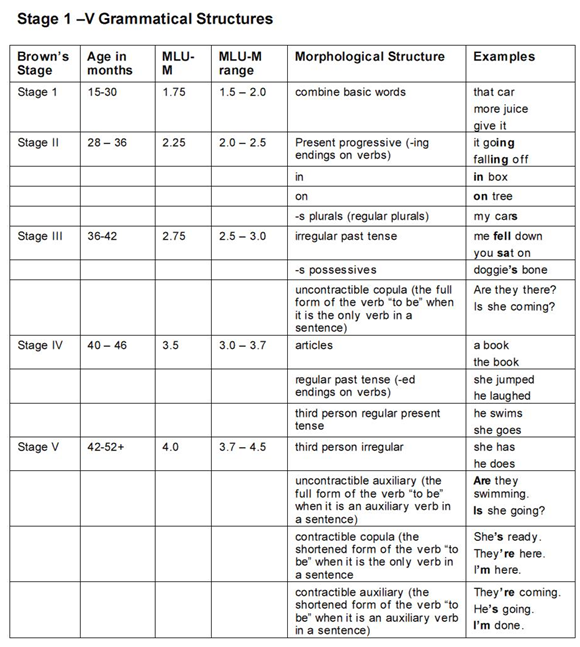
Many practitioners and curricula utilize Brown’s Stages of Language Development.* Brown described the first five stages of language development in terms of the child’s “mean length of utterance” (or MLU) as well as the structure of their utterances.

Brown_Grammatical_Structures_Chart

From aacinstitute.org

Sometimes it is necessary to compare a child to his or her same-age peers in order to receive services or measure progress, but it can be detrimental to focus on what a child should be doing at a specific age instead of supporting them and reinforcing them for progress within their current stage.

Research has suggested that teaching beyond the child’s current stage results in errors, lack of comprehension, and difficulty with retention. Here are some common errors you may have witnessed:

  • The child learns the phrase “I want _____ please.” This phrase is fine for “I want juice, please” or “I want Brobee, please,” but it loses meaning when overgeneralized to “I want jump, please” or “I want play, please.” It’s better to allow your learner to acquire hundreds of 1-2 word mands (or requests) before expecting them to speak in simple noun+verb mands.
  • The child learns to imitate only when the word “say” is used. Then the child makes statements such as “say how are you today,” as a greeting or “say I’m sorry,” when they bump into someone accidentally. Here, the child clearly has some understanding of when the phrases should be used without understanding the meanings of the individual words within each phrase.
  • The child learns easily overgeneralized words such as “more.” This is useful at times, but the child can start using it for everything. Instead of saying “cookie” he’ll say “more.” Instead of saying “train,” he’ll say “more.” And he may say “more” when the desired item is not present, leaving the caregiver frustrated as he/she tries to guess what the child is requesting. Moreover, as language begins to develop, he may misuse it by saying things such as “more up, please.”
  • The child learns to say “Hello, how are you today?” upon seeing a person entering a room. A child comes into the classroom and the learner looks up, says “Hello, how are you today?” The child responds, “Great! Look at the cool sticker I got!” Your learner then doesn’t respond at all, or may say “fine,” as he has practiced conversations of greeting.

These are only a few of the common language errors you may see. While you may want your learner to speak in longer sentences, your goal should be to have them communicate effectively. With this goal in mind, it becomes essential to support them at their current stage, which means it’s essential to assess them and understand how to help them make progress.

This is why I always use the VB-MAPP to assess each child and make decisions about language instruction. I need to have a full understanding of how the learner is using language, and then move them through each stage in a clear progression. I may want the child to say “Hello, how are you today?” But when I teach them that, do they understand those individual words? Do they comprehend what today means as opposed to yesterday or tomorrow? Do they generalize the use of “how” to other questions?

As you make treatment decisions for your learner, think about their current stage and talk about how to support your child with both a Speech Language Pathologist and an ABA therapist.

*Brown, R. (1973). A first language: The early stages. London: George Allen & Unwin Ltd.


Written by Sam Blanco, PhD, LBA, BCBA

Sam is an ABA provider for school-aged students in Brooklyn, New York. Working in education for over 15 years with students with Autism Spectrum Disorders and other developmental delays, Sam utilizes strategies for achieving a multitude of academic, behavior, and social goals. She is also an assistant professor in the ABA program at The Sage Colleges and the Senior Clinical Strategist at Encore Support Services.

Consider Behavioral Momentum in Improving Compliance

If I were to ask you right now, what types of activities does your learner like to do, and what types of activities is your learner resistant to, you’d probably be able to respond pretty quickly to both questions. For instance, you might say, my son loves to practice addition facts, but he is resistant to working on spelling homework. Or you might say, my student enjoys passing out papers in class but is resistant to lining up with the rest of the class when it’s time to go to lunch.

You can use this information to increase the likelihood of compliance for those tasks your learner does not like. First, let’s call the tasks your learner enjoys high-p tasks (or high probability tasks) and the tasks your learner does not enjoy the low-p tasks (or low probability tasks). Once you have identified high-p and low-p tasks, you can use this information to produce behavioral momentum.

So what might this look like? Let’s take our first example of the learner who liked to practice addition facts, but is resistant to spelling. The conversation might look like this:

Parent: 2 + 4
Son: 6
Parent: 3 + 5
Son: 8
Parent: 4 + 3
Son: 7
Parent: Spell “apple.”
Son: A-P-P-L-E

Behavioral momentum is quite a broad topic. The conversation above is an example of just one element of behavioral momentum: a high-probability (or high-p) request sequence. This is “an antecedent intervention in which two to five easy tasks with a known history of learner compliance (high-p request) are presented in quick succession immediately before requesting the target task, the low-p request” (Cooper, Heron, & Heward, 2007, p. 492).

By providing several sequences such as the one above, you can practice all of the spelling words without fighting him to sit down at the table and practice only spelling for ten to fifteen minutes.

With the example of the young girl who likes to hand out papers but doesn’t like lining up before lunch, it might look something like this:

Teacher: Can you take this paper to Lucy?
Student takes paper to Lucy.
Teacher: Can you give this one to Marcos?
Student takes paper to Marcos.
Teacher: Nice work. Can you stand behind Henry?
Student gets in line behind Henry.

It should be noted that the goal is to move the low-p tasks to high-p tasks. We don’t want the learner to always require two to five high-p tasks before they engage in the low-p task! You can do this by decreasing the number of high-p tasks before giving a low-p task, or by increasing the number of low-p tasks. For instance, maybe the first learner is responding quickly each time his parent gives him a spelling word, so the parent can start giving two spelling words after the series of high-p tasks, then systematically increase the number of spelling words over time.

Overall, the high-p request sequence is an easy-to-implement strategy that can improve compliance and reduce stress for all parties involved.

REFERENCES

Cooper J.O, Heron T.E, & Heward W.L. Applied behavior analysis (2nd ed.) Upper Saddle River, NJ: Pearson, 2007.


Written by Sam Blanco, PhD, LBA, BCBA

Sam is an ABA provider for school-aged students in Brooklyn, New York. Working in education for over 15 years with students with Autism Spectrum Disorders and other developmental delays, Sam utilizes strategies for achieving a multitude of academic, behavior, and social goals. She is also an assistant professor in the ABA program at The Sage Colleges and the Senior Clinical Strategist at Encore Support Services.