Language Milestones

How many professionals have been asked: “How do I know if my child is behind in language development?” How many parents have asked the question, or at least wondered to themselves?

Language development varies from child to child, and there are wide ranges of expected “normal” language development in young children. If you are using Stages Learning Materials products with your own child, and you are concerned about language development, you should definitely discuss this with your health care professional. However, for reference sake, in general:

By the age of one, a child is expected to achieve the following general language milestones: 

  • Respond to the speech of others verbally or through facial expressions or other simple gestures such as shaking the head up and down for “yes”
  • Pay attention to speech of others
  • Respond to simple verbal requests including the word “no”
  • Babble with inflection
  • Attempt to imitate speech of others
  • Use simple works such as “dada”, “mama” and simple exclamations such as “oh-oh!”
  • Use exclamations, such as “oh-oh!”
  • Follow simple commands or instructions
  • Point to an object or picture when it is named for her
  • Recognize names of familiar objects, body parts and familiar faces
  • Repeat words overheard in the conversation of others
  • Say several single words and simple phrases by 15-18 months
  • Use simple phrases and 2-4 word sentences by 18-24 months

By the three-four years of age, a child is expected to achieve the following general language milestones:

  • Understand the concept of “same” and “different”
  • Speaks in sentences of five to six words with an understanding of simple grammar
  • Speaks clearly enough for strangers to understand
  • Tell stories

Again, it is important to realize that all children are different, and develop at their own pace, but if you feel that your child is falling significantly behind, it may be a good idea to consult your pediatrician, speech therapist, or other child development professional to discuss a strategy to help your child reach language development milestones.

— Adapted from an article written by Dr. Jen Canter, pediatrician and inventor of the U-Play
Mat for Education


About The Author

Angela founded Stages Learning Materials in 1997 as a vehicle to publish and distribute her line of photo-based teaching tools for autism and special needs. Angela has a BA in Psychology, and a JD, both from UCLA; and an M.Ed. from Harvard Graduate School of Education from the Technology, Innovation and Education Program. 

At UCLA Angela studied behavioral psychology under Dr. Ivar Lovaas, head of the premier program in the treatment and education of children with autism. Following graduation, she worked as a senior therapist for the Center for Autism and Related Disorders, supervising educational programs, performing assessments, and conducting workshops for parents and professionals across the country and in Europe. During her graduate work at UCLA, Angela completed multiple cross-departmental courses through the MBA program at UCLA’s Anderson School of Business Management. 

Angela is currently the incoming Chair of the Education Market Association, serves as a Teaching Fellow at the Harvard Graduate School of Education, and speaks at national conferences and education institutes on autism education and early literacy. 

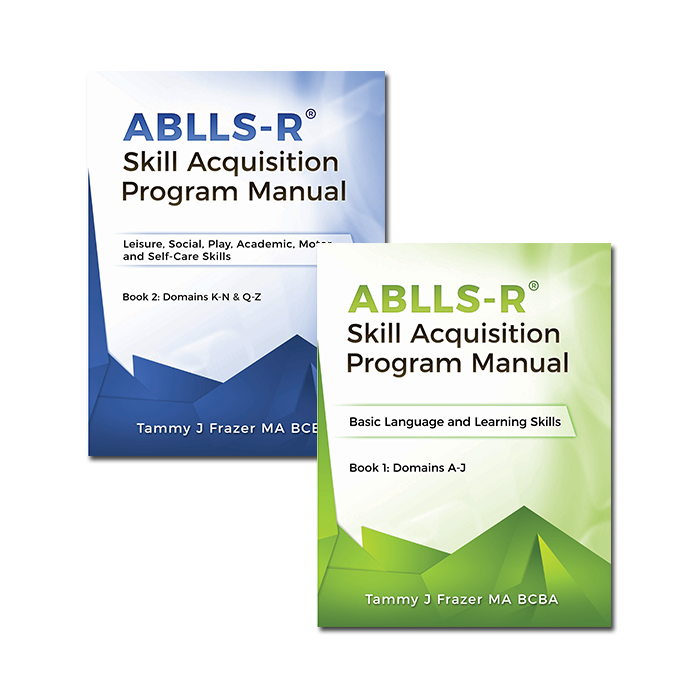
ABLLS-R® Skill Acquisition Program Manuals (Book 1 & 2)

The development of these manuals is a culmination of years of clinical work involving direct ABA intervention, teaching, coaching, training, and clinical oversight to teams delivering ABA intervention.

I have always enjoyed seeing students’ progress in their learning – knowing that the foundation of ‘good teaching’ is not only based on proper training, supervision, coaching and modelling – but also a standardized teaching approach that can be individualized for each student.

With a multitude of approaches and teaching methods being used to impact the potential of a student’s learning and success, I became inspired to create a series of step-wise, quality Skill Acquisition Teaching Plans that provided a framework of consistency for Instructors and teachers who were working with the students.
I am excited to share with you the ABLLS-R® Skill Acquisition Program Manuals – created as companion manuals to Dr. James Partington’s Assessment of Basic Language and Learning Skills – Revised (ABLLS R ®). We are confident that these plans will provide users a consistent framework for skill assessment, skill teaching and skill tracking for students with autism spectrum disorders.
In conjunction with the ABLLS-R®, the contents of the manuals provide information for each of the Task Codes in the ABLLS-R® curriculum for how to:

• Assess baseline performance levels for skills/tasks within the ABLLS R®
• Arrange the teaching environment for optimal teaching and learning
• Set up and administer prompts
• Implement and embed various teaching strategies to teach a skill
• Use Error Correction Procedures
• Collect data to measure and monitor progress

Both manuals include Companion Forms and Data Templates that are used along with the written Skill Acquisition Teaching Plans. These documents offer a user-friendly structure for setting up a student’s program binder, as well as information for how to organize necessary information for teaching and monitoring student progress.
We trust you will find as much value in these manuals as we have, and that you will see continued success with your students learning.

The ABLLS-R® Skill Acquisition Program Manuals are currently available for pre-order. Head to our site for more details! 


About The Author 

Tammy J. Frazer is a Board Certified Behavior Analyst with over 18 years of experience working with individuals with autism and developmental disorders. She earned a Masters of Arts in psychology with a specialization in Applied Behavior Analysis from the University of Nevada, Reno and has been a BCBA since 2007. Tammy is the Founder and Director of On Solid Ground Inc, an organization in Barrie, Ontario that is committed to the delivery of quality, effective, and evidence based behavior assessment and intervention to individuals with autism and developmental disorders and delays.

Back to Basics: Core Strategies in ABA

Applied Behavior Analysis (ABA) is the practice of the science of behavior. Often misunderstood as a collection of techniques (or worse, one particular technique), ABA is much more complex and is based in analysis so that all interventions are individualized, functional, and effective. That being said, there are some core strategies that are useful to know about in the application of ABA to individuals with autism.

• Reinforcement is probably the best known and most widely recognized ABA strategy. The principle of reinforcement is simple: behavior that is followed by preferable outcomes increases in future probability. If the preferable outcome is something given, like praise, a toy, or a fun activity, that’s called positive reinforcement. If the preferable outcome is something taken away, like work being removed during a break, or an unpleasant noise stopping, that’s called negative reinforcement. Contrary to popular belief, negative reinforcement is not the reduction of behavior or the application of punishment. Both positive and negative reinforcement are highly individualized and will look different for different people, but the principles remain the same no matter who you are: behavior increases because it is followed by a preferable outcome.

• Prompts are another commonly used strategy in ABA, and they also look different for different people. Prompts are any stimuli added to the natural environment to make behavior more likely. We all use prompts throughout our daily lives, often without realizing it. Smart phone reminders, highway signs, and fire alarm bells are all every day prompts. Additional prompts may be added to support individuals with autism in many ways. For example, some children with autism are taught to follow activity schedules, which are prompts for sequences of actions. These prompts may be used to help the child to be more independent in an activity of daily living, like making a sandwich, or just to transition between play activities and remain actively and appropriately engaged for longer periods of time.

• Structured teaching procedures are often used to break down and teach important skills such as communication, social skills, self-care skills, and academics. Sometimes these procedures are highly structured and repetitive, such as discrete-trial teaching, and sometimes they are looser and less structured, such as natural-environment teaching. Most individuals with autism who are learning using these strategies are provided with a combination of more and less structured learning opportunities, depending on their individual needs.

• Self-management is the set of skills that enables independence. For many individuals with autism, these skills need to be explicitly taught. ABA programs should include opportunities to learn and use self-management skills, as the ultimate goal of any ABA intervention should be independence.


About The Author 

Dana Reinecke is a doctoral level Board-Certified Behavior Analyst (BCBA-D) and a New York State Licensed Behavior Analyst (LBA).   Dana is an Assistant Professor and Department Chair of the Department of Special Education and Literacy at Long Island University Post.  Dana provides training and consultation to school districts, private schools, agencies, and families for individuals with disabilities.  She has presented original research and workshops on the treatment of autism and applications of ABA at regional, national, and international conferences.  She has published her research in peer-reviewed journals, written chapters in published books, and co-edited books on ABA and autism.  Current areas of research include use of technology to support students with and without disabilities, self-management training of college students with disabilities, and online teaching strategies for effective college and graduate education.  Dana is actively involved in the New York State Association for Behavior Analysis (NYSABA), and is currently serving as President (2017-2018).

Explaining Decision to Use Science-based Autism Treatments

This month’s ASAT feature comes to us from David Celiberti, PhD, BCBA-D and Pamela Feliciano, PhD. To learn more about ASAT, please visit their website at www.asatonline.org. You can also sign up for ASAT’s free newsletter, Science in Autism Treatment, and like them on Facebook!


“I have decided to rely on science-based treatments for my child with autism. Now, how do I explain this to friends and relatives who insist I try something “cutting edge?”


We certainly respect any individual’s right to his or her own opinion, and certainly for parents of children with autism to make decisions for their child regarding treatment; however, we believe that scientific evidence and the use of objective data should guide treatment options for all diseases and conditions, and autism is no exception. The late Senator Patrick Moynihan eloquently said, “Everyone is entitled to their own opinions, but not their own facts.” It is simply a matter of fact that theories, hypotheses, and testimonials do not provide adequate information to guide treatment decisions.

When friends or acquaintances hear about our experiences with autism, quite often the first thing they ask is, “What is your opinion of vaccines?” despite the retraction of Andrew Wakefield’s article by the Lancet (a very rare occurrence by this highly reputable journal). Sadly, the vaccine debate has long distracted the autism community from important discussions such as how best to help children already diagnosed with autism realize their fullest potential and live a happy and meaningful life.

In an ideal world, all treatment providers would make a commitment to science and evidence-based practices, and all members of the journalism community would make a commitment to responsible journalism. Until these ideals become the norm, those who do understand science-based treatments must do what they can to inform and educate others about the benefits of scientifically validated treatment, and the use of data to guide decision-making when assessing the benefits of any and all treatments.

Although applied behavior analysis is the treatment for autism with the most scientific support, we are rarely ever asked our opinion of this therapy, or if it is effective. Instead, every few months or so, some “new” treatment (or “repackaging” of a known treatment) will gain the attention of consumers. Given the large numbers of television reports, newspaper articles, blogs, and websites putting forth “miracle cures” and “breakthroughs,” it is not surprising that parents frequently receive advice and suggestions from extended family members, neighbors, and co-workers, particularly after a news item is broadcast, printed, or otherwise disseminated. Many of these individuals have the best intentions and are eager to share what they believe is “cutting edge” information about autism. In other cases, the advice is sometimes provided in a manner that comes across as critical of what you are choosing to do or not do for your child (i.e., it may be implied that you are not doing enough as a parent to help your child with autism).

If the information is offered by a more casual acquaintance, it may be best to simply thank him or her for their interest and concern and move on; however, such a strategy may not fare as well with individuals with whom you have a closer relationship. In these cases, you might consider sharing the following:

     • There are dozens of “miracle cures” and “breakthroughs” (i.e., pseudoscience) for autism that manage to receive widespread media attention, even if they have not been proven effective. In fact, there are over 500 treatments touted to address autism;

     • It is important to be critical of all available information, regardless of the source, and to recognize that not all information on the Internet is reliable and accurate;

     • There is a large body of scientific research published in peer-reviewed journals and carried out by hundreds of researchers that supports the choices that you have made;

     • Numerous task forces (some are listed at the end) have looked closely and objectively at the available research and have determined that the vast majority of autism treatments lack any scientific support and, in fact, some may be harmful;

     • Autism treatment is a multi-million dollar industry, and many treatment proponents rely heavily on sensationalism and extraordinary claims to “sell” their products;

     • Interventions that are actually shown to be the most effective often receive the least amount of media attention; and

     • For most other medical conditions, a provider that disregards proven intervention and uses a fringe treatment may actually be sued for malpractice (you may even consider drawing an analogy to a medical condition of particular interest to the person providing the advice).

Of course, you may also consider addressing this matter proactively. This would involve clarifying your choices and commitment to science-based treatment to more significant family members and friends on your terms and at your convenience. It may be helpful to view this tactic as a series of tiny conversations. You may even consider sharing links to websites such as the Association for Science in Autism Treatment (ASAT), which will help your family members and friends separate the wheat from the chaff. We would like to draw your attention to a few sections of ASAT’s website that bear relevance to this discussion.

     • Learn more about specific treatments

     • Summaries of published research articles

     • Making sense of autism treatments: Weighing the evidence

     • Recommendations of expert panels and task forces

Finally, ASAT’s newsletter, Science in Autism Treatment, is a free publication, so encourage your friends and family to subscribe.

It is our hope that the information shared above may help your friends and family better understand the role that science should play in the treatment of autism, the need for objective data to drive decision making, how to better identify pseudoscience, and perhaps most importantly, why parents must be such savvy consumers.


David Celiberti, PhD, BCBA-D is the part time Executive Director of ASAT and Past-President, a role he served from 2006 and 2012. He is the Co-Editor of ASAT’s newsletter, Science in Autism Treatment. He received his PhD in clinical psychology from Rutgers University in 1993. Dr. Celiberti has served on a number of advisory boards and special interest groups in the field of autism, applied behavior analysis, and early childhood education, and been an active participant in local fundraising initiatives to support after school programming for economically disadvantaged children. He works in private practice and provides consultation to public and private schools and agencies in underserved areas. He has authored several articles in professional journals and presents frequently at regional, national, and international conferences. In prior positions, Dr. Celiberti taught courses related to applied behavior analysis (ABA) at both the undergraduate and graduate levels, supervised individuals pursuing BCBA certifications, and conducted research in the areas of ABA, family intervention, and autism.

Pamela Feliciano, PhD, joined the Simons Foundation in 2013 and serves as the scientific director of SPARK (Simons Foundation Powering Autism Research through Knowledge) and is a senior scientist at SFARI. SPARK is a SFARI initiative that seeks to accelerate autism research through a vibrant and informative online platform (SPARKforAutism.org). Previously, Feliciano worked as a senior editor at Nature Genetics, where she was responsible for managing the peer review process of research publications in all areas of genetics. Feliciano holds a B.S. from Cornell University, an M.S. from New York University and a Ph.D. in developmental biology from Stanford University. Feliciano is also the mother of an adolescent boy with autism spectrum disorder.