Does your child have big reactions when you tell them no? Is the word no sometimes or often a trigger for your child leading to all kinds of problem behaviors?
We have to tell our kids no. No- do not run into traffic. No- do not touch a hot stove. And no- do not stray outside of the boundaries we have set as your parents. Take all the freedom you want within these boundaries, but no don’t stray.
But are there other ways to get your point across without the word no itself. If we can avoid the word that triggers the big reactions, maybe, just maybe we can avoid those meltdowns completely and spend our efforts focused on teaching and building up the good stuff.
What are some other ways to say no?
Not right now.
You can do (this) instead.
Maybe another time.
We have to do ____ right now.
Sure you can (do/have) that after you do (this) first.
Please do (this) instead.
I wish we could, but…
I’m afraid not.
I don’t think so.
Bummer! Not right now.
That’s not possible right now.
What a great idea, but not right now.
If you are telling your child to stop doing something or no, don’t do that action, try flipping your phrasing to what they CAN do instead.
From this
To that
No running.
Walk.
No jumping on the couch.
Sit on the couch.
No candy before dinner.
You can have candy at or after dinner.
No yelling.
Use your inside voice.
No grabbing.
Ask your sibling for a turn with the toy.
If the word no has been conditioned to cause an over the top reaction from your child, stop using the word no. Use other alternatives that get the same point across.
Whenever you find yourself about to say no, try to reframe it to tell your child what they can do or have instead. Give choices as much as possible.
Can I have some candy?
You can have some grapes or a banana.
Can we go to the park?
We can play trains or lego at home right now.
Child is running around the house.
You can walk in the house or run in the backyard.
No means no. But other wording also means no and is associated with a learning history of problem behavior. If something super simple like changing up our wording can help us move more quickly past the problem behavior- why not try it?! We want to spend our time and energy on teaching the more appropriate ways to communicate wants and needs instead of just dealing with problems.
Leanne Page, MEd, BCBA, is the author of Parenting with Science: Behavior Analysis Saves Mom’s Sanity. As a Behavior Analyst and a mom of two little girls, she wanted to share behavior analysis with a population who could really use it- parents!
Leanne has worked with children with disabilities for over 10 years. She earned both her Bachelor’s and Master’s degrees from Texas A&M University. She also completed ABA coursework through the University of North Texas before earning her BCBA certification in 2011. Leanne has worked as a special educator of both elementary and high school self-contained, inclusion, general education, and resource settings.
Leanne also has managed a center providing ABA services to children in 1:1 and small group settings. She has extensive experience in school and teacher training, therapist training, parent training, and providing direct services to children and families in a center-based or in-home therapy setting.
Leanne is now located in Dallas, Texas and is available for: distance BCBA and BCaBA supervision, parent training, speaking opportunities, and consultation. She can be reached via Facebook or at Lpagebcba@gmail.com.
By: Catherine L. McHugh, MA, BCBA, LBA and Thomas Zane, PhD, BCBA-D Department of Applied Behavioral Science, University of Kansas
Historically, teaching a communicative repertoire to children or individuals with autism spectrum disorder (ASD) and intellectual and developmental disabilities (IDD) focused on vocal verbal speech and modeling a speech sound with the hopes of the individual being able to imitate that sound (Charlop-Christy et al., 2002). However, prompting vocal verbal behavior is limited in comparison to a physical motor movement. Unless the individual has the ability to imitate, teaching speech sounds may be difficult (Bondy & Frost, 2001). Sign language is one potentially excellent option for teaching an alternative modality for communication. However, it also requires the individual to be able to attend to and imitate, as well as discriminate, very fine motor movements (Shwartz et al., 1998). For individuals with ASD and IDD, this may be a skill deficit making it very difficult to learn complex language. Therefore, Andy Bondy and Lori Frost turned their attention to exploring different modalities of communication that may better lend themselves to prompting and therefore result in greater contact with reinforcers. At the time of the development of Picture Exchange Communication System (PECS; Bondy & Frost, 2001), picture pointing was emerging as a form of communication; however, the individual may point to and cover the picture (i.e., preventing the communication partner from being able to see the image selected). Or they may touch the picture when no one is attending to them and therefore miss an opportunity for reinforcement resulting in possible extinction of the behavior. Bondy and Frost (2001) wanted to focus more on the communication exchange that occurs in language, so they developed a communication modality that teaches the individual to select a picture, pick it up, and place it in the hand of the communicative partner. This allows the teacher or caregiver to use physical prompts for communication and reduce the number of required prerequisite skills of the learner.
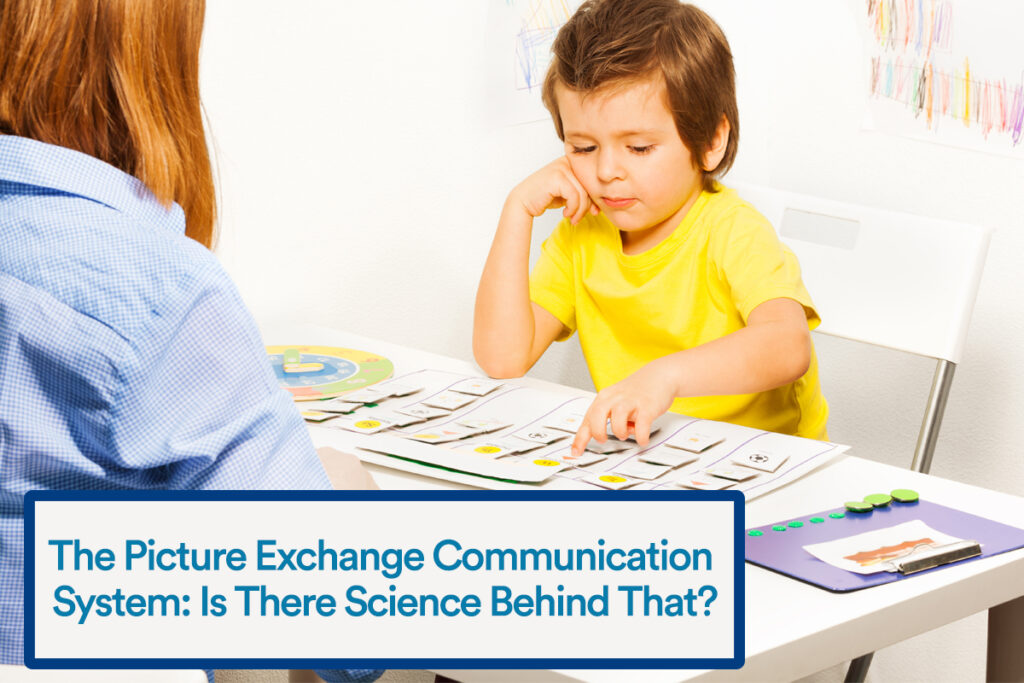
According to the seminal article by Bondy and Frost (2001), there are six steps of teaching PECS. The first focuses on the physical exchange and how to communicate. It teaches the learner the basic exchange of communication (i.e., expressing an idea to another person via the exchange of a symbol). Once the individual masters the exchange, the second step is referred to as the distance and persistence phase. This phase tests the durability of the communicative response, focusing on increasing the distance and response effort of communication such that the learner may have to travel and recruit the attention of the partner in order to contact reinforcement, as well as travel in order to access the symbols themselves. The third phase focuses on discrimination between symbols such that as more pictures are added to their system, they are able to find and exchange the picture that corresponds to the item they want. The fourth phase involves increasing the mean length of utterance and using phrases such as “I want” or “I see”. This allows the learner to move from mands (i.e., requesting) to perhaps engaging in tacts (i.e., labeling) or intraverbals (i.e., responding to questions). Phase five teaches the learner how to use PECS to answer questions and finally, phase six teaches commenting. As mentioned, not all phases need to be taught or mastered. Phase one is the building block for the remaining phases, but teaching the fundamental phase 1 exchange can have major implications for communication and other areas of the individual’s life. There are articles and manuals on how to use and teach PECS (e.g., Charlop-Christy et al., 2002; Conklin & Mayer, 2011; Frost, 2002; Paden et al., 2012; Schwartz et al., 1998), but the question remains, is there science behind PECS?
The existing research literature on PECS is vast and focuses on different phases and aspects of the system across populations with various skill sets and goals. Fortunately, researchers have produced several meta-analyses and review papers, so they will be summarized here.
For example, Preston and Carter (2009) reviewed the literature on PECS and found studies that utilized both randomized control trials (RCT) and single subject designs. The authors noted that, at the time, there had been only three experiments using RCTs and concluded that the methodology and data were insufficient for drawing any conclusions on the efficacy of PECS and encouraged future researchers to conduct more research in this area. However, Preston and Carter also noted that there was supporting evidence for PECS provided across the experiments that incorporated single subject research design methodologies. In conclusion, they found preliminary support for PECS as a communication modality for children and adults with ASD and IDD who have little or no vocal verbal language.
Sulzer-Azaroff et al. (2009) reviewed 34 peer-reviewed publications on PECS. This review included children and adult participants working with caregivers, teachers, and parents. Sulzer-Azaroff and colleagues reported that the results suggested that PECS was effective in teaching individuals who previously had no or limited functional communication, how to communicate. Most of these individuals learned new requests and some learned the more advanced phases in which they learned to describe things. When they reviewed articles that compared PECS to another modality, Sulzer-Azaroff et al. (2009) noted that the participants performed the same or better with PECS (e.g., Adkins & Axelrod, 2002). Overall, the results of this literature review further supported the use of PECS for teaching communication to non-speaking individuals.
Hart and Banda (2010) conducted a meta-analysis of the single subject research design studies on PECS. They reviewed 13 published studies and found that teaching PECS increased functional communication for all but 1 participant. They also noted some reasons why it might have been so successful for this population. First, the basic PECS procedure incorporates motivating operations (MO; Poling, Lotfizadeh, & Edwards, 2017) for teaching requests. The use of MOs presumes to increase the value of the reinforcer thereby increasing the likelihood of the individual engaging in the exchange in order to access the items. This contingency is very salient and likely a major reason why so many are able to acquire phase one of PECS so quickly. Therefore, PECS has the ability to teach someone abstract concepts using more salient stimuli and behaviors.
Schreibman and Stahmer (2014) conducted a randomized control comparison of the effects of verbal and pictorial communication on spoken language for children with autism. This study included 19 randomly assigned 2.5-year old’s who had a diagnosis of ASD that had fewer than 10 spoken words at the onset of the intervention. Participants in this study acquired about 90 spoken words on average after 6 months and about 120 spoken words after 9 months following intervention, showing strong evidence of the effectiveness of PECS.
According to these and more recent work on PECS, it appears that there is science to support the use of PECS for teaching communication to individuals with ASD and IDD across the lifespan. What is also interesting about PECS is some of the affected collateral behaviors (i.e., behaviors that were not directly targeted in the intervention) that are noted in these and other studies. First, there are some reports of vocalizations emerging while teaching PECS (e.g., Greenberg et al., 2014; Hart & Banda, 2010; Sulzer-Azaroff et al., 2009). For example, Greenberg et al. (2013) studied the amount and pattern of their participants’ vocalizations before and after PECS training. In study 1, the experimenters measured spontaneous vocalizations during and after PECS training. They saw an increase in vocalizations when compared to baseline. In study 2, participants who demonstrated limited vocalizations after study 1 were exposed to a procedure that included a time-delay prompt (i.e., waiting 3 seconds after the picture exchange to deliver the item to see if they would emit a vocalization) and verbal prompting procedures. Results of study 2 suggest that spontaneous vocalizations increased and occurred with every exchange. These results were quite promising and addressed the concern that if caregivers teach an individual to use PECS, they might not learn to vocalize. This does not seem to be the case. The emergence of vocalizations may be due to a variety of factors and is an empirical question that researchers should continue to study.
Another possible benefit of teaching PECS was reported by Hart and Banda (2010), who noted that in the studies they reviewed, there was a decrease in problem behavior for the participants who learned PECS. This is likely due to the fact that the individuals are learning functional communication skills. Functional communication training (FCT) is a procedure that teaches individuals a more appropriate way to request (i.e., communication rather and problem behavior) access to their reinforcers (Tiger et al., 2008). FCT can include a variety of communication modalities, but picture exchange is commonly used in the literature (e.g., Tiger et al., 2008). During FCT, the individual receives access to their reinforcer for a communicative response and no longer receives it for problem behavior. Therefore, they are taught a new way to get the things they need and want without engaging in problem behavior. One can also look at this from a response effort perspective. Communication is much less effort than engaging in physical aggression. Therefore, once PECS is acquired, the child may prefer this response that requires less effort and results in their preferred items.
Conclusions and Future Research
Numerous literature reviews and individual research studies provided evidence to strongly suggest that PECS can be considered an evidenced-based procedure. So, parents and caregivers can confidently use PECS to establish and shape communication in their children, with confidence that improvements are likely to be made. Furthermore, there are manuals that are both clear and comprehensive to guide the implementation of each step of the system.
Given that, continued research to establish whether or not PECS works seems unnecessary. Instead, researchers involved in studying this communication system could extend what is known about PECS along different variables and dimensions. For example, more research could be done on the extent of generalization and maintenance of PECS acquisition. Another area to address would be the preference of communication modality – that is, studying what influences an individual to select different communication systems, such as PECS, signs, or speech. Although some small n studies have been done on this (e.g., Tincani, 2004), it remains a very fruitful avenue to explore. Finally, it would be helpful to develop a more comprehensive literature based on the issue of whether the acquisition of PECS is responsible for a reduction in behavior problems and a spontaneous increase in spontaneous vocalizations.
The experimental research shows that PECS is an evidenced-based procedure. When working with individuals with communication impairments, PECS can be used to establish foundational or complex communication. Since communication deficits are one of the common symptoms of ASD, this particular procedure is a very welcomed and needed intervention approach.
About the Authors
Catherine McHugh, M.A., BCBA, LBA-KS is a doctoral student in Dr. Claudia Dozier’s lab at the University of Kansas in the Applied Behavioral Science Department. She a Board-Certified Behavior Analyst and a Licensed Behavior Analyst in the state of Kansas. Catherine completed her Masters of Applied Disability Studies and then a Masters of Arts with a focus in Applied Behavior Analysis at Brock University, St. Catharines, Ontario, Canada. She is the Vice President of the Graduate Student Organization for the Applied Behavioral Science Department at the University of Kansas. Catherine has worked with individuals with intellectual and developmental disabilities across the lifespan from children to older adults who engage in severe problem behavior.
Dr. Thomas Zane is a Professor of Practice and the Director of Online Programs in Behavior Analysis in the Department of Applied Behavioral Science at the University of Kansas. Dr. Zane earned his Bachelor’s and Master’s degree in psychology at Western Michigan University and his doctorate in Applied Behavior Analysis at West Virginia University. He has served as a Post-Doctorate Research Associate at the University of Massachusetts and as a Research Scientist at Johns Hopkins University Department of Psychiatry. Dr. Zane serves on the Executive Board of the Cambridge Center for Behavioral Studies, the international organization that represents the field of behavior analysis. He is also a member of the Scientific Council of the Organization of Autism Research, a group that funds innovative research in Autism Spectrum Disorders. Dr. Zane has been past President of the Ethics Special Interest Group of the International Association for Behavior Analysis. His research interests include online learning, evidenced-based practice in autism, and the philosophy of science and radical behaviorism. He is particularly interested in why some behavior analysts drift from the code and the importance of adhering to choosing scientifically-supported treatments in clinical and educational work.
References
Adkins, T., & Axelrod, S. (2002). Topography-versus selection-based responding: Comparison of mand acquisition in each modality. The Behavior Analyst Today, 2(3), 259–266. http://dx.doi.org/10.1037/h0099941
Charlop-Christy, M. H., Carpenter, M., Le, L., LeBlanc, L. A., & Kellet, Kristen. (2002). Using the Picture Exchange Communication System (PECS) with children with autism: Assessment of PECS acquisition, speech, social-communicative behavior, and problem behavior. Journal of Applied Behavior Analysis, 35(3), 213-231. https://doi.org/10.1901/jaba.2002.35-213
Conklin, C. G., & Mayer, G. R. (2011). Effects of implementing the Picture Exchange Communication System (PECS) with adults with developmental disabilities and severe communication deficits. Remedial and Special Education, 32(2), 155-166. https://doi.org/10.1177%2F0741932510361268
Frost, L., & Bondy, A. (2002). The Picture Exchange Communication System training manual. (2nd Ed.). Pyramid Educational Products.
Greenberg, A. L., Tomaino, M. E., & Charlop, M. H. (2013). Adapting the Picture Exchange Communication System to elicit vocalizations in children. Journal of Developmental and Physical Disabilities, 26(1), 35-51. http://dx.doi.org/10.1007/s10882-013-9344-2
Hart, S. L., & Banda, D. (2010). Picture Exchange Communication Systems with individuals with developmental disabilities: A meta-analysis of single subject studies. Remedial and Special Education, 31(6), 476-488. https://doi.org/10.1177/0741932509338354
Paden, A. R., Kodak, T., Fisher, W. W., Gawley-Bullington, E. M., & Bouxsein. (2012). Teaching children with autism to engage in peer-directed mands using a Picture Exchange Communication System. Journal of Applied Behavior Analysis, 45(2), 425-429. https://doi.org/10.1901/jaba.2012.45-425
Poling, A., Lotfizadeh, A., & Edwards, T. L. (2017) Predicting reinforcement: Utility of the motivating operations concept. Behavior Analyst, 40(1), 49-56. http://dx.doi.org/10.1007/s40614-017-0091-z
Preston, D., & Carter, M. (2009). A review of the efficacy of the Picture Exchange Communication System intervention. Journal of Autism and Developmental Disorders, 39(10), 1471-1486 . http://dx.doi.org/10.1007/s10803-009-0763-y
Tiger, J. H., Hanley, G. P., & Bruzek, J. (2008). Functional communication training: A review and practical guide. Behavior Analysis and Practice, 1(1), 16-23. https://doi.org/10.1007/BF03391716
Tincani, M. (2004). Comparing the Picture Exchange Communication System and sign language training for children with autism. Focus on Autism and Other Developmental Disabilities, 19(3), 152-163. http://dx.doi.org/10.1177/10883576040190030301
Schreibman, L., & Stahmer, A. C. (2014). A randomized trial comparison of the effects of verbal and pictorial naturalistic communication strategies on spoken language for young children with autism. Journal of Autism and Developmental Disabilities, 44(5). 1244-1251. http://doi.org/10.1007/s10803-013-1972-y
Schwartz, I. S., Garfinkle, A. N., & Bauer, J. (1998). The Picture Exchange Communication System: Communicative outcomes for young children with disabilities. Topics in Early Childhood Special Education, 18(3), 144-159. http://dx.doi.org/10.1177/027112149801800305
Sulzer-Azaroff, B., Hoffman, A. O., Horton, C. B., Bondy, A., & Frost, L. (2009). The Picture Exchange Communication System what do the data say?” Focus on Autism and Other Developmental Disabilities, 24(2), 89-103. https://doi.org/10.1177/1088357609332743
Citation for this article:
McHugh, C. L., & Zane, T. (2022). Picture Exchange Communication System: Is there science behind that? Science in Autism Treatment, 19(5).
By: Katie McKenna, MS, OTR/L (originally posted on The Autism Helper)
It is so hard to believe that summer is upon us! Summer can bring about many different experiences and emotions. On one hand, it can be exciting to take a break from the intense schedule of the school year. However, on the other hand, summer often brings less structure and routine, which can be hard for our learners. As I wrap up the school year, I like to provide my families with some therapeutic activity ideas that not only maintain or build skills throughout the summer but also are fun and easy to implement. Here are some of my tips for putting together a summer therapy home program!
1. Embrace the Outdoors
Summer is the best time to truly embrace outdoor activities. Kids NEED to be active. Check out my blog post here about why outdoor play is so vital. Additionally, many summer activities that families naturally do may include amazing outdoor motor and sensory experiences, such as swimming, going to the beach, hiking and bike riding. Even just playing at the playground can be so beneficial – check out this post for more! When recommending summer activities for families, I always include outdoor play ideas as they tend to be easy to setup and free or low cost, but full of amazing opportunities for students.
2. Encourage Hands On Activities
Early in my career, I used to send home a lot of paper packets that contained prewriting and drawing practice worksheets. I have since stopped. Why? So much learning comes from experiences that do not involve pencil and paper and summer is the perfect time to explore that! Kids NEED to experience more hands-on activities and play in order to have strong muscles for pencil and paper tasks. Instead of completing writing worksheets, try suggesting students use sidewalk chalk or draw shapes and letters in the sand. You can also recommend families try some of these easy gross and fine motor activities using household items!
3. Focus on Life Skills
Summer is the perfect time to work on various household tasks and life skills, such as cooking, cleaning, and even community outings. For sensory sensitive kids, some of these tasks can be very overwhelming. One of the pros of a slower summer schedule is there may be more time and flexibility to gradually build confidence and skills to be able to engage in some of these tasks.
4. Make it Routine
Routines and themes help me stay on track during the school year, and I like to suggest the same to my families for the summer. Depending on your student, you may recommend a few activities for families to focus on consistently in daily or weekly routines. Some years, I have recommended daily ‘themes’ and corresponding activity ideas such as Movement Monday, Fine Motor Tuesday, Sensory Wednesday, Cooking Thursday, Community Outing Friday. Families can choose one activity per day based on the daily theme. Or, you could collaborate with a family to choose 1 or 2 daily routines to target and recommend a therapeutic spin on it. For example, when reading books at bedtime, have the student lay on his tummy. During the morning routine, try to encourage decreased verbal prompts. This way, activities don’t feel like ‘extra’ work because they are already embedded into activities that happen in the family on a daily basis!
5. Keep it Simple
This is probably the most important tip of all. Let’s face it. It has been a long school year! While some families may be looking for very detailed activity plans, others may be looking for a few practical ideas. In general, I like to recommend simple, actionable ideas that can be easily implemented and don’t require a lot of preparation and planning. Like everything, touch base with your families and see where they may be looking for support and you can tweak your plan from there. I recommend starting simple and adjusting as needed to meet individual needs.
About the Author:
Katie McKenna, MS, OTR/L is an occupational therapist working with students in the school setting. Katie has worked with students of all ages, from early childhood up to high school transition. Before she was an OT, Katie worked as an in-home respite worker as well as an inclusion aide. Katie earned an undergraduate degree in Communication Sciences and Disorders from Saint Louis University, and a Masters degree in Occupational Therapy from the University of Illinois at Chicago.