Simplifying the Science: Choiceworks App – Increase Self-Monitoring and Autonomy in Students with ASD

Finding the appropriate educational setting for individuals with autism can be quite challenging. And in working to provide the least restrictive environment, sometimes students are placed in classrooms where they can do the work but requires additional supports. This makes teaching self-monitoring all the more important as we strive to help our students attain independence in all areas.

A recent study by Miller, Doughty, & Krockover (2015) used an iPad app as part of an intervention to increase self-monitoring for three students with moderate intellectual disabilities in their science class. The goal was to increase autonomy in problem-solving activities linked the science lesson for that day. The app they used was called Choiceworks, which the authors described as: “a daily routine board maker [that] contains prompting tools to assist users through daily tasks. Checklists, schedule boards, activity timers, and a communication board can be developed using this system” (p. 358).

Over the course of a two-week period, each student was provided with three training sessions for how to use the iPad based on a task analysis the authors had devised. Skills taught included swiping, changing the volume, and operating the Choiceworks app. Next, the authors introduced five steps of problem-solving and provided mini-lessons on each of the steps. The authors used stories that required problem-solving, then taught the students how to use the app to navigate through the five steps of problem solving. Finally, the intervention was introduced in the science classroom.

All three students in this study significantly increased their independence in problem-solving. Furthermore, the results were generalized to solving problems related to daily living and were maintained over time.

The results of this study are important for several reasons. First, it demonstrates one method for increasing independence in individuals with developmental disabilities. Second, this increase in independence provides opportunities for more natural peer interaction since the individual with the disability will not have an adult always standing next to them. Finally, using a tool such as an iPad mini (as these researchers did) or iPhone is beneficial because many people are walking around with such devices, allowing individuals with disabilities to use a device to promote independence without increasing the threat of social stigma. The authors clearly show that, when provided with proper instruction, students with developmental disabilities can use the iPad mini to become more independent with both academic and daily living skills.

REFERENCES

Miller, B., Doughty, T., & Krockover, G. (2015). Using science inquiry methods to promote self-determination and problem-solving skills for students with moderate intellectual disability. Education and Training in Autism and Developmental Disabilities, 50(3), 356-368.

WRITTEN BY SAM BLANCO, MSED, BCBA

Sam is an ABA provider for students ages 3-12 in NYC. Working in education for ten years with students with Autism Spectrum Disorders and other developmental delays, Sam has developed strategies for achieving a multitude of academic, behavior, and social goals. Sam is currently pursuing her PhD in Applied Behavior Analysis at Endicott College.

Pick of the Week: Coin-U-Lator + Worksheets!

Learn about money with this fun and interactive coin-counting calculator. With reinforcing voice acknowledgements such as “Good Job!” or “Way to Go!” kids will enjoy learning how to count money and how to determine how much is needed to make a purchase with the Coin-U-Lator.

The Coin-U-Lator also comes with accompanying worksheets that offer lessons and further practice for learning how to count money. The workbook comes with 100 reproducible worksheets that are arranged in progressive levels of difficulty.

This week, save 15%* on your order of both the Coin-U-Lator and Coin-U-Lator Worksheets and get a head-start on teaching your young learner how to count money in a fun and engaging way! Use promo code COIN15 when you check out online.

*Offer expires on December 29, 2015 at 11:59pm EST. Offer is not valid on past purchases. Be sure there are no spaces or dashes in your code COIN15 at check-out! Call our friendly customer service team at (800) 853-1057 with any inquiries.

7 Tips for Choosing Educational Apps for Your Learner

While tablets can provide a wealth of material for teaching all sorts of skills, it can be incredibly challenging to wade through all the mediocre or just terrible apps in order to find something worthwhile for your learner. Here are a few tips for finding apps that are appropriate for your learner’s skill level and interest.

  1. Use social media to get suggestions. I’ve found several apps that I love to use with my students simply through following facebook groups focused on apps in education or apps in special education. If you love twitter, following teachers may also help you get good recommendations.
  2. Look at websites such as teacherswithapps.com or graphite.org. Both of these websites are chalk full of recommendations and reviews from teachers, and both have sections devoted specifically to special education. Graphite.org, in particular, has great search capabilities for you to easily find apps based on subject matter, grade level, or skill type.
  3. Take a look at this exhaustive list from Autism Speaks. This list is focused on apps specifically for learners with autism, and it allows you to filter your search by category of app, age group, and type of device.
  4. Don’t ignore apps with in-app purchases! Many parents and teachers I speak with can’t stand in-app purchases. I’d like to re-label this as a free trial. You can take a look at the app, assess the quality on your own, and see if your child enjoys it. If it looks good, then you get to add content after you’ve tried it out.
  5. Look at the developers of apps you’ve already had success with. There are many app companies out there that are putting out consistenly good educational apps (Tiggly, Toca Boca, Pepi Play, Artgig Studios, and Motion Math just to name a few). So once I find a good app, I always look at the other apps created by the same company.
  6. If you’re a teacher, look for options to modify or individualize material. I always want to use an app with multiple students, so if I’m able to level the material or even add in individualized material, that’s ideal. For instance, Mystery Word Town just added an aspect to the game in which you can put in the individual learner’s target spelling words. What’s better than that?!
  7. Ask other parents, other kids, and your kid! You might find some of your favorite apps simply by starting the conversation with other people. You can even start a conversation by sharing your favorite app.

WRITTEN BY SAM BLANCO, MSED, BCBA

Sam is an ABA provider for students ages 3-12 in NYC. Working in education for ten years with students with autism spectrum disorders and other developmental delays, Sam has developed strategies for achieving a multitude of academic, behavior, and social goals. Sam is currently pursuing her PhD in Applied Behavior Analysis at Endicott College.

Pick of the Week: “Introducing Inference” Workbook

Teach inferencing and problem-solving skills to young learners with this comprehensive workbook by Marilyn M. Toomey! Our ability to infer or to draw conclusions given partial information is a cornerstone of our reasoning process. Guessing, implying, hinting, suggesting, supposing and reasoning are just a few of the mental processes in which we draw inference. Throughout Introducing Inference, students are encouraged not only to draw conclusions using inference, but to explain how they solved the problem at hand. The aim is to teach students that using inference in their reasoning process is using their best judgment.

The book starts out with pictures of objects, each with an obvious part missing and moves to sequenced events, with a part of the sequence missing. Finally, questions requiring answers that tell what is missing complete the path to learning this basic skill. For example, an image of bike with a missing wheel is accompanied by: “A bicycle is supposed to have two ____, but this bicycle has only one. One ____ is missing.”

Introducing Inference covers topics in:

  • Missing parts: animals, objects
  • Sequenced events
  • Missing parts: sequenced events
  • Predicting outcomes
  • Identifying intermediate events
  • Analyzing outcomes
  • Inferring causal events
  • and more!

Use our promotional code INFER15 at check-out this week to take 15% off* your copy of the Introducing Inference workbook!

*Offer expires on Tuesday, December 22, 2015 at 11:59pm EST. Promotion does not apply to past purchases. Be sure there are no spaces or dashes in your code INFER15 at check-out! Call our friendly customer service team at (800) 853-1057 with any inquiries.

“Increasing Articulation in Children with Autism” by Tracie Lindblad

Following our last feature on guided playdates, we’ve partnered with the Association for Science in Autism Treatment (ASAT) again this week to bring you an article by Tracie Lindblad, Reg. CASLPO (SLP), MS, MEd, BCBA, on increasing speech intelligibility in children with autism. To learn more about ASAT, please visit their website at www.asatonline.org. You can also sign up for ASAT’s free newsletter, Science in Autism Treatment, and like them on Facebook!

How do you increase speech intelligibility (articulation skills) or the variability in the sounds produced by children with autism spectrum disorders?
Answered by Tracie L. Lindblad, Reg. CASLPO (SLP), MS, MEd, BCBA

Approximately 30–50% of individuals with autism spectrum disorder (ASD) remain minimally verbal throughout their lives, with little or no functional speech (National Institutes of Health & National Institute on Deafness and Other Communication Disorders, 2010; Johnson, 2004; Mirenda, 2003). These individuals may rely on more effortful modes of communication such as reaching for desired items, taking another’s hand to gain access, or obtaining the item independent of communication. Attempts to communicate may also take the form of challenging behaviours such as aggression, self-injury, and tantrums.
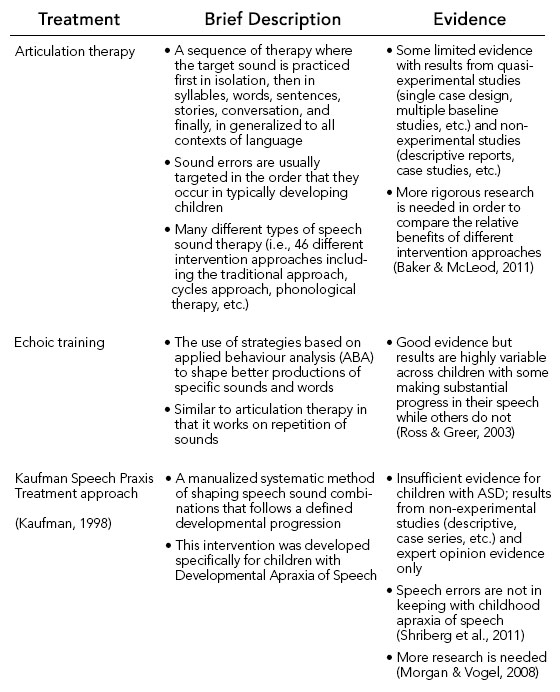
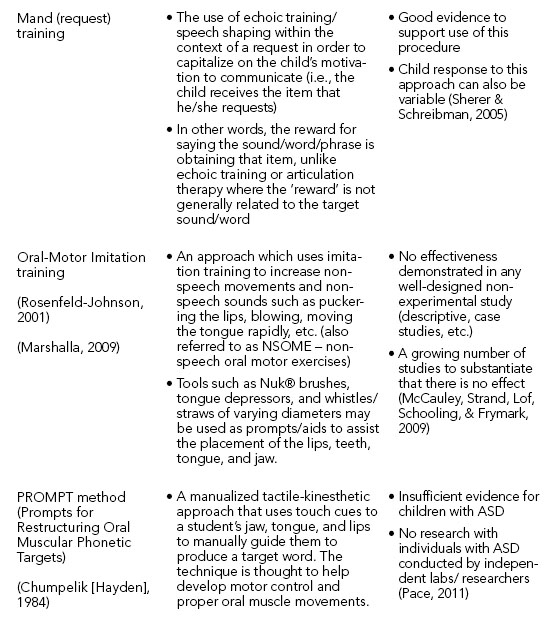
Parents face a difficult task in choosing a treatment for minimally verbal children with ASD because a wide range of techniques are routinely used by speech-language pathologists and behaviour analysts with varying degrees of success and evidence.

The following table highlights some of the most-commonly implemented interventions to target speech skills and the current evidence base for each.

Increasing Articulation Table 1Increasing Articulation Table 2

Within the fields of behaviour analysis and speech pathology, evidence-based practice (EBP) should shape and guide our treatment decisions. EBP is the integration of:

  • external scientific evidence,
  • clinical expertise/expert opinion, and
  • client/patient/caregiver perspectives.

Principles of EBP can help any professional to provide high-quality services which reflect the interests, values, needs, and choices of the individuals, and promote the best outcomes possible with the current evidence to date. Continue reading →

Tip of the Week: The Importance of Replacement Behaviors

Recently I’ve written several posts about the importance of reinforcement, but now I want to turn my attention to another important concept: replacement behaviors. It can be very easy to slip into the habit of telling kids what NOT to do. “Don’t touch that! Don’t pick your nose! Don’t run!” However, if we can turn it around and tell kids what to do instead we often see higher rates of compliance.

Cute little girl isolated, holding a stop sign

Here are a few examples of replacement behaviors you can teach:

  • A student refuses to speak when he/she does not understand a question. You can teach the student what to say, such as “I don’t understand” or “Can I get help?” Teach through modeling and role playing in one-to-one settings, then generalize it to the classroom or other environments in which the skill is necessary.
  • When you begin a math lesson, one student frequently attempts to run out of the room. Introduce a signal or symbol (such as a holding up a stop sign) to request a break. Initially, you might give the break each time the student uses the sign correctly, then begin to require more and more math work before a break is received. This allows for appropriate and safe breaks without disrupting the rest of the class.
  • When your learner is done with dinner, he pushes his plate into the middle of the table. Teach your learner to instead put items in the sink. You might start with just placing the fork in the sink, then add more and more items until he/she is clearing the table independently. Another replacement behavior may be to use a symbol or signal as in the previous example to request to leave the table, or to teach the learner to say “May I go?”

Replacement behaviors should be simple to implement, should be taught one-on-one with multiple opportunities to practice and be reinforced, and should, if possible, be functionally equivalent to the undesirable behavior. (For example, if a child is engaging in one behavior to escape, the replacement behavior should teach a more appropriate way to escape.)

Sometimes, simply instructing the learner on a replacement behavior makes a huge change, but often you need to combine teaching a replacement behavior with other strategies (such as differential reinforcement). What I do know is that identifying and teaching a replacement behavior is a necessary part of almost any intervention and should not be overlooked.

WRITTEN BY SAM BLANCO, MSED, BCBA

Sam is an ABA provider for students ages 3-12 in NYC. Working in education for ten years with students with Autism Spectrum Disorders and other developmental delays, Sam has developed strategies for achieving a multitude of academic, behavior, and social goals. Sam is currently pursuing her PhD in Applied Behavior Analysis at Endicott College.

Pick of the Week: Savings on ALL Super Duper® Items!

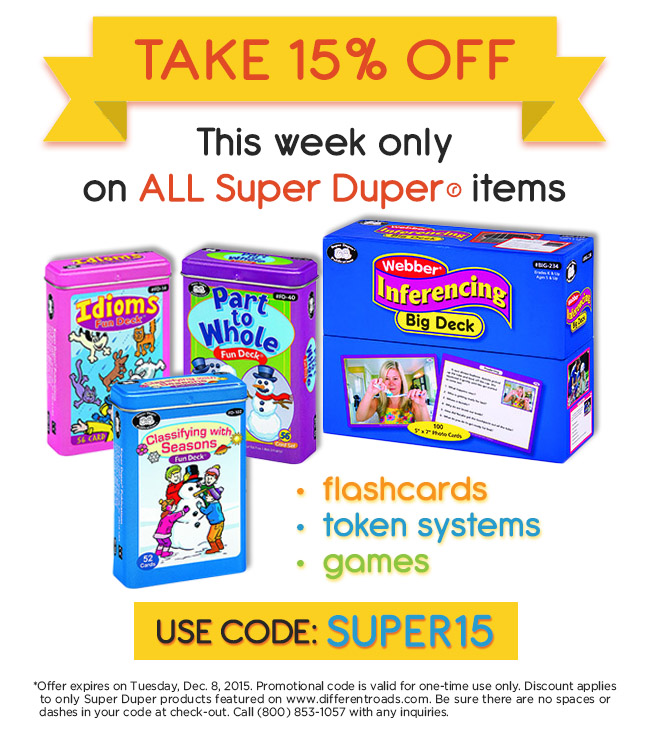
Super Duper Promo

Items pictured: Idioms (DRC 751); Part-to-Whole Fun Deck (DRC 752); Classifying with Seasons Fun Deck (DRC 028); Inferencing Big Deck (DRC 025). Visit the entire Super Duper category for more items.