How To Use Contingency Contracts in the Classroom

As adults, we’re fairly accustomed to contracts for car loans, new employment, or updates to our smartphones. But contracts can also be beneficial in the classroom setting. A contingency contract is defined as “a mutually agreed-upon document between parties (e.g., parent and child) that specifies a contingent relationship between the completion of specified behavior(s) and access to specified reinforcer(s)” (Cooper, Heron, & Heward, 2007). There are several studies that indicate using a contingency classroom can be beneficial in the classroom setting.

Cantrell, Cantrell, Huddleston, & Wooldridge (1969) identified steps in creating contingency contracts:

Interview the parent or guardian of the student.

This allows you to work together to identify problem behaviors to be addressed, identify the contingencies currently maintaining these behaviors, determine the child’s current reinforcers, and establish what reinforcement or punishment procedures will be used.

Use this information to create a clear, complete, and simple contract.

The authors provide examples of how these contracts might look. You can vary the contract based upon the behaviors you are addressing with your student and the student’s ability to comprehend such contracts.

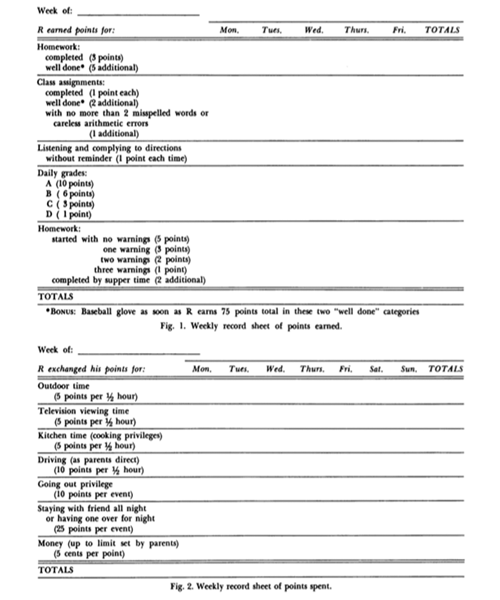
Build data collection into the contract itself.

You can see an example from the article below. For this example, it is clear how points are earned and how the child can utilize those points, and the contract itself is a record of both the points and the child’s behaviors.

An example of a classroom contingency contract from Cantrell, Cantrell, Huddleston, & Wooldridge (1969)

There are clear benefits to utilizing such contingency contracting: building relationships across different environments in which the student lives and works, addressing one or more challenging behaviors simultaneously, and providing opportunities for students to come into contact with reinforcement. You can read the entire article here:

Cantrell, R. P., Cantrell, M. L., Huddleston, C. M., & Wooldridge, R. L. (1969). Contingency contracting with school problems. Journal of Applied Behavior Analysis, 2(3), 215-220.

And much more has been written about contingency contracting. If you’d like to learn more, we suggest taking a look at one or more of the following:

Bailey, J. S., Wolf, M. M., & Phillips, E. L. (1970). Home-based reinforcement and the modification of pre-delinquent’s classroom behavior. Journal of Applied Behavior Analysis, 3(3), 223-233.

Barth, R. (1979). Home-based reinforcement of school behavior: A review and analysis. Review of Educational Research, 49(3), 436-458.

Broughton, S. F., Barton, E. S., & Owen, P. R. (1981). Home based contingency systems for school problems. School Psychology Review, 10(1), 26-36.

Miller, D. L., & Kelley, M. L. (1991). Interventions for improving homework performance: A critical review. School Psychology Quarterly, 6(3), 174.

Follow us on Facebook and Instagram to stay caught up our guest blog posts!


WRITTEN BY SAM BLANCO, PhD, LBA, BCBA

Sam is an ABA provider for students ages 3-15 in NYC. Working in education for twelve years with students with Autism Spectrum Disorders and other developmental delays, Sam utilizes strategies for achieving a multitude of academic, behavior, and social goals. She is also an assistant professor in the ABA program at The Sage Colleges. You can read more of Sam’s posts for Different Roads To Learning by clicking here!

ABA Journal Club: A response from Dr. Bryan J. Blair

This month’s response comes from Dr. Bryan J. Blair. The original discussion questions can be found in last week’s post. Don’t forget to let us know your thoughts on our Facebook page!

One of my early applied behavior analysis (ABA) supervisors used to say that the hardest part of his job was changing direct care staff behavior so that the staff would comply with administrative policies and to ensure the consistent implementation of treatment plans.  He certainly did not mean to imply that developing effective interventions for severely challenging and dangerous behavior, such as aggression and self-injury, was easy or formulaic.  But he rightly noted how challenging it can be to train and supervise staff using the same behavior analytic principles that we use directly with clients in clinical settings.  The article for the ABA Journal Club, An Assessment-Based Solution to a Human-Service Employee Performance Problem (Carr, Wilder, Majdalany, Mathisen, & Strain, 2013), tackles this supremely relevant issue by providing us with an empirical analysis of a tool that can be used in the process of improving staff performance.

One of the defining features of interventions based on applied behavior analysis is that the procedures and protocols rely on objective operational definitions of the world around us and that the natural world is continually empirically analyzed to ensure that treatments are relevant and effective.  As ABA practitioners, we have realized great success in this approach for developing and implementing treatments and interventions for a vast array of skill deficits and challenging behaviors.  However, far too often we fail to use these same guiding and controlling principles when training and supervising the professionals who directly implement ABA technologies.  As Dr. Blanco noted, the vast majority of trained Board Certified Behavior Analysts (BCBAs) have received little formal training in the management and supervision of direct care professionals, so it is ultimately not overly surprising that many BCBAs struggle with using the principles of ABA to develop staff skillsets.

However, that will soon change!  As of January 2022, the Behavior Analyst Certification Board’s (BACB) 5th Edition Task List (BACB, 2017b) and Verified Course Sequence Coursework Requirements (BACB, 2017b) will include content related to staff supervision and training.  Graduate programs will be required to develop academic content that targets supervisory skills and strategies associated with training direct care professionals and BCBA supervisors will need to address these areas in supervised fieldwork settings.  This is certainly a welcome development and I am optimistic that these new requirements will lead to practicing behavior analysts who are better equipped with skills that can be applied to staff supervision and performance management.

Early in my career, along with several colleagues, I developed a new direct staff observation and feedback protocol using a partial-interval observation and data collection system that allowed for empirical analysis of the performance of an individual staff person over time.  Prior to the development of the system, we relied on more subjective and anecdotal observational strategies that limited our ability to provide meaningful, timely, accurate, valid, and relevant feedback to staff in order to develop their clinical and administrative skills.  The new tool allowed us to graph staff performance data over time and visually analyze the data to determine objective performance levels across a variety of defined skills, and this visual presentation of behavior was shared with the staff themselves so that they could see their own behavioral changes over time as well.  The summarized data were included in staff evaluations and referenced during supervision and mentoring meetings.  The PDC-HS provides behavior analysts with an opportunity to screen for deficits in strategic and systemic supervision practices (as opposed to more tactical procedures such as directly observing the implementation of a discrete trial training protocol) and I feel that such a tool is essential when developing staff observation and feedback systems.  Had we used such a tool in conjunction with our more direct observation tool, we may have identified agency-level holes in training, mentoring, and supervisory practices that resulted in staff performance that didn’t meet the expected clinical standards.  In essence, by using the PDC-HS, we might have identified other contributing factors to poor performance that might not have been easily identified by direct in-vivo observations.

In addition, the PDC-HS provides behavior analysts who supervise staff with directly applicable empirical references that can be used to further support the development of staff supervision and feedback systems.  BCBAs are well aware of the fact that we must always use evidence-based interventions for clients of ABA interventions and services (BACB, 2014); however, given the fact that many practicing behavior analysts have received little formal training on staff supervision, it is imperative to provide the field of ABA with tools to help facilitate the process of staff performance management.

Coincidentally (or perhaps because of the pervasiveness of this skill deficit), when I supervised a team of ABA therapists who shared an office space, I too needed to address cleanliness and orderliness of the shared space with a simple behavior analytic intervention (i.e., a gamified group reinforcement system).  Again, however, had I used the PDC-HS tool, the intervention would most likely have better reflected the setting events, training and supervision deficits, and functions of the skill deficit (or motivative deficit).  Given the rapid expansion of direct ABA therapy in a variety of unstructured settings where supervision from a BCBA might occur less frequently than in a clinic (e.g., in a general education classroom or in the client’s home), I agree that systematic replications can and should address the fidelity of the implementation of teaching protocols and behavioral interventions.  Such replications would provide supervisors with much-needed clarification regarding the conditions and systems that control certain behaviors that interfere with the effective implementation of behavior analytic interventions.

As Dr. Blanco noted in her remarks about the article and the PDC-HS, BCBAs must be well-versed in effective and individualized staff supervision and performance management strategies and tactics.  BCBAs are highly encouraged to develop their own tools to facilitate the consistent application of principles of ABA to such supervision, and tools like the PDC-HS can be used to help frame staff skill and performance deficits that might otherwise be difficult to analyze.

References

Behavior Analyst Certification Board. (2017a).  BCBA/BCaBA coursework requirements based on the BCBA/BCaBA Task List (5th ed.). Retrieved from: https://www.bacb.com/wp-content/uploads/2017/09/170113-BCBA-BCaBA-coursework-requirements-5th-ed.pdf

Behavior Analyst Certification Board. (2017b).  BCBA/BCaBA task list (5th ed.). Littleton, CO: Author. Retrieved from:  https://www.bacb.com/wp-content/uploads/2017/09/170113-BCBA-BCaBA-task-list-5th-ed-.pdf

Behavior Analyst Certification Board. (2014). Professional and ethical compliance code for behavior analysts. Littleton, CO: Author.  Retrieved from: https://www.bacb.com/wp-content/uploads/BACB-Compliance-Code-english_190318.pdf

Carr, J. E., Wilder, D. A., Majdalany, L., Mathisen, D., & Strain, L. A. (2013). An assessment-based solution to a human-service employee performance problem. Behavior Analysis in Practice, 6(1), 16-32.  doi: 10.1007/BF03391789


About The Author

Dr. Bryan J. Blair is a licensed behavior analyst (MA), Board Certified Behavior Analyst, and is currently an Assistant Professor at Long Island University – Brooklyn where he is also the coordinator of the Applied Behavior Analysis graduate certificate and supervised fieldwork programs.  He has worked with children and adults with developmental disabilities and other clinical disorders for over 15 years in a variety of settings.  For more information or to contact Dr. Blair please see his website:  https://ww.bryanjblair.com.

ABA Journal Club #8: Performance Diagnostic Checklist

One of the tenets of ABA is to provide evidence-based practice. The best way to help us do this is to keep up with the literature! Each month, Sam Blanco, PhD, LBA, BCBA will select one journal article and provide discussion questions for professionals working within the ABA community. The following week another ABA professional will respond to Sam’s questions and provide further insight and a different perspective on the piece.

For many BCBAs, a large part of their role is supervising others in implementing ABA treatment.  In the course of my week I typically supervise 12 different paraprofessionals. Their training needs are highly variable, my time with them is minimal, and in my BCBA coursework I did not receive formal training on how to be an effective supervisor. This is an issue within the field of ABA, and can have a big impact on the services individuals with autism receive.

When I first came across the Performance Diagnostic Checklist – Human Services (PDC-HS) I was ecstatic. It is an easy-to-complete assessment of employee training, and provides clarity for next steps in addressing issues related to employee performance. The article for this month’s ABA Journal Club explains how the PDC-HS was utilized to evaluate training in an early intervention setting.

Carr, J. E., Wilder, D. A., Majdalany, L., Mathisen, D., & Strain, L. A. (2013). An assessment-based solution to a human-service employee performance problem. Behavior Analysis in Practice, 6(1), 16-32.

  1. The PDC-HS is a tool “designed to be used by a behavior analyst during an interview with the employee’s direct supervisor or manager” (p. 20). Is this a reasonable format for your work environment?  
  2. Have you or your organization used the PDC-HS or a different formal tool to evaluate training of staff? What has been your experience with such formal evaluation?
  3. Part of the procedure for this study was to show employees graphed feedback. Is this a strategy you have utilized in the past? If not, how could you utilize it for current skills you are teaching employees?
  4. The dependent measure in this study was cleanliness of the treatment room. This is an important workplace skill, especially if materials for instruction or lost or damaged, if problem behaviors of clients increase while the practitioner is looking for materials, or if the messiness of a room interferes with efficient use of session time. The authors note that systematic replications of their study should include other aspects of training, such as appropriate prompting. If you were to complete a study on the PDC-HS, what training skill would you address? Why?
  5. What are some obstacles in your current setting to implementing the PDC-HS? How can you address those obstacles?
  6. Reread Appendix B, which contains the full PDC-HS. What do you think about the questions they ask? Why are those specific questions asked? Is there anything you would add?
  7. My favorite part of this article is the Intervention Planning portion on pages 30-31. It provides clear direction on what interventions may be appropriate for different training issues along with citations. Why is this an important resource for supervisors?

 [SB1]Link to: https://www.ncbi.nlm.nih.gov/pmc/articles/PMC3680147/pdf/i1998-1929-6-1-16.pdf

One of the tenets of ABA is to provide evidence-based practice. The best way to help us do this is to keep up with the literature! Each month, Sam Blanco, PhD, LBA, BCBA will select one journal article and provide discussion questions for professionals working within the ABA community. The following week another ABA professional will respond to Sam’s questions and provide further insight and a different perspective on the piece.

One of my favorite parts of my job is training people who are working to become BCBAs. There is an immense amount of content for my supervisees to learn, and one of the key aspects of this is to understand how to implement all of the new concepts their learning within the context of an actual case. This is often far more challenging than it might appear at first blush. I frequently supervise students pursuing their BCBA, and I require each one of them to read LeBlanc, Raetz, Sellers, & Carr (2016) because it provides a clear model for clinical decision-making.

LeBlanc, L. A., Raetz, P. B., Sellers, T. P., & Carr, J. E. (2016). A proposed model for selecting measurement procedures for the assessment and treatment of problem behavior. Behavior analysis in practice, 9(1), 77-83

  • Why is this article important for practitioners to read?
  • The model proposed by the authors incorporates several variables (such as observability of behavior and personnel resources.) Are there any other variables you might consider when selecting a measurement procedure?
  • Table 1 clearly outlines each form of measurement along with strengths and limitations. Discuss the forms of measurement you frequently use and the limitations to incorporating other forms into your current practice.
  • In Figure 1, the authors provide a flow chart for easily selecting the most appropriate form of measurement. Many of the questions are directly related to observer resources. In this article, the term “resources” relates directly to the ability of personnel to continuously monitor the behavior. Are there any other factors you would consider in relation to personnel? If yes, how do you typically address those factors?
  • In discussing the behavior being measured, the authors write: “If the behavior can occur at any time, consider all dimensions of the response and select the ones that are most critically important to fully capture the important features of the behavior and the potential change in the behavior that may occur due to intervention” (p. 81). How do you determine which dimensions of the response are the most critically important? Can you think of an example?
  • One of the limitations of this paper is that the model it presents has not been empirically tested. What might such an empirical study look like?

WRITTEN BY SAM BLANCO, PhD, LBA, BCBA

Sam is an ABA provider for students ages 3-15 in NYC. Working in education for twelve years with students with Autism Spectrum Disorders and other developmental delays, Sam utilizes strategies for achieving a multitude of academic, behavior, and social goals. She is also an assistant professor in the ABA program at The Sage Colleges.

How do self-injurious behaviors develop?

This month’s ASAT feature comes to us from Ennio Cipani, Ph.D. To learn more about ASAT, please visit their website at www.asatonline.org. You can also sign up for ASAT’s free newsletter, Science in Autism Treatment, and like them on Facebook! You can read more of our ASAT featured posts here.

I am a new teacher who will have a student with some self-injurious behavior entering my classroom next year. Although his behavioral intervention will be overseen by a board-certified behavior analyst, I would like a general understanding of how certain behaviors develop into self-injury.

Like yourself, many teachers will have contact with students with autism and/or intellectual disabilities who engage in severe and intense forms of self-injury. Indeed, these self-destructive acts seem to defy any reasonable explanation. Common explanations for a student who engages in self-injury have often disregarded an environmental analysis of antecedents (i.e., the events that take place right before the behavior occurs). In some cases, statements are made such as “It comes out of nowhere,” or “She does it because she has autism/intellectual disabilities.”

A behavior analytic model shows us that challenging behavior is functional (i.e., serves a purpose) for the individual and can indeed explain even cases where self-injury has reached such dangerous intensity that it results in soft tissue damage, concussions, etc. But, as you asked, how do such dangerous behaviors develop? Research and anecdotal reports from families have demonstrated that mild forms of self-injurious behavior can start innocuously, and over time, become dangerous in terms of their effect on the person’s health and welfare.

Let’s consider a hypothetical student to demonstrate how events in the student’s environment can reinforce and shape severe self-injurious behavior. Initially, tantrum and screaming behaviors are effective (functional) in producing a desired outcome. These behaviors can result in access to desired items and events, such as candy or a preferred activity or in escape from aversive conditions, suchn this mont as demands to turn off electronics or complete a non-preferred task. In other words, the tantrum and screaming are effective in producing access to reinforcement.

Although the adult responding to such behaviors may feel uncomfortable about “giving in”, tantrum behaviors produce a very uncomfortable and aversive condition for the adult, who then relents in order to get the student to stop the behavior. In what can quickly become a vicious cycle, the student engages in challenging behavior to obtain a desired result. That behavior creates discomfort for the adult. The adult gives the student what he/she wants and the challenging behavior ceases.

How then does an extreme exacerbation of intensity develop and/or the form of the initial challenging behavior change? One scenario is that during one of these tantrums where the desired result has not yet been delivered, the student slaps him or herself. After a brief amount of attention, e.g., “Stop doing that, you are hurting yourself,” the desired outcome also is produced. As you can see, hitting oneself has now become more adaptive than a tantrum of long duration. As the milder forms of behavior fail to result in the desired outcome, behavior intended to obtain reinforcement can become more varied. Regrettably, the teacher now responds to a more intense variation of challenging behavior. The form that achieved the student’s desired result is the increased intensity of self-injury. What was previously a slap to the leg could now transform to multiple slaps to multiple areas of one’s body.

You may have observed that the self-injury often involves hits/slaps to the face/head. Why would this be the case? Ask yourself this: Are you more likely to intervene if the hitting occurs to one’s thigh area or the face? This could result in adults providing reinforcement more quickly or ceasing to place a particular demand on the child when the self-injury is directed at the face or head. If a more dangerous form of self-injury becomes more efficient than milder forms of the behavior at accessing the reinforcer, the probability that the child will engage in the extreme form of the behavior to access that particular reinforcer increases.

In summary, self-injurious behaviors, like other forms of behaviors, can serve a variety of environmental functions, involving both access (to something) and escape/avoidance (from something). The Cipani Behavioral Classification System (BCS) is a pioneering function-based classification system for categorizing problem target behaviors for education and mental health settings (Cipani & Cipani, 2017). It provides a standard framework for identifying functions of problem behavior. This unique diagnostic classification system identifies the four basic (operant) behavior functions (originally specified in Cipani,1990,1994). It then derives 13 different function-based categories within those four functions.

A functional perspective of self-injurious behaviors can lead to a more effective and efficient treatment. It is important to examine the environmental variables that occur at the time of the self-injurious behavior to determine the function of the behavior. If that function can be determined, then the student can be taught safer, socially acceptable ways to get his or her needs met. Your board-certified behavior analyst should be able to assist you in developing a comprehensive set of strategies based on the underlying function that the self-injury serves for your student.

References

Cipani, E. (1990). The communicative function hypothesis: An operant behavior perspective. Journal of Behavior Therapy and Experimental Psychiatry, 21, 239-247.
Cipani, E. (1994). Treating children’s severe behavior disorders: A behavioral diagnostic system. Journal of Behavior Therapy and Experimental Psychiatry, 25, 293-300.
Cipani, E., & Cipani, A. (2017). A behavioral classification system for problem behaviors in schools: Diagnostic manual (1st edition). New York: Springer Publishing.

Editor’s Note: This article has been adapted and shortened with permission from Behavior Development Solutions and the author. Please see the “Ask Cipani” column to read more articles authored by Dr. Cipani. For more information about functional analysis, please see a previously published Clinical Corner article authored by Dr. Robert LaRue.


About The Author

Ennio Cipani, Ph.D. is a licensed psychologist since 1983 in California. Dr. Cipani has been doing in-home and in-school behavioral consultation for families facing child problem behaviors since 1982. He has published numerous articles, chapters, books and software in the areas of child behavior management and parent and teacher behavioral consultation. His most recent book (Cipani & Cipani, 2019); Cipani Behavioral Classification System for Children and Adolescents: Diagnostic Manual (2nd edition) can be obtained for free in pdf form by emailing him at ennioc26@hotmail.com

Posted in ABA