
A Guide to Approachable, Engaging Parent Training

By: Morgan van Diepen, M.Ed., BCBA, Author of ABA Visualized

Many providers feel intimidated by or uncomfortable with the parent training component of ABA services. When I first started in this field, I personally felt extremely out of place giving parents advice on supporting their children, not yet being a parent myself. Over time, I have realized that parent training is not about teaching how to be a better parent but how to incorporate ABA strategies into their daily lives to help them reach their family’s goals. Yet, even with our field’s understanding of how essential parent involvement is in creating positive outcomes and long-lasting change, I often hear providers feel under-prepared to lead effective and engaging parent training. That’s why at ABA Visualized, our books aim to give you the tools you need to lead approachable, engaging parent trainings!

Initial Consult

First impressions are everything! For many families, even having access to a BCBA is a luxury. Some have to navigate through waitlists, limited providers, and insurance barriers, so their first meeting with you is often a sign of hope! To help make that first meeting meaningful, here are our top questions to ask to learn about the family’s values and priorities:

  • What do you hope to achieve by receiving behavioral supports?
  • Describe what a typical day looks like for you and your child.
  • What is the hardest part of your day?
  • What strategies are you currently using that are working/helping?
  • What specific activities would you like more support with?
  • What activities would you like your child to be more independent in? When you imagine them being independent in this, what does it look like?

Choosing Parent Training Goals

Did you know that the average time a Behavior Intervention Plan (BIP) is implemented correctly is only 7-10 days?! When we ask parents and caregivers to utilize behavior strategies daily, we should be informed of common barriers to prevent them proactively. Research shows that behavior jargon, lack of collaboration with other service providers, limited time, and a lack of agreement between the recommendations and the family’s goals and values are the most significant barriers to effective parent training. How can we improve? By choosing parent training goals that focus on their priority concerns and can easily be embedded into their daily lives! When recommending goals, return to your initial consult notes to ensure that the skills you chose to teach directly align with their reported priorities. Here are some of our favorite parent training goals, as they have the most versatility and impact:

  • Parent will engage in 10 minutes of child-led play per day (ABA jargon: “Pairing”)
  • Parent will recognize and reward every occurrence of (replacement behavior) (ABA jargon: “DRA”)
  • Prior to (common trigger), parent will set their child up for success by (proactive strategy)
  • Parent will create opportunities to model functional communication of (specific skill) at least x times per day (SLP jargon: “Aided-language input”)

Leading a Parent Training Session

Now that you have chosen meaningful goals to make an impact, it’s time to teach the skills! Follow these steps to leading an approachable, engaging parent training session:

  1. Start with celebrating success! Ask the family to share a recent situation in which their child had a behavioral success & ask them to share something they did recently to support their child’s growth that they feel proud of.
  2. Ask about current challenges/concerns. Yes, ask this every session! Priorities change!
  3. Choose a parent training skill that relates to their current needs. Be flexible! You may need to change your plan on what you intended to go over in that session.
  4. Explain the rationale behind the strategy in the context of how it will help with their current concerns.
  5. Teach the skill using various methods until you learn which teaching style works best for that family.
    • Visuals: Many people learn best from visuals! By utilizing step-by-step visuals of how to do the skill, you eliminate language barriers and provide them with a resource they can refer back to between your sessions. In our ABA Visualized Guidebook, we have visualized all of the essential evidence-based ABA strategies!
    • Modeling: Demonstrate how to do the skill in a situation/context that is related to their current concern (e.g., instead of just modeling a standard example of how to use Providing Choices, show how they can offer choices during bedtime routine if that is the trickiest part of their day).
    • Video modeling: Cultural differences impact families’ comfort level in asking clarifying questions. Try recording a video of you demonstrating the skill so they can review and practice it outside of session.

Whichever teaching method you choose, be sure to use approachable, jargon-free language. For example, in our ABA Visualized Guidebook, we’ve renamed Behavior Momentum as “Easy, Easy, Hard” and 3 Step Prompting as “Tell, Show, Help,” making these strategies easier for families to remember, ultimately leading to more success for your clients! Check out our Guidebook for more tips on leading engaging, approachable parent trainings!

About the Author

Our mission at ABA Visualized is to make behavioral expertise approachable, accessible, and relatable. This has been our mission since our first publication in 2018 and continues to guide decisions in everything we do.

As a BCBA working abroad and then with the vibrant international community in Los Angeles, Morgan quickly developed a passion for supporting under-serviced families. She realized the recurring barriers affecting these communities and limiting their access to effective behavioral expertise: long waitlists to learn from expert service providers and an abundance of technical jargon-filled texts. Morgan began to refine her approach to better disseminate behavior strategies to those who truly need it: families and educators.

As an infographic designer, Morgan’s husband, Boudewijn (Bou), naturally understands how visual storytelling can make the unclear, clear and the unknown, known. In a true collaboration between Morgan and Bou’s skillset, their flagship product, the ABA Visualized Guidebook, was created utilizing step-by-step visuals and approachable language to accomplish that sought-after accessible behavior expertise.

Since this publication, ABA Visualized as a company has grown to offer a collection of books and trainings available worldwide. We aim to continue empowering others through approachable education on strategies that can make truly meaningful impacts on individuals’ lives.
Posted in ABA

What is Happy Relaxed Engaged in ABA?

Reposted with permission from How To ABA

HRE is a more recent term in ABA that says a learner should be happy, relaxed, and engaged during ABA therapy. But what exactly does happy, relaxed, engaged mean? 

What is Happy, Relaxed, Engaged?

Dr. Gregory Hanley states in his paper, A Perspective on Today’s ABA, that individuals with autism learn better through joy. He says that we should have conversations with our learners about what they love and hate, and use that information to create a context in which they feel happy, relaxed, and engaged during their sessions. 

This helps them to feel safe and in control. So, our functional assessments need to incorporate practical control periods where students are happy, relaxed, and engaged. 

I recently Googled this term in order to give more information to some therapists I work with. And there’s really not a lot of content out there that expands on this terminology. We just assume that everybody knows what happy is, what relaxed is, and what engaged is. But that’s not always the case. So let’s break down those terms. 

Happy

So first of all, let’s look at “happy.” As ABA professionals, we need to get to a place where our student is really comfortable and prepared to learn. What does this look like? They’re content – they may be smiling or laughing – they are definitely not crying or trying to leave the situation. They desire to be in the moment. Period. That’s happy. But sometimes, people can be happy but they’re not always relaxed. 

Relaxed

What does “relaxed” look like? The individual is calm and not at all anxious. If you know the Zones of Regulation, they’re in the green zone. 

Now, let’s say you have a student that your therapist says is relaxed, but when he’s playing with something he gets really revved up. That’s not actually relaxed. We want the student to be calm, cool, and collected. No anxiety, no precursors to challenging behavior. That’s what relaxed means. 

Engaged

Finally, what does “engaged” look like? Actual engagement means participation in activities. If there are toys around and the student is looking at them but not interacting with them (they may or may not be engaging in some stereotypy or self-stimulatory behavior), that is not engagement. True engagement means that your learner is actually interacting with the toys around them. This is also true for activities other than toys.  People can be engaged in any part of the environment around them.  Maybe they’re engaged with you or with the therapist. 

If a student is supposed to be on a movement break, but they’re just standing there doing nothing or engaging in stereotypy, that’s not engaged either. Watch and understand what true engagement looks like for your student and then have a conversation about it with your team so everyone can learn and adjust as needed.

Why is Happy, Relaxed, Engaged Important?

According to Dr. Hanley, when a learner is “happy, relaxed, and engaged,” you can show them that you hear them, see them, and are there for them. He says that a happy, relaxed, and engaged learner is less likely to engage in severe problem behavior, which will allow you to empower them and teach them more challenging skills.

We hope this gives you more insight into HRE.

Check out the How To ABA website for additional resources and free downloads.

About the Authors

Shayna Gaunt, MA, BCBA | With over 20 years in the field of ABA, Shayna is a master program developer. She has a unique knack for finding the practical application of ABA to real-life so that the interventions are doable and successful!

Shayna has been practicing Applied Behavior Analysis (ABA) since 1997. In 2005, after graduating with a Masters Degree in ABA from the University of Nevada Reno (UNR), she was one of the first in Ontario, Canada to obtain her BCBA. She is the Founder and Executive Director of Kid Mechanix, Inc. in Toronto, Canada, where she met Shira Karpel.

Shayna also has international experience, providing clinical expertise and training workshops to clients in Canada, United States, Costa Rica, England, Egypt and Qatar.

Because of her extensive training in a wide variety of interventions over the years, Shayna has a knack for developing unique, practical programs that teach across operants. She seriously thinks in data sheets!!!!

Shayna’s super-power is her ability to explain complex ABA principles in practical, relatable terms. She is a master program-developer and most of what you see in The Bx Resource is her ABA-mind put down on paper.  As a member of The Bx Resource, you get the privilege of learning from her and leveraging all that ABA knowledge for your own practice!

Shira Karpel, M.ED, BCBA | As a former teacher, Shira is passionate about spreading the benefits of ABA to more children.  She envisions a world where ABA is the go-to, accepted intervention in classrooms and homes everywhere!  She is the co-founder of How to ABA which was started to create a community where all BCBAs and ABA professionals can get support and resources so that clients can get the best treatment possible.

Shira has a Masters in Special Education and then went on to pursue her BCBA.  With extensive supervision and training (ahem, thanks Shayna!!), she has been working in the field of ABA since 2011.  Together with Shayna, they trained, and taught many therapists, clients, and parents and collected a massive bank of ABA programs and resources.  One day, the light bulb went off and Shira said, “We should be sharing all of this!” Hence, How to ABA was born!

Her passion is in creating positive, comprehensive learning environments for all students.  She loves that with her knowledge in ABA, she can now support teachers in their classrooms.  She is the Director of Behavioural Services at a private school in Toronto and is loving getting to make a difference in the lives of children and families daily. She is passionate about making the principles of ABA practical and doable and relevant to every child in any situation.

Posted in ABA

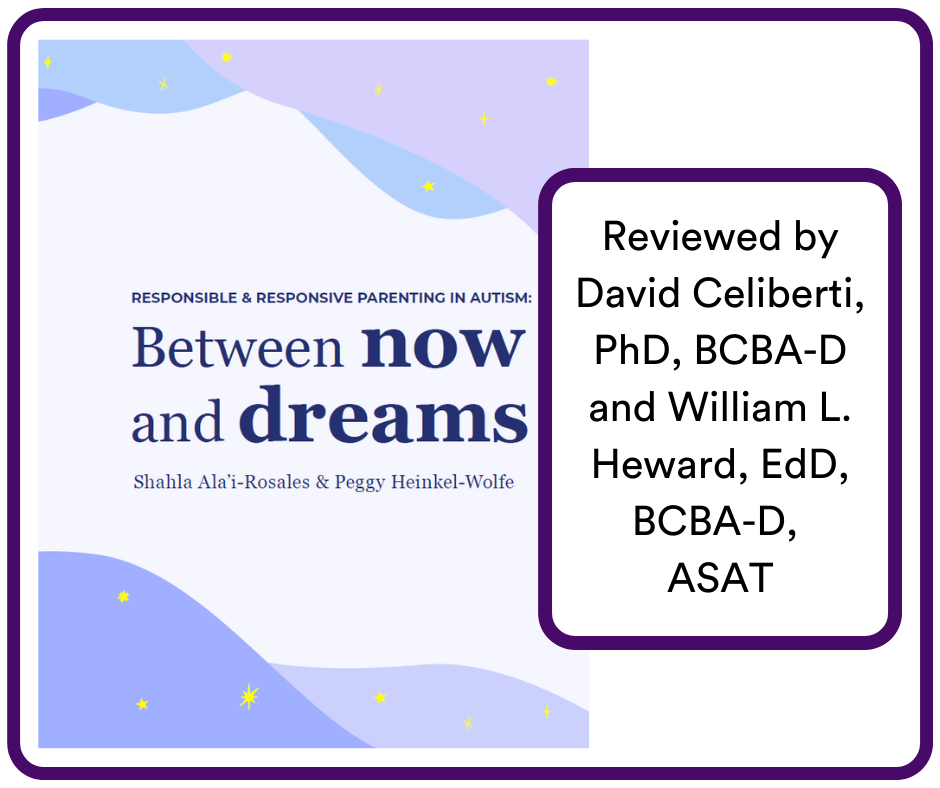
Review of Responsible and Responsive Parenting in Autism: Between Now and Dreams

Reviewed by David Celiberti, PhD, BCBA-D and William L. Heward, EdD, BCBA-D
Association for Science in Autism Treatment

This month’s ASAT feature comes to us from Executive Director David Celiberti, PhD, BCBA-D, Association for Science in Autism Treatment and William L. Heward, EdD, BCBA-D, Professor Emeritus, the College of Education and Human Ecology at Ohio State University. To learn more about ASAT, please visit their website at www.asatonline.org. You can also sign up for ASAT’s free newsletter, Science in Autism Treatment, and like them on Facebook!

Parents of children with autism face many challenges beyond those directly associated with raising a child who may have a myriad of needs. They face a dizzying array of treatment options with interventions lacking any scientific basis, which are cleverly marketed and often eclipse those interventions enjoying scientific support. Access to qualified, compassionate providers may be difficult or delayed, particularly for children in rural communities, children of color, individuals who age out of the educational system, and families outside of the United States. Misconceptions and misinformation about autism and ways to help people with autism abound and those messages often distract and derail many parents from obtaining accurate information, support, and intervention. Parents who seek help for their children are often harshly criticized and labeled by some bloggers as lacking love or acceptance. Taken together, these realities can weigh heavily on parents who are just trying to help their children with autism develop independence and purpose, pursue their dreams, and live their best lives.

Fortunately, a new book provides a break from the vitriol, snake oil, and antagonism. Between Now and Dreams thoughtfully and artfully explains the complementary concepts of responsible and responsive parenting of children with autism. It provides a space for parents to reflect, to engage, and to look ahead.

Prior to offering details about this book, the first reviewer would like to share some background. I first met Shahla Ala’i-Rosales and Peggy Heinkel-Wolfe thirty years ago at the University of North Texas (UNT) when I was a newly hired Assistant Professor in the Department of Psychology. Shahla was a behavior analyst, researcher, and practitioner in early autism intervention; Peggy, the mother of a son with autism, held an administrative job at the University. With a few other UNT colleagues, we formed a small working group to support each other in our individual efforts as well as to develop a community in which future collective efforts could take root. My time at UNT was brief, but I am so pleased (and a tad jealous) to know that Shahla and Peggy continued to collaborate and form a long-term friendship and professional alliance. Their book, Responsible and Responsive Parenting in Autism: Between Now and Dreams is a timely, and much needed gift to the autism community. Ala’i-Rosales and Heinkel-Wolfe share a series of interrelated events – challenges, plans, setbacks, and victories, large and small – in the lives of real children and their families (including their own). These stories demonstrate the importance of recognizing and celebrating children’s capabilities while encouraging and nurturing their self-actualization, individuality, and independence.

The authors put forth that raising a child with autism with an abundance of joy, purpose, and serenity relies on three interconnected powers: learning, connecting, and loving. Although the authors state that these powers are interconnected and that they influence and strengthen each other, Ala’i-Rosales and Heinkel-Wolfe have used them to organize their book into three unique parts. Each part is composed of several chapters; each chapter opens with a thoughtful quote that sets the stage for the lessons and wisdom that follows.

Part One: The Power of Learning  

Between Now and Dreams opens with a section devoted to principles of learning and how those principles can guide parents’ efforts to help develop their child’s fullest potential. The authors stress the need for creating and implementing carefully planned, intensive, positive applied behavior analysis (ABA) interventions in the home to keep children learning and moving forward in their lives. The abundance of examples discussed throughout this section showcase the vast applications of the science of behavior. Parents who are new to the autism journey will gain comfort in learning about principles that can be readily incorporated into their daily lives and appreciate a shift away from resolving problems to one of promoting empowerment and skill building, both for themselves, as well as for their children.

This section also chronicles the journey of ABA from its early applications to autism treatment, and to what the discipline has become today. The authors provide a sensitive and honest discussion of the bumps along the way.

Part Two: The Power of Connecting

This section of Between Now and Dreams will be invaluable for caregivers who may struggle with feelings of isolation, associated with both raising a child with many needs and experiencing the loss or shift in other relationships and career pursuits that may have followed their child’s diagnosis. Ala’i-Rosales and Heinkel-Wolfe beautifully capture the pursuit of supportive relationships, including with those who offer expertise and experience, as well as with other parents on very similar journeys. How one seeks and nurtures these relationships, as well as opting out when needed, is described with the same compassion and generosity reflected throughout the book.

Part Three: The Power of Loving 

The third section of Between Now and Dreams ties together the two prior sections. On its surface, a reader may assume that the section might focus myopically on positive emotions. Instead, the authors are realistic and don’t sugarcoat the challenges parents of children with autism face. Loss, fear, and disappointment are discussed openly in the context of numerous experiences, observations, and epiphanies. We left this section feeling grateful to the authors for being so incredibly transparent and vulnerable, yet insightful and encouraging in guiding us to be more active and loving parents.

Responsible and Responsive Parenting in Autism: Between Now and Dreams is an important, eloquently written, and engaging book for parents of children with autism of any age and who fall anywhere on the spectrum. It does not provide a cookie cutter approach, but rather a compassionately delivered collection of useful and practical suggestions that parents can select and tailor to their own home and goals.

Aside from behavior analysts, this book is also a must-read for teachers, therapists, medical providers, and others who work with children with autism. The content is accessible to those who are new to ABA and autism intervention, yet impactful for professionals with extensive training and experience.

Citation for this article:

Celiberti, D., & Heward, W. L. (2023). Book Review: Between Now and Dreams. Science in Autism Treatment, 20(3).

About the Authors

David Celiberti, PhD, BCBA-D, is the Executive Director of ASAT and Past-President, a role he served from 2006 to 2012. He is the Editor of ASAT’s monthly publication, Science in Autism Treatment. He received his PhD in clinical psychology from Rutgers University in 1993 and his certification in behavior analysis in 2000. Dr. Celiberti has served on a number of advisory boards and special interest groups in the field of autism, applied behavior analysis (ABA), and early childhood education. He works in private practice and provides consultation to public and private schools and agencies in underserved areas. He has authored several articles in professional journals and presents frequently at regional, national, and international conferences. In prior positions, Dr. Celiberti taught courses related to ABA at both undergraduate and graduate levels, supervised individuals pursuing BCBA certifications, and conducted research in the areas of ABA, family intervention, and autism.

William L. Heward, Ed.D., BCBA-D, is Professor Emeritus in the College of Education and Human Ecology at Ohio State University. He has taught at universities in Brazil, Japan, Portugal, and Singapore and lectured and given workshops in 23 other countries. A Past President and Fellow of the Association for Behavior Analysis International, Bill’s publications include co-authoring the books, Let’s Make a Contract: A Positive Way to Change Your Child’s Behavior (2022), Applied Behavior Analysis (3rd ed., 2020), and Exceptional Children: An Introduction to Special Education (12th ed., 2022). Awards recognizing Dr. Heward’s contributions to education and behavior analysis include the Fred S. Keller Behavioral Education Award from the American Psychological Association’s Division 25, the Ellen P. Reese Award for Communication of Behavioral Concepts from the Cambridge Center for Behavioral Studies, and the Distinguished Psychology Department Alumnus Award from Western Michigan University.

5 Ways to Support Your BCBAs

By Ashleigh Evans, MS, BCBA

Board certified behavior analysts (BCBAs) are instrumental in the development and oversight of ABA services. Working in the ABA field can be incredibly rewarding, but also isolating and exhausting. One recent study found that 72% of ABA professionals experience moderate to high levels of burnout. Burnout can have serious implications for the individual, their clients, and the organization as a whole. One of the leading risk factors for burnout is a lack of support. By supporting your BCBAs, you can greatly reduce the risk of burnout in your organization. Let’s review 5 ways you can support your BCBAs.

1.   Provide Access to Stimuli, Technology, and Assessments

BCBAs need many things to be successful in the workplace. Data collection software and other forms of technology can greatly improve efficiency, streamline administrative tasks, and increase job satisfaction. Similarly, providing access to teaching stimuli can make a BCBA’s job much easier, allowing them to spend less time creating stimuli and more time doing what matters most–caring for their learners.

2.   Seek Feedback

Supervisors and employers regularly provide their employees with feedback on their performance. However, it’s important to remember that employers should also seek feedback from their employees, including their BCBAs. Feedback should always go both ways.

Just as ABA clinicians are continuously growing and improving, so should employers and organizations as a whole. While you may not be able to please every staff member all the time, seeking feedback from your team shows that you value their input and are motivated to improve the working conditions of your organization. Encourage open and honest feedback, but also create a system for anonymous feedback, as your staff may feel more comfortable providing feedback anonymously.

3.   Encourage a Healthy Work-Life Balance

While your BCBAs have dedicated so much of their lives to this field, their life revolves around more than solely work. Ensure your BCBAs have a healthy work-life balance. You can do this by establishing working hours and encouraging boundary setting outside of those hours. For example, if your BCBA’s work day ends at 5 pm, they should not feel obligated to answer client or staff phone calls after this time. A healthy work-life balance also includes taking time off. Encourage and honor your staff’s requests for time off.

4.   Provide Opportunities for Continuing Education

Continuing education is a requirement of the Behavior Analyst Certification Board (BACB) for biennial recertification. The field of behavior analysis is vast and is constantly evolving. Ensuring your BCBAs have access to high-quality CEUs to expand their knowledge, keep up with the literature, and grow as clinicians will benefit your BCBAs, their learners, and your organization. It will also show them that you value their professional and personal growth.

5.   Set Realistic, Data-Driven Expectations

When setting workplace expectations (i.e., billable hours), ensure they are realistic and manageable. Furthermore, determine what is needed to help your BCBAs achieve these expectations and ensure you are providing support in those areas.

ABA professionals know the importance of following the data when making treatment decisions. This should extend into business practices as well. When establishing and modifying expectations, let the data lead the way. Let’s use billable hours as an example. Imagine you need to establish a billable hours expectation for your BCBAs. Using a behavior analytic approach, you would first identify the baseline number of hours that your BCBAs are currently achieving. If they have been successful at 20 hours/week, but you want them to hit 25 hours/week, approach this as you would with a client. Reinforce systematic approximations toward your end goal! You could first increase the expectation to 21 hours/week, then gradually increase the expectation as your BCBAs are successful.

Supporting your BCBAs using the above recommendations may significantly improve your BCBAs’ job satisfaction, improve client outcomes, and ultimately benefit your practice.

Resources

Camille Plantiveau, Katerina Dounavi & Javier Virués-Ortega (2018) High levels of burnout among early-career board-certified behavior analysts with low collegial support in the work environment, European Journal of Behavior Analysis, 19:2, 195-207, DOI: 10.1080/15021149.2018.1438339

Slowiak, J. M., & DeLongchamp, A. C. (2021). Self-Care Strategies and Job-Crafting Practices Among Behavior Analysts: Do They Predict Perceptions of Work-Life Balance, Work Engagement, and Burnout?. Behavior analysis in practice, 15(2), 414–432. https://doi.org/10.1007/s40617-021-00570-y

About the Author

Ashleigh Evans, MS, is a Board Certified Behavior Analyst. She has been practicing in the behavior analysis field for over 13 years and opened her own independent practice in early 2022. Her experience has been vast across different age groups, diagnoses, and needs. She is passionate about improving the field through education, reformative action, and better supervisory practices, leading her to create content and resources for families and ABA professionals which can be found on her website, www.evansbehavioralservices.com/.

How To Implement ABA In The Classroom

By Heather Hoeft, B.S., M.Ed., LBS1 | Reposted with permission from The Autism Helper

Many of us know the advantages to ABA (applied behavior analysis) and what it can do for not only people with Autism, but in changing any human behavior. ABA was not started because of Autistic individuals. ABA is the science of human behavior that uses techniques and strategies to change behavior. Using techniques that are aligned with ABA can be used within any classroom; special education, general education, with resource teachers, in outplacement schoolings, with related services, and so much more. ABA can be used for students and staff alike, and in this post, I will give some strategies on how!

What are the ABA Techniques?

The techniques that I am referring to are reinforcement, differential reinforcement, functional communication, prompting, modeling, discrete trial training, natural environment teaching, shaping, and chaining. All of these can be implemented within a classroom setting in some capacity. But how? I have lived how hard it can be to have many learners on individualized education programs as well as different reinforcement systems, related service schedules, mainstream minutes, etc. It is possible, but it isn’t easy, that I wouldn’t lie about. I have provided some examples below:

  • Reinforcement: There are many different types of reinforcement schedules within ABA. Although implementing them within the classroom per learner may be difficult, reinforcement schedules are possible. Using a token economy or task strips per learner will increase the likelihood of the targeted behavior within the classroom. It is also possible to use learner specific reinforcement within the classroom. This means that we can use M&Ms for Johnny and fidget spinners for Sally. Each learner still has their own set of reinforcers, and each learner should be on their own reinforcement system throughout the school day.
  • Functional communication: this should be a focus in all classrooms, whether a learner is using an AAC device, Picture exchange communication system, or using vocal language. Functional communication should be practiced with all learners throughout the day and is a skill that ;learners need to practice. Having communication skills within a repertoire specific to a learner will help decrease maladaptive behaviors and will make difficult behaviors more manageable to shape.
  • DTT: running DTT sessions can happen throughout center rotations and during other blocks of time throughout the school day appropriate for each learner. The educational team can meet and decide how many DTT table sessions per hour is appropriate per learner, as well as where they should be run and during what times of day they will be implemented. I take advantage of my related service team members and work together to create rotation scheduled throughout the whole week in order to maximize 1:1 time with each student in the class.
  • NET: In naturalistic teaching, the child sets the pace for learning in their daily routines. Naturalistic teaching capitalizes on a child’s natural interests, needs, and abilities. These strategies are incorporated in the moment throughout the school day instead of using a dedicated time period for treatment. Teachers using this strategy offer feedback and coaching for target behaviors as they happen so that they can minimize interference with learning. A type of naturalistic teaching specifically used to improve communication skills is incidental teaching. In incidental teaching, the environment is set up to encourage students to use communication skills to ask for what they want. Similarly, the natural language paradigm method involves arranging an environment to increase the chances for the student to use language.
  • Chaining: when teaching functional routines, choose what type of chaining procedure would be the best per routine and per learner (backwards chaining, forward chaining, whole chain). Mapping a plan out in the beginning per learner and per routine will make training staff much quicker and the learner will progress and gain the skills when the appropriate chaining procedure is in place.

What may be impossible in a classroom?

I don’t like to say that anything is impossible. It may be difficult to implement with fidelity which can be discouraging and of course a disadvantage. Of  course, the school setting has its own standards and skills assessments in which teachers much target to teach their students. Student goals may also last longer. From my experience in both an ABA clinical setting, a therapeutic day school setting, and a public-school setting, educational staff write goals that are broken down into benchmarks that typically last for one year. In an ABA setting, those benchmarks may be written as their own goal with specific targets listed underneath and they are meant to be taught quickly and move on to the next skill or subset of skills. Shaping behavior and running DTT centers may also be difficult. An increase in support staff and adult to student ratios would be key to be able to run these techniques within a classroom. All settings have their disadvantages, so I would recommend talking with administration and the educational team of each learner on what is a priority and what can be implemented per learner with fidelity and integrity.

The Autism Helper is here to help

Not only does The Autism Helper have resources available for many skills and units that can be implemented within a classroom, there is also a VB-MAPP assessment kit and an ABLLS-R assessment kit. Many of our wonderful bloggers have shared information on how to use these, and both of these assessments are my typical “go tos” when reviewing progress of my learners and looking to see where to go next with them.

About the Author

Heather Hoeft is special education teacher in the preschool setting. Heather shares strategies and ideas from her self-contained classroom. Her classroom utilizes Applied Behavior Analysis instructional methods of discrete trial training, pivotal response training, and teaching functional routines. She received her Bachelor’s degree in Early Childhood from Northern Illinois University and Masters in Special Education from Concordia University.

Originally posted on The Autism Helper on January 18, 2023.

Posted in ABA