

Promoting Successful Dental Visits with Children with Autism

By: Randy Horowitz, M.S. Ed., S.A.S.

Children with autism often engage in problem behavior when asked to participate in activities to which they are infrequently exposed (e.g., doctor/dental exams, haircuts, etc.). In many cases, the problem behavior serves as a means to avoid an unpleasant situation or to communicate a need.

Why are dental visits problematic?

Infrequent exposure, combined with fears associated with dentists, sensory issues related to dental implements and changes in schedules (going to the dentist when you should be in school) prevents some children with autism from learning the appropriate skills and behaviors needed to be successful at the dentist.

Because of these challenges, parents and teachers tend to avoid dental exams, when in reality, they need to do the opposite. Create many opportunities to practice. Build skills. Practice appropriate behavior. Come into contact with reinforcement. Do so under the best circumstances (e.g., in the absence of a tooth ache or painful dental issue).

Prepping for success

  • Prepare the dentist/hygienist/receptionist in advance. Talk to the dentist prior to your scheduled appointment. Explain your child’s preferences and aversions (e.g., one person speaks at a time, noises, etc.) 
  • Visit the dental office without having an actual exam. Take a tour. Provide reinforcement for appropriate skills and behavior (e.g. labeling objects in the environment, walking nicely etc.). Leave on a good note. Consider repeating this across several visits.
  • Introduce pictures (e.g., the dentists’ office, waiting room, exam room, etc.) during structured teaching sessions
  • Use visual schedules to indicate when the appointment will be
  • Consider using social stories, peer models or video modeling procedures during regular teaching sessions

In some cases, the above strategies may not be effective, or your child’s rate of acquisition may be slower than the timeframe you have. In these cases, you may have to create a lot of opportunities for direct instruction. Practice a dental exam several times a day with the actual dental implements.

Some Prerequisite Skills (Mastery of these skills may create the occasion for more success during a dental exam)

  • Sits in chair (also lays back/tolerates the reclined position)
  • Imitates adult movements (e.g., opens mouth)
  • Follows simple directions (e.g., “say ah”, “open wide” etc.)
  • Tolerates toothbrushing. Use many different types of toothbrushes and toothpastes during teaching sessions at home. Programming for generalization across materials may help your child accept what the dentist offers.

Strategies for waiting

  • Strategically schedule the appointment for times that are less crowded. Ask the office if the first appointment of the day is less wait time than the end of the day.
  • Use a timer
  • Bring things to do (but avoid a situation where terminating a preferred activity or relinquishing a preferred object may cause problem behavior)
  • Wait in the car, take a walk around the block and ask the receptionist to call or text when the dentist is ready

Strategies for during the appointment

  • Begin with mastered skills. Ask the dentist to do a few trials of general direction following. This builds momentum and also provides an opportunity for the child to access reinforcement for correct responses
  • Pair the exam with reinforcement (e.g., preferred music, TV, etc.)
  • Give breaks out of the chair
  • End on a positive note. Even if the entire exam is not complete, if the child has tolerated many steps for longer periods of time, terminate the exam and schedule follow up.

Through systematic teaching and gradual exposure, children with autism can learn needed skills and behaviors to be successful during a dental exam. The rate of acquisition of these skills and behaviors varies across children. In some cases, mastery may take weeks or even months. In the meantime, remember to celebrate each successful step along the way!

About the Author

Randy Horowitz, M.S. Ed., S.A.S.

Randy has a Master of Science in Education from Queens College and a Certificate of School Administration and Supervision from the College of New Rochelle. Randy is currently a doctoral candidate in the educational leadership program at Concordia University. Randy started her career as a special education teacher in public school in Nassau County and then spent close to 30 years in senior leadership positions at nonprofit organizations serving children and adults with autism in NYC and Long Island. Randy has presented at local, national and international conferences on topics relating to educating individuals with autism. Her particular areas of interest include preparing and supporting individuals with autism for integration into community activities.

In addition to her many work responsibilities, Randy is also a seasoned runner and has participated in countless road races and marathons, including our Blazing Trails Run/Walk, raising well over $65,000 in the past 15 years to benefit the autism community.
Posted in ABA

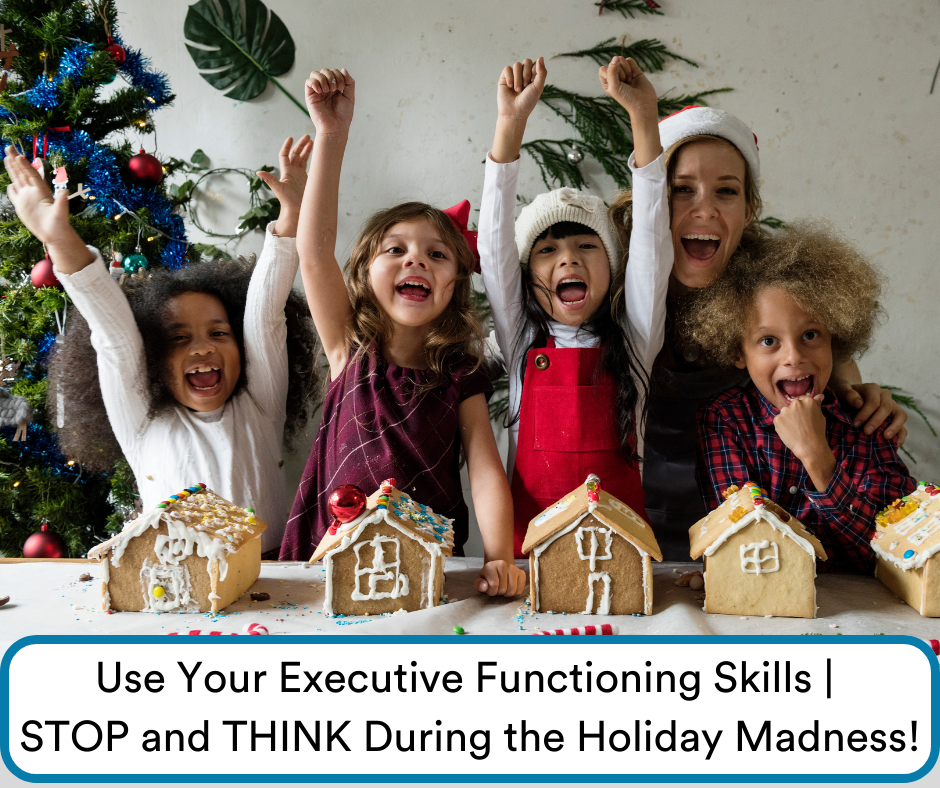
Use Your Executive Functioning Skills | STOP and THINK During the Holiday Madness!

This week’s post comes to us from Stephanny Freeman, PhD and Kristen Hayashida, MEd, BCBA, our partners on the Play Idea Cards app. Play Idea Cards is a full curriculum on teaching play – right in the palm of your hand! Check it out on the Apple App Store! 

Everyone just loves the holidays!

Lots of emotions!  Excitement, joy, love, anxiety, anticipation, stress, and relaxation…

Lots of activities! Giving gifts, eating holiday food, traveling to see family and friends…

Lots of people!  Big groups, little groups, friends, family, loved-ones, and strangers too!

But the holidays are also a FANASTIC time to help your children continue their COGnitive development! 

You can target executive functioning (EF) during these special activities, which is not only a great opportunity to foster skills, but also helps you as a caregiver have a successful and joyous holiday season! Here are some of our tips to build EF during the holidays:

Consider EF Skills when Choosing Gifts for Your Children

Rather than impulsively buying the newest screen toys… plan, problem solve, and control those holiday emotions!! Use your EF skills to buy enriching toys and plan fabulous activities! Deck the Halls with Cogs of EF – fa la la la la, la la la la!

  • Working Memory – look for memory-based board games and the copying pattern games.
  • Planning – consider activities where children can make something (e.g., manipulatives such as blocks or magnetic tiles, arts and crafts, dough).
  • Cognitive Flexibility – give a track set and challenge the child to vary the path or move a vehicle through obstacles. You may also consider any “flexible” toys (e.g., magnetic sets, wax sticks, slime) to talk about how you can change the shape of the object.
  • Task Initiation – outdoor equipment would be great for this skill (think: balls, hoops, chalk, ropes, cones/domes), or cleaning and gardening supplies.
  • Emotional Control and Inhibition – use a gift that challenges your child to inhibit impulsive responses and regulate through frustration/excitement. We think of dress up clothes (for peer play, turn taking), advent calendars, surprise toys, bubbles, foam shooters, noisy electronic infant toys.
  • Organization – find toys that contain lots of pieces and can be sorted and used by category such as figures, furniture, vehicles, houses/garages/buildings with all the associated pieces, doctors/vet kits, cooking/kitchen/ice-cream stand/restaurant.
  • Problem Solving – STEM kits, puzzles, brain teasers all naturally present the child with problems to solve, but you can use these activities as opportunities to solve problems that may naturally occur (e.g., if chemicals don’t react, liquid spills from the beaker).

Embed EF practice in your holiday preparation!

Everyone is so busy making their lists and checking in twice! Involve your child during your holiday preparations to help build EF skills:

  • Shopping!  Make a store plan by the layout, develop a list, check it off as you go, make sure to consider other things if something is not available, don’t buy things not on the list!
  • Baking and Cooking!  Talk about the order, what’s in a recipe, have them retrieve the items (more than one at a time), try to remember the measurements, plan out the decorations (draw first, gather the colors, etc.)
  • Decorating the house/tree!  Sort decorations by room, place items on the tree by tree zone, and compromise and delegate roles and responsibilities.  Include how to be careful with delicate objects, how things are meaningful to others, and fix broken items.
  • Wrapping and giving presents!  Notice how people respond to gifts given.  Work on fixing ripped paper/ribbons that don’t cooperate, and glitter that gets everywhere.  Be sure to label and organize the gifts.  Solving any problems related to gift giving (oops, we forgot cousin Milt!)
  • Family Gatherings!  Organizing some family activity, planning where people are going to sit, getting along with family members and discussing how to behave in other people’s homes.

From our family here at KidsConnect to yours… Happy Holidays to the wonderful, thoughtful, executive functioning-using, caregivers! 

About the Authors

Dr. Stephanny Freeman is a clinical professor at UCLA, a licensed clinical psychologist, and Co-Directs the Early Childhood Partial Hospitalization Program (ECPHP).  For 20 years, she has educated children with ASD and other exceptionalities as a teacher, studied interventions for social emotional development, and designed curriculum and behavior plans in school and clinic settings.

Kristen Hayashida is a Board Certified Behavior Analyst at the UCLA Early Childhood Partial Hospitalization Program (ECPHP).  For the last 10 years she has served as a therapist, researcher and educator of children and families living with autism spectrum disorder through the treatment of problem behavior.

Posted in ABA

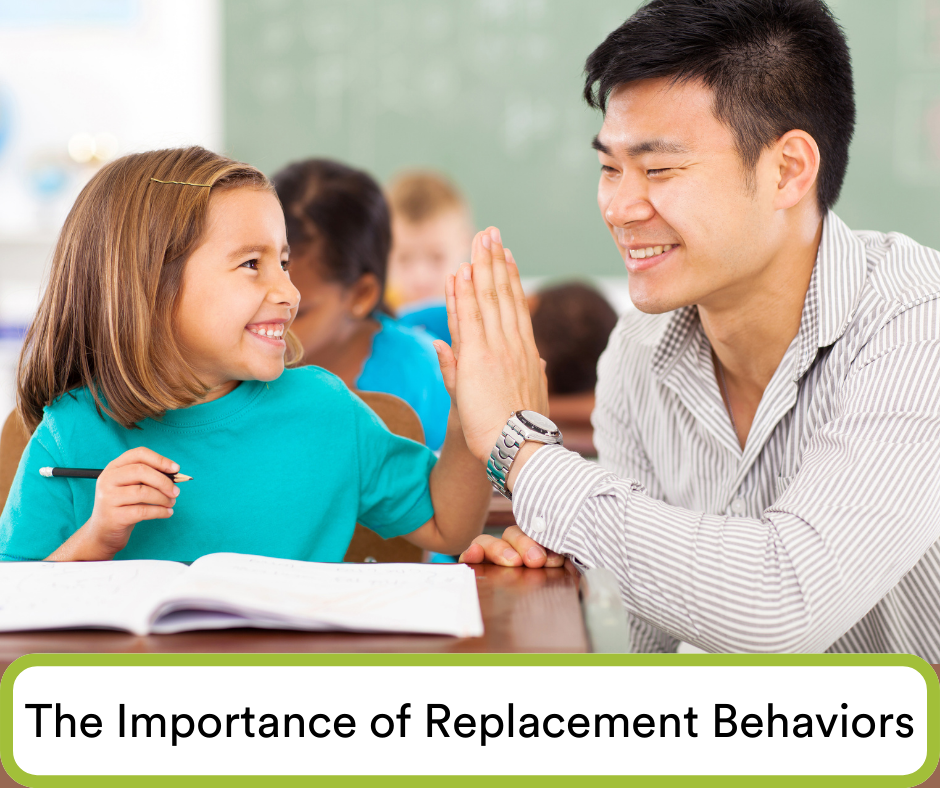
The Importance of Replacement Behaviors

By Sam Blanco, BCBA

I’ve written several posts about the importance of reinforcement, but now I want to turn my attention to another important concept: replacement behaviors. It can be very easy to slip into the habit of telling kids what NOT to do. “Don’t touch that! Don’t pick your nose! Don’t run!” However, if we can turn it around and tell kids what to do instead we often see higher rates of compliance.

Here are a few examples of replacement behaviors you can teach:

  • A student refuses to speak when they do not understand a question. You can teach the student what to say, such as “I don’t understand,” or “Can I get help?” Teach through modeling and role playing in one-to-one settings, then generalize it to the classroom or other environments in which the skill is necessary.
  • When you begin a math lesson, one student frequently attempts to run out of the room. Introduce a signal or symbol (such as a holding up a stop sign) to request a break. Initially, you might give the break each time the student uses the sign correctly, then begin to require more and more math work before a break is received. This allows for appropriate and safe breaks without disrupting the rest of the class.
  • When your learner is done with dinner, he pushes his plate into the middle of the table. Teach your learner to instead put items in the sink. You might start with just placing the fork in the sink, then add more and more items until they are clearing the table independently. Another replacement behavior may be to use a symbol or signal as in the previous example to request to leave the table, or to teach the learner to say “May I go?”

Keep It Simple

Replacement behaviors should be simple to implement, should be taught one-on-one with multiple opportunities to practice and be reinforced, and should, if possible, be functionally equivalent to the undesirable behavior. (For example, if a child is engaging in one behavior to escape, the replacement behavior should teach a more appropriate way to escape.)

Sometimes, simply instructing the learner on a replacement behavior makes a huge change, but often you need to combine teaching a replacement behavior with other strategies (such as differential reinforcement). What I do know is that identifying and teaching a replacement behavior is a necessary part of almost any intervention and should not be overlooked.


About The Author

Sam is an ABA provider for school-aged students in Brooklyn, New York. Working in education for over 15 years with students with Autism Spectrum Disorders and other developmental delays, Sam utilizes strategies for achieving a multitude of academic, behavior, and social goals. She is also an assistant professor in the ABA program at The Sage Colleges and the Senior Clinical Strategist at Encore Support Services. You can read more of Sam’s posts for Different Roads To Learning when you click here!

This post was originally published with Different Roads to Learning on December 19, 2019.

Learn More About Let’s Make a Contract

Jill C. Dardig, Professor Emerita of Education at Ohio Dominican University, and 
William L. Heward, Professor Emeritus in the College of Education and Human Ecology at Ohio State University

In this podcast, Drs. Jill Dardig and William L. Heward discuss their new book, Let’s Make a Contract. Contracts are particularly useful for children on the autism spectrum, who benefit from understanding clear expectations and receiving positive feedback and rewards.

In their interview, they discuss key elements of a behavior contract:

  • What a behavior contract is
  • How long a behavior contract should last
  • Common mistakes made with behavior contracts, and how to avoid negativity when mistakes are made
  • How contracts can benefit children, parents, families, school settings, and self goals

For more information regarding this interview, and for a full transcript of the episode, visit https://marybarbera.com/behavior-change-contract-bill-heward/

Posted in ABA