
A Grandparent Guide for Happy Holidays

This post was written by our old friend Dr. Erica R. Holding for the Grandparent Autism Network. Dr. Holding has a Ph.D. in Psychology and a Masters degree in Counseling Psychology. She is a Board Certified Behavior Analyst-Doctoral level and founder of Avita Nova, which provides early diagnosis and ABA therapy for children and parent training and support. This article is based on her many years of working with families affected by autism.

When you have a grandchild with autism, the holiday season can present some extra challenges for your family. With careful planning your family can make the holiday season warm and happy for everyone.

If you don’t get to see your grandchild regularly, it is important to remember to have realistic expectations for your time together. Before the visit, call your son or daughter to ask if there is anything to do or have on hand to make the visit more enjoyable for your grandchild. You can have favorite toys, food and videos ready and plan to go to places that they like to visit.

Grandparents often express fear and anxiety about how to interact with their grandchildren.  You may feel rejected because you expect welcoming big hugs and kisses and may feel frustrated and unloved if that does not happen. Your grandchild may have sensory issues that make it overwhelming and even painful for them to be touched or hugged. They may not have the skills yet to know what to do or how to respond or they may just be learning these skills, but shut down around new people or in new situations. The most important thing is to not take this personally. They are not rejecting you. A high five or brief gaze may be all that they are currently capable of doing.

If you are planning a party or other special event, ask your son or daughter if they feel your grandchild will be comfortable being present. You may want to change your plan to be more inclusive and focus on creating new holiday traditions together.

Keep demands for social politeness at a low level.  Even if your grandchild has learned new social skills like greeting people by saying hello or shaking hands, don’t anticipate that will happen when there is a lot of stimuli like lights, music and new people in new settings.

Pace yourself and be flexible.  If you have 3 events planned for a day, but there is a midday meltdown after event # 1, maybe it’s best to skip the others. It is better to have one great time together that you can all remember fondly than to watch the rest of the day deteriorate into tantrums or other behavior problems. New situations, new people, and new schedules can be overwhelming for a child with autism. Your grandchild is not being willfully defiant or difficult, and your son or daughter does not have poor parenting skills. Too much input and too many changes can be very hard for children with autism to process. Let your son or daughter know that you understand this may be what is responsible for meltdowns and negative behavior.

Create outlets or escape routes.  Prepare a place in your home that is quieter and provides a comfortable spot where you grandchild can “take a break” from all of the excitement.  Having a place to go for some respite time may prevent you from having to leave or end an event. Just taking a break may be all that your grandchild needs to get on to the next event.

Manage sensory input.  The holiday season is filled with new experiences. Manage these to the best of your ability. If you are taking a trip to the mall, try to go at times when the mall is less busy, or make the trip shorter. The holidays might not be the best time to try new foods. Try to have something your grandchild likes at every meal.

Control Schedules.  Routines and knowing what is happening next is often very important to individuals on the spectrum. Holiday schedules deviate completely from our daily normal routines and this can be especially difficult for a child with autism.  Ask your son or daughter how best to handle daily schedules. Some children with autism can be included in the schedule making and this is very empowering for them. Other children may be more able to understand when given a visual schedule. Find out what works best and if an unexpected change is just about to happen, find out how best to communicate that change.

Be sure to compliment your grandchild and your son or daughter about the new abilities and progress your grandchild has achieved.  Grandparents can be supportive good listeners who consistently give their families loving reinforcement at the holidays – and throughout the year.

Cyber Monday Sale – Save 20%!

Different Roads to Learning is thrilled to be offering 20% off storewide TODAY ONLY! To redeem your savings, enter the Promo Code CYBER12 at checkout at www.difflearn.com.

We have all of the materials that parents and teachers need for Early Intervention, ABA programs, play therapy, teaching social skills to school-age children and more! In addition, we have tons of wonderful educational games and toys that make great gifts for any child or student.

Remember, enter the Promo Code CYBER12 at checkout to redeem your discount – valid today only!


 *Offer NOT valid on the following products: VB MAPP Assessment Kits (DRK 700, DRK 701), 10-Pack of VB MAPP Protocols (DRB 682), 25-Pack (DRB 683) of VB MAPP Protocols, ABLLS-R Assessment Kits (DRK 702, DRK 703). Offer expires Monday, November 26, 2012 at 11:59 EST. Be sure there are no spaces when you enter your Promo Code.

Wait, What Are We Talking About?

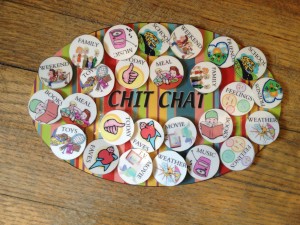
I typically work with very young learners in Early Intervention but there was a time I was working with older children, which necessitated work on conversation skills and topic maintenance. With the start of a new academic year and changes to my caseload I am currently finding myself with students who again need some assistance in this area.  Children with autism spectrum disorders often struggle in conversations because of limited or restricted interests, attending issues, difficulty determining what is relevant or salient to the topic and might also struggle with the rapid transitions necessary to shift between speaker and listener.  This change in my caseload has meant that I’ve found myself digging into old files and unearthing some ancient DIY efforts of mine that I had used in the past.  What I came across that I wanted to share was a visual support that I had used in small groups to facilitate a variety of skills.  It’s something I called Chit Chat and it helped to cue the students in shifting from speaker to listener while maintaining a balance in the conversation with turn taking and reciprocity as well as staying on topic.

The idea was that we would all sit down for a “chat” and initially I would go first in order to model how the board was used rather than providing explicit instruction until the group could use the board on their own and I could fade myself out of the conversation.  The first speaker would choose a token corresponding to a topic of interest, make a statement relevant to the topic chosen and then pass the token to a friend.  The token would provide a prompt for the speaker to maintain the chosen topic as well as cue the rest of the group to visually reference the child whose turn it is to be speaker.  Depending on the level of the group I would individualize the number of conversational exchanges on one topic required before bridging to a new topic. The group I was working with at the time was able to talk about more general topics but this could be individualized to more specific topics depending on the group of students you are working with.

I’m excited embarking upon a new academic year with all it’s unique challenges and successes and am happy to dust off Chit Chat and give it another whirl this year with all new students.  I would be curious to hear from other educators and therapists what tools they’ve created that they find themselves going back to year after year.  You might be surprised what you find at the bottom of your file cabinet!

Also, check out this great link I stumbled across from POPARD Provincial Outreach Program for Autism and Related Disorders in British Columbia, Canada.

https://www.autismoutreach.ca/elearning/social-skills/conversation-and-topic-maintenance

Sandy Relief: Help Us Help Our Community Today

As Superstorm Sandy fades from the front pages of the news, please remember that there are still thousands of families in dire need. In lieu of our usual Pick of the Week, Different Roads to Learning will be donating 10% of all online sales to New York Cares and the Carl V. Bini Fund, two wonderful organizations delivering relief supplies, coordinating volunteer services and providing much needed assistance to the most hard-hit residents of New York City. In parts of Staten Island, Breezy Point, the Rockaways and elsewhere, there is still no power and there is no end in sight. We can tell you firsthand how crucial these organizations have been to coordinating relief efforts and how tremendous the impact is on affected families. From today through Monday, November 19 at midnight EST, all orders placed on our site will be counted towards what, with your help, we hope to be a sizeable donation to these organizations.

If you’ve been putting off making a purchase, this is the week to do it. When we make our donation, we will include all of the names from people who have ordered in our card. We hope that you will join us in helping the affected members of our New York community.

In addition, if you know of a family or school in need, please forward us their information. We have a supply of new and gently used books, games and other materials for individuals on the spectrum that we would be happy to donate.

These are some photos taken by us and our friends who have been working and volunteering in Breezy Point and Staten Island. The help and assistance provided by relief organizations from food to literally helping people pump out and gut their homes is crucial. Please help us help these families by ordering today!