Supporting Your Student with Visual Timers

By Ashleigh Evans, MS, BCBA

Time is a challenging concept for children to grasp. It is even more difficult for concrete thinkers, as many neurodiverse children are. Children with autism tend to understand concrete concepts better than abstract ones, like time. Visual timers and other supports can help bridge the gap, giving children a better understanding of time. 

What is a visual timer?

Visual timers allow you to observe the passage of time through visual cues. There are different types of visual timers. The type you choose will depend on a number of factors, such as your child’s preference and your intended use of the timer.

Here are a few options

The Time Timer demonstrates the passage of time with a colored disk that fades away as time passes. With this timer, your child can easily observe the color closing in as the time passes.

Time Timers are great for longer activities, as you can set them for up to one hour.

Sand timers are another great option to demonstrate the passage of time. Each sand timer has a different duration. They come in durations of 1 minute, 2 minutes, 5 minutes, and 10 minutes. Simply flip it over and watch the sand flow down. When the minutes are up, the sand will be entirely at the bottom.

The Time Tracker is a unique and customizable visual timer. The green, yellow, and red sections light up to serve as warnings for the amount of time left for an activity. You can program the time each section lights up, making it customizable to your needs.

How can visual timers be used at home?

Visual timers are great for helping with transitions, whether big or small.

Here are a few ideas for using visual timers with your child at home

  • To show the remaining time in an activity. Transitioning away from a favorite activity like screen time or playing outside can cause distress for many children. A visual timer can make these transitions easier by providing a visual cue before the activity is over.

  • To help your child wait for an upcoming activity. Waiting is not easy. For children with a limited understanding of time, being told to wait may feel the same as being told “no.” To help your child understand what “wait” means, set your visual timer to allow them to observe the amount of time they need to wait.

  • For morning and bedtime routines. A Time Timer with a dry-erase board can be beneficial to help your child work through morning, bedtime, or any other routines. Set the timer for each task and check each off as you go through the routine.

  • To teach your child how long to engage in an activity. If your child tends to rush through activities they should be spending more time on, set a visual timer to help them identify how long to spend in that activity. Brushing teeth, for example, is a daily task that many children tend to rush through. A visual timer is a great way to help them learn how long to spend brushing.

Review the visual timer with your child and set expectations before using it. This will help things run more smoothly when you begin using it. Don’t worry if it doesn’t click right away. It may take time for your child to understand how the visual relates to the activity. With consistency, your child should be able to understand the concept of time better.

About the Author

Ashleigh Evans, MS, is a Board Certified Behavior Analyst. She has been practicing in the behavior analysis field for over 13 years and opened her own independent practice in early 2022. Her experience has been vast across different age groups, diagnoses, and needs. She is passionate about improving the field through education, reformative action, and better supervisory practices, leading her to create content and resources for families and ABA professionals which can be found on her website, www.evansbehavioralservices.com/.

Posted in ABA

Picking the Right Social Skills Assessment

By Nahoma Presberg, MS BCBA NYS-LBA

You’ve probably heard that ABA is a tool to teach social skills. You’ve probably also heard that one of the characteristics of autism is difficulty with social interactions. But what does that mean exactly? Does that mean that conversations with friends are hard? Knowing if someone is flirting with you? Taking turns at a board game? Interviewing for a job? The answer is, it could mean all of those things and a whole lot of other things too.

Social skills is a hugely broad category used to describe so much to do with the world around us. Young children begin to learn social skills starting with early play skills. Babies learn that making sounds from their mouth can often get an enthusiastic response from a caregiver. Preschoolers learn to share their toys with their friends. Every stage of development includes the expansion of a child’s social world.

For children with developmental disabilities, social skills may not develop in the same ways. ABA therapy can often be a useful tool to help children understand about social contingencies and engage more appropriately with the world around them. But this is a hugely complicated concept. How do we decide which social skills to teach? Assessments are hugely important tools for helping identify strengths and challenges of learners. But it’s important to pick the right assessment. For example, you wouldn’t give an assessment that focuses on pre-school play skills to someone getting ready to apply to jobs.

So how do you pick a social skills assessment? There are number of elements that you’ll want to consider. Picking a good social skills assessment is just the beginning of the process. You’ll also want to consider factors like your client’s age, current social environment, motivations and interests, and feedback from parents and caregivers about where that child might be struggling. Just because someone doesn’t have a skill listed on an assessment tool doesn’t mean that it should be the therapeutic priority because it may not be relevant for their current environment or won’t significantly enhance their quality of life. You may also want to consider using a mix-and-match approach with assessments to most accurately meet the needs of your client.

Let me tell you a little bit about some of my favorite assessment tools and what they’re used for:

Socially Savvy: The Socially Savvy is a curriculum designed to help students learn skills to prepare for kindergarten. They address the following domains: joint attention, social play, self-regulation, social/emotional, social language, classroom/group behavior, and nonverbal communication

PEAK: PEAK is a more comprehensive language and social skills curriculum. It was developed based on teaching advanced relational responding. Relational responding is what contributes to our ability to engage with abstract language and generalize information to broader contexts. PEAK was created to target skills for children as young as 18-months old all the way through teenage years. This is a great choice for a more comprehensive curriculum.

AFLS: The Assessment of Functional Living Skills may sometimes be conceptualized as a functional skills curriculum as opposed to a social skills curriculum. However, for some learners, it may be more appropriate to focus on functional elements of socializing (interacting with community helpers, navigating the community appropriately, etc). The AFLS has a number of different curriculum (daily living skills, community skills, vocational skills, etc.) which can be a great way to really get specific about what is most important for your learner.

Early Start Denver Model: This curriculum is also focused on social skills of younger learners. It covers the following domains: receptive and expressive communication, social skills, imitation, cognition, play, fine motor, gross motor, (challenging) behavior, and personal independence.

Social Skills Improvement System: This tool includes a child self-report form and a parent report form. The assessment looks at social skills and problem behaviors. This assessment is rated for children ages 8-12 years old. While this is certainly not a strict age range, it gives a sense of the level of social skills that this tool assesses for. 

Social Skills Checklist: There are two checklists in this assessment. One is for younger learners and focuses on the following categories: beginning play behaviors, intermediate play behaviors, advanced play behaviors, understanding emotions, self-regulation, flexibility, problem solving, conversation skills, nonverbal conversation skills, and compliments. The checklist for older learners focuses on conversational skills, problem solving, understanding emotions, compliments and flexibility.

Remember, there is no one right way to address social skills. It’s always important to come back to the question: What is going to most benefit my client right now? If you’re able to answer that question, there’s a good chance you’re on your way to effective treatment planning!

About the Author

Nahoma Presberg, MS BCBA NYS-LBA, is a Board Certified Behavior Analyst. Nahoma obtained their master’s degree at the University of Rochester in Human Development. They have been working with clients in their homes for the past 6 years but has over a decade of experience supporting children with developmental disabilities. Nahoma is passionate about neurodiversity affirming care and thoughtful programming that helps every client thrive.

For more information about Nahoma, you can visit their website at https://www.nahomapresberg.com/.

Posted in ABA

Build Desirable Behaviors

By Sam Blanco, PhD, LBA, BCBA

One of my favorite textbooks about ABA is Focus on Behavior Analysis in Education: Achievements, Challenges, and Opportunities. And one of my favorite chapters in that book is called “Building Behaviors versus Suppressing Behaviors,” which focuses on school-wide positive behavior change. This is an often-overlooked key concept in behavior analysis that can have a huge impact on the school environment. Furthermore, when we think of ABA, we often think about individual interventions, but the principles of ABA can be highly effective when applied to large environments, such as an entire school.

The chapter references several studies about school-wide behavior change and offers evidence-based practices for achieving such change. It also outlines social behaviors that should be taught, such as how to apologize or how to make a request, then discusses strategies for rewarding the desirable behaviors. I appreciate that it focuses on getting students involved in making such changes.

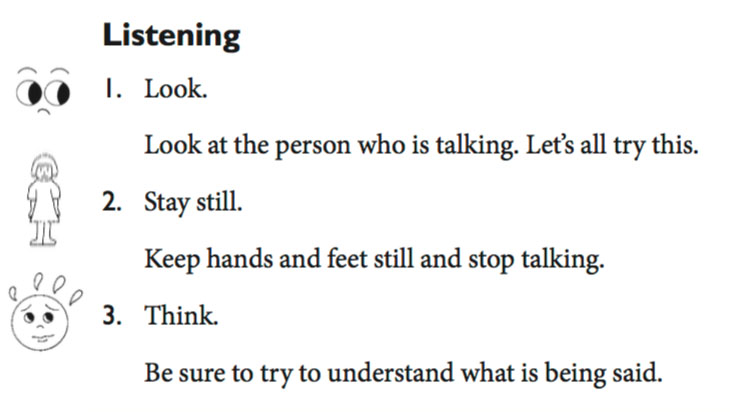
Teaching these desirable behaviors can often feel challenging with the additional stresses of a special education classroom. One curriculum I have found effective in addressing this problem is Skillstreaming. I often use Skillstreaming in Early Childhood with young learners, and love that it clearly defines desirable behaviors, such as how to listen or how to offer help (see image below), but provides those definitions in simple terms with visual prompts that help our young learners. It also incorporates positive reinforcement for learners who are engaging in those desirable behaviors.

Listening Skill

In summary, there is lots of evidence out there that focusing on what kids should be rather than what they should not be doing is beneficial for the learner and the general culture of the classroom. Providing clearly defined desirable behavior and building instruction in those behaviors throughout the day is essential. And that instruction may need to be more frequent and more detailed for our learners with developmental disabilities.

REFERENCES

Heron, T. E., Neef, N. A., Peterson, S. M., Sainato, D. M., Cartledge, G., Gardner, R., … & Dardig, J. C. (2005). Focus on behavior analysis in education: Achievements, challenges, and opportunities. Pearson/Merrill/Prentice Hall.


About the Author

Sam is an ABA provider for school-aged students in Brooklyn, New York. Working in education for over 15 years with students with Autism Spectrum Disorders and other developmental delays, Sam utilizes strategies for achieving a multitude of academic, behavior, and social goals. She is also an assistant professor in the ABA program at The Sage Colleges and the Senior Clinical Strategist at Encore Support Services.

Easy Data Collection for the Classroom

Get a preview of the helpful tips found in ABA Tools of the Trade by Sam Blanco, PHD, LBA, BCBA.

From the beginning of my career, I have loved data collection. Not only does it help me track what interventions are working and how quickly my students are learning, it also provides excellent structure and organization of what needs to be done on a daily basis. Much of this love of data collection was influenced by my colleague Val Demiri. While Val and I both looked at data as a way to make our lives easier, for many of our colleagues, data appeared to be more of an obstacle than a useful tool. So we set out to change that.

We’re both so thrilled about the release of ABA Tools of the Trade: Easy Data Collection for the Classroom. Our goal is to make data collection easier, more useful, and possible considering the many tasks a teacher is already doing on a daily basis in their classroom. Here are few things we’re really excited to have in the book:

  • An overview of some of our favorite tools for data collection, including why we love them and when they might be useful for you
  • An easy-to-use guide based on the specific behavior challenges you are currently facing, with suggestions for data collection and recommended readings
  • A task analysis of the data collection process that breaks down each step for pre-data collection phase, data collection phase, and post-data collection phase
  • A wealth of strategies to use to address problem behavior before they occur
  • An entire section devoted to BCBA Supervision that not only aligns with Task List 5 but also contains lesson plans and rubrics for assessing supervisees

We hope that by making data collection methods more accessible, we can motivate you to appreciate tools for data collection as much as we do!


About the Author

Sam Blanco, PhD, LBA, BCBA, is an ABA provider for students ages 3-15 in NYC. Working in education for twelve years with students with Autism Spectrum Disorders and other developmental delays, Sam utilizes strategies for achieving a multitude of academic, behavior, and social goals. She is also an assistant professor in the ABA program at The Sage Colleges.

Best Practices in BT/RBT Supervision

By Ashleigh Evans, MS, BCBA

Behavior Technicians (BTs) and Registered Behavior Technicians (RBTs) are vital for the success of Applied Behavior Analysis (ABA) therapy programs. When opening a new ABA clinic or beginning a new supervisory relationship, it’s important to establish an environment with supervision dynamics that allow clients to make progress while behavior technicians grow and thrive. Let’s explore some essential BT and RBT supervision practices that will set you up for success.

Establish Clear Expectations

When developing a new supervisory relationship, the first step is to clearly define expectations for your supervisee and yourself. Outline the technician’s roles, responsibilities, and performance expectations, and detail your responsibilities as the supervisor. Clear expectations set the foundation for a mutually beneficial working relationship.

You can establish clear expectations with your behavior technicians by:

  • Writing detailed job descriptions
  • Conducting comprehensive orientation and training for new hires
  • Creating an employee handbook with written policies and procedures
  • Holding 1:1 meetings to set goals collaboratively

Setting clear expectations reduces the likelihood of mishaps as time passes. If challenges arise later, take them as an opportunity to reflect on whether performance expectations were clearly delineated.

Provide Ongoing Feedback

Ongoing feedback is necessary for an RBT’s professional growth and development. Feedback is also vital for ensuring treatment fidelity and promoting high-quality care. Feedback can sometimes be uncomfortable for both the person giving the feedback and the one receiving it. Establishing clear expectations from the start can help prepare technicians for receiving feedback. During orientation, explain the importance of feedback and discuss how they can expect to receive both positive and constructive feedback. During onboarding, you can also take the time to ask staff how they most prefer feedback. For example, some people like company-wide shout-outs, while others find that quite aversive and prefer 1:1 feedback instead.

Also, take your time to develop rapport with new BTs. A strong rapport may ease their nerves and make them more receptive to feedback.

Create a plan for providing behavior technicians with feedback across areas such as:

  • Professionalism
  • Communication
  • Accuracy and reliability of data
  • Following procedures as written
  • Writing objective session notes
  • Recognizing and honoring assent withdrawal.

Maintain Channels of Open Communication

Ensure there are open and transparent channels of communication. Encourage all staff to feel comfortable coming to you with questions and concerns. Inform them of the best ways to reach you and your general availability.

Also, establish opportunities for RBTs to provide anonymous feedback. Feedback should always go both ways. While staff should be encouraged to offer feedback, they are often less likely to do so directly due to the power dynamics. Instead, provide a channel for anonymous feedback. Creating a Google Form that allows anonymous feedback is one easy way to set this up. Send the link to new staff upon hire and include it in your email signature for easy access when needed. 

Support Professional Development

It is natural to crave growth. While many technicians are comfortable staying in their roles, others will likely want to experience career growth. By investing in professional development, you can show your staff that you value their career growth and contributions to your organization.

Some ways you can support your RBT’s professional development include:

  • Offer ongoing training, workshops, and continuing education opportunities
  • Allow staff to pursue their interests and passions within the field by systematically developing new roles
  • Implement RBT leveling systems with additional training and responsibilities at each higher level
  • Hold roundtable discussions with technicians taking turns running them
  • Offer fieldwork supervision for staff who wish to pursue BCaBA or BCBA certification
  • Create professional development plans to outline staff’s career goals and action steps for achieving them

Reflect on your Own Supervision Practices

Section 4.10 of the BCBA Ethics Code for Behavior Analysts requires BCBAs to actively and continuously evaluate their own supervisory practices. Develop plans to self-evaluate your supervision. You can do this by seeking and reflecting on feedback from your staff and clients. You can also self-assess your supervisory practices by evaluating the progress your clients and staff are making toward their individualized goals. Through self-evaluations, you can identify whether your supervisory practices are having a positive impact and develop plans for modification if they are not.

Cultivate a Culture of Support

To run a successful ABA organization, you must foster a culture of support and collaboration where staff feel valued, respected, and empowered. Without the dedication of behavior technicians, your learners would not make progress, and your organization would not thrive. You can create a positive, empowering environment by establishing clear expectations, providing and accepting feedback, ensuring open communication, and supporting professional development. Take care of your staff first. Then, they will take care of your clients.

References

Sellers, T. P., Valentino, A. L., & LeBlanc, L. A. (2016). Recommended Practices for Individual Supervision of Aspiring Behavior Analysts. Behavior analysis in practice, 9(4), 274–286. https://doi.org/10.1007/s40617-016-0110-7

Sellers, T. P., Alai-Rosales, S., & MacDonald, R. P. (2016). Taking Full Responsibility: the Ethics of Supervision in Behavior Analytic Practice. Behavior analysis in practice, 9(4), 299–308. https://doi.org/10.1007/s40617-016-0144-x

About the Author

Ashleigh Evans, MS, is a Board Certified Behavior Analyst. She has been practicing in the behavior analysis field for over 13 years and opened her own independent practice in early 2022. Her experience has been vast across different age groups, diagnoses, and needs. She is passionate about improving the field through education, reformative action, and better supervisory practices, leading her to create content and resources for families and ABA professionals which can be found on her website, https://www.abaresourcecenter.com/

Posted in ABA