There are many reasons that kids can experience a delay in speech development. Sometimes it’s because of a neurodevelopment disorder, such as autism or intellectual disability. Other kids may have an oral-motor coordination or hearing problem. Regardless of the cause, there are some simple strategies that can help kids communicate more. Please note, this information is not intended as a replacement for intervention by a trained professional. If you have concerns about your child’s speech or language development, your first step should be talking with your doctor about diagnosis and treatment.
Receptive vs. Expressive Language
Language skills can broadly be divided into receptive and expressive abilities.
Put simply, receptive language is the ability to recognize and understand words spoken by others. Receptive language abilities can be tested by giving a child a simple instruction such as “stand up,” “clap your hands,” or “come here.” The child does not have to respond verbally to demonstrate receptive language ability.
Expressive language is the ability to use words, gestures, and writing to communicate with others. It can also include the use of an augmentative communication device. Expressive language may be tested by asking a child, “What do you want?” or “What’s this?”. There is frequently a discrepancy between what a child can understand receptively and what they can express. For children with Autism Spectrum Disorder, the expressive language repertoire can often grow more slowly than receptive language.
Top Three Tips for Increasing Language Skills
Start with Simple 1-Step Directions
We almost always start with teaching receptive language before expressive language. Why is that? It is usually easier for children, especially those with speech delays, to start by understanding the vocalizations of others. Producing vocalizations (or gestures) requires significantly more motor coordination. Fortunately, it is pretty easy to start teaching receptive language. In fact, your child may already understand some basic directions already! Some of the first words that most children understand are things like their name and simple directions like “look” and “come here.” You can add to this growing language base by teaching simple directions such as, ”give me,” “clap,” or “wave.”
Teach Words for What They Like
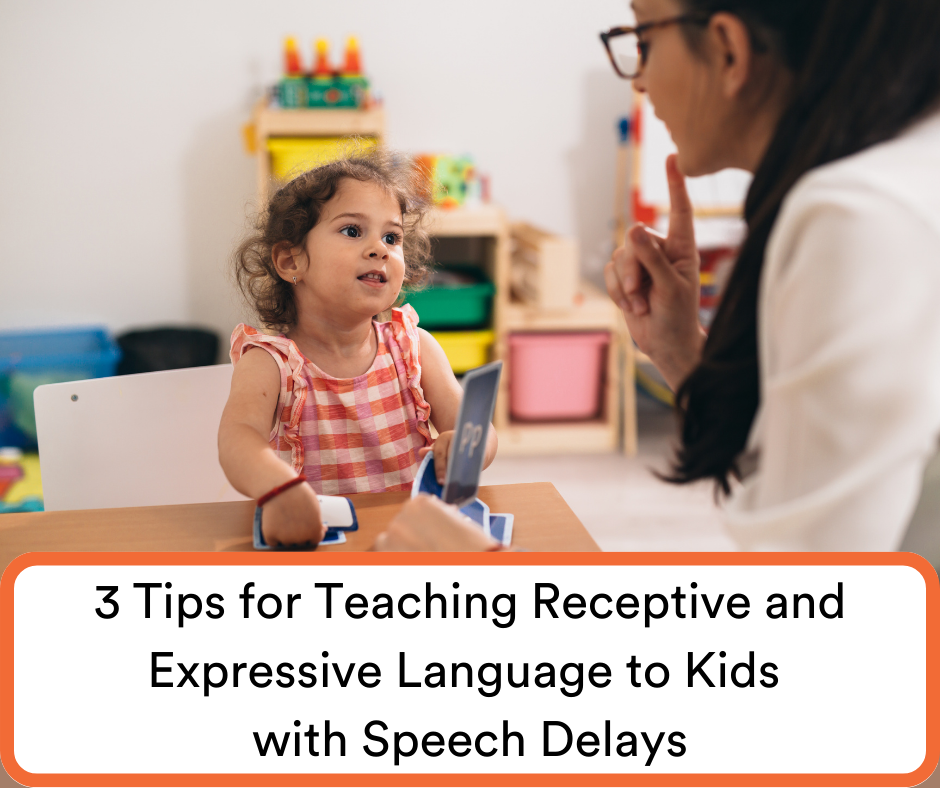
Once a child can follow a few simple 1-step directions, you can begin teaching them to understand the names of objects. Start with objects they like because those are the easiest to learn. Gather 3 of their favorite objects and put them on a table. Then say, “Give me the ball.” If they pick the right object, give a lot of praise (high fives, tickles, etc.). If they make a mistake, give them a gentle prompt by pointing to the object or picking it up and saying “this is the ball!”, and try again. Keep practicing, but keep each practice session short for early learners, just 5-10 minutes at a time. As the child’s vocabulary expands, you can start using pictures in place of physical objects. Why is that? Objects take up a lot of space and it can be hard to gather all the things you want them to learn about (e.g., lions and trees). Having pictures is also less distracting than having the real toy or food item in front of them.
Teach Requesting Skills
Once a child is able to reliably understand at least 5-10 words receptively, you can begin teaching some expressive language skills. The best way to start is by teaching them to ask for what they want! This is a built-in motivator for speaking. Hold some desired objects like toys and food just slightly out of reach. Prompt the child to name the object with an approximation of the word. For example, “ba” for ball or “ma” for mango. Keep practicing and refining the word so it gets more and more clear over time. Once the child is able to reliably ask for what they want, you can start having them label objects or pictures by holding it up to them and saying “What’s this?”. Provide prompts as needed and don’t forget to praise lavishly. Learning should be fun!
Last but not least, try to be patient! All children learn at a different pace and may need some help and practice to start talking more. Make sure to involve your child’s doctor in the conversation and seek professional help as needed.
About the Author
Dr. Anton Shcherbakov is a licensed psychologist and board certified behavior analyst. He has co-authored peer-reviewed research on topics that include depression and suicide prevention. He is also a nationally recognized expert and frequent presenter at national conferences on the treatment of anxiety, ADHD, autism spectrum, OCD, and related conditions. He previously taught at the Rutgers Graduate School of Applied and Professional Psychology.
Dr. Shcherbakov is the co-founder of ThinkPsych, a company committed to making fun and evidence-based toys for social emotional learning. In addition to his work at ThinkPsych, he provides psychotherapy to children, adolescents, and adults at The Center for Emotional Health of Greater Philadelphia. In his free time, he enjoys traveling with his family, cooking meals with too many ingredients, and watching the latest Netflix documentary series.
Reviewed by Marcia Questel, MSEd, BCBA and David Celiberti, PhD, BCBA-D, Association for Science in Autism Treatment
This month’s ASAT feature comes to us from Marcia Questel, BCBA, Content Editor, and Executive Director David Celiberti, PhD, BCBA-D, Association for Science in Autism Treatment. To learn more about ASAT, please visit their website at www.asatonline.org. You can also sign up for ASAT’s free newsletter, Science in Autism Treatment, and like them on Facebook!
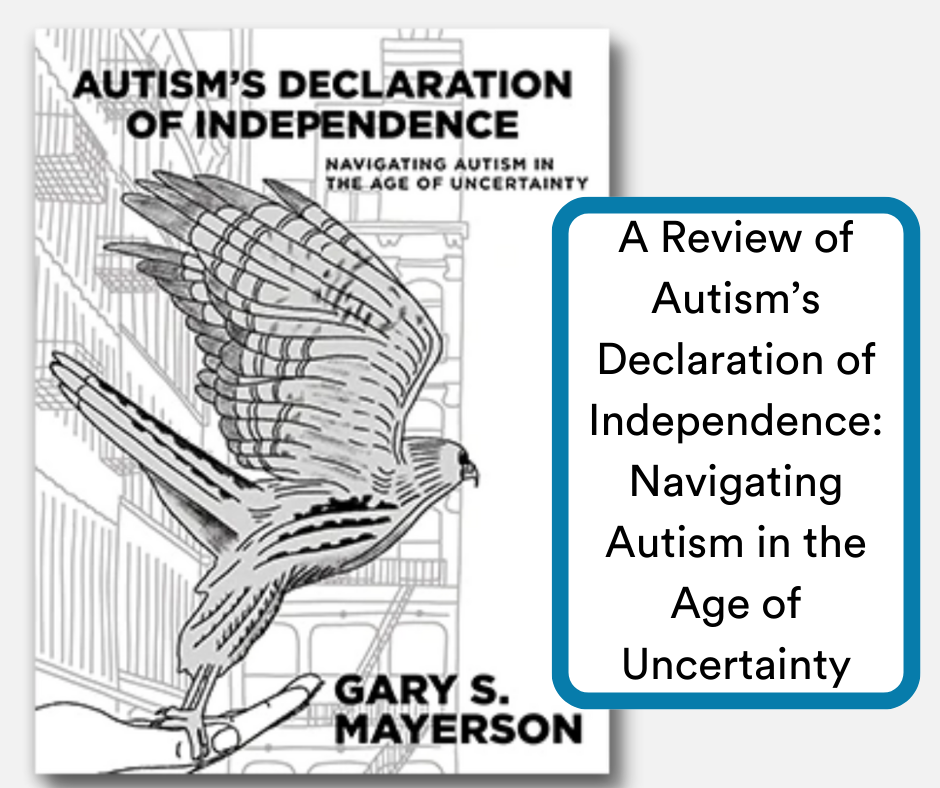
The autism community has many fine advocates for individuals with autism and their families and Gary Mayerson is one of the finest. Prior to sharing a review of the contents of the book, we wanted to provide a bit of background for our readers. Just weeks before Autism’s Declaration of Independence: Navigating Autism in the Age of Uncertainty was published; the world was devastated by the COVID-19 pandemic. Rather than delay the distribution of the book, Mr. Mayerson expanded its contents to address systems turned upside down and new challenges facing our community. So, beyond the high quality of the original content, these efforts shine through pages of COVID-19 dedicated content, aimed at assisting families with pandemic-related questions and concerns. At the same time, Mr. Mayerson was working behind the scenes to ensure that basic legal safeguards were not compromised. Along with helping the families he served to navigate service provisions through the pandemic, he was able to publish this informative book containing crucial information about individual and family rights with rich application before and during the pandemic, and thereafter.
Part 1 – Knowing Your Child’s Rights and How to Apply Them
Mr. Mayerson released a field guide for parents in 2004 titled How to Compromise with Your School District Without Compromising Your Child. He introduces this new 2020 book with how an “age of uncertainty” has developed since then, and he explains the issues being faced by individuals with autism and their families today. Part 1 is comprised of chapters that address a vast array of topics, many of which have become more salient given the current pandemic. Prior to highlighting several of these chapters, we wanted to provide readers with a list of topics to help them assess if this resource addresses their needs as well as which chapter may bear relevance to their current circumstances:
Chapter 1: The autism diagnosis and its impact on the family
Chapter 2: What does the right to a “free and appropriate” education mean for my child?
Chapter 3: Generalization
Chapter 4: Managing your child’s right to be educated in the “least restrictive environment”
Chapter 5: How can parents obtain independent evaluations at school district expense
Chapter 6: How parents can manage and shape the IEP process
Chapter 7: Considering claims against school districts – What relief is available?
Chapter 8: When all else fails – Filing for an impartial hearing (due process)
Chapter 9: Managing safety considerations
Chapter 10: Dealing with suspensions and other disciplinary proceedings
Chapter 11: The threat of criminal charges
Chapter 12: When a residential placement may be warranted
Chapter 13: Preparing for the transition to adulthood – The main event
Chapter 14: Confronting bullying and discrimination in the workspace
Chapter 15: Guardianship, special needs trusts, and powers of attorney
Chapter 16: The advent of telehealth instruction during the COVID-19 pandemic
Chapter 17: The road ahead – Institutionalizing high expectations and discontent
Although it is beyond the scope of this brief review to discuss each of the chapters, here is a sample of highlights. Note that there is so much more to find within this book, but these were selected to simply introduce readers to what they can expect.
Chapter 2: What does the right to a “free appropriate” public education mean for my child?
In this chapter, Mr. Mayerson (2020) explains the history of the development of a student’s right to a Free Appropriate Public Education (FAPE). Beyond how the laws developed, he defines what FAPE truly means and how schools must adhere to it. Importantly, this chapter provides and explains the educational laws by name, providing families with clarity and arming them with knowledge.
Chapter 4: Managing your child’s right to be educated in the “least restrictive environment”
This vital chapter highlights the need for students to be truly included in the educational opportunities offered in their school districts. Yet, there is an important balance that districts must strike between placing students in least restrictive environments and still providing all of the educational supports that they need for success. It begins with a mother’s personal story about inclusion and ends with important questions for parents to consider about inclusive placements. Between these, Mr. Mayerson (2020) describes laws pertaining to inclusion in depth, and his experiences advocating for least restrictive environments for students with autism.
Chapter 8: When all else fails – Filing for an impartial hearing (due process)
This chapter describes many issues related to filing for an impartial hearing for your child’s educational needs. Sections include “Litigating a Case Against the District’s ‘Teacher of the Year,’” “Do Parents Always Need to Hire Counsel to File for Due Process?”, “Preserving and Invoking your Child’s ‘Pendency’ Entitlements,” “Settlement Considerations,” and several others. This chapter thoroughly explains varying situations which may lead a caregiver to filing for an impartial hearing. It provides guidance for parents going through these challenging situations. Readers should take note of the many footnotes found within this chapter that provide even further clarity.
Chapter 9: Managing Safety Considerations
When parents of children with special needs share their priorities, they most often describe safety concerns. This vital chapter delves deep into issues related to elopement, fire and lockdown drills, COVID-19 related risks, unexplained injuries, police encounters, medications, allergies, bullying, and sexual abuse. Mr. Mayerson (2020) provides accounts of his experiences, and that of others, and shares practical advice that parents can take to help keep their children safe – as well as how to respond when they discover that their children have been in an unsafe situation.
Chapter 16: The advent of telehealth instruction during the COVID-19 pandemic
While this chapter was written towards the beginning of the pandemic, there is useful advice within it for parents today, especially considering that the pandemic is not over.While many school districts have opened their doors to in-person instruction, there are still others using hybrid and remote options. Furthermore, many districts are compelled to quickly return to online or hybrid instruction with spikes in community transmission, school-based outbreaks, or as circumstances require. Mr. Mayerson (2020) dedicated this chapter to helping families navigate their rights and ensuring that their experiences are well-documented throughout the pandemic, to help secure service provisions for their children.
As you can appreciate from the table of contents shared above as well as the select chapter summaries, the scope of the content presented is vast. Anecdotes of Mr. Mayerson’s personal experiences, as well as those of families, brought many of the points to life and the author made many deep dives into specificity when warranted. There are many well placed sample letters that parents can use as models of both tone and substance offered throughout Part 1.
Part 2 – Advice From the Experts
In Part 2 of Autism’s Declaration of Independence: Navigating Autism in the Age of Uncertainty, Mayerson (2020) showcases “Advice from the Experts” and a brief summary of each of these sections is included below.
Appendix A: Teaching generalization for a more independent and enriched life.
In this section, authored by Dr. Amy Davis-Lackey, the important topic of generalization is addressed, and a helpful overview of key concepts is provided as carryover and flexible application of skills is paramount. Perhaps one of the most important points relates to the suggestion of a road map related to each target so that generalization efforts can be planned systematically and strategically. We would like to highlight for our readers that generalization is a priority for many providers who use discrete trial instruction. For these providers, the road map suggested by Dr. Davis-Lackey is often built right into the item list and mastery is not celebrated until key generalization indicators are met.
Appendix B: Observing and assessing mainstream, inclusion, and special education classrooms – What I look for
Dr. David Salsberg describes many placement options available for students with autism that are provided by their school districts. He notes that while these placements look different from school to school, it is vital for practitioners to be aware of what they offer. He advises about what he “looks for” in these placements, noting that neuropsychologists must be well-equipped to advise their clients. Besides knowing about potential placements that are appropriate for their clients, they are also responsible for understanding “the applicable rights and laws (p. 175).” Dr. Salsberg explains with fervor how crucial it is that neuropsychologists guide families, saying that “Conducting an evaluation but then making generic recommendations such as ‘contact your local district to initiate an IEP meeting’ would be like going for a checkup and your doctor saying ‘it looks like you have an infection and you need some medicine, but go to your pharmacy and ask what they think and how to get it (p. 175).’” He goes on through this section to discuss various placements (general education classes, inclusion classes, self-contained classes, specialized schools, and private special education schools) and what they offer, as well as what to consider when weighing these options.
Appendix C: Using assessments and evaluations to develop a reasonable calculated and appropriately ambitious IEP
Dr. Jennifer Oratio, Ph.D. describes the differences between evaluations conducted by school professionals and a comprehensive neuropsychological evaluation in this section. She dives deep into the various types of tests that are administered in these evaluations, explaining what they measure in quantitative terms and what they mean for the child in qualitative terms. Parents and professionals must have a deep understanding of these measurements so that they can work to create the most “appropriately ambitious IEP” that they can. Dr. Oratio describes intelligence measurements, such as the Wechsler Intelligence Scale for Children, Fifth Edition ® (WISC-V®), the Test of Nonverbal Intelligence, Fourth Edition™ (TONI-4 ™), as well as important measurements of language ability, visual-spatial and visual-motor skills, memory, executive functioning, academic achievement tests, and assessments of social/emotional/behavioral skills. She provides detail regarding the assessments used in each of these domains. She goes on to discuss adaptive skills assessments and autism-specific assessments. Beyond describing these crucial measures of skills and deficits and describing how they impact the success of the child, Dr. Oratio explains how to share these evaluations with school professionals, and most importantly how to ensure that they are considered through the development of the IEP with the school district.
Appendix D: Evaluating speech and language needs with the right assessment tools.
In this section, authored by Dr. Steven Blaustein, CCC-SLP, a description of the essential components of a speech report is offered. As reflected throughout this book, the content is comprehensive yet accessible and the blueprint provided can raise the bar for both providers and parents alike. In fact, the content can be applied to other disciplines such as occupational therapy to maximize the utility, relevance, and benefit of written reports.
Appendix E: Bullying tips for parents: Q & A with Michael Dreiblatt of Non-Profit STAND up to Bullying
In this final section of the book, Michael Dreiblatt shares a wealth of advice for parents who are concerned about bullying in their child’s school. He shares tips for bystanders who are witnesses to bullying, advises parents about clear warning signs that their child may be being bullied at school, provides instructions for school staff who wish to have a policy that protects against bullying, and more. This section is for anyone who is related to, or is working with, students (who need proactive support to prevent bullying), a victim of bullying, or even a person who is behaving like a bully.
This entire book sheds tremendous light on issues related to autism, and the laws that are in place to protect the rights of individuals. While it is overflowing with practical and immediately useful advice, it is not overwhelming or verbose. Mr. Mayerson (2020) makes great use of every page, which has led to the creation of a condensed book filled with issues of great importance to individuals and families, along with steps that they can take to protect their rights amid a wide variety of situations and conditions. We highly recommend this book for parents and providers alike.
References
Mayerson, G. (2020). Autism’s declaration of independence: Navigating autism in the age of uncertainty. Different Roads to Learning.
Mayerson, G (2004). How to compromise with your school district without compromising your child: A field guide for getting effective services for children with special needs. DRL Books.
Citation for this article
Questel, M., & Celiberti, D. (2021). Review of Autism’s declaration of independence: Navigating autism in the age of uncertainty. Science in Autism Treatment, 18(10).
About the Authors
Marcia Questel is a Board Certified Behavior Analyst (BCBA) with a master’s degree in special education (concentration – autism) and graduate certificate in applied behavior analysis. She has been working with invidivuals with autism for over 20 years. She obtained her bachelor’s degree in developmental psychology with a focus on developmental disorders, where her passion for researching executive functioning (EF) and Theory of Mind (ToM) began. Marcia works in private practice, providing consultation to families and faculty. She is the Content Editor for Science in Autism Treatment and the Externship Co-Coordinator for the Association for Science in Autism Treatment. She is researching access and effectiveness of telehealth during the COVID-19 pandemic. She also creates supportive content for parents and professionals, including free workshops available on the ABAskills YouTube page. In Yale’s Affect Regulation and Cognition lab, she is researching emotions and relationships among teenagers and their parents. Marcia also enjoys research that explores the relationship between EF and emotion regulation.
David Celiberti, PhD, BCBA-D, is the Executive Director of ASAT and Past-President, a role he served from 2006 to 2012. He is the Editor of ASAT’s monthly publication, Science in Autism Treatment. He received his PhD in clinical psychology from Rutgers University in 1993 and his certification in behavior analysis in 2000. Dr. Celiberti has served on a number of advisory boards and special interest groups in the field of autism, applied behavior analysis (ABA), and early childhood education. He works in private practice and provides consultation to public and private schools and agencies in underserved areas. He has authored several articles in professional journals and presents frequently at regional, national, and international conferences. In prior positions, Dr. Celiberti taught courses related to ABA at both undergraduate and graduate levels, supervised individuals pursuing BCBA certifications, and conducted research in the areas of ABA, family intervention, and autism.
Resistance to change and preference for sameness are core features of autism. It can be natural to avoid new things, especially if change is overwhelming. While this may be more comfortable for the individual in the short term, there are long-term consequences, including difficulty in contacting new reinforcers and reduced access to learning opportunities. Over time, the individual may lose out on potentially pleasant and exciting experiences, even becoming bored and unmotivated by the things they previously really enjoyed.
How can we help with this situation?
We can start by looking at how frequently new experiences are offered to the individual. If they are pretty resistant to new things and have demonstrated that in the past, their loved ones, staff, and teachers may have taken a step back and started to avoid even offering new experiences, toys, activities, food, people, or settings. While we would not want to deliberately upset someone, we can work towards making opportunities for exposure to new things available in a gentle, supportive way.
Plan New Things
For some, exposure to new things can be made more tolerable by letting them know what is going to happen ahead of time, and explaining what the expectations will be. For example, “Tomorrow we are going to put on a new movie when you finish your homework. You can watch it if you want, or you can play with your toys. It’s totally up to you!” Or, a picture of a new movie might be added to the person’s activity schedule and the same message reviewed with them using fewer words.
Some families might choose to establish a “try new things” day every week. The whole family can get in on it, to provide encouragement and modeling. For example, Mom, Dad, and child might each pick one new food to try every Saturday. Or, everyone in the family can decide on something new that they want to learn before some milestone occurs. For example, each family member could plan to learn about one new animal or dinosaur before an upcoming holiday.
Pair Reinforcers
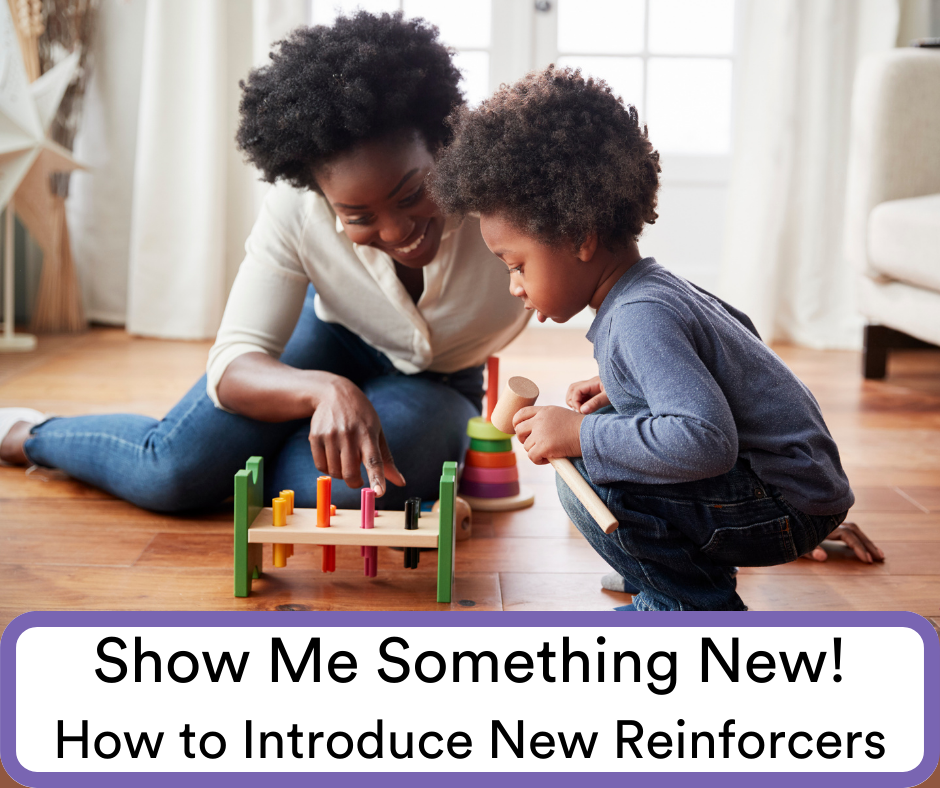
Exposure to new things can also be eased by pairing the new item or activity with something (or someone) that is already reinforcing. A favorite aunt or uncle who brings over and plays with a new toy with great enthusiasm may draw in a child’s attention and willingness to engage more quickly than if the toy is just handed to the child or left for them to discover. Similarly, an older child might be more willing to try a new interest like playing a sport or learning a craft if something else that is pleasurable is also happening, like a favorite snack, music, or friend to do the new activity with.
In a similar way, new activities can be combined with old favorites. For some children who are very attached to particular characters, it can be helpful to introduce their beloved characters into new activities. For example, a child who loves Elmo from Sesame Street is more likely to be interested in a new activity like coloring if the coloring books include Elmo pictures. We can also get creative with mixing interests from different places. An individual who really loves trains might begin to develop interests in geography by learning about train routes through different states. The conversation can gradually be guided from trains to the places where the trains run, to eventually interesting facts about those places.
Be Patient
Exposure to new items and activities does not need to include any requirements to engage with the new items and activities. It may take several exposures before an individual is even willing to look at or start to engage with something new. This is okay and it’s preferable to let interest and willingness occur naturally, even if slowly. Trying to force engagement will likely only make the new activity or item aversive and something to be avoided, which is definitely not what we want to do. Patience is key, along with a willingness to continue to increase exposure to new items and activities. Not every new thing will wind up being a favorite or even enjoyed, but over time some likely will become preferred. More important, newness and change will become more tolerable, opening the person up to worlds of possibility.
About the Author
Dana Reinecke, Ph.D., BCBA-D is a New York State Licensed Psychologist and Licensed Behavior Analyst (LBA). Dana is an Assistant Program Director in the Applied Behavior Analysis department at Capella University, overseeing the PhD in Behavior Analysis program and mentoring doctoral learners. She is also co-owner of SupervisorABA, an online platform for BACB supervision curriculum and documentation. Dana has provided training and consultation to school districts, private schools, agencies, and families for individuals with disabilities. She has published her research in peer-reviewed journals, written chapters in published books, and co-edited books on ABA and autism. Current areas of research include use of technology to support students with and without disabilities, self-management training of college students with disabilities, and online teaching strategies for effective college and graduate education. Dana is a Past President of the New York State Association for Behavior Analysis (NYSABA).
This week, Different Roads is proud to share some tips from Nancy Hammill and Understood on the dos and don’ts of fidgets, both in the classroom and at home!
Fidgets, like squeeze balls and key chains, are self-regulation tools that promote movement and tactile input. They can be great for kids who struggle with attention, focus and sensory processing.
But in my many years as a teacher and parent, I’ve often seen them misused. When I see a child throw a squeeze ball across the room or obsess over making shapes out of Silly Putty, I know something’s gone wrong.
The problem is we often hand fidgets to kids without any direction, thinking they’ll magically know how to use them. Then when they play with them—rather than use them as a tool—we get angry.
That’s why it’s important to teach kids how to use fidgets. Here’s what I suggest.
How to Use Fidgets
First, explain to your child that a fidget is one strategy in her “tool kit” to help her improve focus on a task. When used correctly in the right situation, fidgets can help her be a better listener, sustain attention on her work, and even calm down or slow down her body and mind.
Basically, a fidget is a tool to help her focus—not a toy.
Second, work with your child to identify specific times she might need a fidget. For example, she might need it when she’s doing homework or needs to sit still in a movie theater.
Third, set up clear rules for how to use fidgets in your home, and communicate them to your child. If you’re unsure where to start, here are my “non-negotiables”:
Rule #1: Be mindful. Before you grab a fidget, think about whether you need it. If you don’t know, review rule #2.
Rule #2: You can only use a fidget to help with focus and attention or to calm down. Otherwise it will be taken away.
Rule #3: Don’t use a fidget if it distracts others or interferes with the work others are doing. If the fidget does distract others or interfere with their work, use a different fidget or strategy.
Rule #4: Every time you’re done with a fidget, put it back where it belongs. (In our house, we keep fidgets in a designated basket.)
If you want to try a fidget with your child, there are many options to choose from. Experiment to find what works best for your child. But I recommend that you don’t get a fidget that has a cute face or that looks like a toy. Your child needs to remember that fidgets are tools.
When you’re ready, you can set up a fidget basket (or other spot), print the rules, and put the rules in a place where your child can easily see and review them.
ABOUT THE AUTHOR
Nancy Hammill is the 2016 National Learning Disabilities Educator of the Year, awarded by Understood founding partner the Learning Disabilities Association of America. She has 20 years of experience as a classroom teacher, literacy specialist and learning therapist.
About Understood: The professionals who advise parents on Understood are all experts in their fields. They include educators, learning and attention specialists, physicians, psychologists, lawyers and more. They share a commitment to children with learning and attention issues.