The ABA Tools Of The Trade Kit!

While data collection is a cornerstone of ABA, and essential for providing effective interventions, there are many obstacles to collecting accurate data. My colleague Val Demiri and I have focused a lot of time and attention to addressing these obstacles and working to make the data collection process easier.

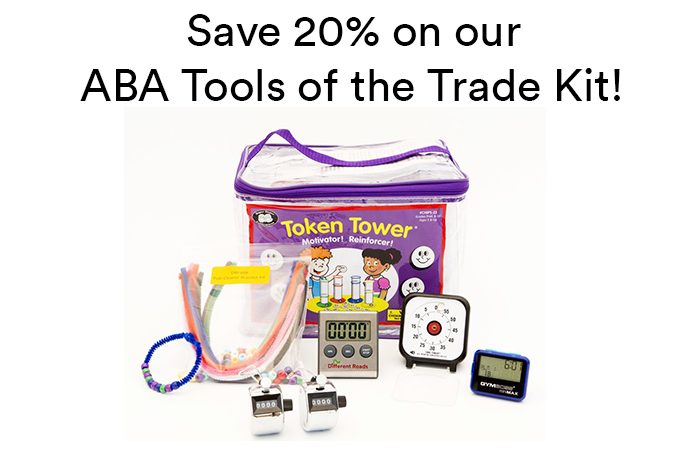
The new ABA Tools of the Trade Kit includes some of our most-used tools, from low-tech tools such as the abacus bracelet to high-tech such as the GymBoss. The tools included here allow you to take a variety of types of data. Here’s a peek at what’s inside:

Tally counters: This is one of the simplest tools available, but incredibly useful. Put it on a lanyard around your neck or keep it in hands-reach to easily tally the number of instances of a target behavior.

Time Timer: I use this tool all the time with my clients. It provides a great visual for them to see time as it is elapsing. I use it for teaching children to wait for a preferred item/activity and to remain on task while the “red bar” is showing.

GymBoss: This interval timer is one of my favorite and most-used tools. I’ve used it and similar items in a variety of ways, for helping parents and teachers provide more positive reinforcement, teaching clients self-management skills, and keeping track of interval schedules of reinforcement when I’m implementing an intervention.

Audible Timer: While this is a basic tool, having something with an auditory stimulus is invaluable!

Token Tower: Speaking of auditory stimuli, this is one of my favorite token systems simply because the plastic token makes a sound when it drops into the tower. I also love that I can move the ring up and down the tower to indicate how many tokens the client must earn.

Abacus Bracelet: This is one of the best low-tech tools around. It’s especially great for classroom teachers who are trying to count a target behavior while teaching. Simply move a bead from one side of the bracelet to the other, and then at the end of the lesson count how many beads were moved. I love technology, but sometimes you can’t beat simplicity.

ABA Tools of the Trade: The book is also included in the kit, which provides much more information about these and other tools, as well as dozens of examples of real-life scenarios.


WRITTEN BY SAM BLANCO, PhD, LBA, BCBA

Sam is an ABA provider for students ages 3-15 in NYC. Working in education for twelve years with students with Autism Spectrum Disorders and other developmental delays, Sam utilizes strategies for achieving a multitude of academic, behavior, and social goals. She is also an assistant professor in the ABA program at The Sage Colleges.

Growing Up: Supporting Teens On The Autism Spectrum

Growing up is exciting and challenging for kids and parents alike.  Teens on the autism spectrum may face difficulties in socializing, planning for their futures, and enjoying independence.  Parents may find it hard to know how to support their children through the rites of passage of adolescence and adulthood, but there are some things to keep in mind to make this time a little easier and more enjoyable for everyone.

First, just like any teen, every teen with autism is an individual and should be treated as such.  There are no one-size-fits all solutions at any age, including adolescence.  Parents and teachers should be aware of the strategies and supports that helped their child in the past as possible sources of information for the present and future.  For example, a child who did really well learning from video models may grow up into a teenager who can learn quite a lot from YouTube videos (under the appropriate supervision, of course).  It’s important to make sure that supports are thoughtfully updated to be age-appropriate, too.  Individuals with autism do not need to be stigmatized by being associated with materials and activities that are typically seen as more child-like.  For example, a teenager with autism who requires a reinforcement system would hopefully be able to use a system that is age-appropriate like actual money, or discreet enough like points awarded in a phone app or on an index card, instead of a colorful token economy with stickers or pennies.  Many children with autism benefit from activity schedules, which can be updated for older children using the same organizational strategies that other teenagers may use, including smartphone-based apps for scheduling, reminders, and to-do lists.

Another important consideration in supporting teenagers with autism is that their goals may need to be updated as they get older.  Hopefully, the “5-year rule” has been observed, in which goals are carefully selected according to what the individual will need to be able to do in the next 5 years.  This means not waiting until the child is in the midst of puberty to teach the self-care routines associated with that time, and not waiting until the child has become an adult who is interested in having a romantic relationship to teach some of the social skills associated with that part of life, in addition to many other examples.  If not, then it’s never too late to work on these skills, but it’s definitely easier and less stressful to address them earlier rather than later.  Keeping this in mind, teens with autism may need to be thinking further ahead than typical teens.  For example, if college is going to be a goal, it’s helpful for parents and school supports to know and be preparing for this from the beginning of high school.  Similarly, if the young person is aiming more towards a career path, the skill set needed for work should be addressed well in advance of the time that he or she is expected to start to work. 

Finally, adolescence is a time to celebrate and enjoy independence.  For teens with autism, independence should be approached as a goal for every area of life, with the careful assessment of safety and readiness.  Independence can be achieved at the right level for each individual, given the appropriate goals and supports.  For example, many teenagers enjoy learning to travel independently, from taking public transportation to eventually driving independently.  If a teen with autism is able to safely navigate these skills, that can be a great achievement.  For teens who may not be ready for this level of independence, alternatives can be focused on, such as learning to map out public transportation routes that will be traveled with a parent or support person, or being responsible for one’s own money when traveling with supports.  For individuals with autism at any age, there are always new levels of independence to strive for.


About The Author

Dana Reinecke, PhD, BCBA-D is a doctoral level Board-Certified Behavior Analyst (BCBA-D) and a New York State Licensed Behavior Analyst (LBA).   Dana is a Core Faculty member in the Applied Behavior Analysis department at Capella University.  She is also co-owner of SupervisorABA, an online platform for BACB supervision curriculum, forms, and hours tracking.  Dana provides training and consultation to school districts, private schools, agencies, and families for individuals with disabilities.  She has presented original research and workshops on the treatment of autism and applications of ABA at regional, national, and international conferences.  She has published her research in peer-reviewed journals, written chapters in published books, and co-edited books on ABA and autism.  Current areas of research include use of technology to support students with and without disabilities, self-management training of college students with disabilities, and online teaching strategies for effective college and graduate education.  Dana is actively involved in the New York State Association for Behavior Analysis (NYSABA), and is currently serving as President (2017-2018).

Sticking to Clear Sds and Planning Error Correction Procedures

Recently I was supervising a session in which the current goal was for the child to identify cards by category. The teacher was placing three cards in a messy array, and asking “Where’s the animal?” or “Point to the food.”

When the child got it right, the teacher did a great job of providing reinforcement. However, if the student didn’t respond correctly, the conversation might look like this:

TEACHER: What is this? (Pointing to zebra)

STUDENT: No response.

TEACHER: Come on. You know this one.

STUDENT: Horse?

TEACHER: No. You know this one. Remember we did a puzzle earlier with this animal.

STUDENT: Animal?

TEACHER: What animal? Remember the puzzle?

While the intention of the teacher is understandable, this is not an evidence-based error correction procedure. We don’t want our student practicing errors. Often, you might see your student is making the same error over and over. This means there has been in error in our teaching, and we need to make adjustments. Many times, the error is in how we correct errors.

The example described above is one that I commonly see when supervising. Many of our students don’t have strong listening comprehension skills, so continuing to give clues isn’t teaching our student to respond to “What is this?” but is actually teaching them to respond to some other stimulus. The very first recommendation I had as this teacher’s supervisor was to be clear with the discriminative stimulus.

But how should we correct the student’s initial error? There are several commonly used, evidence-based error correction procedures, but the most effective procedures vary from individual to individual. It’s valuable to assess the evidence-based procedure that is most effective for you individual student prior to beginning teaching procedures. This will make your teaching more effective and efficient.

There is a lot of research about error correction procedures for individuals with autism. Carroll, Joachim, St. Peter, & Robinson (2015) clearly outline four commonly used procedures and explain how to assess an individual’s response to each procedure. Carroll, Owsiany, & Cheatham (2018) utilized a short assessment for determining which of five commonly used procedures may work best for a specific individual. Starting with these two articles can clarify how to best move forward with your students or clients.


WRITTEN BY SAM BLANCO, PhD, LBA, BCBA

Sam is an ABA provider for students ages 3-15 in NYC. Working in education for twelve years with students with Autism Spectrum Disorders and other developmental delays, Sam utilizes strategies for achieving a multitude of academic, behavior, and social goals. She is also an assistant professor in the ABA program at The Sage Colleges.
Autism Awareness Month Is Over…Unless You’re A Parent

Autism Awareness Month is over, but for many parents of children with autism, awareness is a daily battle. You would think that after decades of research, awareness of what autism  would be more prevalent. But I still talk with parents who are struggling with relatives, friends, or strangers on the street being unaware, (and often incredibly rude,) about Autism.

             One parent I work with recently asked me if I had a stock response for such rude responses. The truth is that even after seventeen years of working with people with autism, I am often at a loss for words when I encounter statements such as “I don’t even think your child has autism. This seems like a discipline issue.” OR “Why aren’t you working on _______ since you’re spending so much time on all of these other behaviors.” So, I turned to some of my colleagues for help.

            Below is a list of some “stock responses” to help out in these awkward, and possibly offensive, conversations.

Response to statements like “Autism isn’t a real thing.”

“Autism is a real thing in our house. We’d be happy to have you come over and see first hand what it is and how it effects our family. In many ways, we need to live differently than we expected, but we have all learned to grow in ways we never expected. “

I think the best answer is probably to refer the person to a resource like Autism Speaks or ASAT. “Thanks for expressing an interest in what we’re doing.  Our strategies are based on scientific principles and are supported by trained professionals.  If you’d like to learn more about what it means, here’s a website you can look at.”  

“Autism is a tricky disorder because sometimes people who have it have strengths in some areas but weaknesses in others.  I know my child may seem just like any other kid, but he’s worked hard to get to this point, and he’s still working hard.”

“It may seem to you like my child is crying/tantrumming/etc. because he’s spoiled or just wants to get his way, but his ability to communicate with others is really impaired, so he gets easily frustrated.  Thanks for your concern, but we’re working on helping him to overcome this.”

I think my response would depend on the day and my mood.  On a BAD day, I might tell (yell at) the person to be thankful they are not faced with the same challenges in their children.  On a more level day, I would attempt to use it as a learning experience and provide a logical response that Autism is a genetic disorder recognized by the Surgeon General and defined in the DSM-V.  That it generally impacts the child’s social and communication skills and can often result in stereotypic motor movements like hand-flapping.  I would go on to tell them about ABA and that there is no known cure.

“Autism is a neurological disorder so his brain works differently than other people. I can send you some info through email if you would like.” (Or end it after the 1st sentence and walk away)

“Thank you for your concern. It really takes a supportive community for us to manage each day.  We prefer to not discuss this with people who don’t understand autism as our time is best spend with our child, rather than explaining ASD to others.”

“Autism isn’t a ‘thing’ – Well, it really is, but it’s a wide spectrum so almost every person with autism is different from any other one you’ve met. That’s why it can be hard to diagnose and treat, because of the wide range of the disability and variability across it.”

“Thanks, but I’d rather not discuss this with you” can go a long way, too!


Response to statements like “Why aren’t you working on _______ since you’re spending so much time on all of these other behaviors?”

“We are working tirelessly everyday to improve social behavior, we target the most interfering behaviors first and will systematically work through the list. “

“While _________ is important, there are other things that are more important at this time- _________ won’t matter if the child can’t tell you what he wants or needs. We’ll get to it eventually but only once it shows to be important and interfering with other things. “

“Or, we ARE working on it, but it takes a long time to change behaviors.” (maybe even insert a “You could help us by…”  line)

“Yes we are working on that too. We still have work to do. And how is your…”


Response to statements like “What’s his problem anyway?”

“He just learns some things differently and a bit slower than others; but you should see how smart he is in (describe an area of strength).”

“There are some things that really get him mad, but he is getting better and is learning to tell us what the problem is.”


Responses to “I’m sorry, but I don’t think my kids can be around your kid. I’m worried about them picking up some of his problem behaviors.”

“I’d say that’s too bad, he’s a great kid and really helps other people in ways that he can; he’s never had a problem with anyone.”

“I tried to think of something good and positive, refine to say/write…but you know me…I would give them the middle finger :)”


More general advice:

I have worked with a parent who had business cards printed that had 2-3 websites listed on it. When the person started up, the parent handed the card to them and just said something like: “That is a big question that would take too much time to answer here so here are some resources for you to check out.” This allowed them to shut it down but in a way that was not confrontational. 

Remember that you don’t have to say anything, especially when it’s to a stranger. It is perfectly okay not to share personal details about your child’s diagnosis.

So you can see I try to not directly contradict someone saying something; I downplay the concern, reflect back, gently push back, and then stop talking and redirect the conversation if I can.


Thank you to Cheryl Davis, Michael Dorsey, Kari Dunlop, Dana Reinecke, Krishna Ruano, Sarah Russell, Erin Stone, and Tom Zane.


WRITTEN BY SAM BLANCO, PhD, LBA, BCBA

Sam is an ABA provider for students ages 3-15 in NYC. Working in education for twelve years with students with Autism Spectrum Disorders and other developmental delays, Sam utilizes strategies for achieving a multitude of academic, behavior, and social goals. She is also an assistant professor in the ABA program at The Sage Colleges.