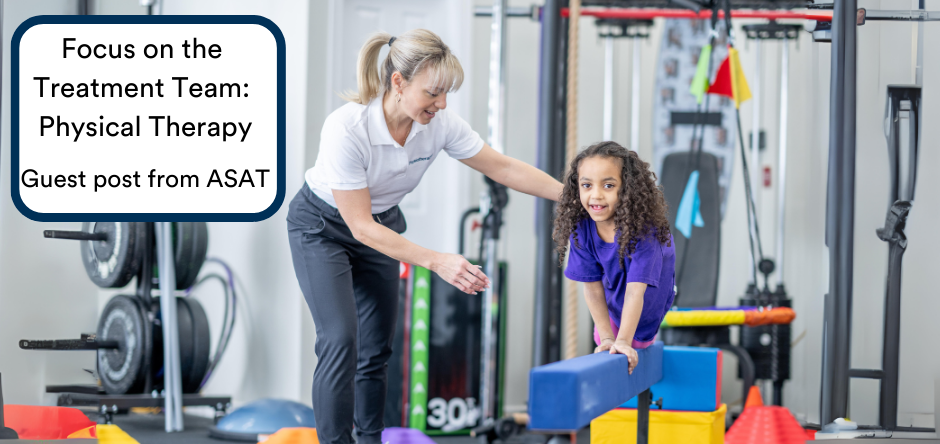
Focus on the Treatment Team: Physical Therapy

This month’s ASAT feature comes to us from Kate McKenna, MEd, MSEd, MS, BCBA, Association for Science in Autism Treatment, and Brittany Hardie, PT, DPT, Melmark. To learn more about ASAT, please visit their website at www.asatonline.org. You can also sign up for ASAT’s free newsletter, Science in Autism Treatment, and like them on Facebook!

This is part of the Description of the Treatment Team series.

History

As detailed in Moffat (2003), physical therapy has a long history in the United States and the profession has evolved over time in response to multiple major historical and medical events. The involvement of physical therapists in responding to polio epidemics that erupted sporadically from the 1800’s to the 1950’s, when the development of the Salk polio vaccine led to control of the disease, resulted in a gradual expansion of the field and innovations in the use of physical therapy to treat severe mobility deficits. Bed rest with long-term splinting and casts which immobilized limbs and the spine was an early accepted treatment for polio. This treatment led to muscle atrophy which then required physical therapy in an attempt to regain mobility. Later interventions for polio included exercise, massages, heat and light therapy, hydrotherapy, and the use of assistive and adaptive equipment. Physical therapists were at the forefront of responding to those who survived polio and needed support to cope with the effects of the disease.

The two World Wars also heavily impacted development and innovations in physical therapy. During World War I, physical therapists, known also as reconstruction aides, worked with doctors, providing exercise programs, hydrotherapy, and massage therapy to wounded soldiers. The number of amputations in World War II led to the funding of the Artificial Limb Program, a 25-year effort to enhance prosthetic services and to support veterans in their use. As with treating polio survivors, physical therapists were instrumental in staffing the programs that developed new technology and intervention strategies for amputees.

Professional associations for physical therapists were first founded in the 1920’s with the American College of Physical Therapy (ACPT), which was later known as the American Congress of Physical Therapy. The American Women’s Physical Therapeutic Association (AWPTA) held its first meeting in 1921 to establish professional and scientific standards for physical therapists, who at that time were predominantly women. The name of this organization was changed to the American Physiotherapy Association (APA) in 1922. The goals of the APA included establishing standards for education and scientific research, promoting the practice of physical therapy, providing a central registry of trained therapists, and providing current information on physical therapy to members of the medical profession and the public. By the late 1930’s, physical therapy was considered a medical specialty. In 1946, the APA changed its name to the American Physical Therapy Association. Also in 1946, the Hill Burton Act was passed. The bill established an effort to build a nation-wide system of hospitals across the United States. Six thousand nine hundred hospitals were built by 1975. As medical specialists, physical therapists continued to work alongside doctors, nurses, and hospital staff to provide critical care in the area of movement rehabilitation.

When the Education of All Handicapped Children Act, now known as the Individuals with Disabilities Education Act, was passed in 1975, physical therapy became a related service offered to students in educational systems. Today, physical therapy is a commonly mandated related service provided to students with autism and other developmental disabilities.

Education

Graduate-level coursework for physical therapists (PTs) includes courses in anatomy, physiology, kinesiology, neuroscience, pharmacology, ethics/values, behavioral sciences, biomechanics, and clinical reasoning. All certified and licensed PTs hold a clinical Doctor of Physical Therapy (DPT) if they enter the field after 2016. This involves obtaining a bachelor’s degree in a related field, such as health science or biology, and then continuing with a 3-year DPT program at an accredited college or university. Prospective PTs then must pass the National Physical Therapy Exam (NPTE®) for physical therapists, which is based on a comprehensive practice analysis to assess critical knowledge, skills, and abilities of physical therapists. Additionally, PTs are licensed to practice in the state or jurisdiction where they work.

A Physical Therapy Assistant (PTA) practices with an associate’s degree from an accredited physical therapy program, which is a combination of coursework and clinical training. PTAs must also pass the National Physical Therapy Exam (NPTE®) for physical therapist assistants. PTAs practice under the supervision of a DPT and the parameters of that supervision may vary by state. The Continuing Education (CE) requirements needed to maintain both levels of licensure also vary by state.

Guiding Documents

PTs are guided in their practice by the American Physical Therapy Association Code of Ethics for the Physical Therapist which consists of eight principles that speak to protecting the dignity of consumers, acting with integrity, the use of evidence-based practices, committing to ongoing professional development, and engaging in ethical business and organizational practices. PTAs practice under the APTA Standards of Ethical Conduct for the Physical Therapist Assistant, which describes the principles as they apply to PTAs, and outlines the limit of their practice under the supervision of a PT.

All members of APTA have access to Clinical Practice Guidelines which are based on systematic reviews of the research evidence. The Guidelines are also intended to maintain consistency in care decisions. To aid PTs in staying current with trends and the latest refinements in their practice, the APTA website provides links for its members through Article Search with full-text access to research and articles from more than 5,000 clinical and academic publications.

Professional Organizations

The mission of the Federation of State Boards of Physical Therapy (FSBPT) is to “protect the public by providing service and leadership that promote safe and competent physical therapy practice.” The process of establishing the FSBPT began in the early 80’s in an effort to form a professional organization to oversee the continuing development and administration of the National Physical Therapy Exam (NPTE), which at that time was owned by the APTA. In 1987, 22 states committed to joining the newly formed FSBPT and in 1989 the ownership of the NPTE transferred from the APTA to the FSBPT. In addition to the certification exam, the FSBPT works to safeguard consumers by identifying and promoting effective regulation in physical therapy, ensuring safe and competent physical therapy service delivery, and providing educational programs and materials to its members and the public.

The American Physical Therapy Association (APTA) is the professional organization of physical therapists in the United States. Its mission is to build a community that advances the profession of physical therapy to improve the health of society. APTA’s stated vision for the profession of physical therapy is to transform society by optimizing movement to improve the human experience. Currently, APTA offers board-certification in 10 specialty areas of physical therapy:

  • Cardiovascular and Pulmonary
  • Clinical Electrophysiology
  • Geriatrics
  • Neurology
  • Oncology
  • Orthopedics
  • Pediatrics
  • Sports
  • Women’s Health
  • Wound Management.

PTJ: Physical Therapy & Rehabilitation Journal, the official journal of APTA, is an international journal publishing peer-reviewed articles for both clinicians and researchers on topics related to physical therapy and rehabilitation. The Journal of Orthopaedic & Sports Physical Therapy (JOSPT®, Inc.) is the monthly publication of the Academy of Orthopaedic Physical Therapy and the American Academy of Sports Physical Therapy of the American Physical Therapy Association. The journal publishes content for members of the health care community with the goal of advancing musculoskeletal and sports-related practice globally. The organization has developed partnerships with 32 orthopedic, manual therapy, and sports organizations in 23 countries worldwide. Physical and Occupational Therapy in Pediatrics (POTP) delivers information to physical therapists involved in the developmental and physical rehabilitation of infants, children, and youth who practice in hospitals, rehabilitation centers, schools, and health and human services agencies. The Journal of Physical Therapy Science is the official journal of the Society of Physical Therapy Science. This monthly publication seeks to accelerate the progress of physical therapy research in Asia. The American Journal of Physical Medicine & Rehabilitation is a publication of the Association of Academic Physiatrists (AAP). Physical Medicine and Rehabilitation (PM&R), also known as physiatry, is a subspecialty of medicine related to the diagnosis, treatment, and rehabilitation of people with a disability who are disabled by disease, disorder, or injury due to conditions with the nervous and musculoskeletal systems. Physical and Occupational Therapy in Geriatrics seeks to publish a balance of articles related to research and clinical practice across the healthcare continuum when working with older clients.

Scope of Practice

PTs practice in a variety of settings including schools, hospitals, homes, and community settings. They provide early intervention, short-term remedial, or long-term care related to improving movement and mobility. Additionally, physical therapists practice in mental and behavioral health settings such as rehab centers. Others conduct research to improve the knowledge and treatments used in practice. Physical therapists also serve as advocates for both their profession and the clients they serve by promoting legislation related to insurance reimbursement, workplace safety, and ensuring that those that would benefit from physical therapy have access to it. In their professional practice, PTs are not solely concerned with client welfare. Their scope of practice also includes contributing to public health services and legislation to maintain and improve the health of the general public.

Many individuals with autism experience delays in gross motor development and function. Early delays in sitting upright, crawling, and walking, for example, can result in a cascade effect in which children lose opportunities to learn by interacting with and exploring their environment. Deficits in postural strength, coordination, and stamina hinder one’s ability to engage in such activities as riding a bike, playing kickball, or swimming. Physical therapists, sometimes working in the area of adaptive physical education, may target functional mobility, body and safety awareness, the ease of transitioning from one activity to another, and increased motor imitation skills. Across the lifespan, individuals on the spectrum may need to learn to step off and, on a curb, enter and exit public transportation, or use an escalator. Physical therapists work with people on the spectrum to build the motor planning skills, strength, and stamina required to access their environment, navigate stairs, move through hallways, sidewalks, and outdoor spaces safely and with as much independence as possible.

Physical therapists diagnose and treat dysfunction and difficulties with movement. In their practice, PTs seek to restore and maintain the optimal physical function and well-being of their clients. Their intensive training provides them a distinct body of knowledge of how the body functions in motion that PTs use to support their clients’ purposeful, precise, and efficient movement across the life span.

References

Becoming a PTA. American Physical Therapy Association. https://www.apta.org/your-career/careers-in-physical-therapy/becoming-a-pta

Brody, L. T., & Hall, C. M. (2005). Therapeutic exercise: Moving toward function, 2nd Edition. Lippincott Williams and Wilkins.

Direct access in practice. American Physical Therapy Association.
https://www.apta.org/your-practice/practice-models-and-settings/direct-access

Directory of physical therapy programs. (n.d.). Commission on Accreditation in Physical Therapy Education. https://www.capteonline.org/

Learn physical therapy basics. (n.d.). The Federation of State Boards of Physical Therapy. https://www.fsbpt.org/Secondary-Pages/The-Public/Learn-Physical-Therapy-Basics

Moffat, M. (2003). The history of physical therapy practice in the United States. Journal of Physical Therapy Education 17(3), 15-25. The History of Physical Therapy Practice in the United States: Journal of Physical Therapy Education (lww.com)

Physical therapist’s scope of practice. (2017, September 13). American Physical Therapy Association. https://www.apta.org/your-practice/scope-of-practice

Specialist certification. American Physical Therapy Association.https://www.apta.org/your-career/career-advancement/specialist-certification

Standards of practice for physical therapy. (2020, August 12). American Physical Therapy Association. Standards of Practice for Physical Therapy | APTA

Citation for this article:

McKenna, K., & Hardie, B. (2023). Focus on the treatment team: Physical therapy. Science in Autism Treatment, 20(10).

Other Articles in this Series

  1. Description of the Treatment Team
  2. Focus on the Treatment Team: Speech-Language Therapy
  3. Focus on the Treatment Team: Occupational Therapy
  4. Focus on the Treatment Team: Applied Behavior Analysis

About the Authors

Kate McKenna, MEd, MSEd, MS, BCBA, LBA, received a Masters in Child Study from the Eliot-Pearson Department of Child Study at Tufts University, a Masters in Special Education from Pace University, and a Masters in ABA from Hunter College.  In addition to New York state certifications in general and special education from Birth to Grade 2 and Grades 1-6, she holds a New York State Annotated Certification in Severe/Multiple Disabilities. Kate is currently completing a Masters degree in Children’s Literature at Eastern Michigan University.  She was an extern at the Association for Science in Autism Treatment before joining the Board of Directors in 2020.

Brittany Hardie PT, DPT, is a physical therapist at Melmark, PA and serves on team for individuals with autism from ages 5 to 22 years. She received her Bachelor’s degree in Health Science from Eastern Nazarene College and a Doctor of Physical Therapy from the University Of Maryland School Of Medicine, Baltimore.  Dr. Hardie is licensed in Pennsylvania and New Jersey and has been practicing for 9 years.  She is also a certified clinical instructor.  Dr. Hardie strives to achieve the best outcomes related to mobility and movement for the individuals she serves and enjoys the abundant opportunities to collaborate with colleagues from other disciplines afford by her current position.

Posted in ABA

A Spotlight On Executive Function in the Early Childhood Classroom

By: Stephanny Freeman, PhD and Kristen Hayashida, MEd, BCBA

The new year brings opportunities for introducing new ideas and refining existing techniques for young learners. This week, we’re revisiting a blog from our archives that focuses on executive function.

When kindergarten teachers are asked what skills they would like their students to have the beginning of the year, their answers might be surprising!  Parents and caregivers are often concerned with making sure their children can say their ABC’s, count to 10, and know their colors. Some may believe that their children should be reading by the time they start kindergarten.  However, kindergarten teachers often have a different set of priorities, and instead are looking for skills such as:

  • The ability to listen to and follow directions
  • Follow classroom routines
  • Control impulses
  • Resolve a conflict or solve a problem calmly with another child

Kindergarten teachers value these skills because they are critical for school readiness, paving the way for children to be academically and socially successful.  Moreover, children who are behind in these skills can require disproportionate amounts of teachers’ attention, derail classroom activities and routines, and interfere with other children’s learning.

Underlying these school readiness skills are a set of higher order thinking skills collectively referred to as Executive Functions (EFs). EFs are the cognitive control functions that help us inhibit our initial impulses and think before acting.

But while most teachers agree that EF skills are very important, they are not explicitly taught in most early education settings (or at any point in most children’s educational experiences).

What skills are part of executive functioning?

Three key skills are generally agreed upon as the core of EF:

  1. Working memory: holding information in mind to manipulate, work with, or act on at a later time.
  2. Inhibitory control: the ability to regulate one’s attention, behavior, thinking, and emotion particularly in response to distractions or temptations.
  3. Cognitive flexibility: the capacity to shift one’s thinking, such as changing one’s approach to solving a problem if the previous approach is not working or recognizing and responding when the demands of that task have changed.

Seven additional skills are also considered to fall under the umbrella of EF, often relying and building on the three foundational EF skills:

  1. Initiation: the ability to begin a task or activity or to generate ideas independently in order to answer questions, solve problems, or respond to environmental demands.
  2. Fluency: how fluidly one can access and use relevant knowledge or skills.
  3. Planning: the ability to identify and sequence all the different steps needed to achieve a specific goal.
  4. Organization: the capacity to prioritize and make decisions about which tasks to undertake, and the needed resources to complete those tasks.
  5. Problem solving: carrying out the steps to achieve a desired goal, while monitoring progress making necessary adjustments.
  6. Time awareness: part of the broader skill of Time Management, which includes to the ability to anticipate how long tasks might take, to be aware of time constraints, track one’s progress, and adjust one’s behavior in order to complete tasks efficiently.
  7. Emotion regulation: skills including identifying one’s own emotion states and responding appropriately to emotional experiences.

Why do executive function skills matter?

Executive function skills predict a host of short-term and long-term outcomes!

  • They are a stronger predictor of school readiness than IQ.
  • They are also associated with higher achievement in both reading and math throughout children’s schooling.
  • EF skills, when tested in early childhood predict outcomes later in childhood and adolescence, including psychological and physical health.

Because EF skills are so predictive of later outcomes, they are being increasingly recognized as a critically important focus of intervention. 

Early EF training is … an excellent candidate for leveling the playing field and reducing the achievement gap between more- and less-advantaged children.

Diamond and Lee (2011, p. 6)

Can executive function skills improve?

Yes! All young children (typically developing and those with difficulties) can benefit greatly from instruction in EF!  Frequent practice of these skills and gradually raising the difficulty benefits children most in generalization and increasing gains. Practitioners and parents should consider:

  • Providing focused instruction in EF skills.
  • Combining explicit targeted instruction in EF skills with other activities in which they can then apply and practice those skills.
  • Building targeted EF skills into daily routines.
  • Providing multiple opportunities every day, particularly for children with disabilities, to test out and practice EF skills.

Most experts consider the development of self-regulation skills, of which executive functions are the crown jewel, to be the most important objective of high quality preschool—to help children focus attention, be emotionally expressive, not be impulsive, and to engage in purposeful and meaningful interactions with caregivers and other children.

Blair (2017, p.4)

About The Authors

Dr. Stephanny Freeman is a clinical professor at UCLA, a licensed clinical psychologist, and Co-Directs the Early Childhood Partial Hospitalization Program (ECPHP).  For 20 years, she has educated children with ASD and other exceptionalities as a teacher, studied interventions for social emotional development, and designed curriculum and behavior plans in school and clinic settings.

Kristen Hayashida is a Board Certified Behavior Analyst at the UCLA Early Childhood Partial Hospitalization Program (ECPHP).  For the last 10 years she has served as a therapist, researcher and educator of children and families living with autism spectrum disorder through the treatment of problem behavior.

Getting Pronouns off the Ground

By Alan Schnee, Ph.D, BCBA-D.

Roughly 34% of the 50 most common words used in English are pronouns. Yet, with few exceptions, children on the spectrum struggle to use them.

Why is it so difficult for children to learn? One likely reason is that the use of pronouns is contextually determined. Learning to use them requires vigilant tracking across shifting speakers and listeners (you, I, they, he, she, Ralph, etc.), and shifting events. It is a complex process requiring acute attention to who is in possession of what, changes in possession, attention to who did or said what,  and who did or said what to whom, etc. If our goal is to assist in teaching children to use and respond appropriately to pronouns, where should we begin?

First, we need to clear up some confusion Pronouns are words that stand in for nouns. Though it is commonly said that we ‘tact pronouns’, saying this lacks sense. Pronouns are not objects or events or properties of an object or event. They are simply words. They exist in language and are used within a normative linguistic practice. There are no pronouns in the world and thus it makes no sense to say we “tact” them.

When it comes to learning pronouns, children need to learn the complicated things we do when we use them; under which circumstances we use which one(s) and the ‘linguistic acrobatics’ required for fluent use. So, for example, when a child is told to, “Go tell Mommy that you need her keys, they need to be able to formulate the response,  “Mommy, I want your keys.”

Teaching pronouns needs to be taken slowly and requires considerable practice (repetition). It requires getting rudiments in place before tackling more complex arrangements and objectives.

Early pronoun exercises quickly become far more complex as ‘transformations’ are required. For example, a standard “My/Your program”, (teacher says, “Touch my nose or touch your nose”) requires learning a straightforward discrimination. However, once a follow-up question such as “Whose nose is this?”, is presented, things become very difficult for children since they need to switch their response such that what was just “my” becomes “your” and visa versa. Instruction in the use of pronouns requires meticulous execution of discrete trials. Additionally, echoic prompting is contra-indicated. Children will need to learn to respond to a “say” instruction. The exercise below, taken from Lund and Schnee (2018) illustrates just how complicated teaching use of pronouns can be.

Nominal Pronouns (4): Shifting speakers

(This sample exercise follows more basic ‘pronoun’ exercises.)

Purpose

To teach the child to use nominative pronouns “I” and “You”, combined with proper names

Set Up

Three or more persons required

Have the child hold an object (e.g. cup)  and you and an assistant each hold different objects. You and the assistant   rotate asking.

Procedure

Step one: You and assistant rotate asking, “Who has the  “X” (e.g. cup) vs “Who has “Y” (e.g. ball), “Who has “Z” (e.g. spoon). When you ask questions regarding the assistant, the child refers to her by name.  When you are the spectator and the assistant is asking questions ,the child will refer to you by your proper name and the assistant as “you”.  Of course the child always refers to themselves as “I” and when you are asking, the child refers to “you” as “you”.

Step two: You or assistant ask the child “What do you have” , “What do I have”, “What does (person/proper name have?)”.

Prompt correct responses according to who is in possession of each object, i.e, I have the X or You have Y, ‘Proper name’ (Sally) has Z . This is more difficult than step one because if requires transforming the pronoun. Make sure to change what each of you is holding so that the child will not memorize responses.

Considerations

This exercise is not only matter of answering questions. It entails personal deixis; the right answer depends on who is asking. The primary goal is to teach the child to say “you” when the speaker asks the child what the speaker is holding, to say “I” when the speakers asks about what the child is holding and to use a proper name when the child is asked about what any other person is holding (if that person is not the speaker). This discrimination requires considerable practice.

If the child struggles with these arrangements, segment instruction into smaller ‘switched’ sequences as described in step 3 of Assigning Pronouns to Pictures of Persons 1.


About the Author

Alan Schnee, Ph.D, BCBA-D. offers consultations to families, schools, and other organizations wishing to enhance their programs so that their children derive maximum benefit from services. His unique approach increases learning efficiencies, broadens the scope, depth, and breadth of your program, provides clarity for children and teachers and imparts sensible purpose and directions to teams and parents.

Posted in ABA

Ideas for Interactive Play for Learning

By Sam Blanco, PhD, LBA, BCBA

Creating opportunities for interactions is key when working with any child, but it is especially important when working with children with autism. ABA often gets a bad rap for being staid or leaving a kid stuck at a table doing discrete trials for hours on end. In reality, it should be neither! While I do discrete trials in my practice, my biggest priority is always focused on increasing learning opportunities by taking advantage of the child’s natural motivations. This typically means leaving the table, so I alternate between discrete trials and lots of teaching through games and activities. Here are a few of my favorites:

Toss & Talk

For this activity, I usually use a large ball, a soft ring, or something else the child can toss. I name a category, and we take turns tossing the ball (or other item) and naming an item from that category. The game can be easily modified for whatever you’re working on: counting, skip counting, or even vocal imitation. I like the game because it’s simple, it provide a back-and-forth that is similar to a conversation, and it can easily be modified to include peers, siblings, or parents. This is particularly great if your learner likes throwing balls, but I’ve also modified it to push a train back and forth or take turns hopping towards one another.

Play Dough Snake

This game is one I saw a preschool teacher use years ago and have had great success with. In this game, I simply create a snake out of play dough. I make a large opening for the snake’s mouth, then roll up little balls of dough that will be “food.” I tell the child that we are going to pretend the play dough is food. I have a silly snake voice, and I tell the child “I’m so hungry. Do you have something I can eat?” The child picks up a piece of the rolled-up play dough, tells me what kind of food it is, and then feeds it to the snake. I pretend to love it, and the little ball of play dough becomes incorporated into the snake’s play dough body (which is great, because the more “food” the snake eats the bigger it gets.)

I can expand the game to have the snake dislike certain foods or tell the child he is too full. On several occasions, the learner has asked if they can be the snake, which is fantastic! This is another great game for peer play, sibling play, and modeling.

Pete’s A Pizza/You’re A Pizza

One of my favorite books for young learners is Pete’s A Pizza by William Steig. In this book, it’s a rainy day and Pete’s parents entertain him by pretending they are making him into a pizza: they roll up the “dough,” toss him in the air, add toppings, etc.


This is another game I saw a preschool teacher using during play time, and one I’ve used with many, many students. Sometimes I read the book beforehand, but if my learner’s level of comprehension or attention span is not appropriate for the book, I can just introduce it as a standalone game. I say, “It’s time to make a pizza!” Then, we get into the fun part of rolling the learner around, tossing him on a couch or mat, etc. This can generate a lot of language, work on sequencing, and provide a lot of opportunity for requesting activities.

Anything with a Parachute

My parachute is one of my best purchases of all time. I use it often and it allows me to play a wide range of games. Besides just having the learner lay on the floor and have the parachute float down onto his/her body, it is a highly motivating toy for a range of activities. Many of my learners love just pulling that large item out of its small bag. I’ve already written about three games I frequently play with the parachute. You can read that here.


Songs

Repeating rhymes and songs with motions that your learner loves can provide anticipation of an activity that may increase eye contact and manding. One of my favorites is shown in a video here. While this video is shown with toddlers, I’ve used it with kids up to 6 or 7 years old. Similar activities might include Going on a Bear Hunt; Heads, Shoulders, Knees, and Toes; and Animal Action.

It’s important to note that none of these activities is beloved by every learner I encounter. The idea is to have a range of possible activities to learn which ones are motivating to your learner, then use those to create opportunities for language and interaction.


About the Author

Sam is an ABA provider for school-aged students in Brooklyn, New York. Working in education for over 15 years with students with Autism Spectrum Disorders and other developmental delays, Sam utilizes strategies for achieving a multitude of academic, behavior, and social goals. She is also an assistant professor in the ABA program at The Sage Colleges and the Senior Clinical Strategist at Encore Support Services. You can read more of Sam’s posts for Different Roads To Learning when you click here!