
3 Ways To Fade Prompts

Prompts are ways we help our learners demonstrate new skills. We use prompts to get our students to greet a peer, flush the toilet, name the color blue, and clap their hands. Prompts are something we add to the situation because the natural or teaching cue was not enough to cause the student to respond. The natural cue of being finished using the toilet was not a strong enough reminder to flush the toilet so we added the verbal prompt, “flush the toilet” and the student now responds. Prompts are important but fading them is just as important.  Prompt fading in ABA needs to be planned from the start and is an integral and essential component to the plan. Unless you are committing to following that child around for the rest of his life and tell him to flush the toilet – prompt fading is essential.

Some rules for prompt fading in ABA:

* Plan it out from the start.
* Train your staff.
* Do it gradually.
* If incorrect responding begins, return to last prompt level.

1. Least to Most Prompt Fading

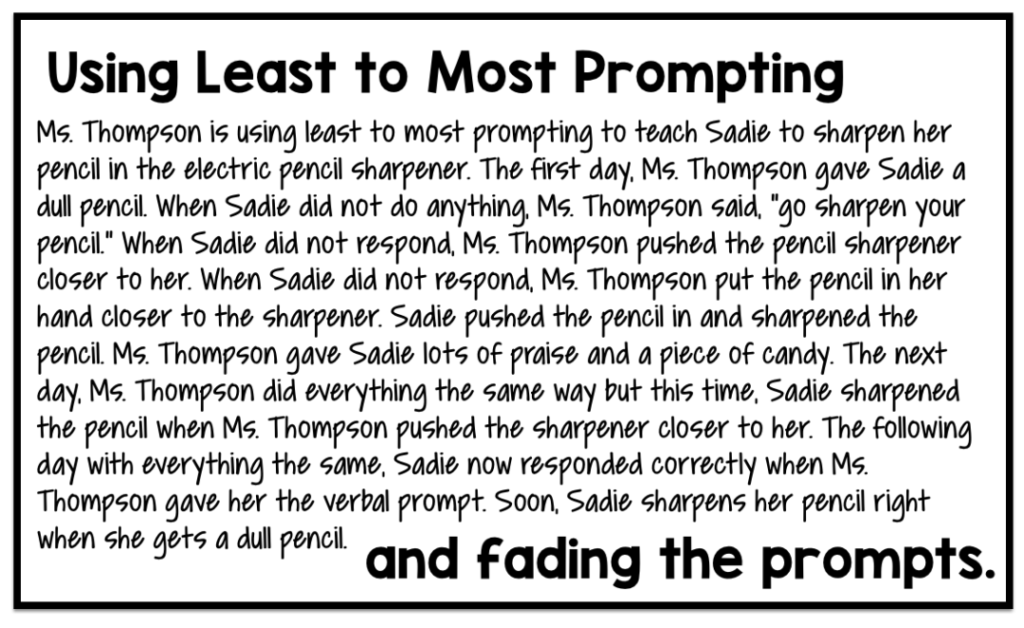
Like we discussed in Monday’s post, least to most prompting involves starting with the least intrusive prompts and moving up in the prompting hierarchy. This can be beneficial because it gives students to the opportunity to be independent and you are only providing as much prompting as needed. This is a strategy we tend to use naturally. When you meet a your friend’s toddler you put out your hand to give a high five. If she doesn’t respond you say, “give high five.” If she still doesn’t respond you move her hand to your hand to give a high five. This is a natural method of prompting. When using this prompt fading technique, ideally the prompts will be somewhat self fading. If you are always starting at the least intrusive prompt, your students will have the opportunity to demonstrate independence. As the student begins to learn the task, he will need less and less prompts to perform it correctly.

Some key tips for using this prompt fading in ABA procedure:

  • allow wait time; if you do not provide wait time you may be providing more prompts than needed and taking away the opportunity for the student to respond correctly
  • take data; data is key to track progress. Every time you utilize this prompting method – note the level of prompt you used. You want to see that your student is requiring less intrusive prompts as time goes on. This will help avoid prompt dependence.
  • use high powered reinforcers; use an item that is actually a reinforcer that your student wants to work for. The sooner he demonstrates the skills, the sooner he gets the reinforcer.
2. Most to Least Prompt Fading

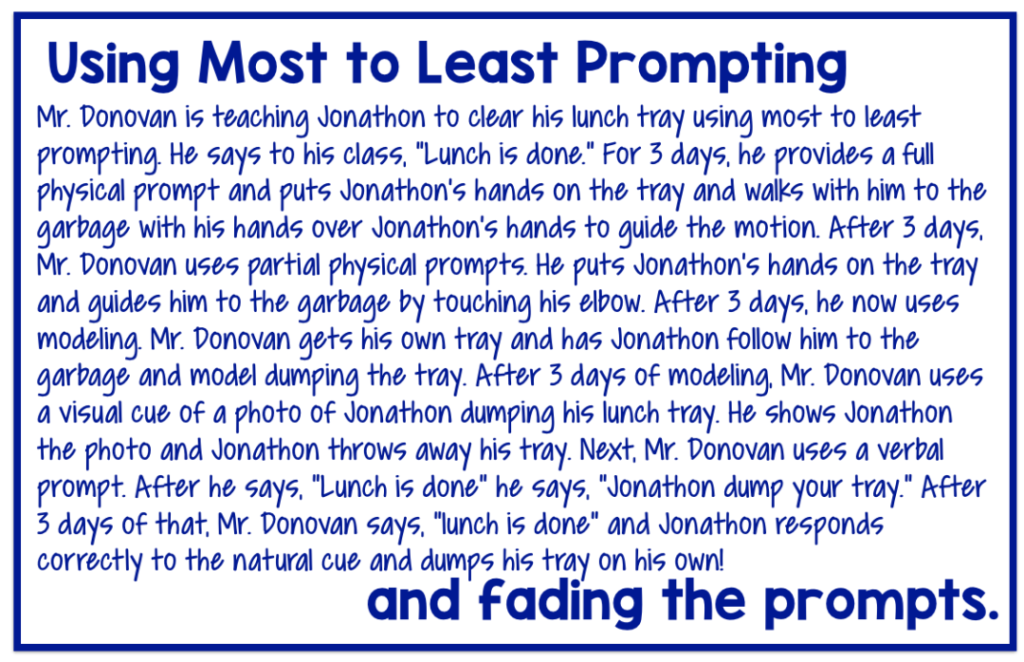
Most to Least prompt fading is another effective method of using prompts. With this method you start the most intrusive prompts and gradually fade to less intrusive prompts. The prompt fading is build right in. However, sometimes people forget that and in their head rename this most to most prompting. The key to errorless learning and using the most intrusive prompts first is that you fade the prompts out. The idea behind most to least prompting is that students will contact reinforcement right away and you will avoid errors and the students developing any incorrect habits.

How to fade prompts in Most to Least Prompting:

  • set criteria for changing prompts; once your student hits a particular number of days or sessions or trials at a particular prompt level, fade to the next level; take data to track progress
  • once you hit the criteria move to the next type of prompt; refer to our prompt hierarchy or order that is in Monday’s post. Move up the list to less and less intrusive prompts.
  • fade magnitude than switch prompt type; before you switch from a gestural to a verbal prompt adjust the magnitude of the prompt. A dramatic point to an object is different that a nod of your head.

Data is critically important for avoiding prompt dependence. You want to set a criteria ahead of time and take data to make sure you are sticking with the criteria. The criteria you set will depend on the student and the task. Maybe you want 3 consecutive days with each prompt level. If you are taking data you can ensure that you are sticking to that schedule. If errors begin occurring, go back a prompt level. The data will guide your implementation of this procedure. If you are fading too quickly, your data will tell you!
Prompt fading in ABA isn’t scary. Plan ahead and make sure you train your staff. This is a group endeavor!
3. Time Delay

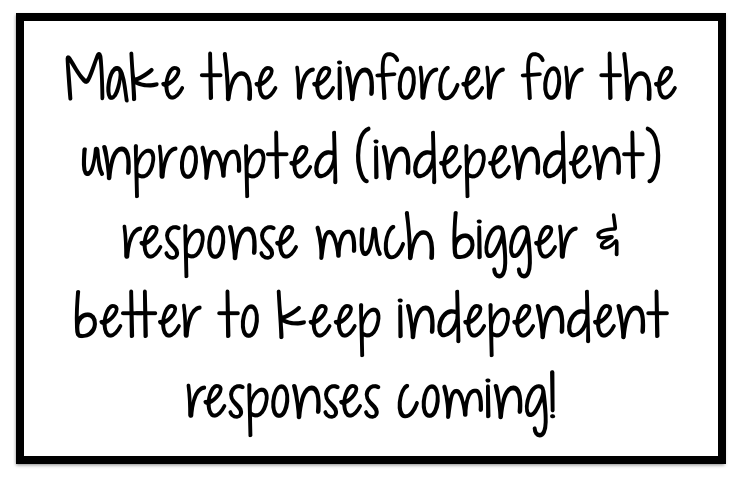
One effective way we can fade prompts is using a time delay. A time delay inserts a set amount of time between the natural or teaching cue and our prompt. When utilizing a time delay, start with a zero second (i.e. no) time delay – so it will basically be like errorless teaching. For the first few trials, give the prompt right away so the student knows how to respond. Then after several trials, increase the time delay. For example, you may start with 2 seconds. If the student does not respond within 2 seconds – provide the prompt. If the student responds before the 2 seconds, provide loads of reinforcement. Once the student is successful and responding under the 2 seconds for several trials, increase the time delay. Now wait until 4 seconds to provide the prompt. Continue on. If the student does not respond with the 4 second time delay, move back to the 2 second time delay.

The key to time delay is planning and data. Set the criterion ahead of time. Plan how many sessions you will do at 0 seconds before moving to the first time delay. Determine what the mastery criteria is – how many times do you want the student to respond within the time delay before increasing the time delay length? Take data on this. It can easily and quickly get confusing if you don’t have a data sheet to track what you are doing. Write the plan in simple terms at the top of your data sheet. I like to track prompted correct (PC), prompted incorrect (PI), unprompted correct (UC), and unprompted incorrect (UI) using those abbreviations on my data sheet. If the student responds before the prompt it is counted as unprompted and if it’s after the prompt it is prompted!
There is no magic number of trials or days you should stay within the 0 second or 2 second time delay. It depends on the student’s level of functioning and the difficulty of the task. This is where data majorly comes in to play. If you’ve moved along too quickly, you will know and you can scale back.

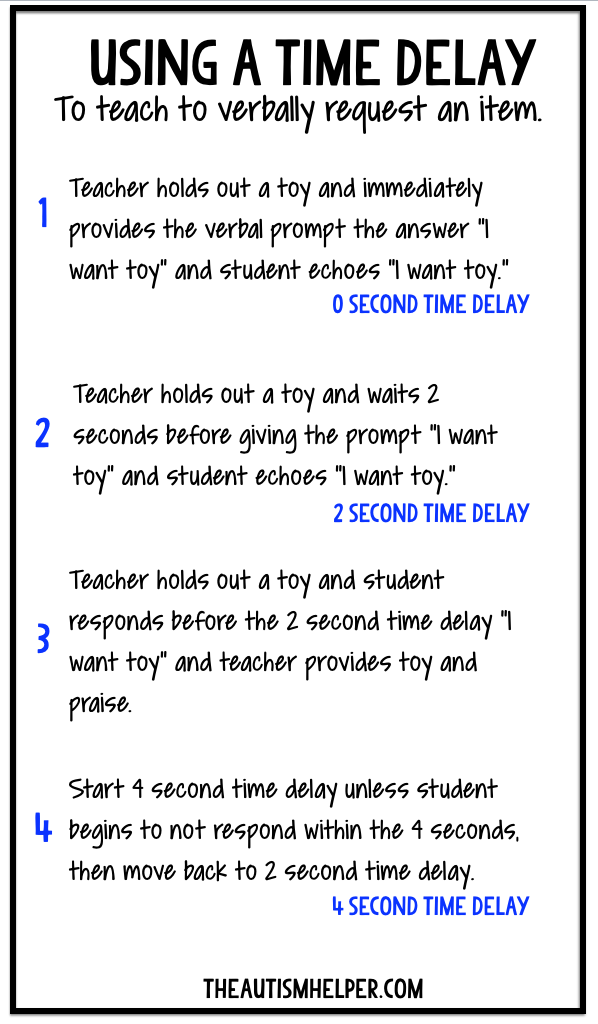
Time delay works really well with verbal prompts. Another key component to time delay working successfully is making sure the reinforcement you give for the unprompted responses is better than the reinforcement for prompted responses. So if Johnny responds before the time delay and says the color blue on his own – give him 3 m&ms and praise but if you are using a 2 second time delay and he doesn’t respond and you provide the verbal prompt “bl…” and then he says blue only provide praise. You want the independent responses to be getting more reinforcement so your student is motivated to engage in those responses more!


About The Author

Sasha Long, BCBA, M.A., is the founder and president of The Autism Helper, Inc. She is a board certified behavior analyst and certified special education teacher. After ten years of teaching in a self-contained special education classroom, Sasha now works full time as a consultant, writer, and behavior analyst. Sasha manages and writes The Autism Helper Blog, as a way to share easy to use and ready to implement strategies and ideas. Sasha also travels internationally as a speaker and consultant providing individualized training and feedback to parents, educators, therapists and administrators in the world of autism. She is currently an adjunct professor in the school of Applied Behavior Analysis at The Chicago School of Professional Psychology. Sasha received her undergraduate degree in Special Education from Miami University and has a Masters Degree in Applied Behavior Analysis from The Chicago School of Professional Psychology. Contact Sasha at sasha.theautismhelper@gmail.com.

Normalization

So much to say on this topic, far more than anyone would actually want to read.

Does ABA therapy require/demand/force individuals into a narrow and specific box titled “NORMAL”? No.

(Well, it shouldn’t anyway)

But the myth persists.

I mean this in the best way, but many of the children I work with just are not going to fit into that “normal” box, no matter how much someone tries to push or squeeze them into it… it ain’t happening.

And that’s a cause for celebration!

The very thing I love about working with such a diverse group of kids, is that they are all different, yet all interesting. I work with some super fascinating small people, who constantly show me how dumb I am. And I thank them for it, because how can you grow if you already think you know everything? You can’t.

As a provider, of course I know the research on the effectiveness of ABA therapy. I also know the many success stories I have seen with my own eyes, of children I directly worked with. But success story does not equal “…and then the child was totally normal!”.

A couple of reasons why my job is not to drive families in my car to a fantasy location called “normal”:

1) Each client/family I work with usually has their own idea of what “normal” means. If you have been in this field more than 10 minutes, you know this to be true. This client over here may live in a home where no one really cares what time they go to bed, as long as they stay in their room and are quiet. But that client over there, may live in a home where all the parents want most in the world is for that child to get their 7.5 hours of sleep every night.

2) Even when a family can explain to me what “normal” means for them, it quickly changes! Again, if you have been in this field more than 10 minutes you know this is true. Sometimes parents tell me they want desperately for their child to talk, but what they really mean is they want their child to communicate. Or, a parent may tell me they want desperately for their child to go to “normal” school with their big sister, but next thing you know that parent has decided to homeschool. Expectations change, as perspective changes.


So if ABA therapy is not about hitting a child over the head with your magical “normal” baseball bat, then how exactly is it decided what the goals of treatment will be? I’m so glad you asked.

If you are working with a quality ABA provider, the goal selection process will look something like this:

“I need to evaluate/assess your child to collect baseline data” – This just means data is collected at the onset of services to create a starting point. Over time, that starting point data will be reviewed again and again to make sure the child is progressing. If therapy has been happening week after week after week, but the child has not progressed past that starting point, then something is seriously wrong. This is why it’s important to collect that initial data, so over time you can compare the child’s current learning to their previous learning.”

“What are your goals for therapy? Tell me the reasons why you initiated services.” – The people who asked the ABA team to show up clearly had reasons for doing so, and we need to know what those reasons are. We cannot fully help if we don’t know what issues are happening. Treatment planning should always be a team effort, with the family/client working together with the BCBA to create goals.”

“What are the highest priority areas of concern in the home? At school? In the community?” – What this question is really getting at is “where do you want to start?”. It isn’t unusual that families want to work on…oh, 85 behaviors or so when you first meet them. Unless I can get a good idea of the priority level of those 85 things, the treatment plan will be a chaotic mess. Prioritizing treatment helps focus in on the areas of deficit that are impacting the client the most.

“Describe your household: rules, routine, disciplinary procedures commonly used, etc.” – This question gets at Culture. Households form a sort of culture, or a way things are done. Stepping into a household/family dynamic and imposing completely opposing culture onto it, is not a great idea. It will likely lead to aggressive resistance. What is more helpful, is to teach the family strategies and techniques that line up with the way their household functions.

“Can you finish this sentence: In 5 years, I want my child to be able to…..” – This question is really getting at long-term goals. Professionals need to know long-term goals, because every long-term goal is really made up of hundreds of baby steps. Gradually introducing those baby steps leaves less work to do down the road and increases the likelihood of successful skill acquisition.

“Your child scored low on (insert skill domain here). Do you care about that??” – One of my fave questions to ask. I have learned to ask this, because I used to do quite a bit of assuming. Things like “Of course, you guys want him to write his name, right?” or “Of course, you guys want her to stop eating with her hands, right?”. Maybe not. If I see an area of concern, I will bring it up. If the parent isn’t as concerned as I am or wants to stick a pin in that issue until a later time, then it’s really important that I know that.

My normal is not your normal, and vice versa. What’s considered “normal” in your household might not fly in my household, and what’s “normal” in your marriage could be unbearable for another couple. That’s why normal is such a useless word to throw around, because it has too many meanings to actually mean anything significant.

One of my pet peeves is when a parent says to me during an intake, “I just want him/her to be normal!”. Ummm, and that means what?? 🙂 Seriously, I need details over here. I do not have an intervention for “normal” behavior, nor do I know how to program for that.

Does ABA therapy seek to change individuals? Yes! Behavior change is the entire point of this therapy, either increasing appropriate behaviors or decreasing inappropriate behaviors. But if you think that the only change ABA therapy values is when a child can be fully “normal”, you are:
100%,
absolutely,
wrong.


About The Author: Tameika Meadows, BCBA

“I’ve been providing ABA therapy services to young children with Autism since early 2003. My career in ABA began when I stumbled upon a flyer on my college campus for what I assumed was a babysitting job. The job turned out to be an entry level ABA therapy position working with an adorable little boy with Autism. This would prove to be the unplanned beginning of a passionate career for me.

From those early days in the field, I am now an author, blogger, Consultant/Supervisor, and I regularly lead intensive training sessions for ABA staff and parents. If you are interested in my consultation services, or just have questions about the blog: contact me here.”

This piece originally appeared at www.iloveaba.com. 

Seaver Autism & YAI Family Peer Advocate Study

The Seaver Autism Center for Research and Treatment at the Mount Sinai School of Medicine is conducting a research study that uses Family Peer Advocates to help improve the health and well-being of children with autism. YAI and Premier HealthCare have also partnered up with the research center to provide participants in the study a comprehensive diagnostic assessment. YAI provides one of the nation’s most comprehensive networks of programs and services to assist people with disabilities in maximizing their potential.


Family Peer Advocates of this initiative will provide peer support and education related to autism, act as liaisons between families and health care providers, as well as assist families in navigating a complex system of services. Eligible participants include parents of children who have been diagnosed with autism, individuals of African-American or Latino descent, and those who reside in the Bronx or Manhattan. Participation is entirely voluntary and free. Eligible participants will be asked to completed a series of questionnaires over the course of six months, and also reimbursed for travel expenses.

The Seaver Autism Center leads progressive research studies while providing comprehensive, personalized care to children and adults with autism spectrum conditions. For more information about the YAI Family Peer Advocate Study, visit the Seaver Autism Center’s Current Studies or call (212) 241-0961.

Horse Program helps both Children and Adults with Disabilities

A new therapy program called Hoof Prints in the Sand services individuals with special needs ranging from ages 5 to 63. This animal based therapy program is aimed at using interactions with horses to help individuals gain not only physical skills like muscle definition, correct posture and hand-eye coordination but also much-needed confidence.

Founded by a special education teacher with an equestrian background the entire Hoof Prints in the Sand  program consists of volunteers who dedicate their time to work one on one with students of varying disabilities and ages. Students begin by testing out a mechanical horse appropriately named “Hope” and then easing into riding lessons on donated horses.  The volunteer coaches help students by riding with them, leading the horses, or walking beside the horse and rider to ensure safety.

Do you know of a unique program for individuals with special needs in your area?

Special Needs Summer Camps

Summer time can be full of excitement for children. Time away from school, vacationing, family events, and of course, summer camp!

For parents of children with special needs it can be a challenge finding a local camp that is able to support yours child’s specific needs. There are a variety of options available for campers with special needs ranging from day camps to overnight camps.  Some programs are need specific while others camps are able to offer a more inclusive setting.

Summer camps can be beneficial for children in various ways. Camps offer environments where children can learn social skills, verbal skills, work on everyday independent tasks, learn new hobbies such as biking, swimming, art, musical instruments and more. While at camp children make important bonds and connections with camp staff as well as other campers. All of these activities and new bonds help campers gain independence, build confidence and raise self-esteem.

Summers camps aren’t only beneficial to the children participating in them. Camps are also a great opportunity for parents to meet, greet and network with each other to share resource information.

To help find a summer camp that meets your child’s special needs try this site:

Special Needs Summer Camps

Interested in reading about some unique summer camps? Check out these additional sites

Social Skills Camp

Bicycle Camp for Speical Needs

Goulds Camp

Know of a great summer camp?  Let us and other parents know!

New monitoring system gives adults with disabilities a new look at independent living

 With all the new advances in technology some adults with disabilities are finding new ways to put them to use enabling them to gain independence and   begin living on their own. A new article details life outside of assisted living and group homes to a new 24-hour monitored independent-living housing situation. A new system called Sengistics is able to monitor programmed activities of a household 24 hours a day. For example things like doors and windows opening after specifically programmed hours can trigger a phone call to a caretaker allowing the caretaker to check-in with the individual moments later. Other features that can be programmed include motion sensors for areas of the house alerting caretakers of possible injuries and accidents, alert systems for appliances to make sure they are secured properly after use, alerts for medications ensuring they are taken on the correct schedule as well as a variety of other individualized monitors that can be programmed to call and notify different contacts.

This type of living situation is ideal for those who cannot live in a fully independent housing situation but who are generally over-served in assisted living homes. It also fosters the use of previously learned living skills as well as helps by giving the individual the opportunity to acquire new sets of skills ranging from simple chores to shopping lists, money management and more. Lastly, for parents with adult children who continually need support and are unable to live fully independent lives this new type of housing situations enables them to gain a piece of mind about the future.

To learn more about the monitoring system and its features click on the following article:

High-Tech Monitoring

Elephant Therapy

Elephant therapy in Thailand

https://www.theautismnews.com/2011/05/12/elephant-therapy-in-thailand/

We’re all familiar with the practice of animal therapy for individuals with a range of disabilities from common household animals like dogs and cats to equine therapy, the newest animal to be include in the mix? Elephants!

An organization in northernThailandrecently introduced a new kind of therapy for their autistic population, elephant therapy, and so far they have found participates responding positively. Elephants, familiar to participants through their cultural importance, provide a range of potential benefits through their interactions with the population being served. Staff running this new-found therapy say tasks included during sessions range from grooming the elephants, shopping for care items such as bananas, sugar cane, etc. for the participating elephants using real funds, playing games, and art-related activities. All of these activities revolve around teaching a variety of specific skills including flexibility, tolerance, creativity, and socialization through group play.

Currently, the program is new and limited to only a few sessions due to funding but hopefully we will see more unique programs being created like these to serve the autistic population!

Posted in ABA

Learn the Lingo

automatic punishment  Punishment that occurs independent of the social mediation of others (i.e., a response product serves as a punisher independent of the social environment).

Cooper, J.O., Heron, T.E., & Heward, W.L. (2007). Applied Behavior Analysis. Upper Saddle River, NJ: Pearson Merrill Prentice Hall.