Behind the Scenes with Socially Savvy: A Note from the Authors

by James T. Ellis, Ph.D., BCBA-D and Christine Almeida, Ms.Ed., Ed.S., BCBA

Since first publishing Socially Savvy, there has been so much progress in the way that we approach, assess, and support students with learning differences. Because we are not only the writers of Socially Savvy, but also users of it, we have also learned so much over the past decade as we have used the assessment and intervention strategies with the children that we have supported. Our belief that there is not a “one size fits all” approach has strengthened. The social skills that we identified in Socially Savvy as important for young children are skills that might be important for some children in some settings, may not be important for other children, and there may be other skills that we have not identified that might be important for other children. We continue to want to make sure that Socially Savvy is used as a guide to help therapists, educators, and parents determine what skills are important to target for the children who they are supporting.

Being a good educator requires us to grow and learn along with the children that we teach. That is why we have released the Socially Savvy Assessment Protocol with Extended Objectives. In addition to adding a second objective for each skill, we have also freshened up some of the initial objectives. A greater understanding of neurodiversity has developed over the past decade, and we want to make sure that we are carefully considering that when we are making decisions about what social behaviors to target for change, which behaviors to accommodate through environmental changes, and which behaviors to embrace and encourage from children. Part of our reason for updating the objectives is to make sure that we are being conscientious about the diverse ways that children act, think, learn, respond to sensory input, and process the world around them.

Additionally, we have realized that it is helpful to have more objectives for the skills that are part of the Socially Savvy Checklist because children are working on objectives in multiple settings and need to apply the skills in a variety of environments – school, home, community, clinic, etc. What might be an appropriate objective in one setting may not fit the environmental expectations of another setting. We have provided an additional objective for each targeted skill, in the hope that one of the objectives might be a fit for the child with whom you are working, or that the objectives might provide inspiration for developing an objective that matches the needs and environment of the child. 

Being a good educator requires us to be creative in how we teach and motivate children to learn. This is especially true when we are teaching social skills, which are complex and often difficult to break down into steps that are achievable for the child and manageable for staff to teach. We want children to learn in a way that is fun, exciting, and continues their growth and curiosity. We also want staff to have fun while they are teaching. By providing an additional objective, we are trying to spark that creativity and help educators make teaching the targeted skills more fun, both for the child and for the teacher. If the objective is clear to staff, appropriate for the setting, and taught in a more fun way, staff are going to work on that skill more. The more targeted social skills can be embedded in simple games and throughout the natural environment, the more fun it should be for staff to run.  Consequently, the child is going to have more teaching opportunities embedded in a fun context and is hopefully going to learn more quickly. This then has the added benefit of staff being reinforced by seeing the child learn at a faster rate. If we are having fun, it’s easier for staff to teach and the child to learn!

We also acknowledge and recognize that educators and professionals supporting the social growth of children, whether in a school setting, a family’s home, the community, or a clinic are busy and often overwhelmed. We hope that refining and adding to the objectives will make your work a bit easier. We respect the great work that you all do in helping children grow to their fullest potential. As always, we appreciate hearing from all Socially Savvy users, whether parents, special educators, behavior analysts, or other professionals. Your thoughts and comments have been invaluable. The idea that you find the curriculum useful has been humbling.  

About the Authors

James T. Ellis, PhD, BCBA-D earned his PhD in Clinical Psychology from West Virginia University and is a licensed psychologist and board certified behavior analyst. For over 20 years, Dr. Ellis has provided services for children with autism spectrum disorders and their families. In 2008, he helped found the Step by Step School for Children with Autism in Guyana, South America and in 2012, he founded Step by Step Behavioral Solutions, through which he continues to provide consultation and therapeutic support to individuals with autism spectrum disorders and their families.

Christine Almeida, MSEd, EdS, BCBA earned her MSEd in Special Education and EdS in Behavioral Education from Simmons College in Boston, MA. Ms. Almeida is a practicing board certified behavior analyst in the Boston area who has worked in both private and public schools. She currently provides oversight of services for young children with autism spectrum disorders for a public school. Ms. Almeida has presented workshops at the local, regional, and national levels on the subjects of educational assessment, play intervention, and social skills.
Posted in ABA

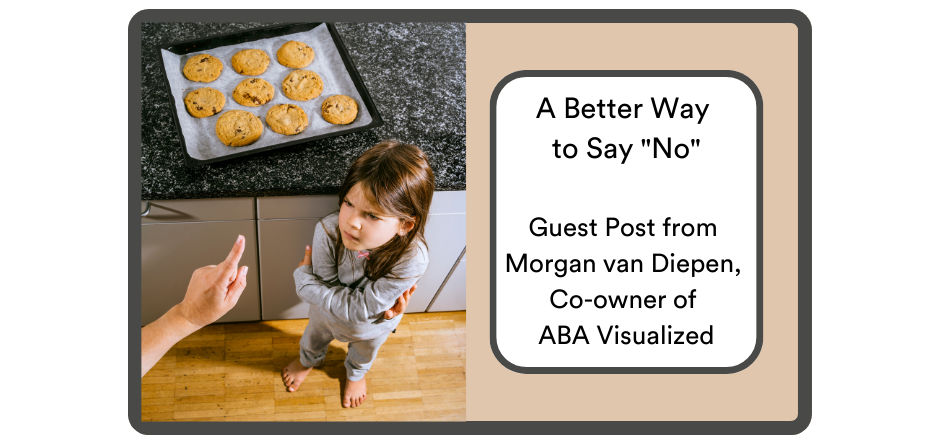
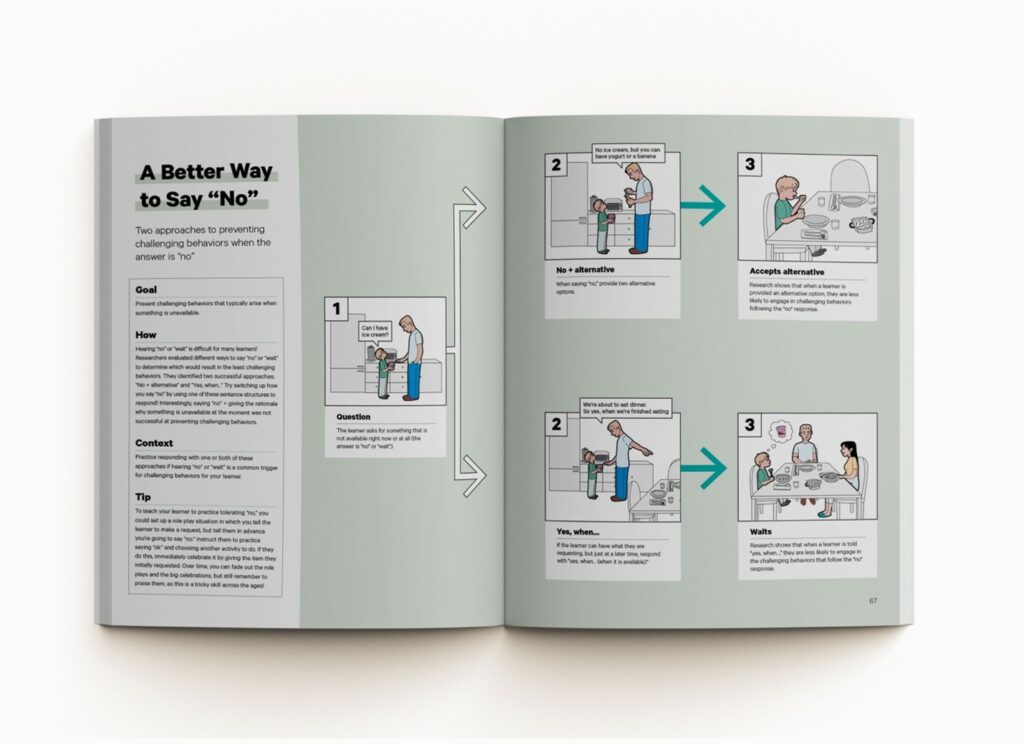
A Better Way to Say “No”

By Morgan van Diepen, M.Ed., BCBA, Co-owner of ABA Visualized

Hearing “no” or “wait” can be challenging for kids of all ages! In fact, as a BCBA, this is one of the most common requests for support that I hear from families. Luckily, researchers have tested out three ways to say “no” when something is unavailable, and the results show how slightly changing our response can actually prevent challenging behaviors! Let’s look at the scenario of a child asking to play a computer game, but the parent is currently using it for work. Which of the three methods do you think was the most effective? 

  1. “No” + Explanation. In this common approach, the parent says it’s not available and gives the honest reasoning: “Not right now. I’m working on the computer.” 
  2. “No” + Explanation + Alternative. Now, we’ve added an extra suggestion of something that is available: “Not right now. I’m working on the computer, but you can play basketball outside with your brother.” 
  3. “Yes” + Contingency. Here, even though our answer is “no,” we’re actually saying “yes!” This can be described as a “yes, when…” statement, where you are describing when the requested item or activity will be available: “Yes, you can use the computer when I’m finished with this meeting at 2:00.” It can also be used to set expectations of what they need to accomplish before the request is available: “Yes, you can use the computer when you finish your homework.” 

So, which do you think resulted in the fewest challenging behaviors?

In this research study, the 2nd and 3rd approaches were equally successful at almost completely preventing vocal protests, aggression, and threats! By just changing the way we say “no,” we can help our learners accept this answer more easily. Little changes that create big results! Strategies like these are perfect for parent training sessions during ABA. Here’s a template parent training goal you could use with families who would like more support in this area:

When (client name) requests for something that is unavailable (provide examples specific to the client), parents will either respond with “No” + Explanation + Alternative (provide example specific to the client) or with “Yes” + Contingency (provide example specific to the client) in attempts to prevent challenging behaviors relating to tolerating “no,” in at least 80% of opportunities across 2 consecutive weeks. 

Looking for a more engaging way to lead parent training sessions and teach effective strategies like this one? Check out our 2nd edition ABA Visualized Guidebook, where we’ve visualized 27 evidence-based strategies (including this one!) as step-by-step illustrations, making behavior strategies easy! 

Article reference: Mace, F. C., Pratt, J. L., Prager, K. L., & Pritchard, D. (2011). An evaluation of three methods of saying “no” to avoid an escalating response class hierarchy. Journal of applied behavior analysis, 44(1), 83–94.

Teaching Language: Focus on the Stage, Not the Age

by Sam Blanco, PhD, LBA, BCBA

Teaching language skills is one of the most frequent needs for children with autism, but also one of the most misunderstood skillsets amongst both parents and practitioners. The desire to hear your learner speak in full sentences can be overwhelming, making it especially difficult to take a step back and consider what it means to communicate and how communication skills develop in neurotypical children. Many times we get hung up on what a child should be capable of communicating at a certain age, rather than focusing on what they are capable of communicating at this stage of development.

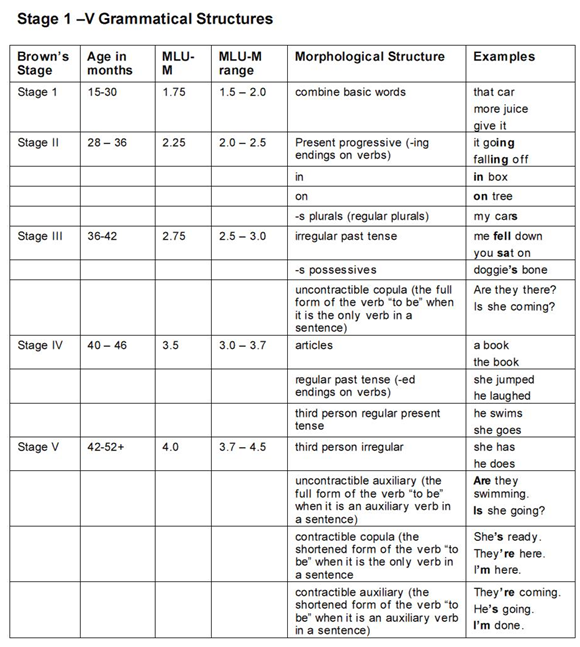
Many practitioners and curricula utilize Brown’s Stages of Language Development.* Brown described the first five stages of language development in terms of the child’s “mean length of utterance” (or MLU) as well as the structure of their utterances.

Brown_Grammatical_Structures_Chart

From aacinstitute.org

Sometimes it is necessary to compare a child to his or her same-age peers in order to receive services or measure progress, but it can be detrimental to focus on what a child should be doing at a specific age instead of supporting them and reinforcing them for progress within their current stage.

Research has suggested that teaching beyond the child’s current stage results in errors, lack of comprehension, and difficulty with retention. Here are some common errors you may have witnessed:

  • The child learns the phrase “I want _____ please.” This phrase is fine for “I want juice, please” or “I want Brobee, please,” but it loses meaning when overgeneralized to “I want jump, please” or “I want play, please.” It’s better to allow your learner to acquire hundreds of 1-2 word mands (or requests) before expecting them to speak in simple noun+verb mands.
  • The child learns to imitate only when the word “say” is used. Then the child makes statements such as “say how are you today,” as a greeting or “say I’m sorry,” when they bump into someone accidentally. Here, the child clearly has some understanding of when the phrases should be used without understanding the meanings of the individual words within each phrase.
  • The child learns easily overgeneralized words such as “more.” This is useful at times, but the child can start using it for everything. Instead of saying “cookie” he’ll say “more.” Instead of saying “train,” he’ll say “more.” And he may say “more” when the desired item is not present, leaving the caregiver frustrated as he/she tries to guess what the child is requesting. Moreover, as language begins to develop, he may misuse it by saying things such as “more up, please.”
  • The child learns to say “Hello, how are you today?” upon seeing a person entering a room. A child comes into the classroom and the learner looks up, says “Hello, how are you today?” The child responds, “Great! Look at the cool sticker I got!” Your learner then doesn’t respond at all, or may say “fine,” as he has practiced conversations of greeting.

These are only a few of the common language errors you may see. While you may want your learner to speak in longer sentences, your goal should be to have them communicate effectively. With this goal in mind, it becomes essential to support them at their current stage, which means it’s essential to assess them and understand how to help them make progress.

This is why I always use the VB-MAPP to assess each child and make decisions about language instruction. I need to have a full understanding of how the learner is using language, and then move them through each stage in a clear progression. I may want the child to say “Hello, how are you today?” But when I teach them that, do they understand those individual words? Do they comprehend what today means as opposed to yesterday or tomorrow? Do they generalize the use of “how” to other questions?

As you make treatment decisions for your learner, think about their current stage and talk about how to support your child with both a Speech Language Pathologist and an ABA therapist.

*Brown, R. (1973). A first language: The early stages. London: George Allen & Unwin Ltd.


About the Author

Sam is an ABA provider for school-aged students in Brooklyn, New York. Working in education for over 15 years with students with Autism Spectrum Disorders and other developmental delays, Sam utilizes strategies for achieving a multitude of academic, behavior, and social goals. She is also an assistant professor in the ABA program at The Sage Colleges and the Senior Clinical Strategist at Encore Support Services.

Originally published by Different Roads to Learning on July 10, 2014.

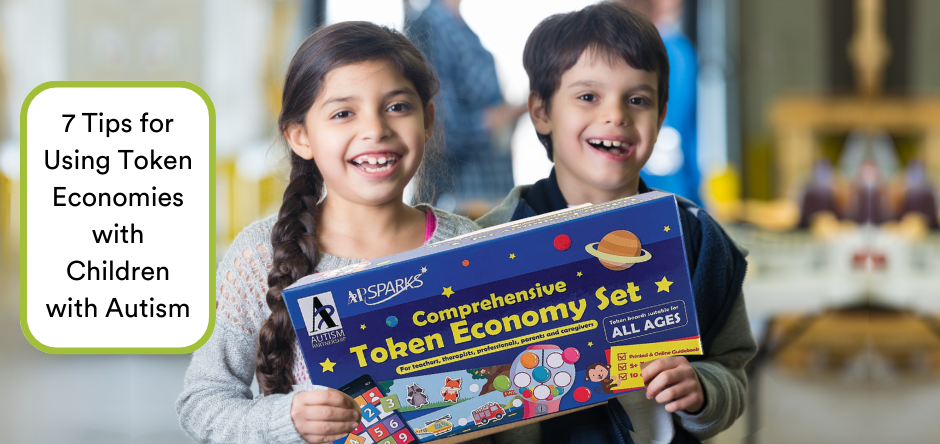
7 Tips for Using Token Economies with Children with Autism

By Ashleigh Evans, MS, BCBA

Token economies are structured reinforcement systems used with people across many different populations. They can be particularly useful for reinforcing behaviors and skills in children with autism and other neurodevelopmental differences.

A token economy works similarly to our world economy. A child earns tokens for demonstrating various skills and behaviors, which can then be cashed in for preferred items or activities. Token economies have a significant degree of individualization, making them highly effective at modifying behaviors.

Getting Started

Let’s consider the following tips for using token economies with children with autism.

  1. Focus on one or two skills or behaviors at first

    Well-meaning therapists, teachers, and caregivers might create a token economy with several different behaviors targeted. However, when introducing a token economy, you should start with only 1-2 behaviors or skills. This is necessary to help your learner associate earning tokens with specified behaviors. If they receive tokens for many different behaviors throughout the day, it may be more difficult for them to grasp why they are receiving the tokens. To help them make this association, identify the behaviors that are of the highest priority and start with those. As the learner advances and makes progress with their current goals, you can begin incorporating additional behaviors into the token economy.

  2. Individualize the tokens

    Tokens can be anything–tallies, stars, poker chips, stickers, or coins, for example. Individualizing the tokens to something the child enjoys can add an extra layer of reinforcement. For example, if you’re using a token board, you might use stickers of objects or characters that your learner enjoys such as vehicles, animals, or cartoon characters. You don’t want your learner to get distracted by and fixated on the tokens either though, so it’s important to consider that when choosing tokens.

  3. Start with continuous reinforcement

    Every aspect of your token economy should be individualized, however, it is often most beneficial to start a token economy with continuous reinforcement, then fade to intermittent. This is especially true for children with more limited language skills. As they begin to pair the behavior with the token, you can shift to providing tokens on an intermittent schedule, depending on an assessment of their unique needs.

  4. Provide immediate reinforcement

    Reinforcement should immediately follow the target behavior. When the learner demonstrates the target behavior, immediately provide the token and pair it with social praise. Praise should be behavior-specific, labeling exactly what they did to earn the token.

  5. Don’t forget your backup reinforcers!

    This one might seem obvious, but backup reinforcers are a common missing piece of token economies. Children may earn tokens throughout the day or week, with no plan built in for cashing them in for something else. Earning the tokens is only one part of a token economy. Make sure prior to implementation that you have a back-up reinforcer menu ready to go, with plans outlined for how many tokens are needed for each item or activity. Incorporate your learner into the planning of this to ensure the backup reinforcers are motivating to them.

  6. Avoid token economies for behaviors that the learner is already motivated to complete

    There is much concern and debate on whether token economies and external rewards in general reduce intrinsic motivation. Research has found that external rewards actually increase intrinsic motivation, but only when the person was not already intrinsically motivated to engage in the behavior (LeBlanc, 2004). For example, imagine a child who enjoys sweeping the floor. She willingly sweeps every day, without external reinforcement. Her mother decides to begin paying her for completing this chore. Adding external rewards to a task that she was previously intrinsically motivated by could actually decrease her intrinsic motivation to complete that task. However, if the same child is not intrinsically motivated to brush her teeth, adding external rewards can increase her intrinsic motivation to brush her teeth. Therefore, only target behaviors that the child is not already motivated to engage in.

  7. Monitor success and adjust

    Token economies should be continuously evaluated. Monitor your learner’s progress and make adjustments when necessary to ensure continued progress through their personalized goals. With a well-planned and executed token economy, your learner can make socially significant gains in skills and behaviors.


References

Dalphonse, A. (2022, October 12). Token economy: Examples and applications in Aba. Master
            ABA. Retrieved May 1st, 2023, from https://masteraba.com/token-economy-2/

Kazdin A. E. (1982). The token economy: a decade later. Journal of applied behavior analysis,
            15(3), 431–445. https://doi.org/10.1901/jaba.1982.15-431

LeBlanc, G., 2004. Enhancing Intrinsic Motivation Through The Use of a Token Economy.

About the Author

Ashleigh Evans, MS, is a Board Certified Behavior Analyst. She has been practicing in the behavior analysis field for over 13 years and opened her own independent practice in early 2022. Her experience has been vast across different age groups, diagnoses, and needs. She is passionate about improving the field through education, reformative action, and better supervisory practices, leading her to create content and resources for families and ABA professionals which can be found on her website, www.evansbehavioralservices.com/.

Posted in ABA