
How Do I Choose the Right Data Collection Method?

This month’s ASAT feature comes to us from Shira Karpel, MEd, BCBA and Shayna Gaunt, MA, BCBA, How to ABA. To learn more about ASAT, please visit their website at www.asatonline.org. You can also sign up for ASAT’s free newsletter, Science in Autism Treatment, and like them on Facebook!

I am a first-year teacher in a self-contained classroom. I appreciate how data can guide my decision-making and help me better assess progress. Nonetheless, I feel a bit overwhelmed and would welcome some general guidance on what type of data to collect and when.

Thank you for your question. We are happy to hear you are considering data-based decision-making to best assess your students’ progress. As ABA professionals, data collection plays an essential role in making decisions and updating or revising programs based on what the data tells us. However, it is possible to be so consumed with data that it interferes with teaching. How well can a person engage and think on their feet when they are preoccupied with data collection? It can also be challenging to select the right method of data collection to accurately reflect skill progress (or lack thereof). For instance, it may look like a student is not mastering any goals, when, in fact, a different type of data collection method may tell a different story.

Data plays a very important role in the classroom for students who have Individualized Education Plans (IEP). In developing an IEP, goals should be chosen based on assessments, as well as what will be personally meaningful to the student in that setting. Data collection is a vital tool in the classroom. It is necessary to assess a student’s strengths and areas of support which will then inform potential goals. For example, data from an assessment can tell us that a student is currently able to label numbers 1-5 and based on this, we might propose a goal of labeling numbers 1-10. Think about the end goal in observable and measurable terms and then choose a type of data collection that is doable amidst a busy classroom. Then, we will be able to make data-based decisions, share objective assessments of progress and update IEPs accordingly. It all sounds nice but how can we use data without it becoming overwhelming?

We feel strongly that data should only support learning and never impede it. This is why it is important to choose a method of data collection that allows teachers to a) monitor progress, b) be present in the moment, c) engage with their students, and d) remain focused on teaching. Students will learn more from good teaching than from good data. In a classroom, this often means that you would choose methods of data collection that are manageable when teaching a large group.

Let’s review a few of our favorite data-collection methods and their potential applications in the classroom.

Frequency

Frequency refers to the number of responses within a specific period of time. In other words, how many times are you seeing the occurrence of a particular target? Tally counters are a great way to collect frequency data. They are not cumbersome! A tally counter is something you can wear on your finger or waist while you’re teaching and click the counter when you observe a behavior. Frequency is often a common measure for behavior reduction goals, for example reducing the number of times a student elopes from the classroom. Frequency data are often collected as part of toilet training efforts (e.g., successes, accidents, initiations). However, frequency is also a simple measure for a lot of skill acquisition goals. Requesting and spontaneous language are some programs where we may choose a frequency count over any other type of data collection. For example, how many times a student greeted a friend or how many times a student asked for help. There can be creative ways to keep track of frequency, most teachers I work with love to carry around a sticky note and make tallies when they can! These tallies can then get added up at the end of the day and graphed.

Duration

Duration refers to how long the behavior persists. We often take duration data when we want to know how long it takes students to complete specific tasks. We also take duration data when analyzing impeding behavior, like tantrums. How long do they persist? It’s important to include duration data for interfering behavior because it can be an important measure of progress; frequency may stay the same but duration increasing or decreasing is meaningful. Duration can also be used for skill acquisition goals like time on task or social skills.

An efficient way to track these interfering behaviors is to use partial interval recording. By dividing the observation period into smaller units of time, like 1-minute and then checking off the times that these behaviors occur, we get information about both duration and frequency. This can then be graphed so that we can see trends in behavior.

Probe Data

Probe data means that we take yes/no data on the first trial of a program and then put our pencils down and teach! Probes can also be done less often if in a classroom situation (e.g., think spelling test), or in the community. Teaching should still happen after the probe (especially if it was incorrect!). Mastery may be something like “3 correct responses across 2 different people.” For example, if a student is learning to label colors, you might mark down a “yes” or “no” for the first time each day that you ask them to name their colors. Then, continue to do lots of fun play activities with colors (but no data!). Probe data can be great for progressing students who learn quickly through programs. They may only need a few exposures of the material. For example, a probe data sheet can be used with a program like, “Expressive Labels” such that multiple targets can be run simultaneously, and the student can advance through them quickly. Caution: the downside of probe data collection is that instructors might not run as many teaching trials as they should if there are no data to record after the first response. Probe data can be easily achieved in a classroom setting as there is often a lot of teaching happening anyway throughout the day.

Trial-by-Trial Data

Taking trial-by-trial data means that we record data for each trial run and then get a percentage of correct responses. If a student is asked to label a set of 3 colors (e.g., blue, red, yellow), you can take data on each color presented (correct or incorrect) and end up with a percentage score. Mastery is usually something like, “80% or more for 2 sessions, across 2 people.” Some children need more exposure, and repetition is good for their learning. Collecting trial-by-trial data encourages instructors to run at least 10 trials. Graphing the percentage tells us more information about performance across trials than probe data. It is also more objective than rating scale data. By graphing the percentage, we can see if the curve is increasing or decreasing or if there are any other notable changes.

See the example below for one graph illustrating an increasing trend and one graph illustrating a decreasing trend. The graph with increasing data tells us that the student can label all 3 of those colors with proficiency. When a graph looks like this, we can “master” teaching those 3 colors and move to teaching another set of colors. The graph with decreasing data tells us that we need to look closer at how the colors are being taught as the student is not learning the way we are teaching. Perhaps the student has over-generalized and is answering, “Blue” for every answer, or perhaps the student is just randomly selecting a response, or just not motivated to respond. In any case, the data show us that we need to look at our teaching procedures and make changes.
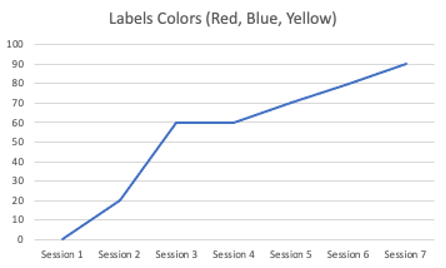
Figure 1. Graph with an increasing trend.Graph with a decreasing trend.

This is often the default measure of progress but also the most cumbersome because it means that you are also looking for every opportunity that the response could have occurred but did not. Percentage is most appropriate for testing-style goals – when working at a table and the student is clearly presented with multiple opportunities in a row. For example, after a unit on animals, the teacher presents 10 animals for the student to label. The student’s score out of 10 would be the percentage correct. This is often not ideal for many goals, so think about choosing frequency or probe instead.

Rating scale data

A rating scale describes behavior along a continuum, like a rubric. Although rating scale data can be subjective, they can describe the level of independence (or resistance) for an activity without impeding teaching. During the time when the instructor and the student are getting to know each other, relationship building and engagement (a.k.a. pairing) are first and foremost (Oliveira & Shillingsburg, 2023). A clipboard or electronic data collection may ruin the quality of that interaction. Rating scale data can outline some goals for the instructor to work on and then the child can be rated at the end of the session, based on a continuum of how well they did that day. The scores are then graphed. Check out more about rating scale data sheets and download a free copy.

A rating scale is also a great measurement tool for group-based learning in a classroom. The students can each have goals that can be accomplished in a group setting, for example “staying on task” or “raising hand.” Then, while the teacher is teaching, another staff member can record rating scale data. Rating scale data is also something that doesn’t need to be recorded in the moment; when the activity is over, the teacher can recall how the student did based on the defined scale. Rating scale data are easy for any staff member to collect without it being overwhelming.

Conclusion

Choosing a data collection method is an important part of the process but only the first step. Do not forget to then analyze and refer to the data to make data-based decisions. Include your team in reviewing the data and ask for input as to what they think might need to be changed. Refer to data when dialoguing with parents about progress, particularly if parents were part of the data collection. You want them to appreciate that data tell an important story.

As a teacher, you want to see your students make progress. Data can help you assess, plan, and monitor that progress in a way that doesn’t have to be overwhelming. When used as a tool, it will help you, parents, and the student see that progress and be able to make changes accordingly.

References

Baer, D. M., Wolf, M. M., & Risley, T. R. (1968). Some current dimensions of applied behavior analysis. Journal of Applied Behavior Analysis, 1(1), 91. https://doi.org/10.1901/jaba.1968.1-91

Burke, M. D., Vannest, K., Davis, J., Davis, C., & Parker, R. (2009). Reliability of frequent retrospective behavior ratings for elementary school students with EBD. Behavioral Disorders, 34(4), 212-222. https://doi.org/10.1177/019874290903400403

Chafouleas S. M., Christ T. J., Riley-Tillman T. C., Briesch A. M., & Chanese J. A. M. (2007). Generalizability and dependability of direct behavior ratings to assess social behavior of preschoolers. School Psychology Review, 36(1), 63-79. https://doi.org/10.1080/02796015.2007.12087952

Cooper, J. O., Heron, T. E., & Heward, W. L. (2020). Applied behavior analysis. Pearson UK.

Fiske, K., & Delmolino, L. (2012). Use of discontinuous methods of data collection in behavioral intervention: Guidelines for practitioners. Behavior Analysis in Practice, 5(2), 77-81. https://doi.org/10.1007/BF03391826

Iovannone, R., Dunlap, G., Huber, H., & Kincaid, D. (2003). Effective educational practices for students with autism spectrum disorders. Focus on Autism and Other Developmental Disabilities, 18, 150-165. https://doi.org/10.1177/10883576030180030301

Merbitz, C. T., Merbitz, N. H., & Pennypacker, H. S. (2015). On terms: Frequency and rate in applied behavior analysis. The Behavior Analyst, 39(2), 333-338. https://doi.org/10.1007/s40614-015-0048-z

Oliveira, J., & Shillingsburg, A. (2023). Clinical Corner: Building rapport with students using specific strategies to promote pairing. Science in Autism Treatment, 20(12).

Citation for this article

Karpel, S., & Gaunt, S. (2024). Clinical Corner: How do I choose the right data collection method? Science in Autism Treatment, 21(5).

About the Authors

Shira Karpel, MEd, R.B.A (Ont), BCBA is the co-founder and director of How to ABA, an online resource and community for ABA professionals. Shira has a Masters in Special Education and has been in the field of ABA since 2011, receiving her BCBA in 2014. Together with Shayna, they trained and taught many therapists, clients, and parents and collected a massive bank of ABA programs and resources. In an effort to give back to the field, Shira and Shayna decided to create How to ABA as a way of sharing our collection of resources with others.  As a former teacher, her passion is in using ABA in classrooms in order to create positive and comprehensive learning environments for all students. She is the Clinical Director at a private school in Toronto and is loving getting to make a difference in the lives of children and families daily. She is passionate about making the principles of ABA practical, doable and relevant to every child in any situation

Shayna Gaunt, MA, R.B.A (Ont), BCBA is a dedicated professional in the field of Applied Behavior Analysis (ABA) and co-founder of How to ABA, an online resource and community supporting ABA professionals. With over two decades in the field, a Master’s Degree in ABA from the University of Nevada Reno, and extensive international experience, Shayna brings a vast expertise across diverse settings.  She emphasizes collaborative excellence in direct therapy, supervision, and training, striving to deliver high-quality services and resources to clients and fellow ABA practitioners. Through How to ABA, Shayna aims to make ABA principles accessible and practical, fostering a community where professionals can share, learn, and grow together. 

Posted in ABA

Supporting Your Clients During the Back-to-School Season: 4 Strategies BCBAs can Implement for a Smooth Transition

By Ashleigh Evans, MS, BCBA, reposted from the Different Roads Archives

Children with autism and other neurodivergence commonly struggle with transitions. The shift from summer to the start of a new school year is one of the most challenging transitions. Getting back into a new routine is not easy and often requires support and patience through these changes. Behavior analysts play a vital role in helping these children navigate the back-to-school season. Let’s review four strategies you can try to make for a successful back-to-school transition for your clients.  

1.   Maintain Open Communication with School Staff

Open communication between the ABA and school teams can help smooth the transition. Introduce yourself to your client’s teacher and support staff, communicating your desire to collaborate for your shared learner’s best interests. Use this as an opportunity to also share and celebrate your client’s growth during the summer. Share mastered skills that your client achieved over the summer and any new concerns to help the school team gain an updated picture of their current skills and behaviors.

2.   Review and Update Goals

Take a look through your client’s goals and progress made. The ultimate goal of ABA is to prepare our learners for optimal functioning in the least restrictive environments. Consider updating goals to encourage the development of skills that will help them be more successful at school. If they attended school last year, review their IEP and reflect on areas they struggled with in the previous year.

One area to consider is your learner’s self-advocacy skills. Do they have the necessary skills to express their needs and desires in a manner that school staff can understand? Do they have the ability to communicate when something is uncomfortable, they need a break, or someone is bothering them? These skills are all critical for success in school and onward. Ensure goals are in place to teach these skills, if not already mastered.

3.   Increase Caregiver Training and Support

During times of major transitions, parents and caregivers may also struggle to navigate the routine shifts that often come with behavioral changes in their child. Empower your client’s parents to support their child through this shift by enhancing caregiver training. If clinically appropriate and feasible, increase caregiver training sessions before and for the first few weeks after the school year starts. Providing additional support can set everyone up for success.

4.   Implement New Antecedent Strategies

Consider the antecedent strategies you can implement to help your client better cope with the new routines and expectations. Visual supports, such as a visual schedule with the child’s morning routine or daily schedule, can help your client envision what comes next, making it easier for them to get into the swing of things. If your client enjoys social stories, you can create one to review with them (or have parents read it to them) to familiarize them with what to expect. Make sure it’s personalized and unique to them with components such as their teacher’s name and picture.

Plan Ahead for a Successful School Year

The back-to-school season can be a stressful time for children and their families. However, with caregiver planning and support, behavior analysts can help make this process significantly easier. Help your families navigate change and prepare for a year of success at school by trying the aforementioned strategies. Each client is unique, so as always, tailor your approach to their particular needs and preferences.

About the Author

Ashleigh Evans, MS, is a Board Certified Behavior Analyst. She has been practicing in the behavior analysis field for over 13 years and opened her own independent practice in early 2022. Her experience has been vast across different age groups, diagnoses, and needs. She is passionate about improving the field through education, reformative action, and better supervisory practices, leading her to create content and resources for families and ABA professionals which can be found on her website, www.abaresourcecenter.com

Posted in ABA

5 Tips on Teaching Safety Skills to Children with Autism

By Sarah Kupferschmidt, MA, BCBA. Reposted from the Different Roads Archives

I am passionate about empowering children with special needs and their families with skills and knowledge that they can use to improve their quality of life. This is why I am super excited to be sharing tips and strategies that relate to keeping your child with autism safe on the street. Learning to navigate the real world involves a lot of complex skills that we sometimes take for granted. For example, learning to determine when it is safe to cross the street requires the ability to attend to your environment, the ability to identify moving cars from cars that are still, the ability to identify the signal at the cross walk that lets you know it is safe to cross, among many, many, more. In some cases even more advanced problem solving is required because if the sign says it is safe to cross and a motorist continues through the intersection we need to be able to identify the moving car is approaching and that we need to wait for it to pass before crossing the street. So where do we begin?

Tip #1: The Learner is Never Wrong

I love the saying “the learner is never wrong” because of what it implies. Whenever considering teaching a new skill to a child or student we need to focus on that unique child’s strengths and weaknesses. Where do we need to boost up their skills and what do they already know so that we can capitalize on those strengths. Before going out to teach your child with autism how to cross the street safely, they should have some imitation skills, be able to respond to instructions and attend to you or a teacher amidst a lot of distractions (e.g., cars, background noise and pedestrians, just to name a few). Once you have determined they are ready to learn this important skill you would want to use things that are of interest to them and that you know align with their learning style. For example, are they a visual learner and if so, how can you incorporate visuals to maximize their learning potential in how you go out and practice crossing the street safely?

Tip #2: Simplify the Complex Skills

As mentioned earlier in the post, many of the skills that we use actually have many components, something we take for granted. In this case, teaching how to cross the street might involve the following steps:

  1. Stop at the curb/crosswalk
  2. Look at the crosswalk signal
  3. Decide if it is safe to cross (e.g., does it say ‘walk,’ or does it say ‘stop’)
  4. If the sign says walk, then look both ways
  5. Decide if it is safe (e.g., is there a car moving or not)
  6. Walk safely across the street (e.g., this means walking not running, perhaps holding your hand)

It is important to remember that these steps are just an example of what you might teach. You would individualize this based on the environment in which you live (e.g., if there is a crosswalk sign or crossing guard, or not) and the expectations you have as a family (e.g., to hold the hand or not). Teach this using tools that you know are effective with your unique child. For example, you may decide to print out a visual depiction for each of the steps and show them as you talk about it and practice. This depends on your child’s unique learning style. As with every skill that that we teach, it is never enough to just tell someone or show someone how to do it. We need to actually go out and practice.

Tip #3: Practice, Practice, Practice

Use every opportunity that you have to go out and practice this very important skill. I would also recommend that you set up specific times to go out and practice. You can use the visuals that you printed and go through each of the steps while you are out. If you notice that your child is struggling on a particular step, then practice that particular step at home even more. For example, if your child is not identifying the walk signal when you are out on the street, set up times to go over that at home.

Tip #4: Monitor Progress

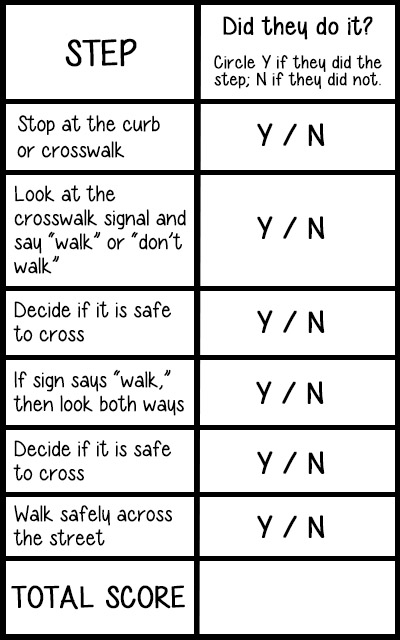
In order to see how your child is doing on each of the steps it is a good idea to record how they do on each of the steps. You might print off a checklist with each of the steps that looks something like this:

Street Safety Chart

You would calculate the number of times you recorded a Y over the total number of steps (e.g., in this case 6). For example, if I worked on this with my child and he did all of the steps he would get a 6/6. If he missed a step his overall score would be 5/6 or 83%. This score can then be used to monitor progress. I would also suggest that anytime you go out and practice you highlight whichever step(s) that they missed, if any. This will allow you to see if you need to work on something a little bit more before you go out and practice.

Tip #5: Notice the Good Stuff

Feedback is critical when you are teaching a new skill. Otherwise how is your child going to know how they are doing? This means that when they get it right we need to notice it and we need to be specific about what it is they did well. You can even use the visuals if you have them. You might say something like “I love the way you followed all of the steps of what to do when crossing the street safely! You stopped at the curb, looked at the signal…etc.” You may point to the visual as you tell them. If they missed a step remind them that next time they should try to remember what it is that they missed. Anytime they do one of the steps spontaneously, point it out to them and give lots of praise. Over time we can fade the praise out but it is really important when teaching a new skill, especially at the beginning.

About the Author

Sarah Kupferschmidt, MA, BCBA, is a Board Certified Behavior Analyst (BCBA) who has worked with hundreds of children with autism and their families across Ontario. She has had the privilege of supervising ABA programs and training clinical staff in those programs.  Currently Sarah offers parent coaching and workshops to teach parents but also educators on the most effective ways to teach children using the principles of ABA.  She is also a part-time faculty member at Mohawk College in the Autism Behavioral Science program, in the social sciences program at McMaster University, and an Adjunct Professor at Sage Graduate School. Sarah has appeared as a guest on CP24, CHCH news, Hamilton Life and the Scott Thompson radio show as an authority on autism.

Back to School: Disseminating the Science for Teachers and BCBAs

By Alicia Marshall, MAT, BCBA LBS

The transition back to school and back to a new routine is always an exciting, yet bittersweet time for students and educators. Carefree summer days are in the past, and getting back into a structured daily routine can be an overwhelming process. However, new teachers, new friends, and new settings provide the opportunity to make progress with academic, behavior, and social goals. Even while students and their families should enjoy every precious moment of summer fun, it is also important to set aside some time to prepare for the transition in the new school year.

Getting Proactive

Most school-based BCBAs can attest that the most important aspect of school consultation is assisting educators and other stakeholders to be proactive about behavior instead of reactive. This advice is especially valuable while preparing for a new school year. Teachers and families can begin to discuss and implement proactive strategies in the days prior to the first day of school.

For teachers and school based BCBAs, summer preparation days can be used to discuss simple environmental manipulations that can be made within the classroom. For instance, before students even step foot in the classroom, the teacher and other support staff can arrange seating that is limited from distraction and enhances engagement. A common suggestion from BCBAs is usually to seat students with a history of elopement behavior far away from the exit doors. Some consultants may even suggest preparing some visual supports and schedules ahead of time in order to prepare staff and students. Students thrive with structure and organization, so if the classroom has established expectations the students will find it easier to decide which behaviors lead to rewards and desired activities.

Building Rapport

Antecedent interventions do not only apply to teacher prep days. Chances are, not all students will engage in challenging behaviors on the first day of school. Hence, those first days of school are crucial because they are the opportune times for pairing. Classroom staff should prioritize gaining trust and rapport with students. This process can begin the moment the students arrive at school on the first day. Teachers and staff can begin pairing with students simply by greeting students with a smile and limiting demands. Students should be given the chance to feel happy and relaxed while adjusting to a new environment.

The more the students feel comfortable in the environment, the more likely they are to view the adults in the environment as a reinforcer, or a signal for access to preferred items and activities. When trust and rapport is established, it will also be easier for teachers and staff to engage in activities that may not be highly preferred. Of course the primary focus of the teachers should not be to place increasingly difficult demands on the students. However, establishing themselves as a person that will provide rewards and other motivators, allows the adults in the classroom to assist the students in developing pivotal behaviors that will provide access to a whole world full of reinforcing items and activities.

While students are adapting to the new enrichment, teachers and staff can use the opportunity to informally assess the students’ preferences. Enriching the enrichment with items high on the students’ preference list will not only assist in the pairing process, but can also be used as potential motivators for instances of positive reinforcement scenarios.

Embracing Collaboration

Lastly, the most important aspect of the transition back to school and adjustment to a new environment and routine is collaboration with all key stakeholders. Parents and caretakers, as well as teachers, should be involved and have input on any strategies and goals put in place. The more the students’ parents and caretakers feel involved in the decisions being made for their children, the more likely they are to carry out plans with fidelity. Also, establishing effective collaboration and communication assists with overhaul generalization of behaviors and makes the students’ support system stronger and more successful.

About the Author

Alicia Marshall, MAT, BCBA LBS, started out as a Special Education teacher and made the switch over to full-time BCBA 5 years ago. Alicia received her BCBA coursework at Rutgers and currently works as a Director of Behavioral Health in the Greater Philadelphia area. Alicia is passionate about making learning fun for all stakeholders and to encourage educators to focus on socially significant goals and compassionate care. 

When Alicia is not disseminating the science of ABA, she can be found on the beaches of the Jersey Shore (and occasionally Hawaii) with her husband and two dogs.

The Importance of Teaching WH Questions

By Ashleigh Evans, MS, BCBA

WH questions are essential building blocks of communication. Understanding and responding to questions about who, what, when, where, and why is vital for a child’s language development. BCBAs and educators commonly focus on teaching these pivotal skills for many reasons. Let’s explore why teaching WH questions is important and how it can help shape a child’s language and communication skills.

What are WH Questions?

Before we dive into why WH questions are important, let’s consider what WH questions are. WH questions encompass many different questions that start with the words “who,” “what,” “when,” “where,” and “why. While it doesn’t start with WH, some people also group “how” questions under this umbrella. WH questions include the following.

Who Questions–Questions about people, such as “Who is coming over today?”

What Questions–Questions about things, thoughts, actions, or ideas, such as “What did you think about that movie?”

When Questions–Questions about times, days, or dates, such as, “When is your birthday?”

Where Questions–Questions about places, such as, “Where did you go last night?”

Why Questions–Questions about the reasons or causes for things, such as, “Why do I have to cut the grass?”

It’s important to teach kids to both ask and answer who, what, when, where, and why questions as they navigate their home, social, and academic environments. 

Why is it Important to Teach Kids to Answer WH Questions?

There are many reasons why children should be taught to answer WH questions, including the following.

  • Safety–If a child is ever lost or in another unsafe situation, they may need to communicate critical information, such as, “What’s your name?” “Where do you live?” “Who are your parents?”, etc. It can also provide parents peace of mind when their child can answer key questions about their day.
  • Building friendships and social engagement–Answering WH questions allows a child to engage socially with peers and build meaningful relationships.
  • Academic success–Understanding how to answer WH questions is vital in educational settings, where children are expected to communicate their knowledge through reading comprehension, math equations, and many other subjects.
  • Reciprocating conversations–Answering WH questions helps learners develop conversational skills, including answering and reciprocating questions. This is necessary in many settings, including social, educational, vocational, and at home.
  • Memory and recall–Teaching children to answer WH questions is a pivotal skill that leads to additional skills, such as recalling events.

Why is it important to Teach Kids to Ask WH Questions?

Learning to ask WH questions is equally important as answering them. Let’s explore some pivotal reasons that underscore the significant benefits of teaching children to ask WH questions.

  • Understanding the world around them–Asking WH questions encourages curiosity, fostering an understanding of the world around the child.
  • Academic success–An ability to ask questions aids in academic success, as the child takes an active role in their education by questioning things that expand their knowledge. 
  • Initiating conversations–Teaching children to ask WH questions helps them develop conversational skills, including initiating conversations. This can foster meaningful connections with peers and others in their lives.
  • Problem-solving–Children who can ask WH questions can build upon their knowledge, asking questions that promote critical problem-solving skills.

Resources for Teaching WH Questions

Teaching children with autism and other neurodevelopmental differences to ask and answer WH questions is a complex process with many layers. Many WH questions are abstract, involving time (when questions) or cause and effect (why or how). These can be challenging concepts for neurodivergent children to grasp.

The first step is to teach simple labeling (referred to as tacts in verbal behavior language). Labeling items and activities is a necessary prerequisite skill. For example, before a child can answer the question, “Where is your cup?”, they need to know how to label items, such as “couch,” so they can answer by saying “on the couch.” You can use flashcards to teach your learner to label various objects, including common objects around the home and school, food, clothing, body parts, and more.

As children develop the basic prerequisite WH skills, you can make learning fun and engaging by expanding upon their knowledge through games and activities. The Ask & Answer Social Skills Game is one such engaging game that you can play to help your learners develop skills related to answering WH questions.

For additional considerations on teaching these vital life skills, check out the blog, What Goes Into Teaching Children to Answer WH Questions?

About the Author

Ashleigh Evans, MS, is a Board Certified Behavior Analyst. She has been practicing in the behavior analysis field for over 13 years and opened her own independent practice in early 2022. Her experience has been vast across different age groups, diagnoses, and needs. She is passionate about improving the field through education, reformative action, and better supervisory practices, leading her to create content and resources for families and ABA professionals which can be found on her website, www.abaresourcecenter.com