Adapting Swim Lessons for ASD Learners

By Jen Knott, BS Recreation Therapy
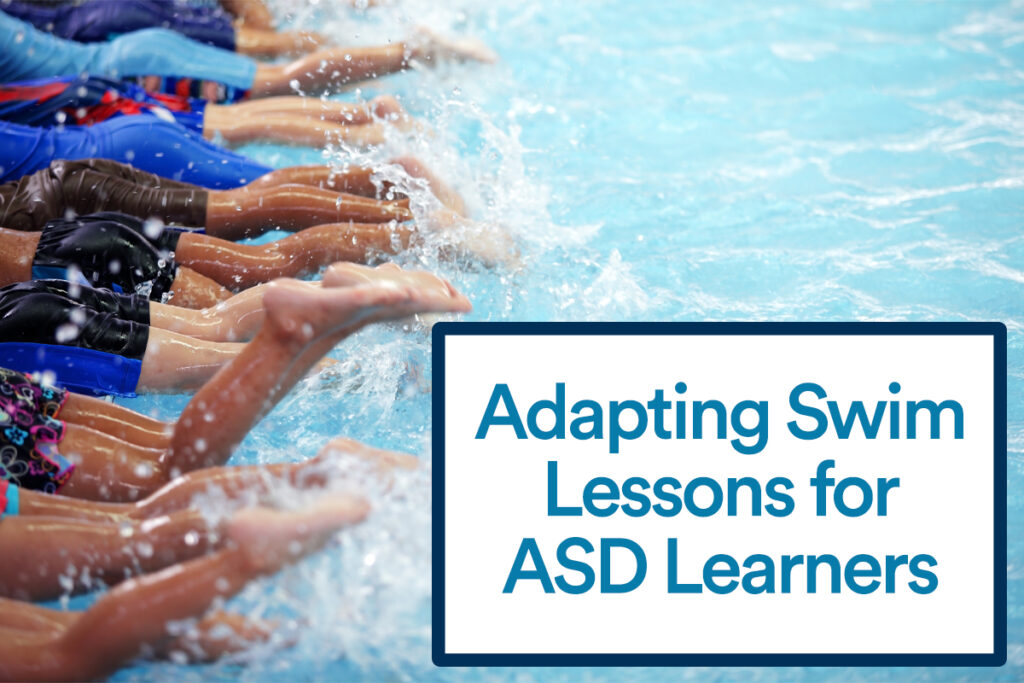
Swimming is a whole-body skill and oftentimes challenging for individuals with autism to master. It requires the use of your arms, legs, core, breathing, spatial awareness, sensory regulation, as well as strength, endurance, motor planning and coordination.

When designing swim lessons for swimmers with autism, working on all the skills listed above via structured activities allows the swimmer to enhance their brain/body connection in many different movements. This approach assists in skill mastery at a faster rate. Specifically, it allows the individual to practice motor planning and strengthening skills such as crossing midline, coordinating arms and legs at the same time, and using arms in a reciprocal motion.

The more individualized, creative, and motivating you can make the activity, the better! Below are some specific actions that can be taken to help acclimate your autistic learner to the basics of swimming!

For example, floating in supine position (on your back) is an essential safety skill that all swimmers should learn. There are many creative ideas to work on this skill, and some can even be done at home! Laying on your back can be an unpreferred skill at home and while sleeping due to the changes in the position in the inner ear. Floating can feel very different to swimmers with autism and they often demonstrate a resistance to the position. Taking small steps in a variety of settings to introduce this skill is key.

  • Laying on your back on the bed, floor, or couch provides a similar feeling to floating with support.
  • Having a child’s head slightly off the couch or bed can also provide the feeling of floating and locating their body in space.
  • In the bathtub you can work on this skill by having swimmers lay on their backs while putting their head back in the water or looking up at the ceiling. This can be done while seated or lying down, any progress is a step in the right direction.
  • Placing one ear at a time in the water can be helpful to slowly introduce the feeling of the water.  We often use songs like Twinkle, Twinkle Little Star, Humpty Dumpty, and counting to assist in distraction from the water in ears and also provide a clear ending to the skill when the song ends or counting reaches 10.
  • You can also place items on the swimmer’s stomach for postural and tactile support that provides input and focus for the swimmer on something other than the feeling of the water in their ears.  
  • In the pool, start with laying in a zero depth entry pool at the entrance, move to looking up in a seated position, and then transitioning to a supine position over time can help ease into it. Often having a hard, grounding surface beneath them can provide the feedback needed, to make the position more comfortable.  
  • Mats, noodles, floatation devices, and neck floats are a few examples of equipment that can be used to assist in floating in the supine position.  
  • Swimmers can also hold onto the side of the pool and work on looking up at the ceiling or preferred object. Allowing the swimmer to control the speed and amount of water they place their head in can give a sense of control and comfort.
  • This can then be shaped into leaning back to place their head on parents or instructors shoulder, providing support at the lower back, shoulders, and head. Fading support is important when the swimmer is ready, providing support just at shoulders and head, then just the head, then independently floating!

These techniques can also be used for submerging under water and floating in prone (on your stomach) position, taking it slow, using motivating items to look for under the water, slowly introducing water to body parts, singing songs or counting, providing tactile support and fading it out when the swimmer is ready. Other activity ideas to complete in the water to develop and practice planning and strengthening skills would be jumping jacks, toe touches, jumping and splashing at same time, swinging a tennis racket or barbell across midline under water, reaching across body or reciprocally overhead for items, and pushing barbells reciprocally. Providing adaptations, creativity, and flexibility is key in all swim sessions for success. Using motivating items, playing games, providing a picture schedule, video modeling, accommodating for any sensory needs, and making the skills fun can help your swimmer succeed with even the most challenging swim skills! 

Jen Knott, CTRS (Certified Therapeutic Recreation Specialist)

Jennifer is a graduate of Kent State University with a degree in Leisure Studies, with a concentration in Recreation Therapy and a minor in Psychology. Jennifer began Rec2Connect in 2009 with 2 clients. She launched the Rec2Connect Foundation in 2014. Her previous experience includes: Classroom Behavior Therapist at Cleveland Clinic Center for Autism, Job coach at Goodwill Industries, Volunteer in Aquatic Therapy at Hattie Larlham in the Physical Therapy Department and Recreation Therapist at the Cleveland Clinic.
Posted in ABA

One Autistic BCBA’s Perspective on ABA

By: Michelle Zeman, MA, BCBA

Board Certified Behavior Analysts (BCBAs) often work with the Autistic community. However, you may not often run into an Autistic BCBA. There are Autistic BCBAs who support and have a career in Applied Behavior Analysis (ABA), and as one I would like to share my perspective.

This field gets a bad reputation for many reasons. It’s claimed that ABA “masks Autistic behaviors” as well as “teaches children to be robots”. I hate the reputation that proceeds today’s ABA; however, if you look back at how ABA was conducted in the 1960s, there’s enough rationale to support.  We must condemn the actions of rigid and uncompromising ABA while changing current stands, as I attempt to do in my practice. Therefore, my perception of ABA is taken into 3 points: (1) using a trauma-informed lens, (2) actively listening and validating our clients, (3) individualizing care.

  1. When we use a trauma-informed lens, it means that we are not just looking at behaviors from the 4 functions. Rather, we look at behaviors that happened because of traumatic experiences. In my own life, I got into a car accident when I was 16 years old. I was already semi-emotional, and I was driving in the rain (it was sprinkling). I was turning left at a green light and overcorrected, thus hitting another car. I was so traumatized by the experience that I couldn’t stand the thought of going behind the wheel for 4 years. What motivated me to get behind the wheel again was the fact that I was sick and tired of my mom and my friends having to drive me around. If anyone would have forced me to comply by making me drive from place to place, there’s a not insignificant  chance that another car accident would take place. Likewise, when we force clients to attempt things they are not ready for, we risk traumatizing them.
  2. Active listening and validating our clients, as well as their caregivers, is vital in this field. Practitioners are not always right (even Autistic ones!), and we must approach in situation with humility and compassion. RBTs implement ABA therapy at their full ABA therapy hours. BCBAs go out anywhere between 5 and 20% of an RBT’s direct therapy hours per month. Then, we have our caregivers, who are with the client when we are not. When emphasizing compliance over collaboration, active listening and validation is thrown to the wayside. We have many elements that we must consider when implementing services, such as trauma, culture, environment, and feasibility of interventions. If we run into issues, we accommodate while doing our due diligence.
  3. Perhaps the third point is the most important – individualizing care. When I was a Clinical Director, I was strict when report reviews. However, I was strict because I wanted to make my analysts place themselves in their client’s shoes. For instance, I have seen vocal and motor stereotypy in several reports with a function of automatic reinforcement. Granted, each of these behaviors are different across each client we work with, but I still ask for rationale for how these behaviors are socially significant to reduce. If I notice the rationale does not fit the criteria, I will say “remove this behavior as it is not socially significant, does not impede the client’s ability to access contingencies, and it is not harmful to themselves or others”. I’ve also had clients ask me to write in specific goals they want to work on in their treatment plans too – for instance, I had a client who told me “Michelle, I want to work on becoming organized.” I wrote in a goal that fit the medical necessity model, but also targeted what the client wanted to work on.

These 3 areas have shaped me into the BCBA that I strive to be. Though I am one Autistic human being, I strive to ensure that I can be a compassionate practitioner. That’s what our clients deserve.

About the Author:

Michelle Zeman, MA, BCBA is an Autistic Board Certified Behavior Analyst based out of Orlando, FL. She has been in the field since 2013, and a BCBA since 2016. She has worked with Autistic clients between ages 2-17, providing client-centered, trauma-informed, and compassionate care to all families. Michelle has worked in-home, in school, in center, and in the community with clients to help achieve her clients’ goals. In her free time, Michelle likes to spend time with her two pugs (Milo and George), ride rollercoasters, go to drag shows, and binge watch RuPaul’s Drag Race.

Posted in ABA

Crafting Connections

By: Tameika Meadows, BCBA from I Love ABA

Impairments in social communication are a key deficit of Autism, and can be seen across the varying range of the spectrum.

Social communication is a big word that can include many difficulties, such as making friends, maintaining friendships, being appropriate near peers, sharing or turntaking, empathy or perspective taking, initiating peer play, joining ongoing peer play, responding to peers, self-advocacy, conflict-resolution, getting AND keeping a job, etc. 
When clinicians throw around the term “social skills”, we are really talking about a lottttt of skills!

Some people have the mistaken belief that ABA therapy only focuses on 1:1 instruction, and therefore isn’t appropriate to target peer social interaction. Nope, not true.
ABA therapy can absolutely include targeted social skills instruction. Depending on the age of the learner and their specific social deficits, that will impact how social goals are assessed and selected. 

Parents of very young children usually want to work on: sharing, playing with peers instead of isolating, playing with toys instead of hoarding toys, reducing aggression towards peers, etc.

Parents of teens or young adults usually want to work on: initiating conversation, increasing MLU (jargon translation= you want your child to use more than 1-2 words to make a statement or answer a question), buying items in the community, talking to community helpers (e.g. a police officer), going on job interviews, assertiveness, dating, etc.

There are also many ABA programs that offer formal social skill groups to families, where learners are grouped together based on interests, abilities, age, or other factors, to participate in games and activities as a group. But the games are far more than just “games”, they are actually carefully designed to target specific social skill deficits. If you are already receiving ABA therapy services, ask if your child can participate in a social group with other clients.

Behavior Analysis has many empirically validated strategies to add to the social skills conversation, and also (depending on the funding source) the ABA provider can target social skills in a group format, at school, or out in the community, to ensure proper generalization. For example:

  • Reinforcement for the win! Social skills training should include reinforcement individualized to the learner, and also should work to pair (transfer) reinforcement to peers, as pre-intervention the learner may not find interacting with peers to be all that fun ;-(
  • Data collection. If no one is collecting data, reviewing that data, and evaluating that data to make treatment decisions then what is happening is not ABA.
  • Generalization. Also known as, “real life”. Learning social skills in the ABA clinic, or at school, or on the playground, will not necessarily generalize to other settings and other kids. Intentional generalization into real-world, real life scenarios is a must.
  • Structure. This may sound weird, but it does NOT mean that the learner must do the same thing, in the same order, for each peer interaction. It means that the learner should be able to predict what will happen in social group today, they know the rules of social group, and they understand what rewards they contact during social group. These things should be somewhat predictable, from the perspective of the learner.
  • Break down concepts visually or tangibly. Help learners understand abstract concepts through video modeling, games, visuals, or manipulatives, that they can touch, see, etc.
  • Follow an evidence based curriculum…..just not too closely. While it is important to have a tool to create the lesson plan for social instruction, I’d also recommend individualizing the curriculum as much as possible across learners. Modifying the curriculum to make the content more relevant to the learner will go a long way to helping social instruction gains “stick”, and be salient for the individual receiving intervention.
  • Behavior management. So obviously, challenging or disruptive behaviors will interfere with learning during social interaction time. These behaviors can also frighten, intimidate, or confuse other peers present, which works against the goal of interacting with peers. This is why ABA providers are a qualified to implement these kinds of interventions, because we already have the tools to decrease inappropriate behaviors and increase appropriate behaviors, and keep the social interaction on track.

*Resources:

Mission Cognition
Crafting Connections (I love this book!)
Social Skills Training for Youth with Autism Spectrum Disorders, Otero, Tiffany L. et al. Child and Adolescent Psychiatric Clinics, Volume 24, Issue 1, 99 – 115
A Review of Peer-Mediated Social Interaction Interventions for Students with Autism in Inclusive Settings, Watkins, L., O’Reilly, M., Kuhn, M. et al. J Autism Dev Disord (2015) 45: 1070
Making & Keeping Friends
Baker, J.E. (2004). Social Skills Training: For Children and Adolescents with Asperger Syndrome and Social-Communication Problems. Shawnee Mission, KS: Autism Asperger Publishing Co.

https://difflearn.com/products/crafting-connections-1

About The Author: Tameika Meadows, BCBA

“I’ve been providing ABA therapy services to young children with Autism since early 2003. My career in ABA began when I stumbled upon a flyer on my college campus for what I assumed was a babysitting job. The job turned out to be an entry level ABA therapy position working with an adorable little boy with Autism. This would prove to be the unplanned beginning of a passionate career for me.

From those early days in the field, I am now an author, blogger, Consultant/Supervisor, and I regularly lead intensive training sessions for ABA staff and parents. If you are interested in my consultation services, or just have questions about the blog: contact me here.”

This piece originally appeared at www.iloveaba.com. 

Posted in ABA

Self Care for Moms

By Leanne Page; originally posted on Parenting with ABA

When you hear the words “self-care”, what is your reaction? A sigh of relief? Rolling your eyes as it feels like just ONE. MORE. THING.?

As a busy mom, we’ve all heard the expression to put your own oxygen mask on first. But when are we supposed to do that?

Self-care doesn’t have to mean bubble baths and beverages. It doesn’t have to mean shopping or pedicures. So what the heck does it mean then?

The World Health Organization defines self-care as “the ability of individuals, families and communities to promote health, prevent disease, maintain health, and to cope with illness and disability with or without the support of a healthcare provider”.

And the American Psychological Association says “Self-care has been defined as providing adequate attention to one’s own physical and psychological wellness. Beyond being an aspirational goal, engaging in self-care has been described as an “ethical imperative”.”

Self care means paying attention to your own wellness- emotional, physical, and psychological. How are YOU doing right now? And the question you’ve heard me encourage you to use before- 6 little magic word: What do you need right now?

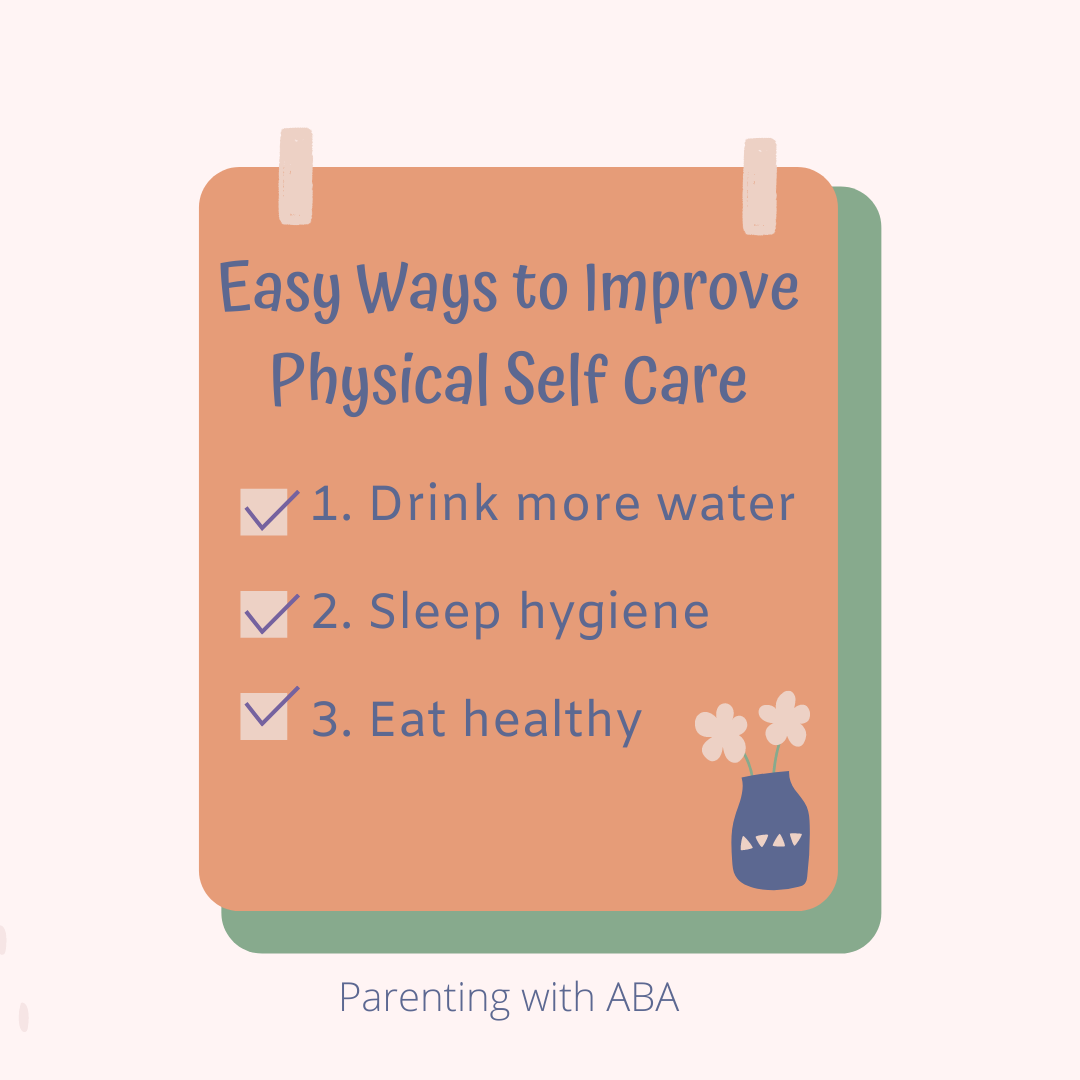
Quick and easy ways to improve your physical self-care:

  • Drink more water. Make this easier by using habit stacking. This means take an existing habit and add the step of drinking a glass of water on top of it. In ABA speak, the existing habit becomes the SD for drinking water. When I turn on my coffee maker in the morning, I drink a big glass of water while the coffee machine heats up.
  • Sleep hygiene. Turn off screens earlier in the evening. Go to bed earlier. Remove distractions. Journal before bed. Whatever works for you to promote good sleep!
  • Eat healthy. Instead of focusing on removing certain foods from your diet, just add in one healthy thing a day- like a fruit or vegetable. Habit stack by adding a piece of fruit to your afternoon cup of coffee, tea, or water.

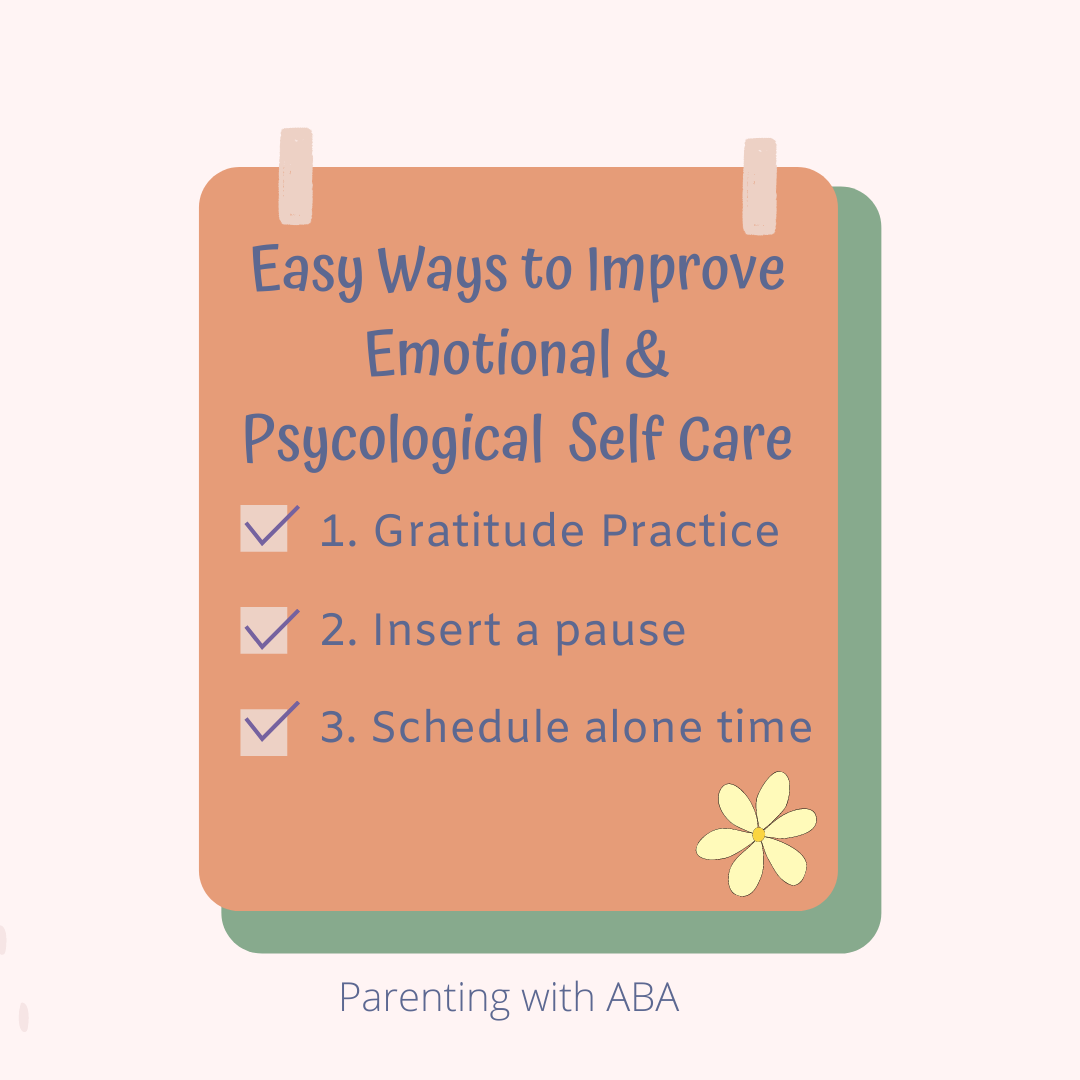
Quick and easy ways to work on your emotional & psychological self-care:

  • Gratitude practice. There is SO much research on the benefits of gratitude practice for your mental health. This doesn’t have to be time consuming or involved. Habit stack by thinking about one thing you are grateful for every time you brush your teeth. Or ask every member of your family what they are grateful for each day (or call it a happy thing or a good thing) every time you all sit down at the kitchen table together.
  • Insert a pause. Just a simple pause throughout your day can help! When you are starting to feel emotionally heightened, pause and take some deep breaths. Insert this pause before you react to your kids or something else. Just giving yourself that moment to breathe and collect your thoughts can be wonderful for your self-care!
  • Schedule alone time. Work with your partner or support system to have a standing date with yourself on the calendar. It may be 20 minutes to sit on the back porch or an hour on the weekend to go to a yoga class. Whatever works for you! Put it on your calendar and treat it like an important appointment. It is important!

If you like bubble baths and wine- feel free to use it for your self-care. But that’s not all that matters! What matters is that you find a way to give yourself a little breather from the mental load of motherhood.

Prioritize yourself- even just in small increments. Learn something new, try a new hobby, read a book, exercise. Find what works for YOU and schedule time for it. Guard that time as an important appointment because you are worth it.

What small ways can you incorporate more self care into your days this week?? Try something and let me know how it goes!

Leanne Page, MEd, BCBA, is the author of Parenting with Science: Behavior Analysis Saves Mom’s Sanity. As a Behavior Analyst and a mom of two little girls, she wanted to share behavior analysis with a population who could really use it- parents!

Leanne has worked with children with disabilities for over 10 years. She earned both her Bachelor’s and Master’s degrees from Texas A&M University. She also completed ABA coursework through the University of North Texas before earning her BCBA certification in 2011. Leanne has worked as a special educator of both elementary and high school self-contained, inclusion, general education, and resource settings.

Leanne also has managed a center providing ABA services to children in 1:1 and small group settings. She has extensive experience in school and teacher training, therapist training, parent training, and providing direct services to children and families in a center-based or in-home therapy setting.

Leanne is now located in Dallas, Texas and is available for: distance BCBA and BCaBA supervision, parent training, speaking opportunities, and consultation. She can be reached via Facebook or at Lpagebcba@gmail.com.