Can the principles of ABA be used to toilet train a child with an autism spectrum disorder?

This month’s ASAT feature comes to us from Dr. Frank Cicero, Ph.D., BCBA, LBA. To learn more about ASAT, please visit their website at www.asatonline.org. You can also sign up for ASAT’s free newsletter, Science in Autism Treatment, and like them on Facebook!

Here is the good news…children with autism can be toilet trained through the exact same methods that are used with typically-developing children. And what are these methods? Applied behavior analysis! If you have ever toilet trained a typically-developing child, you probably used a combination of praise and rewards for going on the toilet, explaining your expectations, removing the child‘s diaper, prompting to the toilet on some type of schedule, rushing him or her to the toilet when they seemed like they needed to go, and teaching how to notify you that he or she needs to use the bathroom. You might or might not have added in some form of punishment or verbal reprimand for accidents. Well…here is my advice for toilet training a child on the spectrum…use exactly the strategies that I just described.

So then, why does it seem so much more difficult? One of the biggest obstacles is simply getting started. Because parents think that toilet training will be very difficult, and something so different than anything else they have taught their child in the past, they delay training. Toilet training for a girl typically is recommended to begin at around two years of age. For a boy it is a little later (about two and a half). When it comes to a child with a developmental disability it is difficult to use these age guidelines. Instead, a child is ready to begin training when they can hold urine in the bladder for at least 1 hour, can remain seated on a toilet for at least three minutes, have an awareness of the relationship between following instructions and getting rewarded, and do not have significantly interfering problem behavior. Another challenge with toilet training a child on the spectrum is the absolute need for consistency and intensity of training once you begin. The more intense you implement a plan, the quicker you will see results. For the most intense procedure, I recommended toilet training for at least 6-8 hours per day. I also usually implement the training directly in a bathroom with the child wearing the least amount of clothing possible (usually underwear, shirt and socks). In this way, he or she can easily get to the toilet when needed and also you, as the trainer, can easily and quickly see when they are beginning to have an accident.

Toilet training consists of four main components: prompting to the toilet on a schedule, rewarding success, teaching how to request, and quickly prompting to the toilet at the start of an accident. For the schedule, I usually recommend starting with 30 minutes. The child sits on the toilet and tries to urinate for 1 minute. If the child is successful, immediately provide him/her with a very powerful reward with verbal praise. If the child is not successful, simply prompt him/her to try again in 30 minutes. In order to teach requests, prompt the child to request the bathroom each time you are about to prompt him/her to the toilet. You can use whatever communication system (i.e., verbal speech, picture exchange, signs, etc.) your child is used to and does best with.

Now, what to do with the accidents? Accidents in toilet training are a good thing. In fact, without accidents, you will only be reinforcing prompted trips to the toilet, thereby resulting in a child that is schedule trained instead of independent. You have two choices here, prompting/reinforcement or punishment. I usually recommend the first choice, prompting/reinforcement instead of punishment, at least in the beginning of training. Try encouraging a lot of drinking during training hours. Within the first second of the child having an accident, produce a loud verbal startle such as “HURRY, HURRY, HURRY.” This is not a reprimand but should be stated in a very loud, surprising, urgent tone of voice. The idea is to temporarily produce a startle response in the child so that urination is reflexively held for a brief moment. In that moment, you physically prompt the child to the toilet, where you instruct him or her (now in a very calm voice) to continue their urination. If they continue (which is likely), you reward the behavior with a reward and verbal praise. In this way, you turned an accident into a positive teachable moment. Continue with these strategies until the child begins to show fewer accidents, goes more on the schedule and begins to independently request. Throughout training it is very important to collect data on accidents and successes, so that you can make data-based decisions along the way. Fade the intensity of the schedule, fade out of the bathroom and ultimately fade the tangible rewards. With this intensive treatment program, I have seen complete training in as little as 1 week; however do not get discouraged if your child takes longer. What about training for bowel movements? Good news….you often get bowel training along with urination training without doing any additional procedures. Bad news…this is not always the case. When a child is trained for urination, but continues to have bowel accidents, you need to figure out the reason behind the problem before you can treat it. Is it simply a lack of knowledge? An ingrained ritual or routine? Noncompliance? A medical problem such as constipation? The nature of the accidents will guide your treatment. Very briefly, if the problem is a lack of knowledge, a reinforcement / punishment procedure should work. This procedure is similar to the procedure that I described for urination training, except that it is rarely implemented for 6-8 hours per day. Instead, you bowel train only when the child is likely to need to have a bowel movement. If the problem is more consistent with a ritual or noncompliance, you need a traditional behavior plan more than a toilet training intervention. And finally, if the problem is medical in nature, follow the recommendations of a physician or dietician.

Please use the following format to cite this article:

Cicero, F. (2009). Clinical corner: Toilet training. Science in Autism Treatment, 6(1), 3-4.


About The Author

Dr. Frank Cicero, Ph.D., BCBA, LBA is a New York State licensed psychologist, licensed behavior analyst and board certified behavior analyst with over 20 experience working in the fields of applied behavior analysis and autism spectrum disorders. He received his master’s degree in school psychology from St. John’s University and his doctoral degree in educational psychology from the City University of New York Graduate Center. Dr. Cicero is currently an assistant professor and aba program director for Seton Hall University, New Jersey. Prior to this position, he served as the Director of Psychological Services for the Eden II Programs, an applied behavior analysis agency in the New York City area serving children and adults on the autism spectrum. Dr. Cicero continues a private practice for child/adolescent psychology and aba as well as conducts program consultations in best practice treatment for autism, developmental disabilities and problem behavior. Dr. Cicero frequently conducts workshops and trainings nationally on a variety of topics within his fields of expertise. He also has several publications including peer reviewed articles, book chapters and a training book titled “Toilet Training Success.”
Build and Generalize: Strategies for Systematic Language Instruction

This week’s blog comes to us from Rosemarie Griffin, MA, CCC/SLP BCBA, creator of the Action Builder Cards! Head to our site to check out some of Rosemarie’s favorite supports for language instruction! 


Helping students with autism and other communication disorders increase their expressive language skills can be overwhelming. It can be difficult to know what targets are the most important to start with. Every situation is so very individualized but following a general framework has made these decisions easier for me and has helped my students make progress in this area.

If we were to focus on the skill of labeling, for example, I would start with labeling items, people or places that are preferred for the student. If you have a student who really loves bubbles, chips and basketball – these would make wonderful first targets. Working on labeling can be difficult for students, so we want to make sure we make the programming fun and engaging. We should also include a plan for generalization at the start of this programming. Showing the student multiple pictures of bubbles, chips and basketball will allow for us to plan for the generalization of materials. This helps to build a bridge between the therapy environment and novel exemplars they may see in the natural environment.

When we start to work on labeling actions, the same framework can be implemented. Starting with preferred actions when available is a great idea. If the student is more motivated by the action or seeing the action, this may help to keep the student engaged in the task of labeling. We could choose targets that are related to the nouns chosen above: blowing, eating and playing. If the student enjoys these actions we could work on engaging in these actions and labeling them as they take place in real time, or we could show them pictures of these actions taking place.

When a student is able to label a variety of nouns and actions, it is time to combine these into action object or agent action phrases. To keep language instruction systematic, we start by combining previously mastered nouns and actions. Using the example from before, we would show the student pictures of the above action and nouns combined: blowing bubbles, eating chips and playing basketball. After the student has worked on creating these phrases with his/her words, pictures or device we can work on multiple exemplars to help plan for generalization. These could include blowing candles, blowing a kiss, eating pizza, eating an apple, playing soccer, playing tennis, etc.

Using a framework can help us plan for systematic language instruction for learners. This framework can help our learners have fun while learning, increase their expressive language, and help them generalize skills along the way.


About the Author

Rosemarie Griffin, MA, CCC/SLP BCBA, is an ASHA certified Speech-Language Pathologist and a Board Certified Behavior Analyst. She divides her time between a public school and a private school for students with autism in Ohio. She’s presented at the national, state and local level about systematic and collaborative language instruction for students with autism. Her professional mission is to help all students expand their communication step by step. She can be reached at www.abaspeech.org, on Facebook or Instagram. 

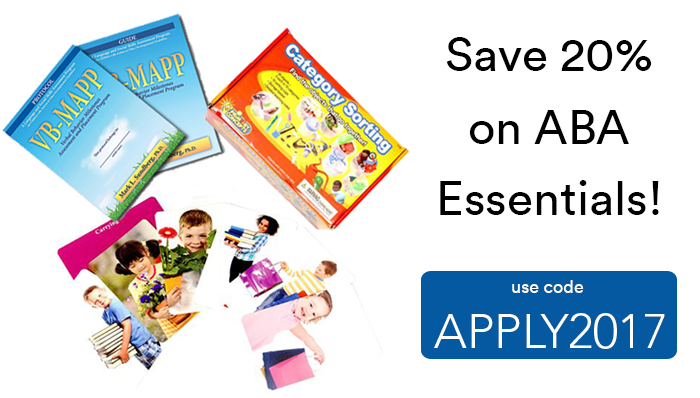
Pick of the Week: ABA Essentials!

ABAEssentialsEmail

This week, we have an amazing collection of essential tools for systematic language instruction selected for us by Rosemarie Griffin, MA, CCC/SLP BCBA – creator of the Action Builder Cards!

*Promotion is valid until December 25th, 2017 at 11:59pm ET. Offer cannot be applied to previous purchases, combined with any other offers, transferred, refunded, or redeemed and/or exchanged for cash or credit. Different Roads to Learning reserves the right to change or cancel this promotion at any time. To redeem offer at differentroads.com, enter promo code APPLY2017 at checkout.


Posted in ABA

Ten tips to prevent autism-related shopping meltdowns

This week’s blog comes to us from Lucia Murillo, Autism Speaks’ assistant director of education research. and was originally posted on Autism Speaks as part of their Got Questions? series.

“How can I help my child avoid meltdowns at the store? Everything is okay with him until he gets into the store.”

Thanks so much for your question. You are far from alone in this challenge. For good reason, outings such as shopping can be particularly challenging for families who have children with autism.

The abundance of sights, sounds, crowds and other sensory stimuli can easily trigger challenging behaviors that seem near-impossible to handle in a public place. Unfortunately, this prompts many families to avoid taking children with autism to public places unless absolutely necessary. This, in turn, can contribute to isolation for the whole family.

So I’m so pleased for this opportunity to share a few meltdown-prevention strategies that, when practiced ahead of time, can help promote a calmer shopping experience.

But when I say “ahead of time,” I don’t mean right before you head to the store. These strategies involve time and patience. Ideally, you’ll also have the guidance of a behavioral therapist skilled in working with children who have autism.

#1 Give fair warning
Research and experience tells us that “knowing what to expect” helps children with autism cope with potentially stressful situations. This means resisting the understandable temptation to try to sneak a quick shopping trip into your son’s day. Whenever possible, I strongly recommend letting him know ahead of time where he is going and what he can expect.

#2 Take a virtual tour 
You and your son may be able to take a virtual tour of the store on the store’s website. If that’s not available, consider visiting the store on your own to take pictures and/or a cell-phone video.

This approach is particularly useful for preparing your child to accompany you to a new store. Sit down and look at the pictures and/or watch the video together so your son can become familiar with the new environment.

You might even take a virtual drive to the store using Google Maps.

#3 Practice and build tolerance

When you feel your child is ready to make an actual trip to the store, I suggest starting with a short trip and small purchase. Reward any degree of success with praise and perhaps a small prize or favorite activity.

As you sense your child is getting more comfortable with the short trips, gradually increase the length of time that the two of you are in the store. At this point, try to incorporate these trips into a regular routine – but always with fair warning – so your child can learn to expect them.

Repetition is important. And occasional reversals are likely. So don’t give up!

#4 Prepare a schedule 
Many children – and adults – on the autism spectrum greatly benefit from having a clear schedule for the day ahead. Visual schedules are particularly helpful, and the Autism Speaks visual supports guide can help you make one.

A morning review of the day’s activities can help your child gain a sense of where he’s going and what he’ll be doing. So on the morning of a shopping trip – or even the night before – sit down with your child as you add a shopping trip to the schedule. Or invite him to add it at the specified time.

It can help to schedule one of your child’s favorite activities following the shopping trip and together enter it on the day’s schedule. This can be as simple as time to play with a favorite toy or game with you.

#5 Remember: Rest is best
It can greatly increase your son’s chances of success if you make sure he’s well rested before the outing. In fact, the same goes for you! Being tired tends to shorten everyone’s tolerance.

#6 Identify triggers 
You know your child best. Are there certain sights, sounds or situations that tend to produce to a meltdown? You might try visiting the store without your son with an eye for such triggers. For some people with autism, fluorescent lighting is a trigger. Others are bothered by the loud hum of air conditioners or the blare of clerks calling to each other over the intercom.

#7 Provide personalized “armor”
Identifying triggers enables you to provide personalized support. For example, if loud sounds provoke anxiety in your son, he might be helped by headphones. If overhead lighting is a problem, he might be willing to wear sunglasses or a baseball cap. Many parents find these strategies make a world of difference for their kids.

#8 Getting ready to shop …
Before leaving the house, consider prompting your son with a finer breakdown of what you’re going to do on this shopping trip. For instance:

* We will drive to the store.

* We will park in the lot.

* We will walk into the store.

* We will find the items we want.

* We will pay for them at the register.

* We will walk back to the car.

* We will drive home.

* And we will play a game of Uno.

If, like many people with autism, your child responds best to visual information, try making a personalized story with pictures about the above steps. Autism Speaks has partnered with the University of Washington READI Lab to provide a series of personalized story templates that include Going to the Store. Learn more and download them for free here.

#9 Have a signal
Make sure there’s a way for your child to communicate to you when he begins to feel overwhelmed. We know that children who have autism vary widely in their ability to communicate. So one child might be able to simply say “I need a break.” Another might need to learn a sign – such as hands over ears. Picture communication systems are yet another option. (See the Autism Speaks visual supports guide mentioned above.)

Even if you child can’t reliably communicate when he’s getting overwhelmed, there are often behavioral cues that you can learn to recognize in time to leave the store or otherwise provide support before the meltdown.

#10 Bring “cool down” items
Meltdowns happen. Sometimes, having a favorite comfort item on hand can help ease the crisis.Despite all the best plans, meltdowns happen. You can ease the crisis by bringing an object or activity that you know will soothe. This could be a favorite toy or blanket. It could be a special little song.

All these strategies have the same goal: To provide optimal conditions for your child when taking him into an overly stimulating environment. By preparing ahead of time, you can increase the chances that the shopping trip – or any outing – will be more tolerable for your child and entire family.


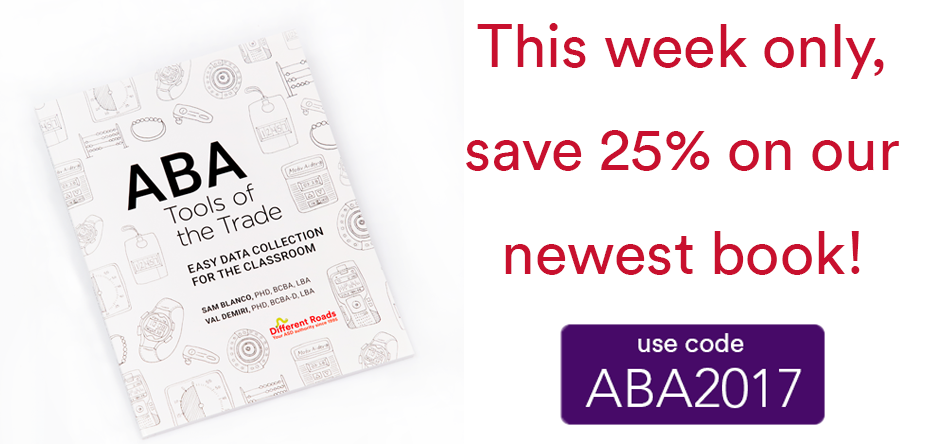
ABA Tools of the Trade!

TOTTHomepage

A Different Roads exclusive, ABA Tools of the Trade is a collection and summary of tools in ABA and how to use them to both track behavior and effect behavior change. Perfect whether you’re new to data collection or just looking for new tools and strategies!


*Promotion is valid until December 11th, 2017 at 11:59pm ET. Offer cannot be applied to previous purchases, combined with any other offers, transferred, refunded, or redeemed and/or exchanged for cash or credit. Different Roads to Learning reserves the right to change or cancel this promotion at any time. To redeem offer at differentroads.com, enter promo code ABA2017 at checkout.
Posted in ABA