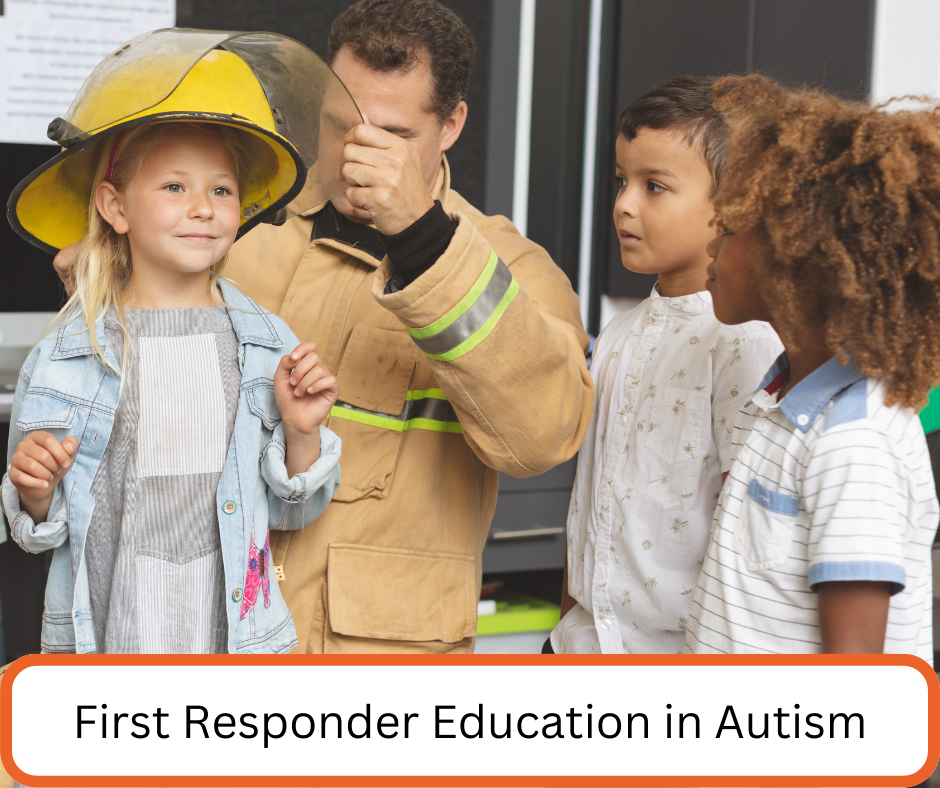
First Responder Education in Autism

This month’s ASAT feature comes to us from Dr. Karen Parenti, MS, PsyD CEO/Executive Director at Special Friends Foundation. To learn more about ASAT, please visit their website at www.asatonline.org. You can also sign up for ASAT’s free newsletter, Science in Autism Treatment, and like them on Facebook!

I am a parent of a young man with autism. I also work in the area of law enforcement. What are some important considerations when teaching first responders and law enforcement personnel how to interact with individuals with an autism spectrum disorder?

This is a very important question and one in which many local communities continue to place their focus. In addition, treatment of individuals with autism spectrum disorder (ASD) by law enforcement is a common worry for parents or caregivers. As such, the topic requires training to increase awareness of ASD for first responders and local community members, as well as collaboration between service providers and law enforcement. As in any crisis or challenging situation, the main focus should be on positive and preventative approaches, as most behavioral crises with individuals with ASD can be avoided or lessened. To promote awareness on the part of first responders and prevent crises, ASD service providers should regularly and proactively prepare individuals with ASD for a possible encounter with emergency personnel and law enforcement using understandable language, pictures, books, or video models about emergencies, so they know what to expect and how to respond. Additionally, building ongoing rapport and familiarity between individuals with ASD and their local police or fire departments might help ensure the person with ASD perceives the first responder as a helper when a behavioral or medical event occurs. In many cases, situations will arise that require emergency intervention by first responders because of the unique challenges and behavioral escalations that commonly occur with individuals with ASD. Therefore, training for first responders is of the utmost importance.

Police officers consistently and expertly respond to a large number and variety of emergency situations daily. Each emergency has its own unique characteristics, and so do the individuals involved in that crisis. First responders and police receive standard and rigorous training on how to respond to emergencies compassionately and effectively. This training, while appropriate and efficient for most situations, is not necessarily the best way to respond to a child or adult who is diagnosed with ASD. Unfortunately, this may lead to a tragic outcome such as injury or death.

Whether the emergency is a medical or behavioral crisis, understanding ASD and how someone with ASD might behave are crucial to ensuring a favorable resolution to any incident. Individuals diagnosed with autism may have heightened emotional responses in these volatile and stressful situations. For persons with ASD, emergencies are difficult to comprehend. During these uncertain and confusing events, a person with ASD may fail to respond to vocal directions, may exhibit a startle response when touched, may run when addressed, or may engage in self-injurious or aggressive behavior.

For emergency responders, interacting with individuals with ASD can seem ambiguous and unpredictable. Therefore, it is essential that emergency personnel learn to respond as sensitively and effectively as possible to individuals diagnosed with ASD, so attempts to speak with or care for the individual do not inadvertently cause the individual’s behavior to escalate. As you may know, this is especially important during a medical crisis because individuals with autism cannot always communicate feelings of pain or discomfort. A person with ASD may already be feeling frustrated and possibly agitated by their inability to convey their concerns and needs, thus when approached, that individual may respond in an unpredictable and unconventional manner. It is important that first responders be prepared for such unusual responses, incongruent emotions, and failure to respond to directives and questions.

In addition to providing police officers and first responders with information about autism symptoms more generally, an important next step is to teach first responders how individuals with ASD might behave in a crisis. In particular, emergency personnel need to understand how individuals with ASD might act when they are scared, agitated, confused, overwhelmed, or in pain.

A Child or an Adult Diagnosed with an Autism Spectrum Disorder May:

  • Avoid eye contact.
  • Walk away from family residence or group home to stores, shopping centers, local pools, or other places they enjoy. They may wander into traffic, not understanding environmental dangers.
  • Be overstimulated and not comply appropriately to police or first responders’ instructions. For example, they may not respond to directives such as “come here”, “get out of the street” or “let me see your hands.”
  • Become preoccupied with certain objects or interests, such as planes, trains, fire trucks, or movies.
  • Repeat or echo phrases, words, or actions.
  • Not know how to relate, talk, or play with others.
  • Have sensory sensitivity, manifested by stereotypical behaviors which may include covering their ears, flapping their hands, spinning, toe walking, or making unusual noises among others.
  • Become agitated due to the disruption in their routine.
  • Have unusual reactions to the way things in the environment look, feel, smell, sound, or taste.
  • Not speak at all or may not be able to communicate their wants or needs effectively.
  • If verbal, may have difficulty understanding questions or may respond noncontextually. For example, they may simply script from a movie, speak about their special interests, or provide answers that appear to be evading the questions posed.
  • Be unable to communicate that they are in pain.

A first responder will be able to interact more appropriately with a person with autism if he or she is able to recognize that the person may have ASD. It may also be helpful if the first responder becomes familiar with the following crisis response and intervention safety habits.

Crisis Response and Safety Habits:

  • Take 30 seconds to assess the situation and the scene before responding.
  • Remain calm.
  • Use an even, controlled tone of voice with minimal directives, including simple phrases and visual cues such as pointing or using simple gestures that may be easily understood by minimally verbal individuals.
  • Pay close attention to the person’s body language, tone of voice, gestures, and any other signs of potential fear or agitation.
  • Practice trauma-informed care and assume that everyone has experienced some type of trauma and is easily startled.
  • Respect personal space, except when it is necessary to approach the person. Remember that getting too close may increase agitation in some individuals with ASD. Ask the person or someone familiar with the individual with ASD what they want/need while maintaining a safe distance.
  • If possible, recruit familiar and trusted persons to assist you in understanding how to approach the individual.
  • Reduce stimulation and allow time and space for the person to process information and requests. For example, it might be helpful to clear the area of additional people, turn off the lights of the emergency vehicles, and eliminate other extraneous noises as much as possible.
  • Be prepared and practice situational awareness. Know your surroundings and the location of the closest exit.
  • Deflect aggression and block self-abuse when and if possible. If a physical intervention is necessary because the situation is unsafe, establish control in a safe, non-threatening manner. Remind the person that you are there to help.

Awareness is Essential

When police officers and first responders receive training in interacting and working with individuals with ASD, incidents in the community may be resolved quickly and more effectively. With quality training, headlines reporting distressing incidents, such as that above, may be a thing of the past. Instead, the type of training discussed here, when offered regularly to our dedicated police officers and first responders, could result in positive approaches like this:

Autism awareness is essential for all members of the larger community but is truly imperative for first responders. In the absence of information, first responders may misinterpret the behavior of a person with ASD, may ascribe hostile intent to agitated behavior, may inadvertently escalate the behavior of the individual, or may fail to safely calm the individual. In cases such as these, there can be dangerous consequences. An opportunity exists for ASD service provider agencies to provide specialized training to local first responders. Providers can contact law enforcement officials and other emergency personnel to offer informational training sessions on a local level. In our experience, the administrators are routinely grateful and accommodating about arranging such training.

First responders need a dual skill set. First, they need accurate information about persons with ASD, including their behavioral characteristics, and secondly, they must use skills to de-escalate the situation when they engage with a person with autism who is in a confused and agitated state. With community outreach, negative outcomes can be averted, bridges can be built, and wider acceptance of persons with ASD can become a reality.

Additional Information and Resources

The following resources provide additional information related to first responders:

About the Author

Dr. Karen Parenti works as the CEO/Executive Director of Special Friends Foundation.  She has extensive experience in ABA and in developing and overseeing group homes, day services, and rehabilitative programs for individuals with intellectual and developmental disabilities and autism. She also serves as the treasurer of the MAX association’s board where she continues to advocate for the needs of the individuals she serves. Karen earned her Bachelor’s degree in psychology from York College of PA, her Master’s Degree in Human Services Administration from Springfield College in Wilmington, DE and her Doctorate Degree in Clinical Psychology from Immaculata University.

This article has been republished with permission from https://asatonline.org/research-treatment/clinical-corner/first-responders/
Posted in ABA

VB-MAPP vs. ABLLS-R: Which Assessment Should I Use?

By Sam Blanco, BCBA

Assessment is the cornerstone of creating appropriate and effective interventions. Two common assessments used for youngsters with autism are the Assessment of Basic Language and Learning Skills-Revised (ABLLS-R) and the Verbal Behavior – Milestones Assessment and Placement Program (VB-MAPP). You’ve likely heard of both the ABLLS-R and the VB-MAPP. While these two assessments are similar in many ways, there are also some big differences that might make one more appropriate for you than the other.

ABLLS-R

The ABLLS-R is made up of two components: the ABLLS™-R  Protocol and the ABLLS™-R Guide. The protocol is comprised of a skill-tracking system, assessing items ranging from listening and language skills to academic and ADL skills. The scoring system is simple, in that each specific skill is broken down into 2-4 levels. You simply mark the level that matches your client’s current skill. The simple organization allows for you to easily track your learner’s progress.

It is important to recognize that the ABLLS-R is more than just the protocol. It also includes the ABLLS-R Guide, which provides instructions for scoring as well as strategies for using the information to develop appropriate goals. Over the years, I have seen many practitioners simply using the protocol without referring to the guide. This is an error that should be corrected, as the guide is a useful resource for parents, teachers, and practitioners. Finally, the ABLLS-R assessed skills that typically develop between approximately ages 2-6.

VB-MAPP

The VB-MAPP is composed of five components.

The Milestones Assessment is comprised of 170 measurable milestones, all based in B.F. Skinner’s analysis of verbal behavior. It focuses primarily on language and social skills, but does include some skills related to academics.

The Barriers Assessment provides a way to assess and measure common barriers to learning experienced by children with language delays. These include barriers such as prompt dependence, impaired social skills, and failure to generalize.

The Transition Assessment provides a way to assess and measure progress towards the child’s ability to move to a less restrictive environment. This portion of the VB-MAPP includes items such as the rate of acquisition for new skills, adaptability to change, and ability to learn from the natural environment.

The fourth component of the VB-MAPP is the Task Analysis and Supporting Skills. This portion goes hand-in-hand with the Milestones Assessment. It is comprised of hundreds of skills that are often directly related to the milestones. It shows the skills that should be taught prior to each milestone and can provide additional information into the child’s current skill level.

The final portion is the VB-MAPP Placement and IEP Goals. This is an in-depth guide for developing IEP goals and identifying interventions based on the results of the other portions of the assessments.  As with the ABLLS-R, I’ve seen many practitioners utilizing the VB-MAPP without referring to the Placement and IEP Goals in the VB-MAPP Guide. This is an error that should be corrected to best use the assessment. The VB-MAPP assesses language skills that typically develop by age 48 months.

VB-MAPP or ABLLS-R?

It is valuable to receive training in both of these assessments. They are important tools for assessment, especially if you are working with young children.

No matter what assessment you choose, we’ve got you covered! Head to our website and check out our full line of ABLLS-R and VB-MAPP supports, including our exclusive full assessment kits!


About The Author

Sam is an ABA provider for school-aged students in Brooklyn, New York. Working in education for over 15 years with students with Autism Spectrum Disorders and other developmental delays, Sam utilizes strategies for achieving a multitude of academic, behavior, and social goals. She is also an assistant professor in the ABA program at The Sage Colleges and the Senior Clinical Strategist at Encore Support Services. You can read more of Sam’s posts for Different Roads To Learning when you click here!

Preference Assessments & The RBT Dilemma

By: Tameika Meadows, BCBA from I Love ABA

Across multiple industries, staffing deficits are a big problem right now. 

There are many different explanations for this, but certainly in a post-COVID world all of us are redefining work, evaluating our priorities, and learning how precious our time is…..if people are unhappy at work/in their career, it makes sense that the past 2 years would push them to DO something about that.

But let’s talk about RBT’s, specifically.

The RBT credential is an entry level position into this field. When a clinician company hops, it is usually for a different BCBA position. After all, there was tremendous time, energy, money, and schooling that went into the decision to become a BCBA, so most will try a new company out before trying a new profession.

For RBT’s though, many are not that connected to the field. They may still be figuring out if this is what they want to do long-term. Or, they may already know that they plan to pursue education, mental health, counseling, or other degrees, and are working as a RBT now for valuable experience. The point being, its often true that RBT’s not just company hop, but industry hop/leave the field. Especially right now, when the impacts of quarantine and the pandemic are still lingering. Client cancelations, health scares (e.g. sessions canceled for a week until a clear COVID test), companies lowering rates or decreasing benefits to ease financial strain, funders decreasing reimbursement rates, etc. All of this contributes to the experience of the RBT.

I mean, just look at current gas prices. If you think that isn’t impacting the job satisfaction of RBT’s who spend most of their day driving from client to client, then you are deluding yourself.

So, what can be done?

Why Do RBTs Leave?

What is often attempted is increasing incentives. Things like: pizza day, bonuses, raffle drawings, trivia nights, casual Fridays, referral bonuses, public recognition/”Shout Outs” from management, use of a company iPad, etc.

Here’s the problem though: did anyone ask for that? 

What are your frontline staff asking for? When people leave, WHY did they leave? When people turn down an offer, or decline moving forward in the interview process, WHY did they lose interest? What happened? When staff complain or bring up concerns, are they addressed and resolved? Or bounced from person to person in the company? Is management toxic to deal with, unprofessional/gossipy (especially in center based settings), incompetent, etc.? Toxic managers are one of the largest reasons why people leave otherwise good companies.

 When I speak with unhappy RBT supervisees, the issues they describe to me tend to be systemic/management level problems (meaning, the supervisee cannot fix the issue), or a symptom of RBT mistreatment/low regard.

For example:

  • Low pay/Pay rate has not budged since hire/Low hours (hired as FT but only working PT hours)
  • Client cancelations or schedule changes that cause loss of income
  • Poor fit to clients on caseload/Working outside of clinical competency
  • Not supported by BCBA/Minimal supervision
  • Issues with admin or management (rude, unprofessional, incompetent, etc.)/Inaccessible owner, management, or HR/Management does not support or “back” the RBT when there are issues with the client parent
  • No company policy on parent involvement or participation/No company policy on respecting the staff or employees/No consequences when client families regularly arrive late to sessions or cancel frequently
  • Excessive driving (only client is 2 hours away)
  • No benefits/No healthcare due to unable to maintain FT hours
  • Company does not provide needed equipment and supplies to perform job/RBT must provide their own supplies
  • Being expected to do extra work for free (required to train new hires for free)
  • Insufficient training on company required technology (required to use data software, but minimal training on it or support when it isn’t working correctly)

If I was working with a client, and providing access to pizza, gift cards, and trivia nights, but the target behavior was not improving, my conclusion would be that I need to reevaluate my reinforcers. Looks like they aren’t so reinforcing after all!

Okay, then let’s apply that same conclusion to our workforce. If they are continuing to quit in large numbers, the reinforcers and motivating variables are lacking. Something is wrong, something is off. And as owners, bosses, managers, and stakeholders in this conversation (supervising BCBAs may not actively hire or employ RBTs, but we can certainly advocate and speak up for them in the workplace) we need to do better for our highly important RBT workforce.

So, what do RBTs want?

Heck, I don’t know. 😊

You need to ask THEM that. Individually. Consistently. Intentionally. At the onset of employment. As well as on a recurring basis once they take the job.

Don’t wait for people to become unhappy and dissatisfied and only then start pouring on the incentives, gift cards, and bonuses. Be proactive and intentional about building a strong workforce, demonstrating value (link), and probing individual employee preferences and reinforcers, so that the workplace can be an enjoyable setting (and reinforcing stimulus) for the people wo work there.

…… Or it’s highly likely they won’t work there for long.

This piece originally appeared at www.iloveaba.com.

About the Author

Tameika Meadows, BCBA

“I’ve been providing ABA therapy services to young children with Autism since early 2003. My career in ABA began when I stumbled upon a flyer on my college campus for what I assumed was a babysitting job. The job turned out to be an entry level ABA therapy position working with an adorable little boy with Autism. This would prove to be the unplanned beginning of a passionate career for me.

From those early days in the field, I am now an author, blogger, Consultant/Supervisor, and I regularly lead intensive training sessions for ABA staff and parents. If you are interested in my consultation services, or just have questions about the blog: contact me here.”

Posted in ABA

This is Hard.

By: Tameika Meadows, BCBA from I Love ABA

“This is hard” is a statement I often hear from families both in the midst of intervention, and pre-intervention during the assessment phase.

Families without support and services find it hard helping their Autistic child navigate the world, and families in the midst of therapies and interventions find generalizing them to be hard.

It’s hard to consistently generalize an intervention plan outside in the home, on the weekends, on Sunday at the grocery store, on vacation at Grandma’s house, or at 6am on a Saturday when your child only slept 2 hours.

But its also hard to supervise/monitor your child 24-7, to break up sibling fights all day long because your child can’t share, to find quality childcare options when your child is highly aggressive, or to figure out if your child is ill or sick when they can’t tell you.

Both are hard.

It is rarely a discussion of hard vs easy, and much more common is a decision regarding which “hard” is acceptable. Yes, toilet training is hard work. On the flip side, changing an 8 year-olds diaper isn’t exactly easy. Nor is it easy to afford to buy diapers for that many years.

Yes, teaching your child to use utensils instead of eating with their hands is hard. On the flip side, restricted diet and issues around mealtimes can be made worse if the child will only eat finger foods (typically, starches and carbs). That is also hard.

Yes, it is hard to consistently follow a Behavior Plan when in public with your child. On the flip side, being asked to leave locations, having friends ask that you not visit, or being scared someone will call the police on your child during a public outburst, is a hard reality to live out.

You have to decide which “hard” to accept.

I intentionally use the phrase “intervention plan” and not “ABA therapy”, because maybe your child isn’t receiving ABA services. Maybe you don’t want that, or can’t access it.

But are they receiving Speech services? OT? PT? In special education at school? Attending an Autism preschool program?

If so, these are all interventions designed to minimize developmental delays and target current deficits.

Whatever kind of intervention your child participates in, there are a few components that tend to be the same across different therapies:

1. Consistency. In order to be effective, the intervention must be applied consistently. Frequent staff turnover, frequently canceling appointments, or other issues like this can negatively impact results.

2. Training must carry over to the home setting/caregivers. There is no way to generalize the intervention if you have no idea what it is.

3. Caregiver Participation. In order for #2 to happen, the caregivers must be willing and available to participate in the intervention/treatment plan.

4. Focus on progress vs miracles. Progress can be slow, it can be up and down, and at times it can mean treading water. Sometimes an absence of regression IS progress. If you have sky high expectations of the intervention process, this can cause “provider hopping” where families move from one agency, provider, or intervention to the next looking for magic. That just is not how quality, ethical treatment works.

5. Individualized Intervention. It doesn’t matter if your child receives 30 minutes of Speech each week, or 15 hours of ABA. Are the treatment goals and the teaching methodology suitable and appropriate for your child? “Cookie-cutter” intervention is when treatment is applied in a lazy, vague, and generic way across multiple clients. In order for intervention to be effective, it must meet your child where they are and incorporate their unique interests and motivation(s).

About The Author: Tameika Meadows, BCBA

“I’ve been providing ABA therapy services to young children with Autism since early 2003. My career in ABA began when I stumbled upon a flyer on my college campus for what I assumed was a babysitting job. The job turned out to be an entry level ABA therapy position working with an adorable little boy with Autism. This would prove to be the unplanned beginning of a passionate career for me.

From those early days in the field, I am now an author, blogger, Consultant/Supervisor, and I regularly lead intensive training sessions for ABA staff and parents. If you are interested in my consultation services, or just have questions about the blog: contact me here.”

This piece originally appeared at www.iloveaba.com. 

Posted in ABA