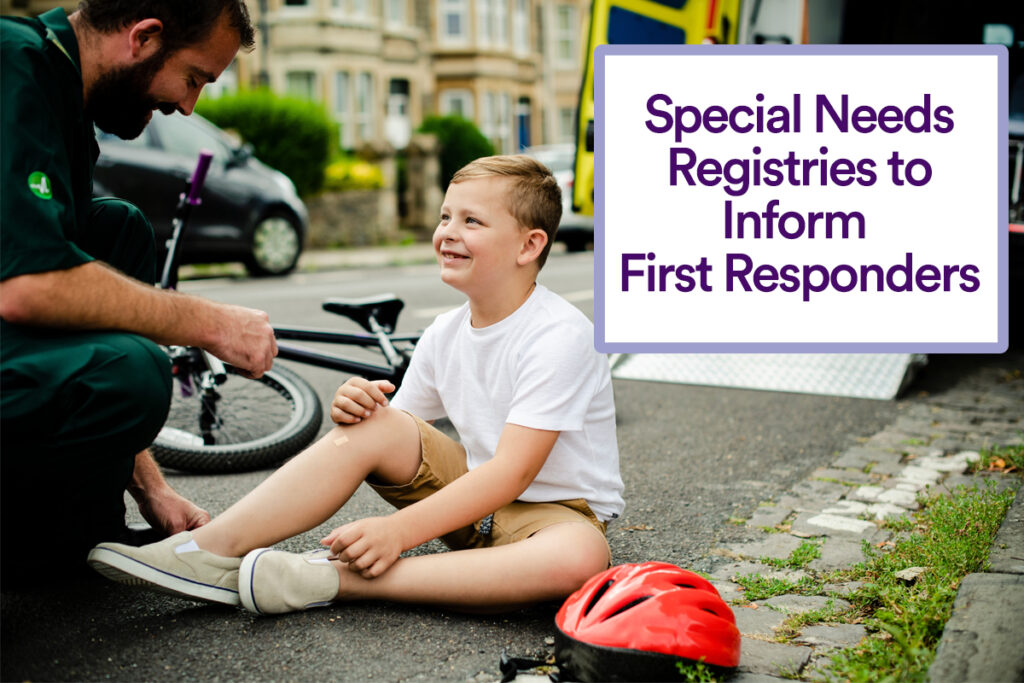
Special Needs Registries to Inform First Responders

By: Cassie Hauschildt
When a child is diagnosed with autism, there are a number of resources, therapies, and programs recommended  to parents. They are told all about ABA, ST, OT, PT, and FT, among others, receiving an alphabet soup of therapies. We explain the importance of early intervention. For parents of older children or teens, they learn how to navigate the school system with BIPs, IEPs, ARDs, and more. They begin to understand the behaviors of their children in a new light, and may even gain a few new fears from behaviors of other children. They learn the proper term for eloping and steps to take to help prevent sensory overload. And while many behaviors are explained, it also becomes obvious that there is not an immediate fix for many of them.

One service that professionals may not tell parents  about at the time of diagnosis is their local police department’s registry program for individuals on the Autism Spectrum (along with other disorders or special needs). However, if this is a service is available to them, it could help alleviate many of the concerns that come along with an autism diagnosis. This free and essential service is often not openly advertised to the public, but rather, lives on a corner of their local webpage. Some don’t even have an obvious link on the homepage, requiring citizens to use the search function in order to get their child included on the list. This service can have a variety of names, including but not limited to: “Safe Return Program,” “[Autism and] Special Needs Registry,” “C.A.R.E.S,” and “Voluntary Registry Program for Vulnerable Populations.”

Registering your ASD Child for this program will create a note associated with your home address in the local police’s internal system. This can help participants in multiple ways. First, if there is ever an officer dispatched to your home, they will be alerted that an ASD individual lives in the home and be prepared to accommodate that person’s needs. Additionally, if a child was to elope, many programs have the option to upload a recent photo. This will make it easier for law enforcement to distribute the child’s picture quickly. For some cities, , this information could also be shared with the any firefighters or paramedics sent to the home by the dispatch team.

The method for finding if your local police department offers this program will differ depending on your city. The best start is to try searching “[CITY NAME] Special Needs Registry” on a search engine such as Google. If this doesn’t work, you may have to do some detective work on the local police website. When trying to find this program locally, I had to find the “Community Programs” tab on the menu bar of the police website.

Each program will require different information to register. At a base, caregivers should expect to provide name, address, diagnosis, and physical description of the registrant as well as the contact information for all caregivers. If the registrant is able to drive, information about their primary vehicle will also be required. Any additional required information will vary depending on the local program. Some require a doctor’s letter proving diagnosis, others ask for a recent picture, and other ask for communication methods and support items.

If you find that your local police department doesn’t have a program, consider approaching them about implementing one. With the updated CDC estimate of 1 in 44 children getting diagnosed with autism, it is almost guaranteed that this program will be useful to more than just you. Additionally, these programs can be utilized for individuals with Alzheimer’s, Dementia, Down Syndrome, and many other special needs. BCBAs and Educators are the perfect individuals to partner with  police on  program parameters. Additionally, it’s a great opportunity to broach your local police department  about training for interacting with ASD individuals.

Cassie Hauschildt received her autism diagnosis at 32 years of age and is the mother of an ASD son, who was diagnosed at 20 months old. Since his diagnosis, she has become an advocate for ASD children. She dedicates her time to mentoring parents of ASD kids through the tough first few months post-diagnosis. She also is trying to get rid of the negativity surrounding ABA therapy. She does this through humor, while using real talk, on her TikTok @AnotherAutismMom. She also runs the “Dino and Nuggets Corner” Facebook Group.

Autism Early Intervention and Joint Attention

By: Rose Griffin, SLP, BCBA

There is a strong bond between joint attention and both receptive and expressive language skills. When we work on joint attention, we are showing that our learners’ communication is powerful! I am sharing a few tips and ideas that I use to build connection before communication while working on joint attention goals.

These activities involve shared activities through playing with toys, singing songs, and reading books. It is okay if your student isn’t ready to fully engage when you introduce these activities, note their baseline data and move forward with goals. You will be amazed to see the transformation and excitement over these simple activities.

Toys:

Playing with toys in therapy is all about creating an interaction in a semi-structured environment. Remember to use simple language and allow for natural curiosity and play and not bombard with questions. 

Examples of toys I love to use:

  • Car and car track
  • Mini Objects
  • Farm Set

Literacy:

Build excitement around the book, use books with repetition, and if your kids like it try an animated voice which can be really fun.

A few books I love to keep in my therapy bag that are a great success for joint attention are, Pete the Cat and his White Shoes, Brown Bear, The Very Hungry Caterpillar, and Chicka Chicka Boom Boom.

Music:

Students love songs, they are familiar, and create engagement. I also love to use visuals that can be just laminated pictures or little toys that match the activity of the song. It can also be engaging to sing songs that have motions for the words.

Songs I love:

  • Old Macdonald
  • Wheels on the Bus
  • Head, Shoulders, Knees, and Toes

It can be difficult to keep data and set goals around these abstract ideas, be sure to check out my goal bank on ABA speech. I hope you love these ideas and get use out of them in your next therapy session! 


Rose Griffin, SLP, BCBA is dedicated to helping SLPs and other professionals provide systematic language instruction with ease. Working with students with autism and other complex communication disorders can be challenging. Rose has dedicated herself to helping by providing professional development and real life examples of what she does in her daily practice. See her podcast, blog, and collaboration opportunities at www.abaspeech.org

Posted in ABA

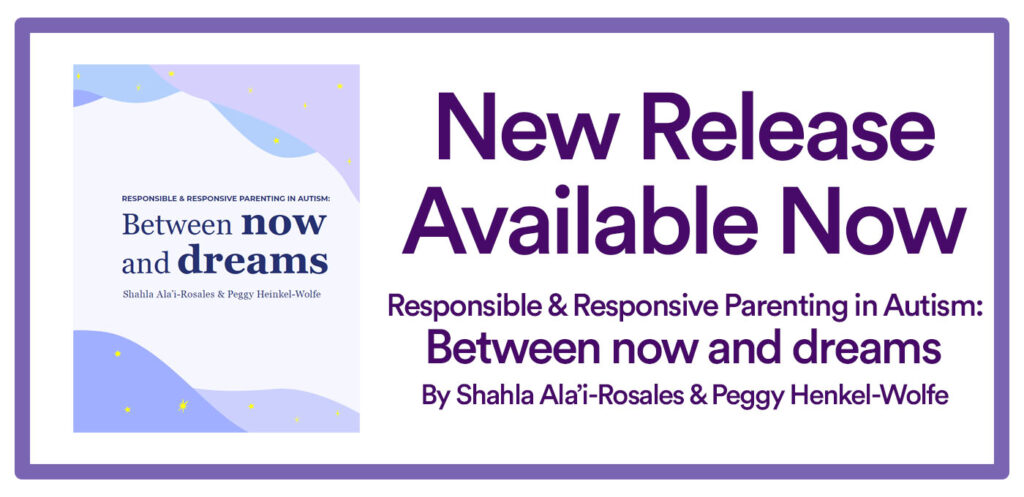
Spotlight: Responsible & Responsive Parenting in Autism: Between Now and Dreams

By: Shahla Ala’i-Rosales and Peggy Heinkel-Wolfe

At one time there were very few avenues available to the increasing number of families receiving autism diagnoses for their children. In the 1960s experimental psychologists took a new direction to improve the quality of life for people on the autism spectrum and their families.  Their work in behavior intervention began as a treatment for people society had neglected.  Little did they know that it created a market.

Their success resulted in a new way of approaching autism that can bring lasting change when services are delivered with intention, skill, effort, and love. Today, autism services are widely available. These services have also become a multi-billion-dollar industry, where a child’s disability risks becoming a business opportunity.

But we can minimize that risk. First, we can ground ourselves in ethical principles and the science of learning. Then, we can remember the power that families have had all along: love. Responsible and Responsive Parenting in Autism: Between Now and Dreams offers timeless guidance as it answers three essential questions: What do you need to know? Who will help you? How can love be your compass?

Prior to the publication of this book, the authors have been friends, colleagues, and allies for 30 years. Shahla’s expertise as an applied behavior analyst and years of clinical work inform this book. Peggy is the author of See Sam Run: a mother’s memoir of autism, winner of a Mayborn Nonfiction Prize.

Together, they have collected meaningful stories from their own experiences and from others on the journey. The stories focus on how family members can understand the scientific principles behind autism services, how parents and professionals can best help and respond to their child and each other, and how they can bring meaning to all of their interactions.

All parents have a responsibility to raise their children with autism as best they can. Parents cannot sidestep this journey. This work is part of how we all develop as humans—nurturing children in ways that honor their humanity and invite full, rich lives. Between Now and Dreams provides the roadmap for a joyful and sustainable journey. The essence of this journey relies on three powers; learning, connecting, and loving. Each power informs the other. Each amplifies the other. And each power is essential for meaningful and courageous parenting.


Shahla Ala’i-Rosales is an Associate Professor int he Department of Behavior Analysis at the University of North Texas. She has taught courses on ethics, early autism intervention, parent training, behavioral systems, applied research methods, technology transfer, and behavior change techniques. She has served on several boards and disciplinary committees and has published and presented research on social justice, ethics in early intervention, play and social skills, family harmony, and supervision and mentoring. Shahla has more than four decades of experience working with families and has trained hundreds of behavior analysts. She has received awards for her teaching, her work with families, and for her work in the community.

Peggy Heinkel-Wofle‘s first book, See Sam Run, a mother’s story of autism, was originally published in 2008 by the University of North Texas Press. The book’s manuscript won the Mayborn Prize for Literacy Nonfiction in 2005. For more than a decade, she has been exploring themes in autism parenting and self-determination on her blog, peggyheinkelwolfe.com. An award-winning writer and journalist, Peggy holds a master’s degree in journalism from the University of North Texas and a master’s degree in music performance from the Eastman School of Music.

Posted in ABA