Pick of the Week: NEW! Executive Function Curriculum Books

How can you help kids with autism be flexible, get organized, and work toward goals – not just in school but in everyday life? It’s all about executive function. This week, we’re offering 15% off* our newest books on teaching executive function: Unstuck & On Target: An Executive Function Curriculum and Solving Executive Function Challenges. Just use our promo code EXECFXN at check out to redeem these savings!

Unstuck_and_On_TargetThese practical resources for parents, teachers, and therapists help high-functioning students with autism improve on these critical skills.

Unstuck & On Target! is a robust classroom-based curriculum book that will help educators and service providers teach these executive function skills to high-functioning students with autism through ready-to-use lessons that promote cognitive and behavioral flexibility. This curriculum gives clear instructions, materials lists, modifications for each lesson, and intervention tips to reinforce lessons throughout the school day. Topics touched upon include flexibility vocabulary, coping strategies, setting goals, and flexibility in friendship, all introduced and reinforced with evidence-based lessons. Lessons will target specific skills, free up the instructor’s time, fit easily into any curriculum, ensure generalization to strengthen home-school connection, and best of all, make learning fun and engaging for students in the classroom.

Unstuck & On Target! also comes with an accompanying CD-ROM that contains printable game cards, student worksheets, and other materials for each lesson. The curriculum is targeted for students with cognitive ability and language skills ages 8-11.

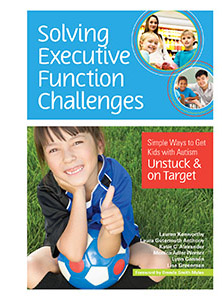
Solving_Executive_Function_ChallengesSolving Executive Function Challenges is a strategy guide that offers teachers and caretakers various ways to teach EF skills, including setting and achieving goals and being flexible, as well as ideas for accommodations and actions to address common problems (e.g. keeping positive, avoiding overload, coping, etc.).

To be used with or without the robust curriculum Unstuck and On Target!, this strategy guide aims to show how to embed executive function instruction in everyday scenarios with specific examples, samples IEP goals, and scripts and worksheets that break down tasks into manageable chunks. This guide is appropriate for learners in grades K–8.

Don’t forget – you can save 15%* this week only on these new executive function books by applying promo code EXECFXN at check out!

*Offer is valid until 11:59pm EDT on October 7th, 2014. Not compatible with any other offers. Be sure there are no spaces or dashes in your code at check out!

Guest Article: “Promoting Socialization in Children with Autism Through Play” by Julie Russell

We’re so pleased to bring you this guest post by Julie Russell, Educational Director at the Brooklyn Autism Center (BAC). BAC is a not-for-profit ABA school serving children aged 5–21. Here, Julie describes specific, simple strategies for promoting socialization in children on the spectrum.

_______________________________

Promoting Socialization in Children with Autism Through Play
by Julie Russell, Brooklyn Autism Center

Socialization – defined as a continuing process where an individual acquires a personal identity and learns the norms, values, behavior, and appropriate skills – is a vital part of life. It is also a particularly difficult skill for individuals with autism. Children with autism often struggle with initiating conversation, requesting information, making contextual comments, and listening and responding to others. These difficulties can interfere with the development of friendships for children on the spectrum.

The best way to improve socialization in children with autism is to emphasize play. There are several strategies to teach play skills to children on the spectrum that can help them improve socialization and develop friendships.

One method of teaching socialization is to condition the typically-developing peer as a reinforcer by pairing the peer with items and activities that are reinforcing for the child with Autism. The peer can give the child with Autism a preferred edible or join in on a preferred activity for the child with autism. If Ben’s (the child with autism) favorite edible is Twizzlers and his preferred activity is completing a puzzle, Adam (his typically developing peer) can offer Ben a Twizzler and join in on completing the puzzle. The typically developing peer is then associated with both the preferred edible and the preferred activity, making Adam a reinforcer for Ben.

This method is a great way to make the peer more desirable for the child with autism. The items or activities used for conditioning should only consist of items/activities that the child with autism already enjoys. When trying to introduce a new item or activity to the child with autism, peers should not be included right away. Trying to teach how to play with the item and the peer simultaneously can be confusing and over-stimulating for the child with autism. The child with autism should first be taught how to play appropriately with the age-appropriate activity during individual instruction, and then the peer can be included in the activity once mastery of the activity has been demonstrated.

Another way to promote socialization is to engage the child with autism in cooperative games, or any activity that requires interaction where each child has a role that is needed in order to complete the activity. This way, the motivation to engage with the typically developing peer will be higher. When teaching the child with autism how to play cooperative games, such as board games, you can include teaching skills that target turn taking and sharing. Children with autism (or any child) may have difficulties with giving up preferred items/activities, so these may be challenging skills to teach. In order to teach these skills with success, begin by having the child with autism share and take turns with non-preferred items/activities, then gradually fade in more highly preferred items to take turns and share.

Evidence-based practices such as social stories, peer modeling, and video modeling are also excellent methods to promote socialization in children with autism. Reading social stories and watching “expert” peers interact will allow children with autism to view and understand appropriate behavior before interacting with a new peer or practicing skills such as turn-taking, requesting information, and listening and responding to others.

All of the above methods of promoting socialization are used in Brooklyn Autism Center’s after school program BAC Friends, which pairs our students with typically developing peers from neighboring elementary and middle schools. We also provide additional opportunities for our students to practice peer socialization (along with academic work) during our reverse inclusion program with Hannah Senesh Community Day School. These methods combined with enthusiastic peers have helped our students improve their socialization skills and develop meaningful friendships.

_______________________________

WRITTEN BY JULIE RUSSELL, MS, BCBA

Julie holds an M.S. in Applied Behavior Analysis from Simmons College in Boston, Massachusetts and received her BCBA in 2009. She has over 10 years of experience working with children with autism and related developmental differences in centers, schools, school districts and home-based programs. Julie received her supervision hours for board certification in behavior analysis by Dr. Nathan Blenkush, Ph.D., BCBA from JRC in Boston, Massachusetts. She was a Clinical Supervisor at ACES (Center for Applied Behavior Analysis) in San Diego California and Clinical Supervisor at the ELIJA School in Levittown, NY before joining the Brooklyn Autism Center as Educational Director.

Pick of the Week: “Classifying with Seasons” Fun Deck – Teach time concepts with match-up games and more

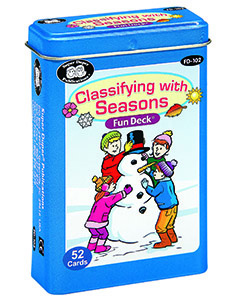
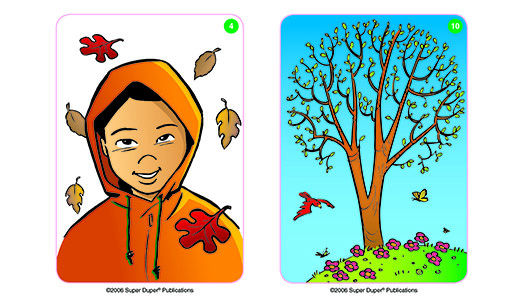
Classifying with SeasonsWinter, Spring, Summer, or Fall… What happens in each season and what do you need for it? With the changing season and cooler days, we thought it was the perfect time to share our newly added Classifying with Seasons Fun Deck as our Pick this week. The Classifying with Seasons Fun Deck contains 13 illustrated cards for each season, depicting holidays, activities, clothing, and weather that might occur. This week, take 15% off* your set of Classifying with Seasons by entering our code CLASSIFY at check out!

Use the Classifying with Seasons Fun Deck to teach time concepts, categorizing, and more. These cards come in a sturdy tin, and make great match-up games, as well as conversation and story starters.

Fall Examples

This week only, don’t forget to save 15%* on your deck of the Classifying with Seasons cards by entering promo code CLASSIFY at check out!

*Offer is valid until 11:59pm EDT on September 30th, 2014. Not compatible with any other offers. Be sure there are no spaces or dashes in your code at check out!

Do-It-Yourself Fall Crafts: Paper Plate Owls and Apple Sensory Cards

Crisp sunny days and cool nights mean that Fall is really on its way. The changing weather is a great opportunity to work on some seasonal activities with your kids. We found two wonderful little do-it-yourself fall craft projects for parents and teachers to engage in with their kids this season.

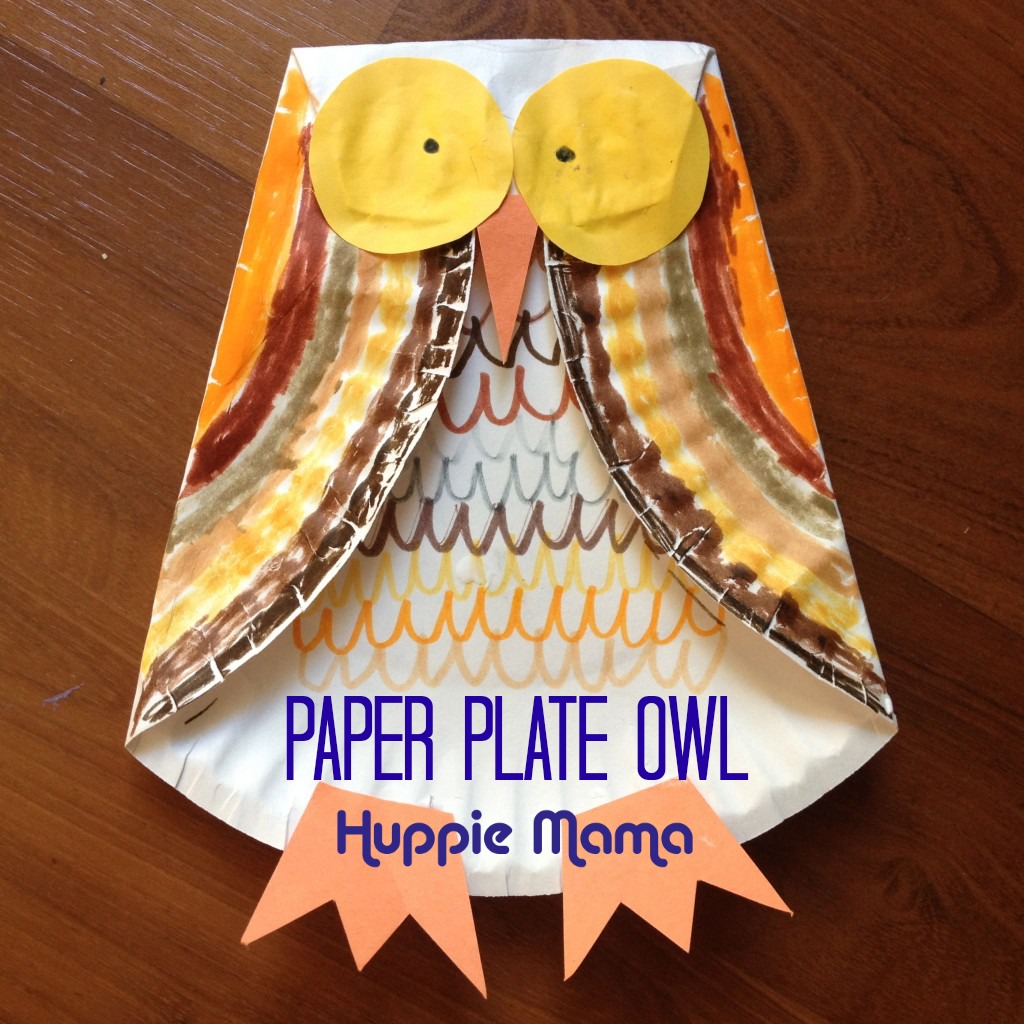
Dr. Carrie Wells over at Huppie Mama came up with an adorable Paper Plate Owl project that requires no more than just a few easy-to-find materials:

  • White paper plates
  • Scraps of construction paper
  • Glue
  • Markers, crayons, or paint

…and of course, some creativity!

Click here for the full DIY Paper Plate Owl project by Huppie Mama, and let us know how creative you and your kids get with these owls for Fall!

Samantha at Stir the Wonder came up with an apple-themed project that introduces various tactile sensations to young kids. Colored in red, yellow, and green, these Apple Sensory Cards can be used to incorporate a variety of textures, such as bumpy, smooth, rough, and soft, all with the following materials:

Click here for the full DIY Apple Sensory Cards project by Stir the Wonder, and share with us what kinds of textures you come up with for your kids!

Tip of the Week: Altering the Teaching Environment to Address Problem Behaviors

A few years ago, I went in to observe an ABA therapist I was supervising. She was working with a ten-year-old girl with Aspergers. One of her goals was to increase eye contact during conversation, but her student wasn’t making much progress in this area. She had consulted the research and was considering a new behavior intervention plan, and wanted my input before doing so.

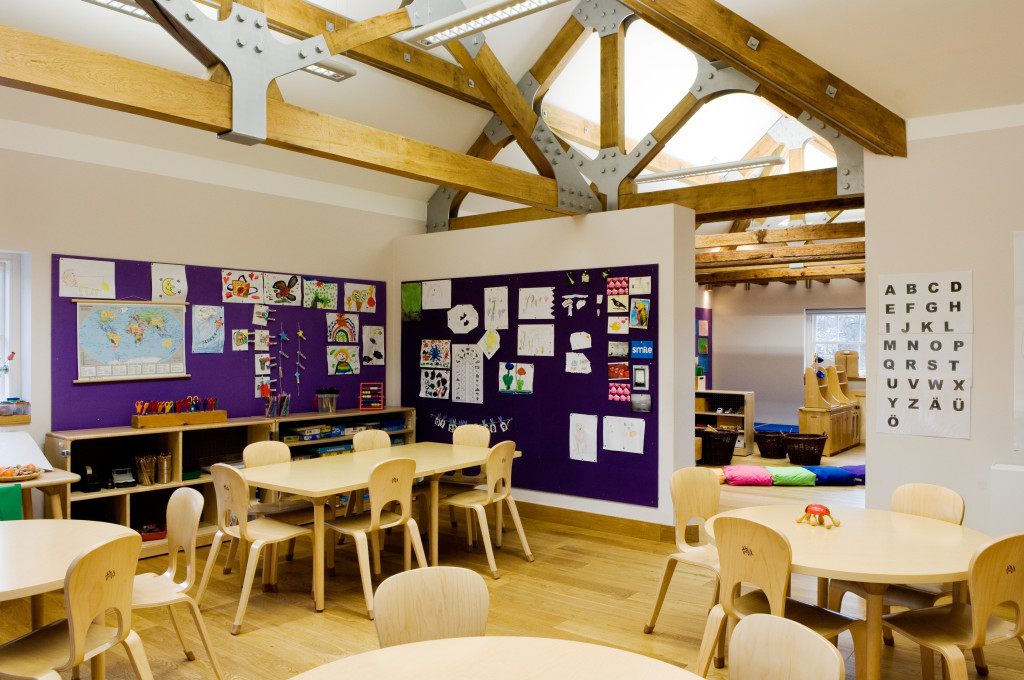
junior school classroom at the German School in Ham, by 3S Architects. Image shot 2006. Exact date unknown.The first thing I noticed when I walked in to observe was that she did her entire session at a long wooden table, sitting side-by-side with her student. After watching for about ten minutes, I asked if we could change the seating arrangement. We moved her student to the end of the table, then had the therapist sit next to her, but on the perpendicular side. This way, eye contact was much easier as they were able to face each other. The student’s eye contact improved instantly with a small environmental change. (Of course, once we made the environmental change, we worked together to address other changes that could be made to encourage eye contact.)

Environmental changes can be a quick and simple solution to some problem behaviors. Here are some questions to consider in order to alter the environment effectively:

  • Is it possible that a change in furnishings could change the behavior? For example, moving a child’s locker closer to the classroom door may decrease tardiness, putting a child’s desk in the furthest corner from the door may decrease opportunities for elopement, or giving your child a shorter chair that allows them to put their feet on the ground may decrease the amount of times they kick their sibling from across the table. You may also want to consider partitions that allow for personal space, clearly-marked spaces for organizing materials, proximity to students and distractions (such as windows or the hallway).
  • Can you add something to the environment to change the behavior? For example, your student may be able to focus better on independent work if you provide noise-cancelling headphones, line up correctly if a square for him/her to stand is taped to the floor, or your child may be more efficient with completing chores if they’re allowed to listen to their favorite music while doing so.  I’ve also seen some cases in which the teacher wears a microphone that wirelessly links to a student’s headphones, increasing that student’s ability to attend to the teacher’s instruction.
  • Will decreasing access to materials impact the behavior? For example, removing visuals such as posters and student work may increase your student’s ability to attend or locking materials in a closet when not in use may decrease your student’s ability to destroy or damage materials.
  • Will increasing access to materials impact the behavior? For example, making a box of pre-sharpened pencils may decrease the behavior of getting up frequently to sharpen pencils. (I recently visited a classroom in which the teacher put pre-sharpened pencils in a straw dispenser on her desk, and each week one student was assigned the job of sharpening pencils at the end of the day).

Whenever you do make changes to the environment, you may want to consider if the changes require fading. For example, if I make a square on the floor out of tape to teach my student where to stand in the line, I will want to fade that out of over time to increase their independence.

A final consideration is that whatever impact you expect the environmental change to have should be clearly defined and measured. Take data to ensure that the intervention is working so you can make adjustments as necessary.

For more detailed information on modifying environments, there is a great article from the Council for Exceptional Children by Caroline A. Guardino and Elizabeth Fullerton entitled “Changing Behaviors by Changing the Classroom Environment.” Click here for the article.

WRITTEN BY SAM BLANCO, MSED, BCBA

Sam is an ABA provider for students ages 3-12 in NYC. Working in education for ten years with students with Autism Spectrum Disorders and other developmental delays, she has developed strategies for achieving a multitude of academic, behavior, and social goals. Sam is currently pursuing her PhD in Applied Behavior Analysis at Endicott College.

States Begin to Include ABA Coverage

It looks like progress is being made on getting treatments such as ABA covered by insurance. Disability Scoop is reporting that states are finally starting to include coverage of treatments like Applied Behavior Analysis for children with autism under Medicaid. This means that states must cover services consistent with the categories defined by Early and Periodic Screening, Diagnostic and Treatment services (EPSDT). This includes Applied Behavior Analysis, speech and occupational therapies, and other personal care services.

Read the full article here.

Has anyone in CA, NV, and CT had success with getting services like ABA covered?


Pick of the Week: Unifix Cubes & Workbook with CD – Hands-on early math activities

Perfect for early counting and mathematical operations, our newly added Unifix Cubes and accompanying Mathematics for Unifix Cubes Workbook and CD: Kindergarten will provide numerous activities and games for teaching young learners early math concepts. This week only, save 15%* on your set of Unifix Cubes and/or the accompanying Mathematics for Unifix Cubes Workbook and CD-Rom by entering our code UNIFIX at check-out.

Each set of Unifix Cubes contains 300 cubes in 10 assorted colors: red, dark blue, light blue, yellow, green, orange, maroon, brown, black, and white, great for teaching math concepts such as patterning, addition, subtraction, multiplication, division, and much more.

Your 90-page Mathematics for Unifix Cubes Workbook and CD: Kindergarten provides ready-to-use activities for early math, including worksheets, games, cards, and full teaching instructions, assessment, and extension suggestions. The accompanying CD-Rom contains a digital version of the workbook, as well as virtual Unifix Cubes that can be projected on the computer to make rods, patterns, and more.

Don’t forget to use promo code UNIFIX at check-out to save 15%* this week on your set of Unifix Cubes and Mathematics for Unifix Cubes Workbook and CD!

*Offer is valid until 11:59pm EDT on September 23rd, 2014. Not compatible with any other offers. Be sure there are no spaces or dashes in your code at check out!

Simplifying the Science: Parent-Conducted Toilet Training for Kids with Autism

For many of the families I work with, toilet training their child with autism becomes a long, painful process. I typically recommend the Rapid Toilet Training (RTT) protocol developed by Azrin & Foxx (1971) but many parents struggle to maintain implementation without the presence of a behavior therapist or toilet training specialist. And while Azrin & Foxx’s results have been replicated in other studies, RTT has primarily been used in educational and outpatient settings, and the amount of time it has taken to complete toilet training has been longer than in the initial study.

This is why I was especially excited to come across the study by Kroeger & Sorensen (2010) about “A parent training model for toilet training children with autism,” which is based on Azrin & Foxx’s initial study with some key modifications. This study focuses on parent-conducted toilet training in the home and was completed with two children with autism.

As mentioned in previous blog posts, the best interventions usually are multi-pronged approaches. This is no different. While there are multiple steps involved, it’s important to recognize that one of these children was fully toilet trained in 4 days, and the other in 11 days. Both children maintained toilet training skills when researchers checked in at 2 weeks, 6 months, and 3 years. Setting aside a few days or a couple of weeks to complete this intensive protocol may be intimidating at first, but achieving similar results as the two children in the study has a huge impact on the life of your child and the entire family.

Prior to starting the intervention, they received medical consent and clearance from the children’s attending developmental pediatricians. They then performed a preference assessment (the RAISD) to determine reinforcers. The study then states that “The families were asked to restrict the children’s access to these reinforcers for a minimum of 3 days prior to implementing the intensive training treatment protocol.”

The intensive toilet training program had 5 components:

Increased fluids: In consultation with a pediatrician, the study states that “parents were instructed to increase the children’s access to fluids for 3 days prior to implementing the training.” This increase in fluid intake continued until 6:00 PM on the first day of training.

Toilet scheduled sitting: Since the protocol was completed in the privacy of the children’s homes, the children were able to remain undressed from the waist down while being toilet trained. The children were continuously seated on the toilet, then able to leave the toilet for voiding in the toilet, or for brief “stretching” breaks. As they achieved higher frequency of appropriate voiding in the toilet, the amount of time spent on the toilet decreased and the amount of time escaping the toilet increased. (The schedule for fading out time seated on the toilet is detailed in Table 1 of the study.) Also, while seated on the toilet, the child was able to play with preferred items, but not the most preferred items.

Reinforcement for continent voids: According to the study, “If the child successfully voided while on a scheduled sit, they were provided immediate reinforcement (primary edible reinforcement and planned escape to a preferred activity). If the child self-initiated a void while on a break, he was provided immediate reinforcement and a new break time was begun after the self-initiated break.”

Redirection for accidents: When accidents occur, a neutral verbal redirection was provided, such as “We go pee on the toilet” and then the child was physically redirected back to the toilet. Once they were on the toilet, a scheduled sit was begun.

Chair scheduled sitting: Once the child began to experience success with voiding on the toilet, a chair was placed next to the toilet. During scheduled sits, the child would sit on the chair. If he began to void on the chair, the study states that he “was provided with the least intrusive, minimal, physical prompt. When he independently moved from the chair to the toilet to void three consecutive times, the chair was systematically moved away from the toilet in 2-feet increments.”

The study goes into further detail on each of these five components, as well as how to generalize the skill and how parents were trained in the protocol. The study made modifications to the Azrin & Foxx study to make it easier to apply in the home setting for parents, and it removed any form of punishment.

While this is a comprehensive toilet training program that requires a high level of time and attention from the parents, it is set up to help parents achieve results in a relatively short period of time.

The study states, “Parents of incontinent children with developmental disabilities report higher personal stress and distress likely related to the toileting problems presented by their children than parents of toilet trained children with developmental disabilities. It could be deduced then that continence training not only increases associated hygiene factors and access to activities and placements, but also increases the quality of life for the parents by reducing stress and subsequently for other family members such as siblings as corollary recipients of the distress” (Macias et al., 2006).

The potential to improve the quality of life for both your child with autism and your entire family is worth the challenge of implementing this protocol.

WRITTEN BY SAM BLANCO, MSED, BCBA

Sam is an ABA provider for students ages 3-12 in NYC. Working in education for ten years with students with Autism Spectrum Disorders and other developmental delays, Sam has developed strategies for achieving a multitude of academic, behavior, and social goals.

Pilot Study Finds that Parent-led Early Intervention Can Reduce Autism Symptoms in Babies

Autism symptoms can display in babies as young as 6 months old. A new pilot study at the UC Davis MIND Institute found that parents could reduce symptoms of autism in babies under 12 months by using intervention treatments in the home as detailed in the Early Denver Start Model.

As reported in a recent Huffington Post article, the study involved parents and their babies between 7 and 15 months of age in a 12 week-long treatment conducted by parents in home-like environments. The treatment was based on the Early Denver Start Model and revolved around parent-child interactions, such as bathing, feeding, playing, and reading. Four comparison groups were also included: Those who were at a higher risk for autism because of an affected sibling; those who were at low risk; those who had developed autism by age 3; and those with early symptoms who received treatment at a later age.

At the start of the study, all babies displayed early signs of autism, such as low interest in interactions and repetitive behaviors, which increased by around 9 months. However, by 18 to 36 months of age, the children in the treatment group produced lower autism severity scores than the comparison groups who did not go through the treatment.

The Huffington Post article “Pilot Intervention Eliminates Autism Symptoms In Babies” highlights the importance of early intervention in autism treatment. While this research is highly preliminary, the findings show that therapy and early intervention are key factors in treating infants and children with early signs of autism, and possibly in reducing them altogether. This study offers hope for parents and professionals in helping their children succeed with more tools and resources for the earliest stages of autism.

Read more about the pilot study on Huffington Post here.

Pick of the Week: “The Asperkid’s Secret Book of Social Rules” – A teen’s guide to not-so-obvious social codes

It’s not easy for any teen or tween to fit in, but it can be especially tough for Asperkids. Jennifer O’Toole knows this first-hand, and has written a book she only wishes she had when she was a teen with Asperger Syndrome.

This week only, save 15%* on The Asperkid’s (Secret) Book of Social Rules by entering promo code ASPERKID at check out!

In The Asperkid’s (Secret) Book of Social Rules, O’Toole doesn’t offer advice on what Asperkids should not do, but on what they should do with witty and wise insights into baffling social codes. With helpful tips, practice scenarios, checklists, and quizzes, Asperkids will learn how to:

  • Thank people, apologize, and offer compliments
  • Build and maintain genuine friendships and how to deal with bullying
  • Actively listen and have a meaningful conversation
  • Step back and see the “big picture” instead of focusing on the details
  • Make a correction and let go of the need to be right

With over 30 social rules and logical explanations, this illustrated handbook offers information that tweens and teens can truly digest. And having been there herself, the author shares her experience and points out the potential pitfalls with humor and sensitivity.

Don’t forget to save 15%* on The Asperkid’s (Secret) Book of Social Rules this week by using our promo code ASPERKID at checkout!

*Offer is valid until 11:59pm EDT on September 16th, 2014. Not compatible with any other offers. Be sure there are no spaces or dashes in your code at check out!