
Pick of the Week: Sensory Tools for Staying Calm And Focused

Maintaining calm and focus can be a challenge in a busy classroom. Our solution? Help reduce fidgeting and reward good behaviors with these sensory tools for staying calm and focused: the Fidgets Kit and Reinforcer Kit. For this week’s Pick Of The Week, save 20% on these items by using promo code FOCUS20 at checkout.
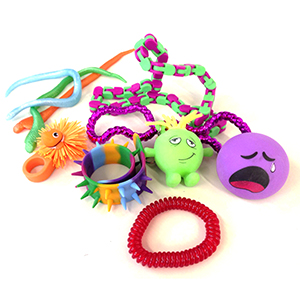
DRK_315_Fidgets_Kit

Fidget toys can be a great and socially acceptable management tool for stereotypical or repetitive behavior in the classroom or community that may be distracting to classmates. While there are many reasons for fidgeting, including sensory overload, boredom, frustration, or anything in between, the good thing is that it can be easily managed. Some students find the repetitive action of “fidgeting” to be calming; thus, they are then better able to focus on the task at hand. Created in conjunction with our behavioral consultant Stacy Asay, LMSW, our Fidgets Kit includes an array of tools that provide a variety of sensory experiences: stretchy, chewy, spiky, twisty, bumpy, twisty, clicky, bouncy and smooshy!
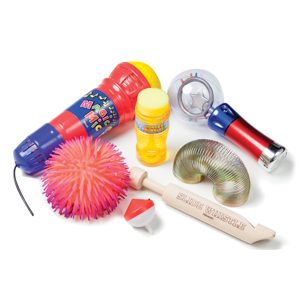
DRP_575_Reinforcer_Kit

Our Reinforcer Kit provides a selection of products that many children diagnosed with autism would not only want to play with but would be willing to “work for” during their one-on-one intervention. Although teachers can always use praise, food, candy and other toys, we think this bright and colorful kit of tools will help our families get a head-start on what to use for children wanting a favored object. The kit includes:

Spectra Spinner (battery operated)

Wooden Slide Whistle

Magic Mic (an Echo Microphone)

Magic Spring

Squishy Flashing Ball

Jelly Ring

Bubbles and more!


*Promotion is valid for one-time use through September 20,  2016. Offer cannot be applied to previous purchases, combined with any other others, transferred, refunded, or redeemed and/or exchanged or cash or credit. Different Roads to Learning reserves the right to change or cancel this promotion at any time. To redeem offer at differentroads.com, enter promo code FOCUS20 at checkout.

Pilot Study Finds that Parent-led Early Intervention Can Reduce Autism Symptoms in Babies

Autism symptoms can display in babies as young as 6 months old. A new pilot study at the UC Davis MIND Institute found that parents could reduce symptoms of autism in babies under 12 months by using intervention treatments in the home as detailed in the Early Denver Start Model.

As reported in a recent Huffington Post article, the study involved parents and their babies between 7 and 15 months of age in a 12 week-long treatment conducted by parents in home-like environments. The treatment was based on the Early Denver Start Model and revolved around parent-child interactions, such as bathing, feeding, playing, and reading. Four comparison groups were also included: Those who were at a higher risk for autism because of an affected sibling; those who were at low risk; those who had developed autism by age 3; and those with early symptoms who received treatment at a later age.

At the start of the study, all babies displayed early signs of autism, such as low interest in interactions and repetitive behaviors, which increased by around 9 months. However, by 18 to 36 months of age, the children in the treatment group produced lower autism severity scores than the comparison groups who did not go through the treatment.

The Huffington Post article “Pilot Intervention Eliminates Autism Symptoms In Babies” highlights the importance of early intervention in autism treatment. While this research is highly preliminary, the findings show that therapy and early intervention are key factors in treating infants and children with early signs of autism, and possibly in reducing them altogether. This study offers hope for parents and professionals in helping their children succeed with more tools and resources for the earliest stages of autism.

Read more about the pilot study on Huffington Post here.