The Countdown to “ABA Tools of the Trade” Begins

We’re incredibly excited to let you know about a new collaboration between Sam Blanco, MSEd, BCBA and Val Demiri, PhD that will focus on data collection and effective behavior change in the classroom while utilizing the most effective tools in ABA. Different Roads to Learning is proud to have this excellent resource scheduled for publication in early 2016. The partnership between these two powerhouses is sure to make ABA Tools of the Trade: A Resource for Data Collection and Effective Behavior Change a must-have for your library.

The book bridges the gap between applied research and real-world settings, including the classroom, home, and community environments. It provides information about efficient tools available for effective data collection and meaningful behavior change. Beyond exploring a wide range of tools available for your use, it offers a comprehensive analysis of the decision-making process for increasing desirable behaviors, decreasing maladaptive behaviors, and examining your own behavior.

We’ll be sharing a tip from Sam and Val’s excellent Facebook page – ABA Tools of the Trade – with you every week so be sure to stay tuned.

“Touch Red” – A Poem by Georgie Herz, ABA Teacher

Here’s a touching – pun intended! – poem given to us by Georgie Herz, an ABA teacher from Special School District in St. Louis, MO, that we thought we’d share with all of you so you can start off your weekend with a smile.

Touch Red
Georgie Herz

Touch red
One card, one choice
Touch red

This is touching red
A prize, cheerios, candy, a car
This is touching red
I’ll guide your hand it’s not far
Touch red

Three times, I’m keeping score
Now with two
Touch red, I pray not blue
This is touching red

Add yellow, three cards, three times
Touch red you score
Pick a prize
Yes there’s more
Touch red

A week or two or three or four
We check again, yea you score
Touch red, there’s more

Cards are gone
See the bears
We start with one
Then it’s two
A prize for each one
You do

Touch red.


Tip of the Week: Use a Time-Out Ribbon

Time-out can be an effective procedure for addressing behaviors that do not function for escape. However, often it can be difficult to implement, and in some schools is not even allowed. There are valid concerns related to time-out. For example, you may not have the opportunity to supervise a child in a separate location for time-out, or you might want to keep them in the same place so they don’t miss a lesson during class.

The time-out ribbon may be an excellent solution for just those types of instances. When Foxx and Shapiro (1978) first wrote about the time-out ribbon, they referred to it as “nonexclusionary time-out,” meaning the individual does not have to be excluded from an environment or activity to be “in time-out.” In their initial study, all students wore a ribbon on their wrist. When the individual has the time-out ribbon on, they have access to socially-mediated reinforcement. If the time-out ribbon is removed, they do not have access to that reinforcement. (Foxx & Shapiro also note that it does not have to be a ribbon, but could be anything that is easy to wear and easy to remove.) However, by again demonstrating appropriate behavior, the ribbon can be placed again on the individual’s wrist.

In a time where we often focus on new, high tech solutions, such as the use of iPads or SmartBoards to introduce behavior change procedures, it’s important to draw attention to low-tech solutions that are easy to implement. Another aspect of the time-out ribbon that is attractive for our particular population is that it provides a clear visual indication that reinforcement is available.

A possible drawback is that, in a classroom setting, if the ribbon is removed, the student could continue to engage in disruptive behavior. Foxx and Shapiro emphasize the need to pair the ribbon with social reinforcement when first introducing it to the individual. This increases the likelihood that the individual will correct their behavior to earn the ribbon back.

Foxx & Shapiro demonstrated the effectiveness of the time-out ribbon with five boys with developmental disabilities. Since then, two more studies have demonstrated the efficacy of the procedure. We know that time-out can be highly effective from a wealth of research over recent decades, but if it’s not available, you should definitely consider the possible use of the time-out ribbon.

Further Reading

Alberto, P.A., Heflin, L.J., & Andrews, D. (2002). Use of the timeout ribbon procedure during community-based instruction. Behavior Modification, 26(2), 297-311.

Foxx, R.M. & Shapiro, S.T. (1978). The timeout ribbon: A nonexclusionary timeout procedure. Journal of Applied Behavior Analysis. 11(1), 125-136.

Laraway, S., Snycerski, S., Michael, J. & Poling, A. (2001). The abative effect: A new term to describe the action of antecedents that reduce operant responding. The Analysis of Verbal Behavior, 18, 101-104.

WRITTEN BY SAM BLANCO, MSED, BCBA

Sam is an ABA provider for students ages 3-12 in NYC. Working in education for ten years with students with Autism Spectrum Disorders and other developmental delays, Sam has developed strategies for achieving a multitude of academic, behavior, and social goals. Sam is currently pursuing her PhD in Applied Behavior Analysis at Endicott College.

Pick of the Week: NEW! Function Wheels – A Behavioral Identification and Intervention System

We’re absolutely thrilled to introduce Function Wheels, an easy-to-use system that enables users to identify the function of behavior and immediately intervene. Created and piloted by Keith Amerson, MSEd, Different Roads to Learning is a proud partner in bringing you the first all-inclusive, systematic approach for identifying the functions of problem behaviors and implementing research-based interventions to manage them.

Get your kit today at the introductory price of $149.95 through July 31st! No promo code necessary.

Click to enlarge.

Be sure to check out this nifty video below for a more in-depth look at the Function Wheels Kit!

Autism Parenting Magazine – News, resources, and expert advice for autism parents

Check out the newest issue of Autism Parenting Magazine! With up-to-date news and professional resources for parents of children with autism, this magazine offers expert advice from medical professionals and therapists among others, autism treatment centers and therapies, news and research in the field, and even real life stories from parents and families that inspire and provide support.


For more information about the Autism Parenting Magazine, visit their website here.

Pick of the Week: Wooden Animal Nesting Blocks

Explore the animal kingdom and develop spatial motor skills with these delightful and durable Wooden Animal Nesting Blocks! From a tiny sea horse to a great big elephant, discover charming animals from four animal habitats.

This week only, you can save 15%* on the Wooden Animal Nesting Blocks with promo code WANB15 at check-out!

With all 8 blocks stacked, they tower almost 3 feet tall. These Wooden Animal Nesting Blocks are great for practicing patterns and sequencing skills in very young learners. Don’t forget to use mention or apply promo code WANB15 at check-out to redeem your savings this week!

*Offer is valid until 11:59pm EST on July 7th, 2015. Not compatible with any other offers. Be sure there are no spaces or dashes in your code at checkout!

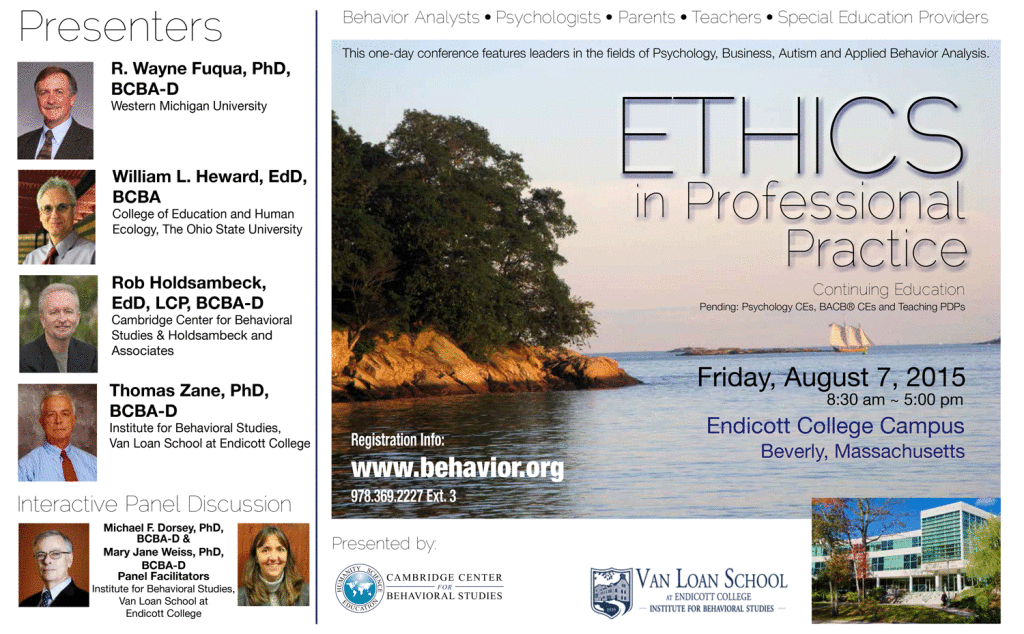
Registration Open for the Ethics in Professional Practice Conference 2015

Presented by the Cambridge Center for Behavioral Studies and the Van Loan School at Endicott College, MA, the 3rd Annual Ethics in Professional Practice Conference will be held on Friday, August 7, 2015. Register for your spot now for a great opportunity to hear leaders in the fields of Psychology, Business, Autism and Applied Behavior Analysis. Speakers include R. Wayne Fuqua, PhD, BCBA-D, Michael F. Dorsey, PhD, BCBA-D and Mary Jane Weiss, PhD, BCBA-D.

Ethics in Professional Practice Conference 2015

For more information, visit the Cambridge Center for Behavioral Studies event page.

Simplifying the Science: Teaching Hand-Raising to Children with Autism

There are many concerns that come up when considering moving a child with autism to a general education setting. One is that the child with autism may not initiate interactions, which makes it less likely they’ll raise their hand to either ask or answer questions. Hand-raising is an important social behavior in the classroom setting as it facilitates learning as well as teacher-understanding of a child’s comprehension of the current topic. In the general education setting, there is much more group instruction than in the special education setting, which makes hand-raising all the more important. A study by Charania, LeBlanc, Sabanathan, Ktaech, Carr, & Gunby (2010) focuses on this skill, stating “Failure to raise a hand when one could answer means a missed opportunity for reinforcement or error correction, whereas raising a hand when one has no subsequent response to provide could be embarrassing or disruptive to ongoing instruction.”

The participants in the study were three boys with autism, ages 8, 9, and 10 who were preparing to transition from a center-based program to a general education setting and had substantial verbal repertoires as assessed by the VB-MAPP. The researchers recognized that often the boys would know the correct answer to a question posed by the teacher during a group activity, but would not raise their hands to respond. They addressed this by building three successive skills. The goal was to teach the boys to raise their hand when they did know the answer, and keep their hands down when they did not know the answer.

In the first task, the boys were placed together for group instruction. Each child was given an opaque bag with a different item in it. The instructor would ask “Who has the [item]?” The boy with that item would raise his hand. Once this skill was mastered, the second task was introduced. In this task, the instructor would tell one boy a “secret” word, while whispering a greeting to the other two boys. The instructor would then ask “Who knows the secret word?” The boy who heard the secret word would raise his hand. Finally, after mastering the second task, the final task would be introduced. Here, the task involved providing verbal responses to factual questions, such as “What animal has a tail and four legs?”

This successive teaching of skills is important to the acquisition of the target skill. In the first task, there was an auditory and a visual stimulus provided to elicit the target response of hand raising (the question and the object in the bag). In the second task, the visual stimulus was replaced with another auditory stimulus, making it two auditory stimuli (the question and the whispered secret word). Finally, the last task consisted of the auditory stimulus, the question itself. The final task emulated the stimulus that would naturally occur in the classroom to elicit hand-raising.

The authors note in their discussion that “The results suggest the importance of conducting both hand-up and hands-down learning trials to establish discriminated responding, rather than simply reinforcing hand raises on every question (i.e., excessive hand raising during hands-down trials might be just as problematic as a complete lack of hand raising).” The method of successive conditional discrimination can be useful for teaching both children who do not raise their hands when they should or who raise their hands when they shouldn’t. All three boys learned how to raise hands appropriately for each of the three tasks. And while there are many more skills related to hand-raising that the three participants would need to learn, the skills taught in this study are essential to promoting success in the general education environment.

WRITTEN BY SAM BLANCO, MSED, BCBA

Sam is an ABA provider for students ages 3-12 in NYC. Working in education for ten years with students with Autism Spectrum Disorders and other developmental delays, Sam has developed strategies for achieving a multitude of academic, behavior, and social goals. Sam is currently pursuing her PhD in Applied Behavior Analysis at Endicott College.

Pick of the Week: NEW! Save 20% on the AFLS Vocational and Independent Living Skills Protocols

Fresh off the press, the final protocols in the Assessment of Functional Living Skills (AFLS) series are now available: Vocational Skills and Independent Living Skills. Now through June 16th, receive 20% off any quantity of these new Protocols. No promo code necessary.

The Vocational Skills Assessment Protocol provides caregivers and professionals with information to teach essential skills to learners who are preparing to enter the workforce or those who are already working but want to further develop skills for a wide variety of settings. This assessment covers skills related to obtaining employment, searching for job openings, creating resumes, completing applications, and preparing for interviews. This protocol also includes a wide range of basic work-related skills such as job safety, payroll, financial issues, and interacting with supervisors and co-workers. It also includes a review of skills required in specific types of jobs in a variety of settings. With this assessment, practitioners can help evaluate vocational skills for individuals with various types and levels of disability. Click here for a quick preview!

The Independent Living Skills Protocol provides caregivers and professionals with information to teach essential skills to learners who are being prepared for independent living. The assessment covers critical skills critical such as organizing possessions, cleaning and cooking, as well as money management skills related to financial planning, banking, paying bills, using debit and credit cards, and shopping. This protocol also incorporates skills about the assertion of personal rights, awareness of the motivation of others, and managing relationships with others in various settings. Click here for a preview!

This week only, take 20% off either or both the Vocational Skills and Independent Living Skills Assessment Protocols. No promo code necessary.

*Offer is valid until 11:59pm EST on June 16th, 2015.

Tip of the Week: Avoid Common Ethical Missteps in the Home Environment as a Behavior Analyst

(Beaumont Health System)

Fortunately, we have the Behavior Analyst Certification Board (BACB) as a resource. You can see the BACB’s Professional and Ethical Compliance Code for Behavior Analysts here. While this code does not take effect until January 2016, it’s important to note that many states have adopted ABA Licensure, which provides for oversight of behavior analysts and implementation of this code, or the specific ethical code that state has adopted.

Keep all identifying information confidential. First, all records should be kept in a locked filing cabinet, (not in a binder inside a tote bag or in the trunk of your car.) Furthermore, while it may be tempting at times, no photos or videos of students should be kept on cellphones or computers, or shared on social media accounts. And while you may have funny stories or great improvements you want to share with friends or loved ones, you should not share, the names, ages, or other identifying information of your students.

Only accept cases for which you have the necessary training and experience. This one can be tricky, especially if you are in a location in which there are few behavior analysts or you’ve been recommended to a parent and they are pushing for you to work with their child. However, it is very important that you follow this guideline. For example, if a child is engaging in self-injurious behavior (SIB) and you’ve never intervened with SIB, you should not take the case. Instead, you should make a referral to a behavior analyst who has the appropriate training and experience. If you are the only behavior analyst available, you should seek out the appropriate training and seek guidance from someone who does have the appropriate experience. This is more possible today with the advent and ease of video-chatting.

Don’t accept gifts or give gifts. As described below, it’s better to express this rule to parents at the beginning of your relationship, rather than when they’re handing you a gift certificate to your favorite coffee shop. While parents want to show appreciation and care for you, gift giving on either end blurs the line between professional relationship and friendship. Which brings us to our next point…

Maintain a professional relationship. This can be challenging when you’re working in the home environment, especially when you’re working in the home daily for one, two, or more years. But it’s important that you relate to the family as a professional with an expertise in behavior analysis. This means that you should not be joining the family for meals, birthday parties, or other events. It also means that information about your private life should not be provided (such as who you’re dating, any personal problems, etc.) and you are not a counselor/therapist for personal problems in the life of the family.

Provide effective treatment. This may seem like a no-brainer, but it can be quite easy to begin using a treatment that was recommended by another professional, only to discover that there is no scientific evidence proving its effectiveness. If you ever have a question about whether or not an autism-treatment is evidence-based, you should take a look at the Association for Science in Autism Treatment. You should also look at the research regarding interventions for specific behaviors in resources such as Journal of Applied Behavior Analysis, The Analysis of Verbal Behavior, or Behavior Analysis in Practice.

Set expectations from the very beginning of your relationship. Some of these missteps can be more difficult if you don’t provide information about what you are allowed or not allowed to do. A simple contract can be given to parents or caregivers at the beginning of the teaching relationship. In their book Ethics for Behavior Analysts: 2nd Expanded Edition, Bailey & Burch provide an excellent sample contract that can be modified for your use. (It’s worth noting that this book is a must-have for any behavior analyst. It contains explanations for each ethical guideline and case studies in an easy-to-read style.) Making it clear that you have professional guidelines to follow from the outset of your relationship is the most effective step you can take towards maintaining an ethical, professional relationship for the duration.

WRITTEN BY SAM BLANCO, MSED, BCBA

Sam is an ABA provider for students ages 3-12 in NYC. Working in education for ten years with students with Autism Spectrum Disorders and other developmental delays, Sam has developed strategies for achieving a multitude of academic, behavior, and social goals. Sam is currently pursuing her PhD in Applied Behavior Analysis at Endicott College.