Pick of the Week: ConversaCards

Many strategies to help individuals on the autism spectrum organize and prioritize their daily activities propose using visual supports, color coding, lists, and other teaching materials such as timers and sequence cards. Understanding the concept of time and honing critical thinking and expressive language skills early in development is especially vital to  creating plans and making conversation independently later on in life.

ConversaCards_Blog&Emailer

Our Pick of this Week this week features the ConversaCards, which were developed to encourage organization, critical thinking, and conversation skills in children. The ConversaCards include six different packs: What Comes Next?, What Do You Do With It?, What Do You Like?, What Do You Need?, What Happened?, and Where Does It Go?

This week only, save 15% on your order with any one of these packs of ConversaCards by using promo code BLOGCNV3 at checkout!

What Comes Next? invites young learners to speculate about sequences of events. Full-color photographs on the cards show children performing sequential activities in identifiable scenarios in series of 2 and 3 cards. Designed to develop effective conversation, listening and social skills, these cards are easy to use and are developmentally appropriate for all levels.

WhDoYouDoWithIt

What Do You Do With it? invites children to speculate about the uses for the everyday objects shown. The photographic objects contain relatable images such as a toothbrush, piano, towel, alarm clock, keys, and ice cream scoop. This set ultimately improves conversation and critical thinking skills, in addition to social skills and sorting in learners.

What Do You Like? invites young learners to identify and share their preferences as well as their reasoning. Designed to promote effective communication and social skills, these cards depict photographs of common objects and scenarios that will encourage analysis and self-awareness.

WhDoYouNeed

What Do You Need? cards were developed to encourage sequencing and critical thinking and invites children to speculate about the possible next steps necessary in order to continue with an activity. Created to promote listening, conversation, and social skills, these cards also inspire creative story-telling.

What Happened? cards were developed to build language skills while inspiring story-telling. These cards are fun and easy to use, so children will enjoy working with them independently or in lessons.

Where Does It Go? cards will encourage children to categorize and place identifiable items, furthering critical thinking while building conversation skills in creative story-telling and sharing experiences.

The back of each card in the ConversaCards™ series contains questions and prompts that can be used for independent work, in one-on-one sessions, or in group lessons. Learning to respond to “what” and “where” questions is the foundation of conversation and expressive language. These flashcards can be used to teach sequencing, storytelling, and logical thinking for a wide range of ability levels. Each deck contains 54 3″ x 5″ cards, a resource guide containing helpful prompts, questioning strategies, and suggested lesson ideas.

POTW_BLOGCNV3_Worm

This week only, save 15% on your order of any one of our six ConversaCards by entering in the promo code BLOGCNV3 at checkout!*

*Offer expires on May 28, 2013 at 11:59 pm EST. Not compatible with any other offer. Be sure there are no spaces after the Promo Code when you enter it at checkout. 

Pick of the Week: The VB-MAPP Set

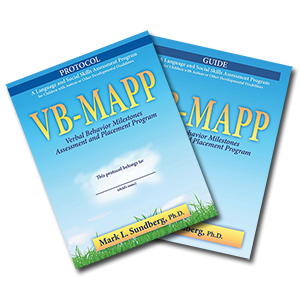
DRB_680_VB_Mapp_SetAssessment and data collection are critical for every student on the spectrum…and can get expensive. This week, we’re thrilled to give you a bit of a break by offering the VB-MAPP Set by Dr. Mark Sundberg as our Pick of the Week. This week only, SAVE 15% on the VB-MAPP Set, VB-MAPP Guide or VB-MAPP Protocol by entering in the promo code BLOGVBM9 at checkout.

Dr. Mark Sundberg’s Verbal Behavior Milestones Assessment and Placement Program (VB-MAPP) is an assessment with a curriculum guide and skill-tracking system that assists educators, speech pathologists, psychologists, and parents in creating individualized intervention programs for children with autism or language-based learning disabilities. Continue reading →

Different Roads to Learning Celebrates National Teacher Appreciation Week

This week is National Teacher Appreciation Week! Are you doing something special to honor the hard work a teacher has done for you or your child? The second week of May is set aside to pay tribute to those who help educate our children in the classroom, build leadership skills, and are passionate about molding future generations into successful individuals. We encourage you all to take the time this week to reach out to a teacher who has impacted you or your child and say “thank you.” Let the teachers in your community know that you appreciate the patience, dedication, and positivity they bring to their job and classroom.

WormFlag

We at Different Roads to Learning would like to show our own appreciation for the commitment that educators all around the world give to ensure that each child is brought to the highest level of potential in his learning and development.

Today, May 9, 2013 through May 16, 2013, we will be accepting stories from you about a special teacher and how he or she has impacted yours or another student’s life. Take the opportunity this and next week to show your continual thanks to a teacher by nominating him or her in our Teacher Appreciation Giveaway. The lucky winner of the giveaway will receive a $100 gift certificate to the Different Roads to Learning store for purchase of any of our products. Stories from entries will be streamed and posted to our Facebook page throughout the week. The winner of the giveaway will be randomly chosen by us and announced on Facebook on Friday, May 17, 2013.

Submit your entries now on our Contest page through May 16, 2013 to give thanks to your teachers!

Posted in ABA

Pick of the Week: Bullying & ASD – The Perfect Storm – NEW from Autism Partnership

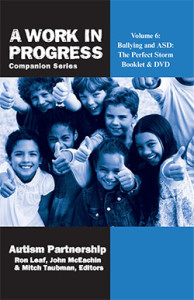
Work in Progress v6 Cover.inddBullying & ASD: The Perfect Storm – the brand new booklet and DVD from Autism Partnership – comes at a most important time. Recent school bullying and cyberbullying statistics show that:

  • 1 out of 4 kids are bullied
  • 77% of students are bullied either mentally, verbally or physically
  • Cyberbullying statistics are rapidly approaching similar numbers, with 43% experiencing cyberbullying
  • Of the 77% of students that said they had been bullied, 14% of those who were bullied said they experienced severe (bad) reactions to the abuse

Bullying is a real and pressing issue in our schools and online, and children with autism spectrum disorder are especially at risk. In the most recent volume of the Work in Progress Companion Series, Doctors Leaf, McEachin and Taubman explore not only the reasons that children with ASD are targets for bullying, but more importantly, they offer realistic and attainable strategies for kids on the spectrum.  

Several traditional methods of dealing with bullies are explored in this booklet and DVD, including avoidance, informing an authority figure, and fighting back.  In addition, there are strategies for educating and preparing the victims so that students with ASD can better combat bullying.  The included DVD features over an hour and 40 minutes of footage including advice from experts, one-on-one interviews with students, and real classroom brainstorming sessions where students with autism spectrum disorder are shown:

  • The difference between teasing and bullying
  • How to avoid the behaviors invite bullying, including determining the important difference between “cool” and “uncool”
  • When and when not to listen to peers
  • How to react to a bully

This week only, save 15% on the important new booklet and DVD – Bullying & ASD: The Perfect Storm –  by entering the promo code BLOGBASD2 at checkout.

*Offer expires on April 30, 2013 at 11:59 pm EST. Not compatible with any other offer. Be sure there are no spaces after the Promo Code when you enter it at checkout.

New Low Price on Our Language App: Tell Me About It!

tell me about it iconAutism Awareness Month excitement continues…We’re thrilled to announce that for the rest of April, you can purchase our App Tell Me About It! Learning Language by Receptive Function, Feature & Category for the low price of $2.99!

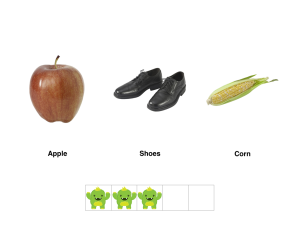
Tell Me About It! teaches the label, category, function, and features of more than 235 language targets over 6 levels of incremental difficulty, with over 1000 unique testable attributes. The presentation of each language target conforms to an Applied Behavior Analysis (ABA) discrete trial program, with reinforcement provided by a token economy system. Tell Me About It! provides a self-contained discrete trial program that error corrects and provides direct and immediate reinforcement while collecting and synthesizing data for up to 10 students. There is a Student Report Card that displays data for each student, with an option to email the results.

For students with speech and language delays or for those with Autism Spectrum Disorder, learning to simply label an image doesn’t necessarily translate into comprehensive understanding of that word. By breaking down each language target by its category, the function that it serves and its salient features, we offer students the opportunity to fully comprehend and then engage in language.

Level 1 

Categories

The App covers 15 categories of language targets that include: Animals, Body Parts, Clothing, Food, Household Items, Dishes, Utensils, Tools, Toys, School Supplies, Sports, Vehicles, Accessories, Furniture, and Musical Instruments.


Levels

The App advances from the basic building blocks of language – simple labeling – all the way through shared features across categories. The Levels presented in incremental difficulty are:

Level 1: Labels
                Level 2: Categories
                Level 3: Function
                Level 4: Feature
                Level 5: Randomized Feature, Function, Category
               Level 6: Shared Featured, Function, Category

Teacher Console


Teacher’s Console            

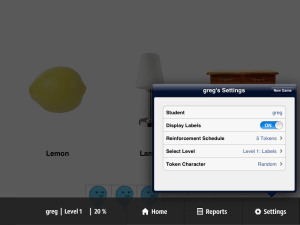
Teachers and parents can delve into the Teacher’s Console to control the settings for each student by turning the written labels for each language target ON/OFF, selecting a specific token character, selecting the default Level, and choosing a Reinforcement Schedule.

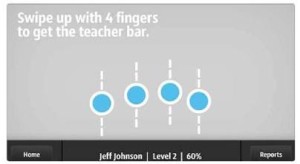
There is even a motion that administrators can use while a game is in progress to access the Teacher’s Menu to adjust the settings or view reports. To access the Teacher’s Bar, simply swipe 2 fingers in an upward motion from the bottom of the screen up:

 TeacherGesture

Reinforcement Schedule

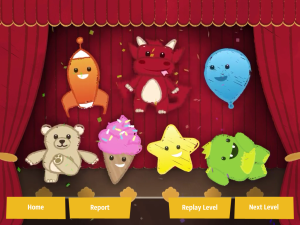
The Reinforcement Schedule determines how many targets the studentmust answer correctly in order to complete a trial session and obtain a 5-10 second animation reward.  There is an option for 3, 5, or 10 tokens and you can even select the character you want or keep the default setting of Random.

 End of Game

Reporting & Data

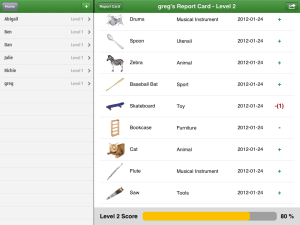
Tell Me About It! tracks each student’s progress and provides a Report after every trial as well as a comprehensive Report Card accessible in the teacher’s console. You’ll see a + for every correct response and a – for incorrect ones. If a student hasn’t yet mastered a target, you’ll see the number of presentations in parentheses after the score.

Report Card

Determining Mastery of Targets

This App strives to mimic an actual one-on-one instructional session with a therapist as much as is possible in an application. For this App, we determine which targets will be defined as mastered by the program in a variety of ways depending on how many times it has been presented.  When answered correctly on the very first presentation, the student receives both a token and verbal praise and that target is considered “known” or mastered and not presented again on that level.  If the answer is not correct on that first presentation, the target will be reintroduced in subsequent trials and must then be answered correctly on two different, consecutive presentations to be considered mastered. When an incorrect response is given, error correction is provided by having the correct image flash while verbal correction is also provided. The App then shuffles the placement of the images, and re-presents the same question. If the student answers correctly on this second attempt, they receive verbal praise only (no token) and then move to another question.  Note that your Data sheets will display, in parentheses, how many times each target has been presented so that you are always aware of your student’s progression and where there might be deficits.


World Autism Awareness Day

In recognition of World Autism Awareness Day, UN Secretary-General Ban Ki-moon noted that early interventions can make a tremendous impact on the lives of children with autism.

With the number of children affected with autism being reported as high as 1 in 50, there is an urgent need to ensure that children are given a proper diagnosis along with early intervention and behavioral therapy that will make a difference in their lives. Our products are geared towards educating and empowering children at every step, from early intervention to school-age programs.

In honor of World Autism Awarness Day and Autism Awareness Month, Different Roads is thrilled to offer 25% off storewide today through April 4.*  To redeem your savings, please enter the Promo Code WAA13D at www.difflearn.com or call us at 800-853-1057 to place your orders.


*Sale does NOT apply to the following products: VB-MAPP Assessment Kits (DRK 700, DRK 701), ABLLS-R Assessment Kits (DRK 702, DRK 703), 10- and 25-packs of VB-MAPP Protocols (DRB 682, DRB 683).*

WAA13D Sale runs from April 2, 2013 through April 4, 2013 at midnight EST.

**This promotion cannot be applied to previous orders.**

 The coupon code must be entered during checkout to receive offer. Offer only applies to selected products and not those currently on sale. Your order must be placed during the time of the World Autism Awareness Day Sale to qualify for this special offer. This promotional offer may not be combined with any other promotional or discount offers.

Our new catalog is here!

And it’s a big one for us – Volume 30! Over 18 years and 30 catalogs, our mission has always stayed the same: to educate and empower children with autism and special needs. We’re so proud of our 30th Catalog and we think you will be quite excited by the 70 new products that we’ve added. We’ll be highlighting and featuring some of our best new products in our Pick of the Week segment so be sure to keep an eye out for special offers by joining our mailing list.

The new catalog contains all of your favorite go-to’s, like the Language Builder and the Time Timer, along with spectacular new products for Early Intervention, teaching social skills, developing conversation and so much more.

You can always request a paper catalog on our site, or you can click here for our fully interactive e-catalog that enables you to dowload, print and link back to the products on our site.

We’re thrilled to share this milestone with you and can’t wait to hear your thoughts on our new products.

Pick of the Week: New Time Timers – On Sale!

New products from Time Timer AND a sale? What words go together better than that? We’re thrilled to introduce you to three new excellent products that raise the bar on that workhorse of a visual timer we’ve all come to love and depend on.

The brand new Time Timer PLUS comes with a portable handle, volume control for an optional alert when time is up, and a protective clear lens to protect the signature red disk. The Time Timer PLUS operates silently with no ticking and measures 7″ x 9″. The Time Timer PLUS contains all of the features you love and trust about the original timers with a fancy new makeover for only $36.95.

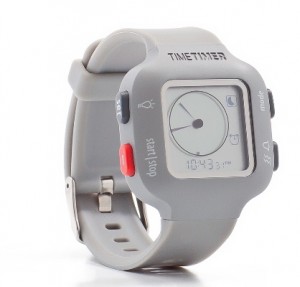
Another new and highly anticipated member of the Time Timer Family has arrived – The Time Timer Watch Plus for youth. In two lovely colors – light grey with white lettering or dark grey with orange – the Time Timer Watch PLUS allows you to watch your time and see it too. The watch has a sporty design and uses simple icons and a large display to ensure ease of use for all age and ability levels. Ideal for anyone who wants a discrete and portable visual timer, the Watch PLUS is customizable: there are two Time Timer modes (Original 60 minutes and Customized), vibrating and/or audible alerts and repeatable time segments for interval training. There is also a 12- or 24-hour clock with one alarm. The soft, silicon watch band measures from 4.75″ to 7″ making it perfect for children or adults with small wrists.

This week only, save 15% on the new Time Timer PLUS and the Time Timer Watch PLUS by entering the Promo Code BLOGTTN7 at checkout. Hurry! Offers like this don’t last too long.

*Offer expires on March 19, 2013 at 11:59 pm EST. Not compatible with any other offer. Be sure there are no spaces after the Promo Code when you enter it at checkout.

Introducing the Eden Autism Services Assessment & Curriculum Series

It is with great excitement that we announce the publication of the Eden School’s Assessment and Curriculum Series. This set of seven assessments and curriculum guides provide an expansive range of content for grades Pre-K through 12.

This week only, you can save 15% on these new assessments and curricula by entering the Promo Code BLOGEDA at checkout.

The Autism Assessment provides educators, therapists, and parents with a tool to accurately assess a student’s current abilities and skill level. This assessment identifies the student’s strengths and weaknesses, assists with goal selection, tracks progress, and makes it easy to translate the assessment into concrete IEP goals. The Autism Curriculum is a comprehensive series of teaching programs designed to provide a valuable resource to enable professionals and parents to effectively teach students with autism. Employing a hands-on approach, the curriculum includes practical strategies for each teaching program. In addition, each skill area includes a systematic assessment and flow chart to support appropriate goal selection. Teaching programs are clearly written, with step-by-step instructions, and include target behaviors, prerequisite skills, criterion-referenced assessment, measurement, materials, procedures, and prompting techniques. Each curriculum delineates Primary, Intermediate and Secondary Skills to help structure learning for students of various ages and abilities.

These teaching programs, grounded in the principles of Applied Behavior Analysis (ABA), have been field-tested with hundreds of students and adults with autism.  They address essential areas of skill such as cognitive, self-care and domestics, speech and language, vocational, physical education, recreation and leisure, employment, and residential living. This series offers specifically targeted curricula for Infants and Toddlers, a 5-part series for school-age students, and an Adult Curriculum.

Teaching programs are clearly written, with step-by-step instructions and include target behaviors, prerequisite skills, criterion, measurement, materials, procedures, and prompting techniques.  Each volume includes flow charts to assist with selection of goals. Teaching programs and data tools are presented in wire-bound format for easy use. Each volume comes with a Curriculum, Assessment and Assessment Score Sheet. Additional blank assessment score sheets are available for sale in sets of 10 for each curriculum volume: Infant/Toddler; Cognitive; PE; Self-Care/Domestics; Speech/Language; Vocational; Adult.
 

Infant & Toddler Assessment & Curriculum

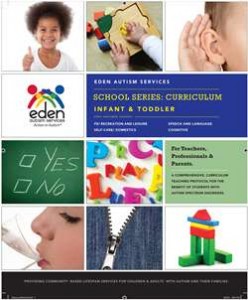
Developed to specifically address the needs of infants and toddlers (up to age three) with autism, the Infant and Toddler Curriculum contains teaching programs for learning readiness, cognitive skills, oral motor/feeding, receptive and expressive language and communication, play and social skills, sensory-motor, self-care, and preschool readiness skills.


Eden Autism Services School Curriculum Series

This five-volume series specifically addresses the educational needs of school-age students with autism by skill area: Cognitive, Adaptive Physical Education, Self-Care and Domestics, Speech and Language, and Vocational Education. The curricula can be purchased individually or as a set of five. Each volume contains the prerequisite skills, criterion, measurement, materials, procedure, prompting techniques and teaching tips for each target behavior.
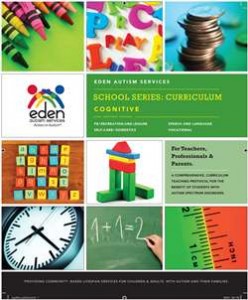
 

Cognitive Volume: School Curriculum & Assessment

The Cognitive volume contains teaching programs to address the educational needs of school aged students with autism in the areas of Learning Readiness (eye contact, gross motor imitation), Pre-academics (block imitation, matching objects, body part ID, etc.), Academics (counting, handwriting, sight word ID, etc.), and classroom language/social play (categorization, pretend play, etc.). There are more than 85 lessons presented with prerequisite skills, criterion, measurement, materials, procedure, prompting techniques and teaching tips.
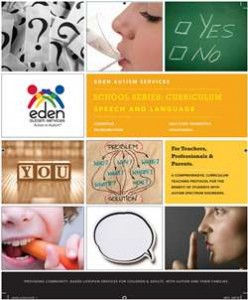
 

Speech and Language Volume: School Curriculum  & Assessment

The Speech/Language volume contains teaching programs for school-aged students with autism which is divided into four domains and then ranked as primary, intermediate and secondary skills. The domains focus on oral motor/feeding, receptive language, expressive language, and pragmatics. There are more than 75 lessons presented in a highly structured, specialized format.
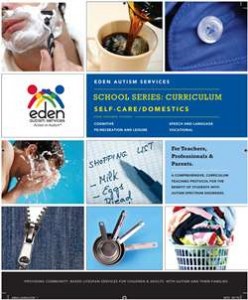
 

Self-Care and Domestics Volume: School Curriculum & Assessment

The Self-Care/Domestics volume contains teaching programs targeting daily living activities for school aged students with autism in the areas of self-care and domestic skills. There are more than 60 target behaviors covering primary skills like dressing, hand washing, and toileting to secondary skills such as bathing, shaving, menu preparation, and food shopping.
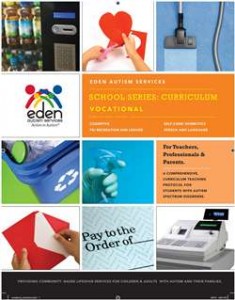
 

Vocational Education Volume: School Curriculum & Assessment

The Vocational volume contains teaching programs specially designed to address a variety of vocational skills for school aged students with autism. The skills taught are designed to prepare individuals with autism and developmental disabilities for adult life and the world of work. The emphasis is on using these teaching programs to foster appropriate levels of independence. There are 55 targets in this volume addressing vocational skills like sorting, labeling, packaging, inventory, stocking, and more.
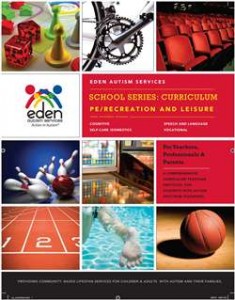
 

Physical Education/Recreation and Leisure Volume: School Curriculum & Assessment

The PE volume contains teaching programs specifically designed to address the physical education, recreation, and leisure skills of school-aged students with autism. While many educators use task-analyzed programs to teach students with ASD, physical education, recreation and leisure skills are often not approached in the same manner. There are more than 35 target behaviors from biking, golf, doing a puzzle to bowling, board games, swimming and video games.


Eden Autism Services School Curriculum Series: 5-Volume Set

The 5-Volume Set includes each volume in the series for school-aged students: Cognitive, Speech/Language, Self-Care and Domestics, Vocational, and Physical Education/Recreation and Leisure.
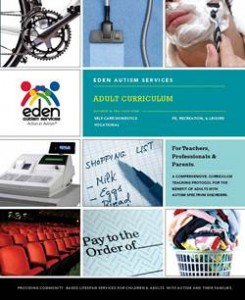
 

Adult Services Assessment & Curriculum

The Adult Residential and Employment volumes have been combined into a single comprehensive volume for Adult Services. Developed for adolescents and adults with autism residing in community-based living arrangements, the Adult Services volume contains teaching programs for self-care, domestics, physical education, and recreation and leisure. There is a complete vocational section that focuses on teaching programs to be implemented in an adult day placement with application in employment settings.

ABOUT EDEN

Since 1975, families, educators, healthcare professionals and others with an interest in autism have looked to the knowledgeable, caring and committed staff at Eden for guidance.  Headquartered in Princeton, NJ,  Eden’s expertise includes early intervention services, pre-K through 21 education, adult residential and employment programs, and support and training for families and professionals.  This Assessment and Curriculum provides educators and caregivers with nearly 40 years of Eden’s teaching expertise.

*Offer expires on January 15, 2013 at 11:59 pm EST. Not compatible with any other offer. Be sure there are no spaces after the Promo Code when you enter it at checkout.



Wait, What Are We Talking About?

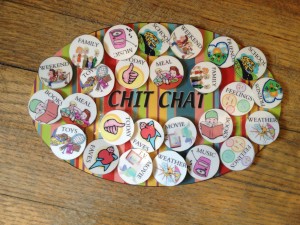
I typically work with very young learners in Early Intervention but there was a time I was working with older children, which necessitated work on conversation skills and topic maintenance. With the start of a new academic year and changes to my caseload I am currently finding myself with students who again need some assistance in this area.  Children with autism spectrum disorders often struggle in conversations because of limited or restricted interests, attending issues, difficulty determining what is relevant or salient to the topic and might also struggle with the rapid transitions necessary to shift between speaker and listener.  This change in my caseload has meant that I’ve found myself digging into old files and unearthing some ancient DIY efforts of mine that I had used in the past.  What I came across that I wanted to share was a visual support that I had used in small groups to facilitate a variety of skills.  It’s something I called Chit Chat and it helped to cue the students in shifting from speaker to listener while maintaining a balance in the conversation with turn taking and reciprocity as well as staying on topic.

The idea was that we would all sit down for a “chat” and initially I would go first in order to model how the board was used rather than providing explicit instruction until the group could use the board on their own and I could fade myself out of the conversation.  The first speaker would choose a token corresponding to a topic of interest, make a statement relevant to the topic chosen and then pass the token to a friend.  The token would provide a prompt for the speaker to maintain the chosen topic as well as cue the rest of the group to visually reference the child whose turn it is to be speaker.  Depending on the level of the group I would individualize the number of conversational exchanges on one topic required before bridging to a new topic. The group I was working with at the time was able to talk about more general topics but this could be individualized to more specific topics depending on the group of students you are working with.

I’m excited embarking upon a new academic year with all it’s unique challenges and successes and am happy to dust off Chit Chat and give it another whirl this year with all new students.  I would be curious to hear from other educators and therapists what tools they’ve created that they find themselves going back to year after year.  You might be surprised what you find at the bottom of your file cabinet!

Also, check out this great link I stumbled across from POPARD Provincial Outreach Program for Autism and Related Disorders in British Columbia, Canada.

https://www.autismoutreach.ca/elearning/social-skills/conversation-and-topic-maintenance