Pick of the Week: Assessing Language and Learning with Pictures (ALL PICS)

Assessing Language and Learning with Pictures (ALL PICS) is an assessment tool designed to be used in conjunction Dr. Mark Sundberg’s Verbal Behavior Milestones Assessment and Placement Program (VB-MAPP). ALL PICS was designed by behavior analysts who specialize in the application of Skinner’s analysis of verbal behavior and have extensive experience in assessing verbal behavior with assessments such as the VB-MAPP.

This week only, take 15%* off ($90 savings!) your order of the ALL PICS assessment program by using our special promo code ALLPICS at check-out!

ALL PICS was designed to make administration of the VB-MAPP more accurate, efficient, and cost-effective for schools, clinics, agencies, and private practitioners. ALL PICS contains all of the 2-D pictures necessary to administer the VB-MAPP Milestones.

ALL PICS consists of 3 spiral bound books, with pre-arranged fields of high-resolution images that correspond with the VB-MAPP specifications. While conducting a verbal behavior assessment, the evaluator using ALL PICS can quickly record responses on the corresponding downloadable data sheets and then turn from one page of the book to the next. For visual tasks, a corresponding box of labeled flashcards is included, permitting the tester to quickly obtain all cards needed for each milestone without the need to search for cards.

The unique benefits of using ALL PICS during verbal behavior assessment include:

  • Includes 275 labeled, high-resolution flashcards for visual performance assessment that correspond to each page of the visual performance book, saving time and increasing efficiency
  • Corresponding, free data sheets that can be downloaded for each learner
  • The opportunity to test generalization with novel pictures, as opposed to familiar flashcards that the learner has seen many times
  • Team members with limited training in behavior analysis can play an active role in the assessment process, reading from the scripts on the data sheets
  • Comprehensive image list of over 1,200 common items that can be used to assess the number of tacts or listener responses in a learner’s repertoire

Don’t forget to use our promo code ALLPICS this week only to save 15%* on your purchase of this comprehensive verbal behavior assessment tool!

*Offer is valid until 11:59pm EDT on March 17th, 2015. Not compatible with any other offers. Be sure there are no spaces or dashes in your code at check out!

Tip of the Week: Recognizing Fad Autism Treatments

Learning that your child has autism is incredibly overwhelming. You’re under intense stress to make the best decisions possible for your child, and to do so quickly. Add to the fact that autism is a popular topic in the news and social media, so tips and quick fixes frequently show up in headlines and news feeds. Autism is considered to be a fad treatment magnet, and while some of the fad treatments are ineffective, others are flat out dangerous. How is it possible to parse through all this to find reliable information? Here are a few tips to help you out:

  1. Avoid products or organizations that promise a cure or rapid progress. All children respond to intervention at different rates. There is no known cure for autism, and there is no “quick fix” either.
  2. Avoid products or organizations that use scare tactics. Anyone who is trying to scare you into using their products or services does not have your best interest at heart. Instilling fear in parents can make it more difficult to make knowledgeable choices and increase the pressure already felt. Scare tactics are generally used to encourage you to make a snap decision, often at a high monetary cost.
  3. Avoid products or organizations that utilize subjective testimonials instead of data-driven science to measure progress. Testimonials may be compelling, but without scientific research it’s impossible to know what actually caused progress. Research should be completed that illustrates an intervention or treatment is directly linked to progress.
  4. Avoid products or organizations that advertise easy solutions which don’t require a professional’s help. Many of the behaviors presented with autism are incredibly challenging. Approaching those issues without the assistance of a trained professional can be detrimental or potentially dangerous for your child, especially when your child exhibits self-injurious behaviors.
  5. Avoid products or organizations that do not measure progress for the intervention being used. It should be very clear what the expected outcome of a product or treatment is, as well as how it will be measured. Relying on informal reports from either parents and/or teachers does not supply valid information about the effectiveness of the product or treatment.
  6. Be wary of treatments that require “faith” to work. If a treatment is not working, it is not because you didn’t believe in it, it’s because something in the treatment needs to be changed to meet the unique needs of your child.

So where can you find valid information? The Association for Science in Autism Treatment is a reliable source for up-to-date information about the many types of treatment available for individuals with autism. The website is packed with useful information, but you may find “Questions to Ask Marketers of Autism Interventions” especially helpful as you make decisions about your child’s treatment. You may also want to pick up Sabrina Freeman’s book, The Complete Guide to Autism Treatments: A Parent’s Handbook: Make Sure Your Child Gets What Works!


WRITTEN BY SAM BLANCO, MSED, BCBA

Sam is an ABA provider for students ages 3-12 in NYC. Working in education for ten years with students with Autism Spectrum Disorders and other developmental delays, Sam has developed strategies for achieving a multitude of academic, behavior, and social goals. Sam is currently pursuing her PhD in Applied Behavior Analysis at Endicott College.

Pick of the Week: NEW! Photographic Matching Cards

One set of cards, so many different skills to work on! Photographic Matching Cards contains 260 cards – 130 unique cards with an identical match – that cover 12 basic categories: Actions, Clothes, Colors, Emotions, Everyday Objects, Farm Animals, Foods, Pets, Shapes, Toys, Transportation, and Wild Animals.

This week only, take 15% off* your set of Photographic Matching Cards by using our promo code MATCH15 at check-out!

DRC_057_Photographic_Matching_Cards

These cards are ideal for developing expressive and receptive language skills, as well as sorting and classifying skills. Students who are ready can use the cards to stimulate discussion and conversation. The cards portray children in a variety of settings, full of real life and childhood enchantment. Each of the 260 cards measures 5½” x 8½”.

Don’t forget to apply or mention promo code MATCH15 to save 15%* when you purchase your set of Photographic Matching Cards this week online or over the phone with us!

*Offer is valid until 11:59pm EST on March 3rd, 2015. Not compatible with any other offers. Be sure there are no spaces or dashes in your code at check out!

Tip of the Week: Use Noncontingent Reinforcement – A Powerful Addition to Your Intervention

Noncontingent reinforcement (NCR) is the presentation of reinforcement independent of behavior, and there are many studies out there that demonstrate it can have a significant impact on behavior.

Before we get to how you can use it with children with autism or other developmental disabilities, it’s important to recognize that noncontingent reinforcement happens all the time with all of us. A few common examples:

  • You’re walking alongside your child. Your child reaches up and grabs your hand. This is a behavior you like, but it did not occur because of any one behavior you exhibited, such as reaching for their hand or requesting their hand. They just did it spontaneously. This probably changes your behavior: you may smile, initiate a conversation, or give their hand a special squeeze.
  • It’s snack time at your preschool. You realize the bag of popcorn you’re giving for snack is almost empty, so you give each student a few extra kernels of popcorn. They did not “earn” it for good behavior, it was just a little extra reinforcement. This may change your students’ behavior: they may sit still a little longer as they eat the additional snack, say thank you, or exclaim, “More popcorn! Yay!”
  • A common example in preschool is placing a child on your lap during story time. They didn’t earn it, but it may change their behavior. For example, instead of calling out to get your attention, they may sit quietly for the duration of the story.
  • You’ve come home from a stressful day at work. You want to just sit down and veg in front of the TV for a few minutes, but discover that your husband has cooked dinner. This may change your behavior: you may sit down at the dining room table or give him a hug. Again, you didn’t exhibit a specific behavior that “earned” you dinner; it was presented independent of your behavior.

Noncontingent reinforcement can be a powerful addition to your interventions. But it looks a bit different when you’re using it as part of your intervention. You want to provide continuous access to the reinforcer maintaining the problem behavior so that the problem behavior becomes unnecessary. The preschooler sitting on the teacher’s lap is an excellent example, because the child has continuous access to the teacher’s attention. This can be faded over time, but can be an effective starting point for reducing problem behaviors when used in conjunction with other strategies.

Research has shown that noncontingent attention can decrease destructive behavior, noncontingent juice can decrease rumination, noncontingent access to preferred items can decrease inappropriate mealtime behavior, and noncontingent social interaction can decrease vocal stereotypy (Hanley, Piazza, & Fisher, 1997; Kliebert & Tiger, 2011; Gonzalez, Rubio, & Taylor, 2014; Enloe & Rapp, 2013). There is much more research out there that demonstrates that noncontingent reinforcement can impact behavior. Here are a few tips for using it:

  1. Make sure it matches the function. If your student is engaging in destructive behavior in order to escape a task, then providing noncontingent attention is unlikely to produce the behavior change you are expecting.
  2. Decide on a method for providing noncontingent reinforcement. Will you provide it continuously (like the preschooler sitting in the teacher’s lap) or provide it on an interval schedule (such as providing verbal attention every 2 minutes)?
  3. Take data! You need to know if the noncontingent reinforcement is actually decreasing the problem behavior or increasing the desired behavior. Define the behavior you want to change and then take data on its frequency, rate, or duration.
  4. Account for other students’ needs. If you are only using noncontingent reinforcement for one student, you need to be prepared to address the needs of other students. For example, if just one preschooler gets to sit in the teacher’s lap every day at story time, you may see an increase in problem behaviors from the other preschoolers in the class.
  5. Plan ahead! Our ultimate goal is that our learners be as independent as possible. Plan for how to fade your intervention over time.
  6. Take a look at the research. There are a few studies cited at the end of this article, but you may be able to find research simply by searching for “noncontingent” and the name of your problem behavior.

Noncontingent reinforcement is much easier to implement than many interventions that are available and can have a huge impact on your learner’s behaviors.

References
Enloe, K., & Rapp, J. (2013). Effects of noncontingent social interaction on immediate and subsequent engagement in vocal and motor stereotypy in children with autism. Behavior Modification , 38(3), 374-391.

Gonzalez, M., Rubio, E., & Taylor, T. (2014). Inappropriate mealtime behavior: The effects of noncontingent access to preferred tangibles on responding in functional analyses. Research in Developmental Disabilities , 35(12), 3655-3664.

Hanley, G. P., Piazza, C. C., & Fisher, W. W. (1997). Noncontingent presentation of attention and alternative stimuli in the treatment of attention-maintained destructive behavior. Journal of Applied Behavior Analysis , 30(2), 229-237.

Kliebert, M. L., & Tiger, J. H. (2011). Direct and distal effects of noncontingent juice on rumination exhibitied by a child with autism. Journal of Applied Behavior Analysis , 44(4), 955-959.


WRITTEN BY SAM BLANCO, MSED, BCBA

Sam is an ABA provider for students ages 3-12 in NYC. Working in education for ten years with students with Autism Spectrum Disorders and other developmental delays, Sam has developed strategies for achieving a multitude of academic, behavior, and social goals. Sam is currently pursuing her PhD in Applied Behavior Analysis at Endicott College.

Guest Article: “Speech-Language Pathology and ABA – Can’t We All Just Get Along?” by Danielle McCormick, MA, CCC-SLP

We’re excited to share with you an exclusive article “Speech Language Pathology and Applied Behavior Analysis: Can’t We All Just Get Along?” by co-founder of Bridge Kids of New York, Danielle McCormick, MA, CCC-SLP, with contributions by Ashley Stahl, MSEd. In this article, Danielle shares with us her quirky and humorous opinions on the importance of combining traditional speech-language pathology practices and those of Applied Behavior Analysis.

SLP-ABA

I have vivid memories of a professor in graduate school essentially condemning the field of Applied Behavior Analysis (ABA) as the most “robotic” and “unnatural” way to help a child learn communication skills. As a passionate and dedicated Speech-Language Pathologist (SLP), I took these words to heart and kept them with me as I continued my career. That was until my first job as a Clinical Fellow at an Early Intervention center—that (insert gasp!) followed the principles of ABA. This center was also filled with the most diverse, beautiful children I have ever known, many of whom were diagnosed with Autism Spectrum Disorder—my passion. I had to take this job!

As if starting my first job in New York City was not daunting enough, here I was surrounded by the enemy—the big, bad ABA therapists! As a newbie who was still building confidence in my field, and having been trained to always respect other professionals (especially those who are above you in the pecking order), I took a backseat and opened my ears and eyes to the ABA that was happening all around me. The voice of my graduate professor was ringing still in my ears, so in my sessions, I made sure there was to be absolutely no ABA (at least I thought at the time!). If they wanted to “do ABA” in the classrooms, that was their business, but I wanted nothing to do with it!

Except—wait a minute—how did they teach that child to start pointing so quickly?

As time went on, I started to notice that some of my children were exhibiting extreme interfering behavior that I had not been trained to deal with. I was lost and did not know how to support these learners. Much to my relief, in came my super hero colleagues wearing ABA capes, telling me exactly what to do and why to do it.


21st Annual Eden Princeton Lecture Series: March 19–20, 2015

Mark your calendars! This terrific lecture series by Eden Autism Services is happening again on March 19–20, 2015 at Princeton University. Guest lecturers include Connie Kasari, PhD, Helen Tager-Flusberg, PhD, Matthew Goodwin, PhD, Ron Suskind, and more.

Attend the 21st Annual Princeton Lecture Series to learn more about current technologies in autism research, strategies for effective early intervention programs, and more. For more information about the event, please email Joni Truch or call (609) 987-0099 ext. 4010.

You can also download a copy of the event brochure here (Registration Form included inside)!

Tip of the Week: Stop Behavior Early in the Behavior Chain

Recently I was working with a family to toilet train their son Jonathan, a six-year-old with autism. (Names and identifying characteristics have been changed to protect confidentiality.) When he eliminated in the toilet, part of his reinforcement was getting to watch the water go down the toilet after flushing. At some point, he developed the behavior of putting his hands into the toilet water as it was flushing.

When I went in to observe the behavior, one of my goals was to identify the steps in the behavior chain. Pretty much everything we do can be viewed as part of a behavior chain, in which one action is a cue for the following action. For Jonathan, each time he placed his hands in the toilet water, the behavior chain looked like this:

Pulled up pants
Stepped towards toilet
Pressed button to flush toilet
Stepped back
Watched water as it flushed
Stepped forward again
Leaned down
Put hands in water

Behavior chains can be even more detailed than the one above, depending on the needs of your learner. Identifying the steps in the behavior chain for an undesirable behavior can have a huge impact on your interventions. For Jonathan, we were able to stop the behavior of putting his hands in the toilet water by interrupting the behavior early in the behavior chain. It’s too late and unsafe to stop him once he’s leaning forward to put his hands in the water. Through prompting, which we faded as quickly as possible, we changed his behavior chain to this:

Pulled up pants
Stepped towards toilet
Pressed button to flush toilet
Stepped back
Watched water as it flushed for 3-5 seconds
Stepped towards sink
Leaned forward
Turned on water
Put hands in water

Instead of waiting for him to engage in the inappropriate behavior, we redirected him several steps earlier in the chain, providing a gestural prompt toward the sink and had him start washing his hands 3-5 seconds after he had started watching the water flush. This was ideal for two reasons: first, it was the expected step in an appropriate toileting behavior chain and second, it provided an appropriate and similar replacement behavior since Jonathan was still able to put his hands in water.

This behavior chain was relatively easy to change. While it may not be as easy in some interventions you may try, it’s essential to remember to stop the behavior early in the behavior chain. It’s much easier to give a child an activity that requires use of their hands as soon as you see them lift their hands out of their lap than it is to remove their hand from their mouth if they’re biting it. And it’s much easier to redirect a child to put their feet back under their desk than it is to get them to stop once they’re sprinting out of the classroom. Looking at the behavior chain and considering when to intervene as a part of your intervention plan is quite possibly the extra step that will make your plan successful.


WRITTEN BY SAM BLANCO, MSED, BCBA

Sam is an ABA provider for students ages 3-12 in NYC. Working in education for ten years with students with Autism Spectrum Disorders and other developmental delays, Sam has developed strategies for achieving a multitude of academic, behavior, and social goals. Sam is currently pursuing her PhD in Applied Behavior Analysis at Endicott College.

Pick of the Week: All Aboard the Language Train!

Endless possibilities make this “language train” a tool you’ll return to time and time again! Create-a-Game: All Aboard the Language Train creates a fun and creative way to enhance teaching language skills to young learners. The set includes a Velcro train and track that await your customized picture cards and words! This week only, you can save 15%* on our newly added Language Train by applying our promo code TRAIN15 at check-out!

With the Language Train, you can teach vocabulary, sequential concepts, spelling, reading, and more. You can even use it as a visual schedule. The set includes one 3-foot track and 8 train cars. Don’t forget to take 15% off* your order of Create-a-Game: All Aboard the Language Train by using promo code TRAIN15 at check-out!

*Offer is valid until 11:59pm EST on February 10th, 2015. Not compatible with any other offers. Be sure there are no spaces or dashes in your code at check out!

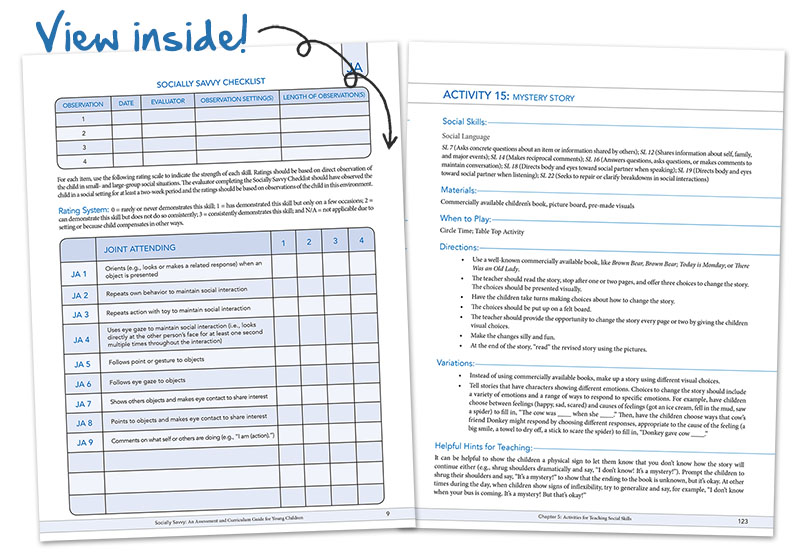
Pick of the Week: NEW! Socially Savvy – An Assessment and Curriculum Guide for Young Children

No child should be left to flounder in a confusing world of social nuances and expectations. Social competencies pave the way for a child to have fun at birthday parties, resolve conflicts with friends, feel heard, and stand up for oneself.

As our Pick this week, we’re thrilled to feature our newly printed assessment and curriculum guide Socially Savvy. Get your copy for an introductory price of only $39.95!

Socially Savvy: An Assessment and Curriculum Guide for Young Children helps educators and parents break down broad areas of social functioning into concrete skills. The included checklist pinpoints a child’s specific strengths and challenges—which in turn makes it possible to prioritize the skills most in need of intervention, develop strategies to address them, and track the effectiveness of those strategies.

This manual includes targeted, play-based activities that foster the development of social skills critical to a joyful childhood and future academic success. Socially Savvy is designed for all parties—from educator to the parent—working with children in planned and naturally occurring opportunities to help develop essential social skills. This manual serves as a resource to make both learning and teaching social skills a fun, rewarding experience. This guide:

  • Introduces the Socially Savvy Checklist and how to effectively integrate it
  • Describes the 7 areas of social development in detail
  • Provides skill-specific sample IEP objectives
  • Offers detailed step-by-step teaching plans
  • Includes 50 specific games and activities for teaching targeted social skills
  • Offers specific ideas on progress assessment and data collection
  • Shares two case studies to illustrate the process from initial assessment to intervention and data collection

DRB_277_View_Inside

Soft cover, 256 pages, by James T. Ellis, PhD, BCBA-D and Christine Almeida, MSEd, EdS, BCBA.

Don’t forget—you can get your copy of Socially Savvy: An Assessment and Curriculum Guide for Young Children for our introductory price of only $39.95 for a limited time. No promo code necessary.

Pick of the Week: Emotion-oes – Like dominoes, but for identifying emotions!

This newly added game will put a smile on any child’s face! With 56 domino-like cards, Emotion-oes for 2–6 players is especially useful for students who are nonreaders. Players will learn to recognize emotions and identify feelings in facial expressions. This week only, save 15%* on your set of Emotion-oes by using our promo code EMOTIONO at check-out!

To play the game, each player is dealt five Emotion-oes facedown and must match the face on one end of his/her Emotion-oe to one end of the Emotion-oe displayed in the center. An instruction sheet also includes variations on the game for even more fun!

Don’t forget to use our promo code EMOTIONO at check-out to save 15%* on your set of Emotion-oes this week!

*Offer is valid until 11:59pm EST on January 27th, 2015. Not compatible with any other offers. Be sure there are no spaces or dashes in your code at check out!