Building Language for Your Child with Autism, Part 3: Building Receptive Vocabulary

Receptive language refers to the thought process involved in hearing, processing and comprehending spoken language. When we mentioned above that a two year old child should be able to follow simple commands, point to objects when they are named, and recognize names of familiar objects; these objectives were examples of receptive language skills.

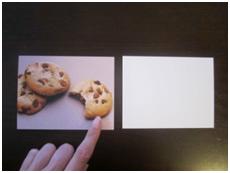
There are a number of ways to help build your child’s receptive vocabulary. Using photo cards is one basic and concrete vocabulary building tool that you can do at home. Place pictures of common objects on the table in front of your child. Ask your child to “touch the cookies” or “give me the hat.” When your child can follow the command and consistently select the requested picture, you have added a new word to their receptive vocabulary.

It is likely that your child will need help selecting the correct card… especially the first few times you try this task. Here is a trick to help make picking the right word easier. Start with just one card on the table and increase the number of pictures slowly. For example, if you are trying to teach the word cookies:


    1. Start with just the picture of the cookies on the table.
    2. After your child has learned to touch the cookies picture on request, add a blank card to the table. Ask your child to touch the cookies picture several more times, rotating the position of the two cards each time.
    3. Then, add a second picture to the table, and a third, and a fourth.
    4. Once your child can select the cookies picture each time, introduce new words using the same method!



This is a part of a series of guest posts by Angela Nelson on building language in children with autism. As the creator of the acclaimed Language Builder Picture Noun Card Set, Angela received her BA and JD from UCLA where she studied and practiced behavior psychology under Dr. Ivar Lovaas. She has been creating autism and special needs curriculum products since 1997.

Building Language for Your Child with Autism, Part 2: Matching Objects and Pictures as a Precursor to Language

Developmental Psychologist, Jean Piaget, observed that a child first becomes aware of a concept and then acquires the words to convey that concept. Think about this for a moment: a child has to know that an apple is a distinct and separate item, before they know they should give it a name. They have to realize that the apple is different than, say, the cup. This is where matching comes in.

To help teach this concept using pictures of objects, place two pictures on the table in front of your child, one picture of an apple, and the other of a cup (or some non-apple picture). Hand your child an identical picture of an apple. Ask your child to “match” the apples, or to “put with same.”

When your child can consistently match the two cards, regardless of the position of the cards, they likely understand that the apple is a distinct object. Now we are one step closer to giving that object a name!


This is a part of a series of guest posts by Angela Nelson on building language in children with autism. As the creator of the acclaimed Language Builder Picture Noun Card Set, Angela received her BA and JD from UCLA where she studied and practiced behavior psychology under Dr. Ivar Lovaas. She has been creating autism and special needs curriculum products since 1997.

Building Language for Your Child with Autism: A Guest Series by Angela Nelson

This week, we’re pleased to introduce a series of posts by Angela Nelson on building language in children with autism. As the creator of the acclaimed Language Builder Picture Noun Card Set, Angela received her BA and JD from UCLA where she studied and practiced behavior psychology under Dr. Ivar Lovaas. She has been creating autism and special needs curriculum products since 1997.

Emerging Language and Building Vocabulary

Language development varies from child to child, and there are wide ranges of expected “normal” language development in young children. If you have specific concerns about the pace of your child’s language development, you should definitely discuss this with your health care professional. However, for reference sake, by the age of two a child is expected to be able to:

  • Follow simple commands or instructions
  • Point to an object or picture when it is named for him or her
  • Recognize names of familiar objects, body parts and familiar faces
  • Repeat words spoken by others
  • Use simple phrases and 2 – 4 word sentences by 18 – 24 months

As we all know, there is no “typical” child with autism. Children on the Autism Spectrum may meet some of these objectives, all of these objectives, or none of these objectives. The goal is to identify your child’s specific language deficits (the areas you see them falling behind) and takes steps to help them catch up.

The first stages of language development, as described above, involve listening to words, imitating words, and building a basic vocabulary. In your child’s education program you may have heard professionals use terms like Receptive Language, Echolalia, Modeling, Matching, or Expressive Language. Don’t let these terms of art intimidate you. Really, they still just mean… listening to words, imitating words, and building a basic vocabulary. 

Encouraging Emerging Language Skills

A most basic step in typical language development is imitation. Many parents are surprised to learn that the parent imitating the child is almost as important as the child imitating the parent! When a 12 month old child looks at his or her mother and says “mamamama,” the mother almost instinctively replies back, “that’s right ‘mama.’” This feedback reinforces the child’s vocalization and encourages them to keep on chatting. Although children with autism may have delayed onset of this type of behavior, or may have some setbacks along the way; it is important to remember to continue to imitate vocalizations with your child to encourage verbal behavior.

Imitation will also provide the first steps in the formation of words for your child. This time I mean your child imitating you! While you are hoping to hear your child imitating full words, remember, this starts with imitating vowels, consonants and syllables. If you say “aaaaa” and your child responds back with “aaaaa,” this is a cause for celebration. You are one step closer to your child saying “apple” than you were before they could (or would) imitate your vocalization. Eventually, modeling words will become the way you build your child’s expressive vocabulary!

Check back this week for from Angela on Matching Objects andPictures as a Precursor to Language.

Study at Hunter College in NY on How Children with Autism Attend to Social Surroundings

Hunter College is conducting a research study where they are recording children’s eye gaze while watching short videos of social situtations to get a better idea of how children with autism attend to their social surroundings.
They are looking for children diagnosed with Autism Spectrum Disorder between 5 and 9 years of age. The study requires one visit to Hunter College in New York City which lasts for approximately 2-3 hours. Participants will be compensated $25 and feedback from standardized assessments will be available.

For more information on participating, email eyetracking@hunter.cuny.edu or call 212-396-6301.


Pick of the Week: Small Steps, Big Skills Video Modeling Game

This week’s pick at a 15% discount is Small Steps, Big Skills which is an evidence-based video modeling game that teaches 22 skills for independence. The software combines Applied Behavior Analysis methods of video modeling and least-to-most prompting by having players watch the skill being completed and then practicing it in a game format. The interactive program rewards players with 8 fun games and shows a wide variety of materials to promote generalization skills. The skill areas covered in the program are: Helping in the Kitchen, Getting Ready for the Day, Helping at Home, Cafeteria Time, My Clean Room, and Time to Relax.

To save 15% on Small Steps, Big Skills this week only, enter the Promo Code BLOGSSBS at checkout.

*Offer expires on October 18, 2011 at 11:59 pm EST. Not compatible with any other offer. Be sure there are no spaces after the Promo Code when you enter it at checkout.


Special Needs Talk Radio has debuted!

Coffee Klatch, a corporation dedicated to providing resources and educational programs for families with special needs children, has a new sister company called Special Needs Talk Radio which features interviews with leading experts, advocates and more in the field of Special Needs. Special Needs Talk Radio debuted on September 6 and will present six new shows hosted by twelve different moderators. This new network is aimed at providing parents with the most current news and information covering a wide range of special education topics.

The network will present six shows that will be broadcasted weekly and are currently scheduled to run through mid-October. They cover topics from Parenting Issues, Raising children with ASD, Special Education and the Law, Inclusion and more. The website also offers interactive features that allow users to be actively engaged in the content by suggesting topics, making comments, and asking questions that can be answered during the live shows.

To find the show schedule and to learn more about each program and upcoming guests, visit:

Special Needs Talk Radio

Pick of the Week: Music in my Mouth – Songs for Speech & Language Skills

This CD with 26 original songs and the accompanying manual are designed to be used by SLPs, early educators and families to teach and practice a variety of skills related to the development of communication skills. Competence in communication is essential to a child’s personal, social, and academic success. Each song equips children with the concepts, behaviors, and self-talk skills that support the development of speech, language and social interaction. The manual provides detailed tips on how to integrate the songs with other activities.

Save 15% on Music In My Mouth this week only by entering the Promo Code BLOGMMM at checkout.

*Offer expires on October 4, 2011 at 11:59 pm EST. Not compatible with any other offer. Be sure there are no spaces after the Promo Code when you enter it at checkout.

25% OFF SALE! Today and Tomorrow Only

Today marks the official start of Autism Awareness month and Different Roads to Learning is kicking things off by offering a 25% storewide sale* today and tomorrow only!!!! To redeem your savings, enter the Promo Code WAAD11 at checkout at www.difflearn.com.  The sale runs April 1 and 2, 2011 until 11:59 pm EST. Don’t miss out on our biggest sale of the year, celebrating Autism Awareness and education.

*Offer NOT valid on the following products:
VB MAPP Assessment Kits (DRK 700, DRK 701),  10-Pack (DRB 682) & 25-Pack (DRB 683) of VB MAPP Protocols,  ABLLS-R Assessment Kits (DRK 702, DRK 703)*
 **The coupon code WAAD11 must be entered during checkout to receive offer. Offer only applies to selected products and not those currently on sale. Your order must be placed during the time of the World Autism Awareness Day Sale to qualify for this special offer. This promotion cannot be redeemed on previous orders placed. This promotional offer may not be combined with any other promotional or discount offers. Offer valid on www.difflearn.com only. 

Upcoming Conferences on Autism and Special Education

Here are some upcoming conferences on Autism across the country. The conferences cover a broad range of topics for learners at different levels and are geared towards both educational professionals and family members.

Queens College Developmental Disabilities QCDD Conference
March 25, 2011- Flushing, NY (Queens College)

The QCDD Conference is focussed on promoting research and effective services focused in the areas of advocacy, behavioral supports and interventions for people with developmental disabilities. Seminar topics include: Assessing the Effects of Behavioral Skills Training on Adult Teaching Responses, Learner Acquisition, and Learner Disruptive Behavior across Responses and Instructional Skill Sets; Effects of Behavioral Skills Training for Teaching Staff to Conduct Functional Analyses: A Component Analysis.

To register and for more information, visit: https://qcpages.qc.cuny.edu/Psychology/

Connecticut Families For Effective Autism Treatment’s (CT FEAT)
Advances in Autism in Connecticut
March 29, 2011- Hartford, CT (Gray Conference Center)

Attending this CT FEAT conference is an efficient way to keep current on the latest autism treatment developments. The new research often presented in such forums can take a long time finding its way into the mainstream of information. Topics will include: Behavior Management; Generalizing Requesting in Social Situations; Using Video Modeling to Teach Social Skills; Using iPad & iPod Applications for Communication.

To register for this event or for more information, please visit: https://www.ctfeat.org/conferences.htm

Los Ninos Services & Fordham University’s 8th Annual Young Child Expo & Conference 2011
April 7-8, 2011- New York, NY (New York Hotel Pennsylvania)

This event brings together top leaders to provide the latest information about essential topics in early childhood development. Early childhood professionals and parents will learn also about services, resources, and products to help all children reach their full potential. In one unique event, this conference integrates learning about typically developing children as well as those with special needs, including autism.

To register or for more information, please visit www.youngchildexpo.com

National Head Start Association’s (NHSA) 38th Annual Head Start Conference
April 4- 8, 2011- Kansas City, Missouri (Kansas City Convention Center)

This event offers targeted training and educational opportunities that enhance participants’ ability to deliver high-quality comprehensive services and optimize early childhood development by bridging the divide between theory and practice and equipping participants with the practical skills and essential knowledge needed to effectively address the many challenges they face in their professional roles. Carefully selected conference seminars and workshops highlight evidence-based methods and evolving knowledge in the early childhood field and provide an engaging forum for open, thoughtful, and candid discussions on a broad range of topics. Participants learn best practices, effective strategies, and cutting-edge approaches that keep them current with new advances and trends in the field.

To register or for more information on this event, please visit: https://www.nhsa.org/?e=events.detail&event_id=78


Council for Exceptional Childrens’
2011 Convention & Expo
April 25-28, 2011- National Harbor, MD (Gaylord National Hotel & Convention Center)

The CEC 2011 Convention & Expo is one of the largest professional gatherings of the special education community. This event offers you an experience with more than 800 sessions to help you learn the latest in evidence-based practices; explore innovative technologies, products, and services; and network with other professionals working with children with exceptionalities and their families. To register for this event or for more information, visit: 
http://www.cec.sped.org/Content/NavigationMenu/ProfessionalDevelopment/ConventionExpo/

Autism Research Institute’s 2011 Spring Conference (Formerly known as Defeat Autism Now!Conference)
April 28-May 1, 2011- Atlanta, GA (Renaissance Waverly Hotel)

This website is for physicians, researchers, and parents committed to finding biomedical effective treatments for autism. Exhibitors will provide attendees with a broad sampling of products and services that are specifically helpful to the autistic population.

To register for this event or for more information, please visit: https://www.ariconference.com/

Autism, Vaccines and Andrew Wakefield

The current media storm surrounding vaccinations and autism is one that, I’m sure, we’ve all been following with great interest. The initial study that linked autism with vaccinations has been dismissed and retracted by the majority of the original authors. Currently, there is speculation that Mr. Wakefield may have falsified data. Many parent advocates are claiming this is a smear campaign being conducted in the name of protecting pharmaceutical companies to the detriment of children.

We know that this is an incredibly sensitive issue with opinions strong on both sides of the fence. We do think it’s an important issue to discuss, respectfully, within our community. For parents, do you believe that the MMR vaccination contributed to your child’s autism? What is your opinion of Andrew Wakefield and his study?

Here’s some coverage of both sides of the issue from CNN, if you’d like to see more on the reporting.