Teaching Functional Living Skills to Children with Autism at the Grocery Store

We hear over and over again how children with autism may need hundreds or even thousands of opportunities to practice a skill before acquiring it. It’s important to keep this fact in mind when it comes to functional living skills (e.g. making the bed, cooking a meal, etc.). Many of the parents I work with prefer to focus on academic skills rather than functional living skills. Some feel that by focusing on functional living skills, they’re giving up on larger goals for their child, such as being placed in a general education environment, having the opportunity to go to college, and/or having the opportunity to have a career.

I always encourage parents to focus on both academic and functional living skills. While it may seem unnecessary to start thinking about teaching a nine year old how to grocery shop, it’s really just providing them with many, many opportunities to practice the skill. Typically developing children “practice” grocery shopping from a young age by watching their parents and playing “store” with friends, but children with autism are unlikely to observe their parents while they’re shopping or to play such games as “store” without explicit instruction. By practicing the skill with your child early on, you’re promoting future independence.

You can practice these skills when you are in the grocery store with your child, and you may just find that your child enjoys shopping. (Grocery shopping is a favorite activity for two of my current students.) It may be beneficial for you to just start out with one skill, choosing the one you think your child is the most likely to experience success with or that your child will be the most motivated by.

 BEGINNER SKILLS
  • Choosing if you need a cart or a basket (Is our list long or short? Do we have big or small items?)
  • Using a grocery list (reading the list, crossing off items already placed in cart/basket)
  • Using supermarket signs to find items (understanding categories, knowing where to look for signs)
  • Greeting cashier
 INTERMEDIATE SKILLS
  • Choosing good fruit or vegetables (looking for bruises, identifying ripeness)
  • Giving money to cashier
  • Accepting change from cashier
  • Taking bags when it’s time to leave
 ADVANCED SKILLS
  • Comparison shopping (looking at unit price, comparing prices of two brands)
  • Making sure you received correct change
  • Returning an item that is damaged

You shouldn’t limit these skills to just the grocery store either. All of these skills are useful in department stores, pharmacies, book stores, and more. Your child may be more motivated to use these skills at the book store or a toy store. You can help your child learn the skills there, then generalize them to other types of stores.

If you need help getting started, you should ask your child’s teacher or therapist to accompany you on your first trip. They can help you identify the appropriate steps to put your child on the path to independence.

Interview with Ron Suskind, author of “Life Animated: A Story of Sidekicks, Heroes, and Autism”

A few weeks back, we shared the wonderful article in the NY Times by Ron Suskind titled Reaching My Autistic Son Through Disney. 

This week, CBS Sunday Morning profiled Ron and his son Owen, sharing their journey and experiences. It’s an incredible, moving story and we hope you’ll find the time to watch their interview as they share Owen’s story of reconnecting with his family and finding his voice through the movies of Disney.

Tip of the Week: Scanning – Best Teaching Practices

Scanning is one of the first skills we teach learners with autism. This skill, (looking at each item presented and using that information to make decisions,) is essential for almost every other skill we teach children in early childhood. Historically, we have taught scanning skills through matching and listener responding activities by lining up 3 pictures or objects, then having the learner choose the correct match out of the three items or point to the item we have named. However, this is not representative of the way scanning skills are used in the natural environment.

Toddler boy reaching for carrots in grocery storeConsider how you use scanning in your own life: searching a row of books on a shelf to find a particular title, trying to find your favorite tomato soup in a supermarket aisle filled with soups, or looking through a box of Legos for one blue square Lego to complete a structure. None of the ways we scan in the natural environment present materials in a field of 3 neatly lined-up items.
There are steps you should take in order to help prepare your learner for scanning in the natural environment. When working on matching items or identifying items, you should quickly reduce prompts (as discussed in this previous post) and increase the difficulty of scanning. There are two ways to do this: (1) increase the number of items in the field and (2) make the array of items messy.

If we take a look at matching, here is a sample of the steps for a matching program you might use to help teach the skill:

  1. Match an object to 1 of 3 objects placed on the table
  2. Match an object to 1 of 5 objects placed on the table
  3. Match an object to 1 of 5 objects placed in a messy array on the table
  4. Match an object to 1 of 8 objects placed in a messy array on the table
  5. Match an object to 1 of 10 objects placed in a messy array on the table
  6. Match an object to 1 of 5 objects with similar but non-matching items in the messy array (example: you’re trying to match a red car, in the array there will be a red car as well as a blue car and a red truck.)
  7. Match an object to 1 of 8 objects with similar but non-matching items in the messy array

As the learner masters each step, he/she is getting closer to what that skill looks like in the natural environment. Lastly, here are a few examples of how children use scanning in the natural environment. These can be used to practice the skill in ways that are motivating to your individual learner:

  • searching for all the pieces to a costume for dress up play
  • finding a specific piece to complete a puzzle or block structure
  • looking for his/her favorite candy or snack at the supermarket
  • finding a specified item in a picture (for example, if I have a learner that loves Elmo, I’ll find many pictues with Elmo shown and have the learner point him out)
  • retrieving shoes from a shelf or closet
  • picking out a nail polish color
  • choosing their favorite tv show from a DVR or computer menu
  • playing “I Spy”
  • finding the right tool from a messy utensil drawer for a cooking activity
  • retreiving his/her favorite train from a bucket of trains

The Power of Music (and Katy Perry)

What can you say? Imagine this mother’s absolute delight when her 8-year old son, mostly non-verbal, started singing the big pop song of the day? His mother, Carla, said “I was so happy to know something that he liked. I don’t know what his favorite food is, I don’t know what his favorite color is. I know he likes music, but I didn’t know he liked a particular song.” Have a listen and be warned – you may erupt in applause.


Tip of the Week: Avoid Prompt Dependence When Teaching New Skills

“She won’t say hi unless I say ‘Say Hello.’” “He will only wash his hands if I put his hand on the knob to turn on the water.” “He won’t use his fork until I put it in his hand.”

I hear statements like this all the time from both parents and providers working with learners what autism. What they are describing is “prompt dependence,” which is when a learner requires a prompt from a teacher or parent in order to complete a task. So how do you avoid prompt dependence with your own learners?

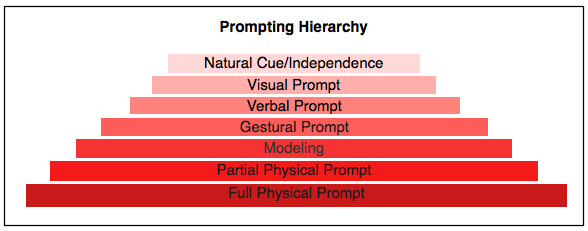
Let’s start with the prompt itself. There are many different ways to prompt which can be divided into levels by how intrusive the prompt is. Below is a sample of a prompt hierarchy, with the least intrusive prompt at the top and the most intrusive prompt at the bottom. Your goal is to quickly move through the prompt levels to move your learner to independence.

Prompting Hierarchy

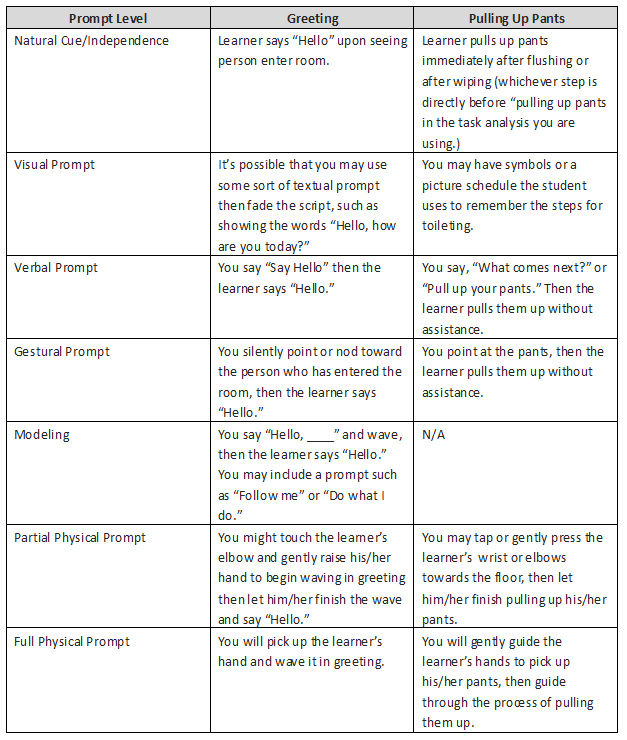
Now let’s look at two different examples to show these prompt levels. In the first example, the goal is for the learner to greet a person who walks into the room. In the second example, the goal is for the learner to pull up his/her pants after using the bathroom as a part of a toileting routine.

Prompt Chart

Research shows that least-to-most prompting increases potential for errors and slows down rate of acquisition for new skills. Therefore, most-to-least prompting is preferred for teaching new skills. This means that you would start at a full physical prompt, then move your way up the prompt heirarchy until your learner achieves independence with the task.

In the past, when working with discrete trials, it has been common practice to have a learner master a skill at a certain prompt level, then move to a less intrusive prompt and have the learner master the skill at that prompt level, steadily moving towards independence. This can actually encourage prompt dependence because the learner remains on the same prompt level for too long.

Instead, you should try to quickly move up the prompt hierarchy in a way that makes sense for the skill you are trying to teach. Below are some tips to help you help your learners achieve independence.

  • Follow the rule of three: Whether you are teaching with discrete trials or in the natural environment, once your learner has successfully responded to a demand three times consecutively, move to a less intrusive prompt.
  • If you are taking data, make a notation of what prompt level you are using at each step. (And remember, that only independent responses should be counted towards the learner’s percentage of correct responses.)
  • At the end of a session or group of trials, note what prompt level you were at by the end of the session. Then start at that level during the next session.
  • If your learner does not respond correctly when you move to a less intrusive prompt, then move back to the most recent prompt level. Once they respond again correctly at that prompt level three times consecutively, move again to a less restrictive prompt.
  • Remember that verbal prompts are very difficult to fade. Though they are less instrusive, you should avoid using them when possible.
  • You can pair prompts and then fade out the more intrusive prompts. For example, with the sample of pulling up pants described above, you can pair a visual prompt with a gestural prompt by showing the symbol for pulling up pants while pointing at the pants. Over time, you stop using the symbol and just use the gestural prompt. The gestural prompt can be faded by moving your point further and further away from the pants.
  • Write down what the prompt levels will look like for the specific task you are teaching. This way you will be fully prepared to quickly move your learner towards independence.
  • Differentiate your reinforcement! If you move to a less intrusive prompt and the learner responds correctly, then you should immediately provide a stronger reinforcer than you did for previous responses. If a learner spontaneously responds without a prompt, you should do what I call “throwing them a party” by combining reinforcers (such as tickles and high fives) or providing a highly desirable reinforcer.

Prompting can be very difficult to do well, but following these tips should help set your learner on the path to independence.

Sam’s Hints for the Holidays: 6 Tips for Success on Halloween

TrickorTreatHolidays can be challenging for everyone in the family. Your to-do lists get longer, your routines are switched around, and all the little stresses can be especially difficult for your child with autism. Here are a few tips to ease the difficulties related to Halloween.

For Preschool & Elementary Children

  • Practice – Invite your neighbors to have a “rehearsal” for Halloween so your learner can practice the steps. If this isn’t a possibility for you, it may be helpful to watch youtube videos of trick-or-treating.
  • Prepare – Let your child know the trick-or-treating route in advance. In the days leading up to Halloween, make yourself aware of houses to avoid based on decorations that are gory, include excessive lighting, have strobes, or any other aspects that you know will make your learner uncomfortable.

For Teenagers

  • Consider alternatives – You may want to join with other parents to throw a Halloween party that is autism-friendly based on the needs of your learner and the needs of other party guests. Another suggestion would be to celebrate with a themed activity, such as Halloween activities at local museums or art institutions.
  • Give a task – Let your child have a job such as giving out the treats at the door, managing an activity for younger children, or helping with decorating your home.

For All Children

  • Be flexible – Think about what is necessary for your learner, what your learner is interested in, and what success looks like in terms of Halloween. Maybe success means you visit three houses, or maybe success means your learner chose a costume. The idea is to keep it fun.
  • Remember it’s okay to stay at home! – You can create your own Halloween tradition that fits your family’s needs. This could include a special movie night, creating Halloween-inspired foods together, or anything that is fun for the whole family.

Pick of the Week: Bullying & ASD – The Perfect Storm – NEW from Autism Partnership

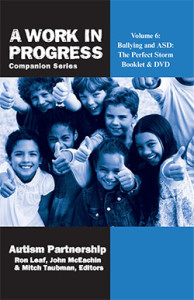
Work in Progress v6 Cover.inddBullying & ASD: The Perfect Storm – the brand new booklet and DVD from Autism Partnership – comes at a most important time. Recent school bullying and cyberbullying statistics show that:

  • 1 out of 4 kids are bullied
  • 77% of students are bullied either mentally, verbally or physically
  • Cyberbullying statistics are rapidly approaching similar numbers, with 43% experiencing cyberbullying
  • Of the 77% of students that said they had been bullied, 14% of those who were bullied said they experienced severe (bad) reactions to the abuse

Bullying is a real and pressing issue in our schools and online, and children with autism spectrum disorder are especially at risk. In the most recent volume of the Work in Progress Companion Series, Doctors Leaf, McEachin and Taubman explore not only the reasons that children with ASD are targets for bullying, but more importantly, they offer realistic and attainable strategies for kids on the spectrum.  

Several traditional methods of dealing with bullies are explored in this booklet and DVD, including avoidance, informing an authority figure, and fighting back.  In addition, there are strategies for educating and preparing the victims so that students with ASD can better combat bullying.  The included DVD features over an hour and 40 minutes of footage including advice from experts, one-on-one interviews with students, and real classroom brainstorming sessions where students with autism spectrum disorder are shown:

  • The difference between teasing and bullying
  • How to avoid the behaviors invite bullying, including determining the important difference between “cool” and “uncool”
  • When and when not to listen to peers
  • How to react to a bully

This week only, save 15% on the important new booklet and DVD – Bullying & ASD: The Perfect Storm –  by entering the promo code BLOGBASD2 at checkout.

*Offer expires on April 30, 2013 at 11:59 pm EST. Not compatible with any other offer. Be sure there are no spaces after the Promo Code when you enter it at checkout.

Remembering Dr. Nathan Azrin, Psychologist Who Developed the Token Economy

AZARIN-obit-articleLarge

Perusing the New York Times this morning, I ran across an obituary for Dr. Nathan Azrin.  The name rang a bell but it wasn’t until I read the article that I realized that he had taken B.F. Skinner’s work and made theory into practice.  He created the “first token economy” and was able to change and shape behaviors for many different types of patients. 

 I wonder if Dr. Azrin had any idea of the hundreds and thousands of children he supported and helped through the years.  It’s boggles my mind to think of all of those token boards, penny boards and reward boards we’ll all created and used.

As we quoted in our most recent catalog, according to Matson & Boisjoli (2009): “One of the most important technologies of behavior modifiers and applied behavior analysts over the last 40 years has been the token economy.”

While we’re working with our kids today, let’s take a moment and thank Dr. Azrin for making a difference in the lives of those on the spectrum.  Here’s the whole article:

https://www.nytimes.com/2013/04/16/health/nathan-azrin-behavioral-psychologist-dies-at-82.html?ref=obituaries


New Low Price on Our Language App: Tell Me About It!

tell me about it iconAutism Awareness Month excitement continues…We’re thrilled to announce that for the rest of April, you can purchase our App Tell Me About It! Learning Language by Receptive Function, Feature & Category for the low price of $2.99!

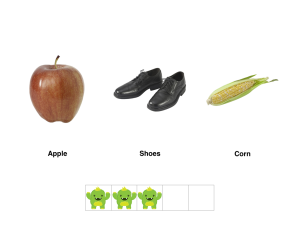
Tell Me About It! teaches the label, category, function, and features of more than 235 language targets over 6 levels of incremental difficulty, with over 1000 unique testable attributes. The presentation of each language target conforms to an Applied Behavior Analysis (ABA) discrete trial program, with reinforcement provided by a token economy system. Tell Me About It! provides a self-contained discrete trial program that error corrects and provides direct and immediate reinforcement while collecting and synthesizing data for up to 10 students. There is a Student Report Card that displays data for each student, with an option to email the results.

For students with speech and language delays or for those with Autism Spectrum Disorder, learning to simply label an image doesn’t necessarily translate into comprehensive understanding of that word. By breaking down each language target by its category, the function that it serves and its salient features, we offer students the opportunity to fully comprehend and then engage in language.

Level 1 

Categories

The App covers 15 categories of language targets that include: Animals, Body Parts, Clothing, Food, Household Items, Dishes, Utensils, Tools, Toys, School Supplies, Sports, Vehicles, Accessories, Furniture, and Musical Instruments.


Levels

The App advances from the basic building blocks of language – simple labeling – all the way through shared features across categories. The Levels presented in incremental difficulty are:

Level 1: Labels
                Level 2: Categories
                Level 3: Function
                Level 4: Feature
                Level 5: Randomized Feature, Function, Category
               Level 6: Shared Featured, Function, Category

Teacher Console


Teacher’s Console            

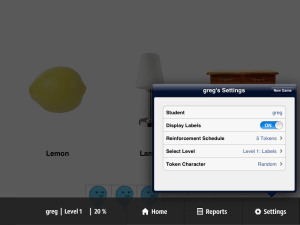
Teachers and parents can delve into the Teacher’s Console to control the settings for each student by turning the written labels for each language target ON/OFF, selecting a specific token character, selecting the default Level, and choosing a Reinforcement Schedule.

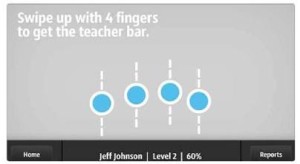
There is even a motion that administrators can use while a game is in progress to access the Teacher’s Menu to adjust the settings or view reports. To access the Teacher’s Bar, simply swipe 2 fingers in an upward motion from the bottom of the screen up:

 TeacherGesture

Reinforcement Schedule

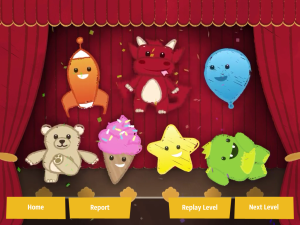
The Reinforcement Schedule determines how many targets the studentmust answer correctly in order to complete a trial session and obtain a 5-10 second animation reward.  There is an option for 3, 5, or 10 tokens and you can even select the character you want or keep the default setting of Random.

 End of Game

Reporting & Data

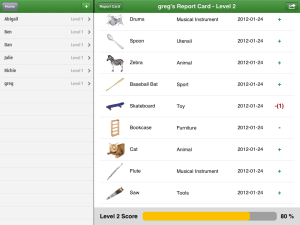
Tell Me About It! tracks each student’s progress and provides a Report after every trial as well as a comprehensive Report Card accessible in the teacher’s console. You’ll see a + for every correct response and a – for incorrect ones. If a student hasn’t yet mastered a target, you’ll see the number of presentations in parentheses after the score.

Report Card

Determining Mastery of Targets

This App strives to mimic an actual one-on-one instructional session with a therapist as much as is possible in an application. For this App, we determine which targets will be defined as mastered by the program in a variety of ways depending on how many times it has been presented.  When answered correctly on the very first presentation, the student receives both a token and verbal praise and that target is considered “known” or mastered and not presented again on that level.  If the answer is not correct on that first presentation, the target will be reintroduced in subsequent trials and must then be answered correctly on two different, consecutive presentations to be considered mastered. When an incorrect response is given, error correction is provided by having the correct image flash while verbal correction is also provided. The App then shuffles the placement of the images, and re-presents the same question. If the student answers correctly on this second attempt, they receive verbal praise only (no token) and then move to another question.  Note that your Data sheets will display, in parentheses, how many times each target has been presented so that you are always aware of your student’s progression and where there might be deficits.


Our new catalog is here!

And it’s a big one for us – Volume 30! Over 18 years and 30 catalogs, our mission has always stayed the same: to educate and empower children with autism and special needs. We’re so proud of our 30th Catalog and we think you will be quite excited by the 70 new products that we’ve added. We’ll be highlighting and featuring some of our best new products in our Pick of the Week segment so be sure to keep an eye out for special offers by joining our mailing list.

The new catalog contains all of your favorite go-to’s, like the Language Builder and the Time Timer, along with spectacular new products for Early Intervention, teaching social skills, developing conversation and so much more.

You can always request a paper catalog on our site, or you can click here for our fully interactive e-catalog that enables you to dowload, print and link back to the products on our site.

We’re thrilled to share this milestone with you and can’t wait to hear your thoughts on our new products.