
Building Language for Your Child with Autism, Part 4: Building Expressive Vocabulary

This is the step where your child learns to actually say the words out loud. All of the tasks described in previous posts come into play when building your child’s expressive vocabulary. Picture cards are a useful tool again, because it just isn’t feasible to bring every object directly to your child. We certainly want them to learn the words bus and airplane, but it’s difficult to get those items into your living room!

The basic idea for building expressive vocabulary using picture cards is just to hold the card up and ask your child “what is it?” The intricacy comes in knowing how to prompt your child and how to fade that prompt. We talked previously about the importance of your child being able to imitate the words that you say. Imitation is the basis for the prompts you will use to build your child’s expressive vocabulary.

The first several times you ask your child the name of a new picture, you will likely have to model the word for him or her. For example, you ask your child “What is it?” If you do not get a response, you say “apple.” Ideally your child repeats the word “apple.” After a few tries, you can shorten your prompt to “app….” And then to “aaaa…….” And then perhaps to just opening your mouth as if to say “aaaa…” but not making a sound.

A Comprehensive Picture Card Library

It is a good idea to have a large selection of pictures ready to go when you start to teach the lessons we just described. Here are a few tips to help you choose or take appropriate pictures:

  1. Start with words that are familiar to your child. Words like apple, cup and cookies may be better than ­saxophone or stethoscope.
  2. Start with pictures on a plain white, or a distraction free background.
  3. Make sure to have duplicates available for the matching tasks when you first start out.
  4. Consider taking multiple pictures of the same item (6 different apples for example) to help your child generalize their newly learned words.
  5. As your child becomes more comfortable learning new words move to more natural settings for your pictures.
  6. Have a broad range of pictures, across multiple categories, ready for when your child is ready to move forward!
  7. If you take the pictures yourself, consider having them laminated for durability.If you don’t have the time to make your own pictures, a 350-Card Set of photo flash cards called the Language Builder Picture Card Set is avaibable and is specifically tailored to meet the needs of an early language vocabulary building program.


This is a part of a series of guest posts by Angela Nelson on building language in children with autism. As the creator of the acclaimed Language Builder Picture Noun Card Set, Angela received her BA and JD from UCLA where she studied and practiced behavior psychology under Dr. Ivar Lovaas. She has been creating autism and special needs curriculum products since 1997.


Building Language for Your Child with Autism, Part 3: Building Receptive Vocabulary

Receptive language refers to the thought process involved in hearing, processing and comprehending spoken language. When we mentioned above that a two year old child should be able to follow simple commands, point to objects when they are named, and recognize names of familiar objects; these objectives were examples of receptive language skills.

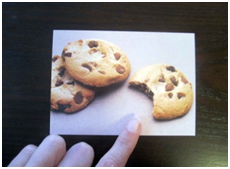
There are a number of ways to help build your child’s receptive vocabulary. Using photo cards is one basic and concrete vocabulary building tool that you can do at home. Place pictures of common objects on the table in front of your child. Ask your child to “touch the cookies” or “give me the hat.” When your child can follow the command and consistently select the requested picture, you have added a new word to their receptive vocabulary.

It is likely that your child will need help selecting the correct card… especially the first few times you try this task. Here is a trick to help make picking the right word easier. Start with just one card on the table and increase the number of pictures slowly. For example, if you are trying to teach the word cookies:


    1. Start with just the picture of the cookies on the table.
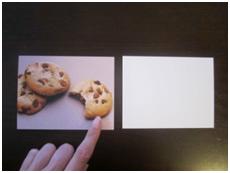
    2. After your child has learned to touch the cookies picture on request, add a blank card to the table. Ask your child to touch the cookies picture several more times, rotating the position of the two cards each time.
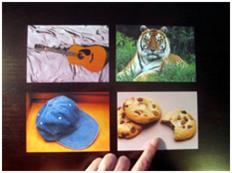
    3. Then, add a second picture to the table, and a third, and a fourth.
    4. Once your child can select the cookies picture each time, introduce new words using the same method!


This is a part of a series of guest posts by Angela Nelson on building language in children with autism. As the creator of the acclaimed Language Builder Picture Noun Card Set, Angela received her BA and JD from UCLA where she studied and practiced behavior psychology under Dr. Ivar Lovaas. She has been creating autism and special needs curriculum products since 1997.
Building Language for Your Child with Autism, Part 2: Matching Objects and Pictures as a Precursor to Language

Developmental Psychologist, Jean Piaget, observed that a child first becomes aware of a concept and then acquires the words to convey that concept. Think about this for a moment: a child has to know that an apple is a distinct and separate item, before they know they should give it a name. They have to realize that the apple is different than, say, the cup. This is where matching comes in.

To help teach this concept using pictures of objects, place two pictures on the table in front of your child, one picture of an apple, and the other of a cup (or some non-apple picture). Hand your child an identical picture of an apple. Ask your child to “match” the apples, or to “put with same.”

When your child can consistently match the two cards, regardless of the position of the cards, they likely understand that the apple is a distinct object. Now we are one step closer to giving that object a name!


This is a part of a series of guest posts by Angela Nelson on building language in children with autism. As the creator of the acclaimed Language Builder Picture Noun Card Set, Angela received her BA and JD from UCLA where she studied and practiced behavior psychology under Dr. Ivar Lovaas. She has been creating autism and special needs curriculum products since 1997.

Building Language for Your Child with Autism: A Guest Series by Angela Nelson

This week, we’re pleased to introduce a series of posts by Angela Nelson on building language in children with autism. As the creator of the acclaimed Language Builder Picture Noun Card Set, Angela received her BA and JD from UCLA where she studied and practiced behavior psychology under Dr. Ivar Lovaas. She has been creating autism and special needs curriculum products since 1997.
Emerging Language and Building Vocabulary

Language development varies from child to child, and there are wide ranges of expected “normal” language development in young children. If you have specific concerns about the pace of your child’s language development, you should definitely discuss this with your health care professional. However, for reference sake, by the age of two a child is expected to be able to:

  • Follow simple commands or instructions
  • Point to an object or picture when it is named for him or her
  • Recognize names of familiar objects, body parts and familiar faces
  • Repeat words spoken by others
  • Use simple phrases and 2 – 4 word sentences by 18 – 24 months

As we all know, there is no “typical” child with autism. Children on the Autism Spectrum may meet some of these objectives, all of these objectives, or none of these objectives. The goal is to identify your child’s specific language deficits (the areas you see them falling behind) and takes steps to help them catch up.

The first stages of language development, as described above, involve listening to words, imitating words, and building a basic vocabulary. In your child’s education program you may have heard professionals use terms like Receptive Language, Echolalia, Modeling, Matching, or Expressive Language. Don’t let these terms of art intimidate you. Really, they still just mean… listening to words, imitating words, and building a basic vocabulary. 

Encouraging Emerging Language Skills

A most basic step in typical language development is imitation. Many parents are surprised to learn that the parent imitating the child is almost as important as the child imitating the parent! When a 12 month old child looks at his or her mother and says “mamamama,” the mother almost instinctively replies back, “that’s right ‘mama.’” This feedback reinforces the child’s vocalization and encourages them to keep on chatting. Although children with autism may have delayed onset of this type of behavior, or may have some setbacks along the way; it is important to remember to continue to imitate vocalizations with your child to encourage verbal behavior.

Imitation will also provide the first steps in the formation of words for your child. This time I mean your child imitating you! While you are hoping to hear your child imitating full words, remember, this starts with imitating vowels, consonants and syllables. If you say “aaaaa” and your child responds back with “aaaaa,” this is a cause for celebration. You are one step closer to your child saying “apple” than you were before they could (or would) imitate your vocalization. Eventually, modeling words will become the way you build your child’s expressive vocabulary!

Check back this week for from Angela on Matching Objects andPictures as a Precursor to Language.

Pick of the Week: Time Timer

You’re probably all familiar with the excellent Time Timer. These visual timers have been a staple at home and in classrooms for students with special needs for years now. This week, save 15% on all three sizes of the Timer Timer: 3-inch, 8-inch and 12-inch. The Time Timer is ideal for transitions, scheduling, getting ready and so much more.

Save 15% on the Time Timer today through April 5 by entering the promo code BLOGTTR at checkout.

*Offer expires on April 5, 2011 at 11:59 pm EST. Not compatible with any other offer.

Don’t Forget…April is Autism Awareness Month

Light It Up Blue Autism SpeaksApril is National Autism Awareness Month and there are tons of events, conferences and fundraisers occurring across the country. To kick of the month, Autism Speaks is raising awareness through their Light It Up Blue campaign. On the evenings of April 1 and 2, prominent buildings across North America and the world — including the Empire State Building in New York City and the CN Tower in Toronto, Canada — will turn their lights blue to raise awareness for autism and to commemorate World Autism Awareness Day on Saturday, April 2. You can wear something blue, use a blue light or wear a puzzle piece to commemorate the day and raise awareness. Click here for a long list of events taking place around the world.

Are you planning on participating in any events for Autism Awareness Month? We’d love to hear about events in your city or town.

Make sure to check back with us on April 1 for Different Roads to Learning’s kick-off to Autism Awareness Month.

Posted in ABA

Stop Additional Budget Cuts in Early Intervention!

New York State is in talks over the budget and Early Intervention is facing additional cuts after a 10% cut just last year!  WIth 14 years of experience I have seen how dramatically Early Intervention can change a child’s life.  Please get involved and let your voice be heard.

Professional Agencies for Children’s Therapy Services has drafted a letter that can be personalized and sent to the decision makers in Albany. Click here to learn more and do your part.

Posted in ABA

Apps for Children with Special Needs

For all you technophiles who are loving using the iPad with your students and children, this website – Apps for Children with Special Needs – is going to knock your socks off. They’re completely on top of all the new educational apps coming out. They list each one, explaining their features in detail and even provide a video of the app in use so you can decide if it’s right for you before shelling out the money. This is a GREAT site that we highly recommend!

Defining ‘Essential’ Care


With healthcare reform underway, this article in the Wall Street Journal highlights the differences between habilitative services and rehabilitative services and how those definitions will impact future insurance coverage. The article specifically looks at coverage for children with Autism and whether early intervention services will be covered or considered reimbursable expenses. More specifically, if services defined as habilitative are indeed covered, families would be entitled to behavioral therapy as well as speech and OT. Opponents claim that the costs would be too high. What are your thoughts on the issue?

Tips for Making a Move More Successful

I’ve recently moved from one apartment to another one only two blocks away.  The funny thing is that it has left me completely discombobulated.  I leave the house improperly dressed for the weather because I have no idea where the hats, scarves and gloves are.  I’ve fallen behind in several tasks and generally just feel a bit ‘out of it’.

This started me thinking about what families with a child on the spectrum most likely experience when moving.  Many children with autism are disrupted by change and any variations in the daily routine can dramatically impact their level of functioning.  It would be important when moving, like most predictable events, to prepare your child ahead of time.   I only have one first hand experience working with a family who moved.  It went pretty smoothly because they were relocating in the same city and had family close by where therapy could take place while the new apartment was being set up. Additionally, this particular child is pretty easy going and isn’t as bothered by change as many of my other students.  However, I have a feeling that this is the exception to the rule rather than the norm.

Clearly, all children are different and this should be taken into consideration when preparing them for the move but in general there are some things to consider for all children.  I would suggest the following ways to try and lessen the stress and help facilitate a smoother transition.

Prepare your child for the move. – This one goes without saying but I’m going to say it anyway.  Just because you think your child might not conceptually understand a discussion about moving doesn’t mean you can’t begin to prepare them for the change.  There are many great children’s books about moving and it wouldn’t be a bad idea to start reading these together several weeks before you move.  You can create social stories about what changes can be expected and even talk about some of the “what if’s” that can be encountered when moving.  If you are moving within the same city or town you can become familiar with the new neighborhood before hand by going to the new playgrounds or any other place you might frequent.  If you are not able to visit the new places you can put pictures of them in a photo book to review and discuss.  You can also count down the days until the move on a calendar so that the arrival of the actual day is predictable.


Keep the schedule the same as much as possible. –  This is always a safe starting place when unsure about how your child might react to change.  Whether a holiday or moving to a new apartment if you’re able to keep the schedule the same it will make everyone’s life a little easier.  It might also be helpful to reintroduce a visual schedule for a few weeks surrounding the move if you don’t have one in place already.


Keep favorite and comforting items accessible. – If there is a particular toy or item that plays a critical role in your child’s ability to self soothe when upset you will want to make sure you know where it is during the move.  The location will be changing but you want to make sure that it still feels like home by having familiar items available.  It is also a good idea to have the child’s room set up in a similar way in the new house so there isn’t too much of an adjustment in their personal space.  This isn’t a good time to update furniture or purge old toys as you will want to keep things as similar as possible.

Use Positive Reinforcement. – Moving is one giant transition but you can be sure that within that there will be a lot of little transitions and adjustments too.  It’s important to not lose sight of any success your child experiences with these smaller transitions up until and even after the move.  When your child transitions smoothly REINFORCE it!  Reserve a favorite toy or snack as reinforcement for transitions so that it remains powerful and meaningful to the child.  Even if these are transitions that no longer require reinforcement you can use it as an opportunity to emphasize their ability to transition and remind them up the upcoming move.

What is your personal experience with moving?  Were there things that were crucial to your child transitioning smoothly?  Are there things you tried that you would do differently if you had to move again?  What tips would you share with other families who are preparing to move? We would love to hear your story!