New from the Social Thinking team, Should I or Shouldn’t I? encourages players to think about their own behavior choices and compare how their perceptions match—or don’t—those of others. The game is built on the idea of perspective-taking and explores social behaviors from different viewpoints to help develop understanding of how these affect relationships with others. The object of the game is to have players think about their own thoughts and behaviors and those of others in various situations. This week, we’re featuring both the Middle/High School and Elementary School editions as our Pick of the Week with a 15% discount to your order. Just enter in promo code SHOULDI3 to redeem your savings at checkout.
The brand-new Elementary School edition fosters important discussions about social situations that elementary-aged students ages 8-11 may encounter at home, at school, and out in the community. Between the ages of 8-11, the social demands placed on kids begin to change. Teachers expect kids to be more socially aware of others and be more independent in monitoring their own social behaviors. Kids of this age are also expected to successfully navigate unstructured social experiences such as recess and lunch. For many, this is difficult. As kids move through grades 3-5, play also changes from being imaginative to being competitive. Kids “hang out” more, which often translates into increasingly sophisticated conversations where group members must figure out other people’s motives and intentions. Overall, social nuance becomes much more complex.
 This game gives kids a chance to explore this shifting social landscape and learn how their own views compare/contrast with the way their peers view things. The Prompt and Challenge cards address a wide range of age-matched situations that arise at school, during down time together, or in the community. However, it is always wise for parents or therapists to read through the cards and remove those that may be inappropriate for any of the players or that are mismatched to their level of social functioning or social understanding.

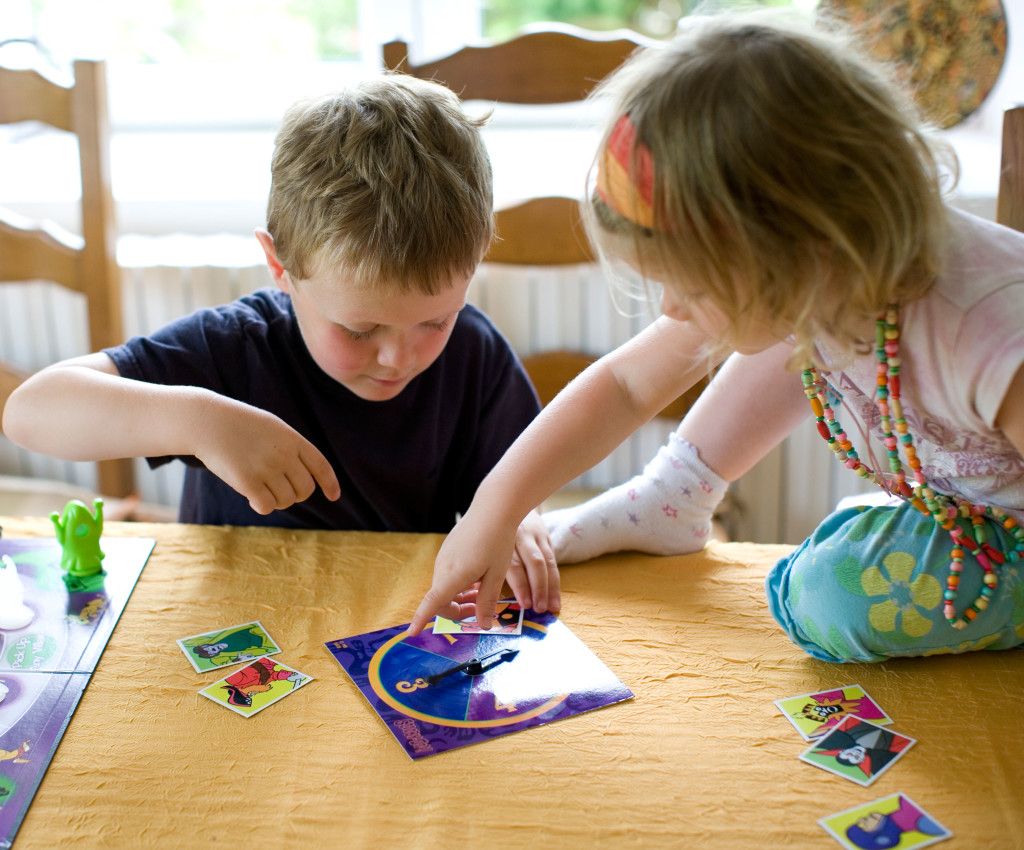 Activities should be reinforcing for both kids in order to increase the likelihood that siblings will independently engage in play without prompts by adults. Try to avoid situations where you are requiring the typically developing sibling to engage in an activity just because it is motivating for the learner with autism.
 When beginning with a new student, there are two important things you must do. First, pair with your student, as described
 Write it down. Some parents I work with choose to print out the steps for their child’s intervention and place them near their computer or in their wallet so they see it on a regular basis. Having access to a reminder of the steps can be an essential part to ensuring success. For example, one of the steps in Barbara’s son’s intervention was access to his favorite comic books with new comic books available every 7-10 days. Barbara put a recurring reminder in her phone that was scheduled to appear every 7 days. Having the visual reminder helped Barbara and her husband stay on schedule with replacing the comic books in their son’s travel backpack, as well as stay on track with all the steps involved in the intervention.
 There are many great mainstream games available out there but it can sometimes be challenging to know if a particular game’s intended uses are feasible for a learner on the spectrum. With a few simple tips and modifications, many of these games can be altered to provide an excellent learning opportunity through play and most of all, fun.


 There are likely activities most people enjoy that your child is unable to tolerate. Try to pair these difficult activities with activities/items that your child does enjoy. For example, if your child is unable to tolerate the sounds and energy level of the whole family unwrapping gifts, you can pair that activity with something highly desirable that is frequently unavailable such as a specific toy or listening to his/her favorite song on headphones. You can ensure greater success if you have a few pairing sessions before the big day. For this example, you might have family members unwrap one box while your child has the preferred item/activity, then have family members unwrap 3 or more boxes while your child has the preferred item/activity.


 Consider how you use scanning in your own life: searching a row of books on a shelf to find a particular title, trying to find your favorite tomato soup in a supermarket aisle filled with soups, or looking through a box of Legos for one blue square Lego to complete a structure. None of the ways we scan in the natural environment present materials in a field of 3 neatly lined-up items.