Tip of the Week: Do It Again

Teacher and Student In A Classroom At SchoolTeaching learners with autism or other developmental delays can frequently be a complicated, stress-inducing labor of love. This is why I especially appreciate that one of the most useful strategies in working with learners of all ages is just three simple words: “Do it again.”

The basic idea behind “Do it again,” (Or “Try it again,” or “Do it better”) is that you are calmly stating that the learner must try an action again and do it better than previously done. You are not yelling, you’re voice isn’t even raised. And you are communicating to the learner that you know he/she is capable of doing more.

In some cases, working with learners who may require more invasive prompts such as physical prompts, it may be necessary to have two adults for this to work best. Below are a few example scenarios of how this might work.

Scenario One

  • Teacher asks student to hand a paper to her.
  • Learner drops paper on desk next to her hand.
  • Teacher: (Hands paper back to student.) Try it again. (Holds hand out for paper.)
  • Learner places paper in hand.
  • Teacher: Thank you.

Scenario Two

  • Non-verbal learner wants to get attention from teacher. Grabs teacher’s shirt and pulls.
  • Second adult (possibly another teacher or paraprofessional): Try it again. (Provides hand-over-hand assistance for giving a light tap to get teacher attention.)
  • Teacher: What do you need, _____?

Scenario Three

  • Learner: S@*!
  • Teacher: Try again.
  • Learner: S@*!
  • Teacher: Try it again. (calm, even tone)
  • Learner: I’m mad.

Scenario Four

  • Learner is running across the room to get a toy.
  • Teacher: Go back. Try again. (The learner must return to the point in which he/she began to run.)
  • Learner walks across the room.

Behaviors to use this with:

  • recurring behaviors in which you know the student knows the rule, or you have repeated the rule many times
  • behaviors that are maintained by attention or desiring “shock value” such as cursing, insulting, or using rude language
  • increasing behaviors related to polite speech
  • decreasing behaviors that could cause injury (such as running in the classroom or being rough with peers or adults)

Why it works:

  • you are demonstrating a calm sense of control
  • you are demonstrating that you have and enforce high expectations
  • you are willing to spend the time to have your learner complete requests correctly
  • the learner is still receiving attention, but it is low-quality attention. You should differentiate the quality of the attention you provide based on the quality of the learner’s behavior.
  • the learner still gets what he/she desires, but only after behaving in the desired manner. It is important that the learner still receives the tangible, attention, or escape instead of being punished for finally engaging in the desired behavior, EVEN IF the learner has to “do it again” multiple times. Over time, the learner will engage in the appropriate behavior more quickly because it increases the speed with which they receive the desired item or activity.


Pick of the Week: Three Bear Family Counters & Sequencing Cards

Teaching sequencing to our early learners is important for developing logical order of thinking. Practicing hands-on sequencing skills makes discovering abstract concepts even more enjoyable with these manipulatives. This week only, save 15% on the set of Three Bear Family Counters and Sequencing Cards. Just enter in the promo code BLOG3BFC at checkout to redeem your savings.

These adorable counting bears come in three sizes, three weights and 6 colors for counting, size and weight comparison, categorizing by color and for developing pattern and sequencing skills. These bears are also proportionally weighted and can be used on a balance for measurement discoveries. This 96-piece set contains 24 Papa, 24 Mama, and 48 Baby Bear counters.

Perfect for use with the Three Bear Family Counters, these sequencing cards can help develop your child’s ability to recognize size, color, patterns, and logic, as well as early math skills. Children can actively explore and discover abstract concepts through hands-on learning. This set also comes with 30 full-color activities and a teacher’s guide.

Remember, this week only, take 15% off your order of the Three Bear Family Rainbow Counters and Sequencing Cards by entering in the promo code BLOG3BFC at checkout!*

*Offer is valid until Oct. 22nd, 2013 at 11:59pm EST. Not compatible with any other offer. Be sure there are no spaces in the promo code at checkout!

Tip of the Week: Always Be Pairing

Yesterday, we introduced you to Sam Blanco, BCBA-extraordinaire and Different Roads’ wonderful new consultant. Today, we’re thrilled to commence her new weekly segment, the “Tip of the Week.” We’re sure you’ll find them to be as interesting and insightful as we do.

TeacherStudentHighFiveAlways Be Pairing

If you are familiar with ABA, you have probably heard of the term pairing. The idea behind pairing is that you will establish and maintain a positive relationship with the child by pairing yourself with preferred items or activities. Pairing is important not only in establishing a relationship with a learner; but also in maintaining the relationship, preventing boredom, and increasing motivation throughout your relationship with the child.

Below we address four common misconceptions with pairing.

Common misconception #1: Pairing only takes place when you are building a relationship with the child.

Many therapists I’ve supervised tell me that they pair for the first 1-4 weeks, then start teaching. But pairing shouldn’t end there (nor should it necessarily take so long as we’ll see with common misconception 2.)

Before each session, you should engage in “pre-session” pairing. This means that you are providing free reinforcers without placing demands. For early learners you might start off a session with blowing bubbles or playing with a parachute. For older learners you might start off a session with a game or sharing a book the child enjoys. Usually, it’s a good idea to present the learner with options during pre-session pairing. Involving choice frequently increases motivation, and it also increases the likelihood of delivering a more highly reinforcing item.

Some people feel that pairing every session eats up valuable instructional time. However, pre-session pairing increases motivation and cuts down on maladaptive behavior, which actually increases the amount and the quality of your instructional time for a given session.

Common misconception #2: Pairing takes a long time, and a provider or teacher should not start placing demands until the pairing process is complete.

In some cases, pairing may take a long time. However, in many cases, you are able to start placing demands during the first session. This does not mean that you’ll necessarily start doing discrete trials on the first day, but you can begin placing simple demands to build instructional control while you are pairing. It’s helpful for gaining instructional control to incrementally increase the number of demands placed across sessions, while always starting with a pre-session pairing session.

Unfortunately, pairing is not an activity that can be measured, and it’s important to recognize that the pairing process is never complete.

Common misconception #3: Pairing should involve sensory toys because all children with autism are highly motivated by such toys.

For some learners, sensory toys are highly motivating. However, a common error is using the same pre-session pairing with every learner. What you believe is reinforcing in general may not be reinforcing for your learner in particular. If the learner is not engaging with the item, ignoring it, putting it down, or displaying maladaptive behaviors when the item is presented; then the item is not reinforcing.

Another consideration is that big aspect of pairing is that the learner associates these motivating items and activities with you. While it is beneficial to be the purveyor of fun sensory items; it may be even more beneficial to engage in activities with the learner, such as cause and effect toys or games or physical activity that requires your involvement.

Common misconception #4: A learner will always be motivated by the same items.

Several times when a provider calls me to come in and assist with behavior problems, I discover that there is not enough novelty within their pairing sessions. A learner may love a marble run one session (which happens to be one of my all-time favorite toys) then have no interest the next session. Or, what I see much more often, is that the learner loves the marble run for two months, then suddenly has no interest in it. The provider or teacher is uncertain about what happened and depended too heavily on that reinforcer. Then, without a powerful reinforcer to use throughout the session, the learner displays a drop in motivation and sometimes an increase in maladaptive behaviors.

There’s a word for this: satiation. Learners display a wide range of satiation levels. Some learners you work with may satiate on reinforcers within minutes, while other may prefer to see the same items over and over from session to session. A learner’s satiation can vary based on many different variables, so you should be prepared to address it.

One way to address this is to choose not to bring the same reinforcers to each session. This way, if a battery dies, you forget to bring a favorite toy, or something breaks you have not set yourself and your learner up for failure. A second way to address satiation is to remove the item while the child is still motivated to engage with it, instead of waiting until he/she has lost interest before introducing other choices.           

When pairing is consistent, specific to the child’s interests, and involves a variety of items and activities learners will maintain motivation and you will be more easily able to maintain instructional control.

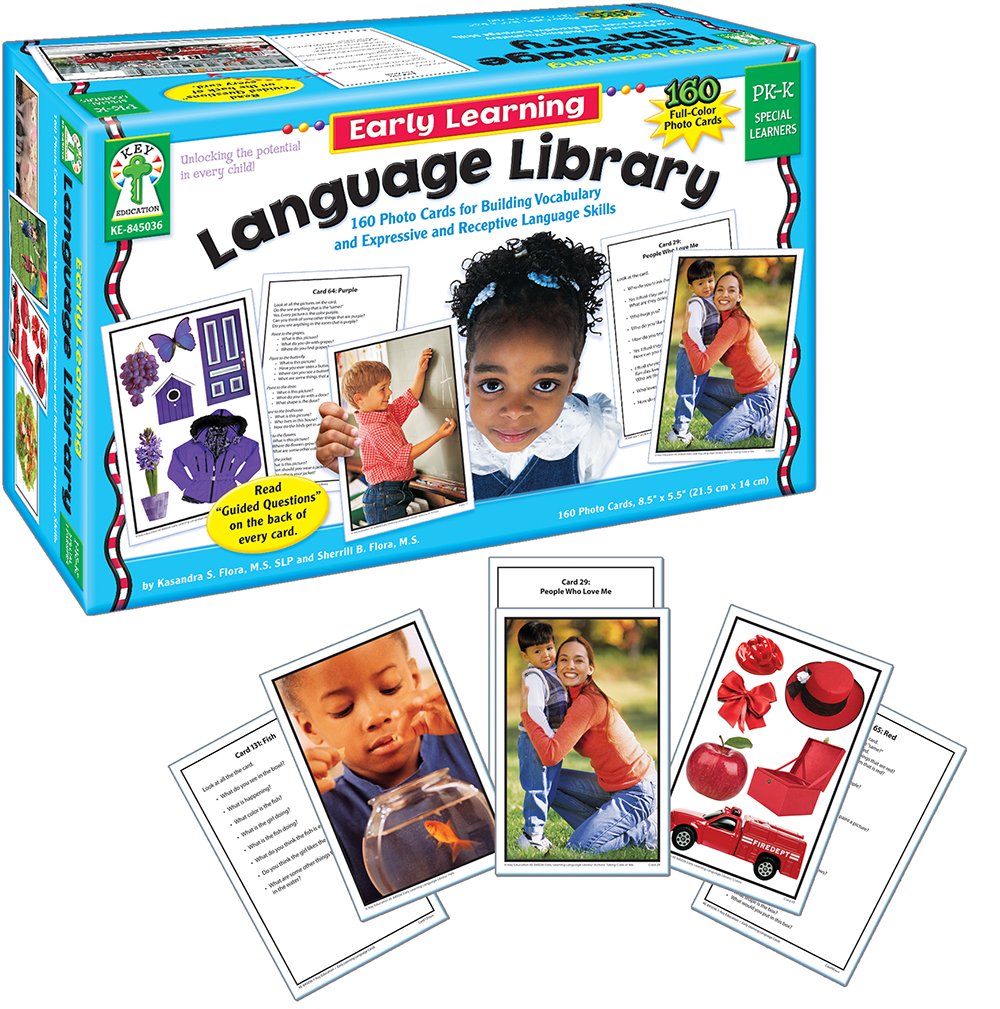
Pick of the Week: Early Learning Language Library

Help your young learner build vocabulary, expressive and receptive language skills with the Early Learning Language Library. This week only, we are offering a 15% discount on this set of 160 photographic learning cards to help you stimulate conversation and social awareness in your student or child. Just enter in the promo code BLOGELL7 at check out.

Suitable for children in preschool and kindergarten, these cards include photographs of everyday objects and people with guided questions and encouraging prompts on the back of each card to help teach effective communication skills and improve critical thinking.

Each card measures 8 ½” x 5 ½” and the set even comes with a resource guide with word lists and activity ideas in English and Spanish!

Save 15% on your purchase of the Early Learning Language Library by entering in the promotional code BLOGELL7* at checkout!

*This offer expires on October 15, 2013 at 11:59 pm EST. Not compatible with any other offer. Be sure there are no spaces in the promo code at check out!

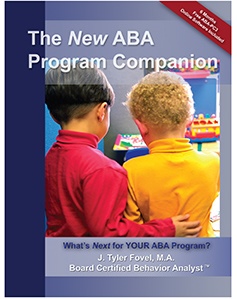
Introducing The NEW ABA Program Companion: What’s Next for YOUR ABA Program?

New ABA Program Companion Cover.inddWe’re thrilled to introduce The NEW ABA Program Companion: What’s Next for YOUR ABA Program? by J. Tyler Fovel, M.A., BCBA. This is an expansive brand new edition of the bestselling ABA Program Companion, completely updated with a new online software package, the ABA-PC3. Designed for practitioners who need to solve educational problems through analysis and creation of technically powerful solutions, this brand new book is sure to be at the top of your go-to references. The New ABA Program Companion offers important information and ideas on how to design, document, implement, evaluate and offer the best skill acquisition programs you can create for your students.

Managing a complex, multidimensional ABA Program involves vision, teamwork and infinite coordination. This book will help you choose and attain your next steps, wherever you may be in the process.

With school back in full swing and new cases starting up, now is the perfect time to utilize this powerful resource to create and organize your ABA programs. For a limited time, we’re offering The NEW ABA Program Companion at the introductory low price of $35. This offer will only be valid until September 17, 2013 so be sure to order your copy today!

CHAPTERS (for full chapter listings, click here)

Chapter 1: Attributes of an Effective ABA Program
Chapter 2: Introduction to Instructional Program Writing
Chapter 3: Managing the Setting and Materials
Chapter 4: Attention and Engagement
Chapter 5: Prompts and Prompt Hierarchies
Chapter 6: Developing a Solid Reinforcement Strategy
Chapter 7: Errors and Error Correction
Chapter 8: Generalization and Incorporation
Chapter 9: Data-Based Decision Making
Chapter 10: The Big Picture: ABA Project Management

About the ABA Program Companion 3.0 (ABA-PC3) Online Software

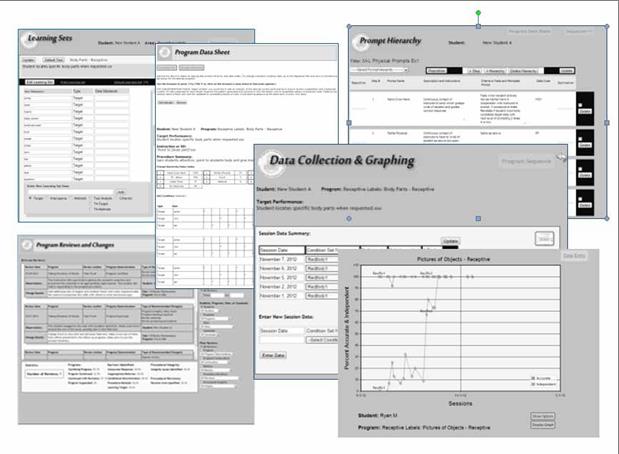
The ABA-PC3 software offers an online curriculum development environment for ABA teams. This is the newest version of a curriculum development tool specifically designed for ABA programs that helps with nearly every phase of the program creation process from selecting individual target performances to writing detailed step-by-step procedures to generating data sheets, entering data, and producing graphs. There’s also a program review module that structures the process of revising procedures based on observation and student performance measures.

ABA software

The unique software has a built-in library of 650 programs and over 4000 individual learning targets, all fully customizable by the user for their particular circumstances. Users can quickly search the library using keywords and select appropriate programs or write their own, rapidly building a comprehensive set of student programs. The set can be implemented or used to quickly create multistep sequences of programs for a variety of settings and instructional purposes.

The software helps focus and streamline the process of building an individualized comprehensive curriculum for students in an ABA program and provides a common workspace to enhance collaboration among different service providers on the special education team. In addition to the program library and learning targets, a variety of easy to use tools are included that help accomplish essential ABA implementation tasks including:

•      Automatically-generated data sheets customized for each student
•      Simple data entry screens for skill acquisition and behavior reduction programs
•      2-click graphing that automatically labels changing conditions
•      Reports of active and mastered programs
•      A structured workspace to assemble clear and well-defined prompt hierarchies and error correction strategies
•      A centralized area to organize the goal performance specifications and individual targets, record mastery dates, flag targets for implementers, and construct subsets of the comprehensive target list (condition sets) for presentation to the student
•      Clinical review and progress determination area that allows a user to enter information from observations and provides summary statistics on the progress of individuals or groups of students

**NOTE: Limited introductory price of $35.00 valid through 9/17/13 at 11:59 pm EST. All purchases made after that date will be at the regular retail price of $42.95.

Pick of the Week: Parachute Play

DRG_350_Parachute_PlayAs Fall creeps up and school looms near, we thought this week’s pick should embody the carefree and playful aspects of summer. Within a few short days, our regular school-day routines will start up again and the memories of sand squishing between our toes and summer BBQs will fade. So celebrate these final days with one of the most simple yet fun games around – the Parachute! This week, save 15% on our Parachute Play by entering the Promo Code BLOGPP13 at checkout. It measures 6 feet with 6 handles so you can play one-on-one or involve the whole family.

And if you’re feeling like you should be focusing on school readiness and not play, well the Parachute can help there too! Here’s a post by our brilliant friend Sam Blanco on her Teachthrough Blog about all of the educational uses of the simple yet wondrous parachute.

Age level: Preschool, Early Elementary
Description: I still remember how excited I would be when the teacher brought out a parachute during elementary school. Even now, I can’t exactly identify what it is about a parachute that draws children in, but I have found that it almost always works even for my most difficult to motivate students.

Skills & Modifications: There are many things you can do with a parachute. I’ve listed a few below, but if you have used it in other ways, please leave a comment explaining the activity!

  • Manding (Requesting) – I frequently use a parachute to have my early learners mand for actions. For example, I’ll have the learner lie down on the parachute, then they have to mand for me to “pick up the handle,” “swing,” ready set “go,” or “stop.” I also use the parachute (or a blanket) to teach early learners with autism how to request a parent’s attention. I will have the parent hide behind the parachute, and when the child says “Mommy” or “Daddy” the parent will drop the parachute so he/she is immediately visible and give the child lots of attention in the form of tickles, kisses, verbal praise, etc.
  • Comparisons/Adjectives – To help students understand the concept of big and little, I will have the children stand around the sides of the parachute holding onto it with their hands. I will place an object on the parachute, and we will bounce the parachute up and down to try to get the object to fall into the hole in the center of the parachute. Some objects will fall, but some will be too big to fall into the hole. I will ask the students why the object fell or did not fall.
  • Sorting – I will place several colorful objects on the parachute. We will then bounce the parachute up and down playfully. After a 30 seconds to a minute, we will put the parachute back on the floor, and the student will have to move each object onto a panel of the parachute that matches in color.
  • Identifying body parts – Because the parachute has a hole in the middle, I will sometimes use it for identifying body parts. The learner can lie down on the floor. Then I will put the parachute on top of them. I’ll pretend I’m looking for them (for example, “Where is Charlie?”) Then I’ll position the parachute so that one part (such as their hand or their nose) is clearly visible. I’ll lightly touch it and say “What is that?” and have the student label nose or hand or elbow, etc. Once the learner has an idea of the game, I may let them initiate it, or have them say “Find my nose” and I’ll place the parachute so their nose is visible.
  • Song Fill-ins – I like to sing songs while shaking or spinning the parachute. For students with autism or other language delays who struggle with this skill, the parachute can be a great motivator to help with song fill-ins and other intraverbal skills. I will sing the song while shaking or spinning the parachute, and I’ll stop singing AND moving the parachute when I want the child to fill in a word. As soon as the child fills in the word, I will begin singing and moving the parachute again. For many students, this is more motivating than a high five or saying “good job.”
  • Quick Responding – If you are working with learners with autism, the absence of quick responding is sometimes a serious barrier to learning. I have found that using the parachute isa  good way to motivate the student to respond quickly when presented with at ask by using it as described above with the song fill-ins. Once I am getting quick responding with the parachute, I quickly begin to work on generalizing the skill to other environments (such as the table or during a floor activity.)

Pros: There is a wide variety of activities that you can do with a parachute. As mentioned before, my experience has been that it is a great tool for motivating students who are difficult to engage. The parachute is also fantastic as a reinforcer or to use during a break. It is fun for students to play hide-and-seek with it, lie on the floor and have you lift the parachute high into the air then bring it down on top of them, or spin it in a circle. One final pro is that, depending on the size of the parachute, you can do these activities indoors. I have a parachute that is six feet in diameter, which is perfect for indoor activities with preschool and early elementary learners.

Cons: You have to think carefully about the environment in which you will be using the parachute and choose the appropriate size. Many parachute activities also require more than two people, so if you are working 1:1 with students, you should prepare ahead of time to ensure that a sibling or parent will be available to participate in the activity with you.

Remember, enter the promo code BLOGPP13 at checkout to save 15% on our Parachute Play this week only.

***This expires September 3, 2013 at 11:59 pm EST. Not compatible with any other offer. Be sure there are no spaces in the promo code at check out!

Autism & Applied Behavior Analysis: 10 ABA Myths Debunked

We came across this great post on ABA and Autism by our friend Brenda Kosky Deskin over at AutismBeacon.com and wanted to share it with you. It’s a good read!

autism and aba, autism, autism treatment

Applied Behavior Analysis, or ABA, has been around for years, helping people of all ages on the Autism Spectrum learn and thrive. Some, however, frown upon its use with autistic individuals but I suspect that those who don’t like ABA might not know what ABA really is and is not. I hope that by clearing up some widely held misconceptions about this evidence-based intervention for Autism, that more individuals will embrace ABA as their treatment of choice for their students and loved ones on the Autism Spectrum.

1) Myth: ABA is not effective

FACT: Of all treatments associated with Autism, ABA is the one that has the most peer-reviewed scientific research behind it to support its efficacy. If you would like to learn more about the importance of evidence-based practice with respect to Autism, The Association For Science in Autism Treatment (ASAT) features an excellent article on its website about this very topic.

2) Myth: ABA is punishing and unpleasant

FACT: While it is most unfortunate that some of the pioneers of ABA back in the late ’50s used physical punishment in their teaching procedures, today’s ABA programs depend primarily on praise and preferred items as a means of rewarding a learner for a job well done. Technically speaking, a “punishment” in the world of ABA today would be considered using the word “no” or sometimes if necessary, perhaps withdrawing a preferred object. Even these punishments procedures are used rarely and only when absolutely necessary in any of the quality programs of which I am aware. Certainly any physical or verbal punishers that are abusive in nature should not be tolerated nor considered acceptable. In fact, the importance of using methodologies that focus on reinforcement rather than punishment are written right into the Code of Ethics of the Behavior Analysis Certification Board (BACB).

As I state often, a good ABA program is a fun ABA program. My son, Michael, is very fond of his ABA therapists and has a great time with them. His therapy program includes visits to the book store, walks in the forest, swimming, go-karting and countless other activities that he enjoys. A talented and knowledgeable ABA therapist takes an activity his or her learner likes and turns it into a teaching opportunity that his learner will enjoy.

3) Myth: ABA means hours of sitting knee-to-knee at a table doing drills

FACT: This is a very common misconception. What is being described here is a teaching methodology called “Discrete Trial Teaching” or “Discrete Trial Training.” It is only one of many different teaching methodologies used in an ABA program and should never be relied upon as the only approach to teaching an individual on the Autism Spectrum. No one wants to nor should spend hours sitting at a table learning. Incidental Teaching, for example, is another ABA-based teaching approach that is extremely effective and can be used in many different environments and situations.

5) Myth: ABA is only appropriate and effective for young children

FACT: As we are all very well aware, people of all ages can and do learn. People on the Autism Spectrum are no exception. While the major, groundbreaking studies on the overall effectiveness of ABA in treating individuals on the Autism Spectrum all focused on children, there are numerous smaller studies which examine the use of ABA to address specific tasks including clothing selection, appropriate mealtime behaviors, vending machine use, non-disruptive bus riding, and the list goes on. Many of these studies’ participants are autistic adults and the results are promising indeed, proving that autistic individuals of all ages can make tremendous gains given ABA-based instruction.

States Dr. Bobby Newman, PhD, BCBA, on this topic, “Learning goes on throughout life. The principles of learning upon which ABA heavily relies are universal, as far as we know, going across species and CERTAINLY across the lifespan. A teenager or adult is nowhere near done. I would argue, in fact, that the need for good solid ABA-based instruction increases rather than decreases as the student ages toward adulthood. Many new demands will be placed (e.g., vocational, travel, independent living, etc.), and school/instruction hours often decrease. This increases the need for scientifically-based and efficient instruction; it doesn’t decrease that need.”

6) Myth: ABA is only for people who have Autism

FACT: ABA has proven to be effective in a wide variety of applications including rehabilitating stroke victims and individuals with acquired brain injuries. Whether many of us are aware or not, it has many other day-to-day applications within the general population as well. We use ABA strategies to train our dogs. Many good parenting practices have strong roots in ABA. (Have you ever given your toddler a sticker for using the potty?) ABA techniques can also be used to overcome different kinds of social or behavioral problems including dieting and quitting smoking. Do you ever reward yourself for hard work with say, a visit to the spa or by taking a vacation? Has your boss ever recognized your work endeavors with a compliment (otherwise known in the world of ABA as a “Social Reinforcement”) or a bonus or raise (a “Tangible Reinforcement”). These every-day principles are really no different than those used in an ABA program for an individual on the Autism Spectrum.

7) Myth: ABA is all about bribing people with food and toys

FACT: It is important to recognize that there is a major difference between a bribe and a reinforcement. A bribe is a type of negotiation before something occurs. It is stated or implied that “If you do this, you’ll get…”. On the other hand, a reinforcer is something favorable that a learner receives for a job well done after it occurs. In this way, it is allowing the learner – often subconsciously – to start pairing or making associations in his mind between the behavior that he has already done, with the reinforcer that he receives immediately after. With repeated practice, after these associations are firmly ingrained in the learner’s mind, the reinforcer can then often be removed all together as the newly learned behavior becomes habit.

With respect to what is actually used as a reinforcer in an ABA program, I again make reference to the Code of Ethics of the Behavior Analysis Certification Board (BACB):

“The behavior analyst minimizes the use of items as potential reinforcers that maybe harmful to the long-term health of the client or participant (e.g., cigarettes, sugar or fat-laden food)”

My son, for example, has never been rewarded with food. His therapists use whatever happens to be motivating to him at any particular moment and this could and does change all the time. Some of his reinforcers include swimming, looking through stacks of photographs, searching for YouTube videos, and therapists repeating lines from his favorite movies.

8) Myth: ABA only helps treat behaviors; it can’t help teach actual skills or language

FACT: While ABA-based interventions are certainly ideal for addressing problem behaviors like physical aggression, tantrumming and the like, they are equally effective in teaching new skills and promoting language development. Michael has learned how to fold laundry, prepare a snack and a myriad of other important life skills from his ABA therapists. Academics like reading, writing and math can also be taught successfully within the confines of an ABA program.

9) Myth: ABA is a one-size-fits-all treatment

FACT: While there are many excellent books and computer-based resources available for parents that can help educate them about ABA and even provide basic foundations and curriculums for an ABA program, in an ideal world, these should not be relied upon exclusively. Because every person with Autism is different, every ABA program must accordingly be customized to every learner’s unique set of circumstances, abilities and challenges. Furthermore, learners’ needs and behaviors can turn on a dime so expertise is needed in order to correctly analyse these changes and devise solutions that are based on years of education and training in the field. This experience can best be found in an ABA professional who is certified with the Behavior Analyst Certification Board.

10) Myth: ABA can or should only be done during “therapy time”

FACT: An effective ABA-based intervention, to a certain extent, runs 24-7. I’m by no means stating that a learner should be deluged with information or have demands put upon him during his every waking moment. What I’m talking about here is consistency.

I too often see kids who go to an ABA school and have great behaviors, toilet independently and thrive under these predictable learning environments. Then they go home where the same expectations are not upheld. Kids of all ages are going to “test” their parents and caregivers whether they are autistic or not. If we don’t maintain the same expectations of our kids at home that their teachers have of them in school, it is almost guaranteed that behaviors will worsen and anxiety levels will skyrocket. Conversely, some parents run great ABA programs at home which are then undone by teachers who don’t adhere to the same ABA principles in their classrooms where the child attends.

My advice to parents is to at very least learn the basic underlying principles of ABA and stay connected to your child’s teachers so that you can help your child generalize what he is learning at school in your home and community. In the case of parents who struggle with teacher non-compliance at school, advocate, advocate, advocate. Show your child’s teachers and principals exactly what your child is capable of at home by way of data and videos and provide them with or direct them to ABA-based resources that can help your child thrive both at home and at school.

AutismBeaconLogoReprinted with permission from AutismBeacon.com, a one-stop source for parents, caregivers, service providers, professionals, advocates and family members of people with Autism to learn, share and access vital resources around the corner and  around the world.

Pick of the Week: ConversaCards

Many strategies to help individuals on the autism spectrum organize and prioritize their daily activities propose using visual supports, color coding, lists, and other teaching materials such as timers and sequence cards. Understanding the concept of time and honing critical thinking and expressive language skills early in development is especially vital to  creating plans and making conversation independently later on in life.

ConversaCards_Blog&Emailer

Our Pick of this Week this week features the ConversaCards, which were developed to encourage organization, critical thinking, and conversation skills in children. The ConversaCards include six different packs: What Comes Next?, What Do You Do With It?, What Do You Like?, What Do You Need?, What Happened?, and Where Does It Go?

This week only, save 15% on your order with any one of these packs of ConversaCards by using promo code BLOGCNV3 at checkout!

What Comes Next? invites young learners to speculate about sequences of events. Full-color photographs on the cards show children performing sequential activities in identifiable scenarios in series of 2 and 3 cards. Designed to develop effective conversation, listening and social skills, these cards are easy to use and are developmentally appropriate for all levels.

WhDoYouDoWithIt

What Do You Do With it? invites children to speculate about the uses for the everyday objects shown. The photographic objects contain relatable images such as a toothbrush, piano, towel, alarm clock, keys, and ice cream scoop. This set ultimately improves conversation and critical thinking skills, in addition to social skills and sorting in learners.

What Do You Like? invites young learners to identify and share their preferences as well as their reasoning. Designed to promote effective communication and social skills, these cards depict photographs of common objects and scenarios that will encourage analysis and self-awareness.

WhDoYouNeed

What Do You Need? cards were developed to encourage sequencing and critical thinking and invites children to speculate about the possible next steps necessary in order to continue with an activity. Created to promote listening, conversation, and social skills, these cards also inspire creative story-telling.

What Happened? cards were developed to build language skills while inspiring story-telling. These cards are fun and easy to use, so children will enjoy working with them independently or in lessons.

Where Does It Go? cards will encourage children to categorize and place identifiable items, furthering critical thinking while building conversation skills in creative story-telling and sharing experiences.

The back of each card in the ConversaCards™ series contains questions and prompts that can be used for independent work, in one-on-one sessions, or in group lessons. Learning to respond to “what” and “where” questions is the foundation of conversation and expressive language. These flashcards can be used to teach sequencing, storytelling, and logical thinking for a wide range of ability levels. Each deck contains 54 3″ x 5″ cards, a resource guide containing helpful prompts, questioning strategies, and suggested lesson ideas.

POTW_BLOGCNV3_Worm

This week only, save 15% on your order of any one of our six ConversaCards by entering in the promo code BLOGCNV3 at checkout!*

*Offer expires on May 28, 2013 at 11:59 pm EST. Not compatible with any other offer. Be sure there are no spaces after the Promo Code when you enter it at checkout. 

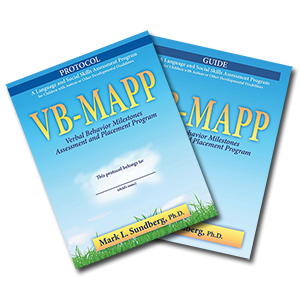
Pick of the Week: The VB-MAPP Set

DRB_680_VB_Mapp_SetAssessment and data collection are critical for every student on the spectrum…and can get expensive. This week, we’re thrilled to give you a bit of a break by offering the VB-MAPP Set by Dr. Mark Sundberg as our Pick of the Week. This week only, SAVE 15% on the VB-MAPP Set, VB-MAPP Guide or VB-MAPP Protocol by entering in the promo code BLOGVBM9 at checkout.

Dr. Mark Sundberg’s Verbal Behavior Milestones Assessment and Placement Program (VB-MAPP) is an assessment with a curriculum guide and skill-tracking system that assists educators, speech pathologists, psychologists, and parents in creating individualized intervention programs for children with autism or language-based learning disabilities. Continue reading →

Pick of the Week: Bullying & ASD – The Perfect Storm – NEW from Autism Partnership

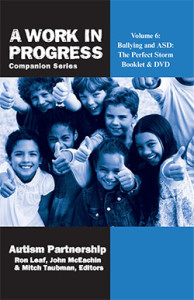
Work in Progress v6 Cover.inddBullying & ASD: The Perfect Storm – the brand new booklet and DVD from Autism Partnership – comes at a most important time. Recent school bullying and cyberbullying statistics show that:

  • 1 out of 4 kids are bullied
  • 77% of students are bullied either mentally, verbally or physically
  • Cyberbullying statistics are rapidly approaching similar numbers, with 43% experiencing cyberbullying
  • Of the 77% of students that said they had been bullied, 14% of those who were bullied said they experienced severe (bad) reactions to the abuse

Bullying is a real and pressing issue in our schools and online, and children with autism spectrum disorder are especially at risk. In the most recent volume of the Work in Progress Companion Series, Doctors Leaf, McEachin and Taubman explore not only the reasons that children with ASD are targets for bullying, but more importantly, they offer realistic and attainable strategies for kids on the spectrum.  

Several traditional methods of dealing with bullies are explored in this booklet and DVD, including avoidance, informing an authority figure, and fighting back.  In addition, there are strategies for educating and preparing the victims so that students with ASD can better combat bullying.  The included DVD features over an hour and 40 minutes of footage including advice from experts, one-on-one interviews with students, and real classroom brainstorming sessions where students with autism spectrum disorder are shown:

  • The difference between teasing and bullying
  • How to avoid the behaviors invite bullying, including determining the important difference between “cool” and “uncool”
  • When and when not to listen to peers
  • How to react to a bully

This week only, save 15% on the important new booklet and DVD – Bullying & ASD: The Perfect Storm –  by entering the promo code BLOGBASD2 at checkout.

*Offer expires on April 30, 2013 at 11:59 pm EST. Not compatible with any other offer. Be sure there are no spaces after the Promo Code when you enter it at checkout.