Holiday Gift Guide


At this time of year, it can be a challenge to find an appropriate gift for the child with autism in your life. Aunts, uncles, grandparents, and family friends often call us inquiring about what a good present would be for the child with special needs in their lives. This year, we’ve put together a holiday gift guide with some suggestions for children on the spectrum. All of the items are educational while being fun and engaging. Hopefully, this will make your search a bit easier and you’ll be able to cross someone off your list!

And to sweeten things, we’re offering 15% off on these products through December 19. Just enter the Promo Code GIFTS11 at checkout to redeem your savings.

We wish all of you a very happy and healthy holiday season!


            Stocking Stuffers  


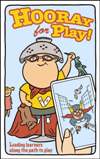
Hooray for Play– $12.95

Get everyone involved and pretend to be a firefighter, pirate, chef and more! These cards lead learners on the path to play.


Token Board– $5.95

Are all of those holiday cookies proving too tempting for your child? Use a token board to reinforce them for work accomplished with the reward of a holiday treat.
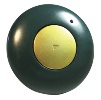
 

Go Talk Button– $11.95

Record a 10 second message and attach these small, handy buttons anywhere in the house. These are great for children with limited language and can keep them engaged in all the holiday cheer.


On the Road Toob– $9.95

Miniature vehicles provide fun opportunities for imaginative play as they VROOOM around the holiday table.


Presents


Wedgits Blocks and Design Cards- $23.99

Nest, stack, and link these blocks together to create endless shapes. The Wedgits are fun and challenging for the whole family.


Scents Sort Match-Up Kit- $39.95

Who can identify the smell of honey? What about the cantaloupe? Guessing each scent inevitably leads to laughter.


Wiggle and Giggle- $24.95

This board game is great for getting everyone active as players have to balance and move around according to what the spinner lands on.


Winomino-$29.95

With over 900 puzzle combinations possible, this game is ideal for students of all ages and levels. The geometrical puzzle develops fine motor, visual spatial and problem solving skills.


S’Match- $19.95

A fun SPIN on the classic Memory Game, S’Match requires players to find matches based on color, number or category.
 

Finding Good Apps for Children with Autism

It’s amazing that a whole new market of educational tools have popped up in the market for educating individuals with ASD. In the last few months, there have been so many apps for autism to choose from that it’s difficult for parents and teachers to navigate and find the ones that will work best for their particular child. There are now entire sites dedicated to showcasing various Apps and describing them in detail to help you narrow your choices. Check out today’s Gadgetwise column in the NY Times for the list of 4 sites so you can make wiser choices for your student.

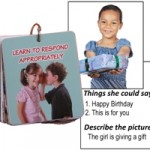
Pick of the Week: Learn to Respond Appropriately

With the holidays coming up and socializing in full swing, Learn to Respond Appropriately flahcards offer children the skills to be successful in their interactions in various situations. There are 32 photographic images of social situations and the back of each card has the appropriate response. Examples include what to say on the phone, asking for a turn, expressing affection, commenting on events and more.

Save 15% this week only on the Learn to Respond Appropriately cards by entering the Promo Code BLOGLRA11 at checkout.

*Offer expires on November 29, 2011 at 11:59 pm EST. Not compatible with any other offer. Be sure there are no spaces after the Promo Code when you enter it at checkout.

Building Language for Your Child with Autism, Part 4: Building Expressive Vocabulary

This is the step where your child learns to actually say the words out loud. All of the tasks described in previous posts come into play when building your child’s expressive vocabulary. Picture cards are a useful tool again, because it just isn’t feasible to bring every object directly to your child. We certainly want them to learn the words bus and airplane, but it’s difficult to get those items into your living room!

The basic idea for building expressive vocabulary using picture cards is just to hold the card up and ask your child “what is it?” The intricacy comes in knowing how to prompt your child and how to fade that prompt. We talked previously about the importance of your child being able to imitate the words that you say. Imitation is the basis for the prompts you will use to build your child’s expressive vocabulary.

The first several times you ask your child the name of a new picture, you will likely have to model the word for him or her. For example, you ask your child “What is it?” If you do not get a response, you say “apple.” Ideally your child repeats the word “apple.” After a few tries, you can shorten your prompt to “app….” And then to “aaaa…….” And then perhaps to just opening your mouth as if to say “aaaa…” but not making a sound.

A Comprehensive Picture Card Library

It is a good idea to have a large selection of pictures ready to go when you start to teach the lessons we just described. Here are a few tips to help you choose or take appropriate pictures:

  1. Start with words that are familiar to your child. Words like apple, cup and cookies may be better than ­saxophone or stethoscope.
  2. Start with pictures on a plain white, or a distraction free background.
  3. Make sure to have duplicates available for the matching tasks when you first start out.
  4. Consider taking multiple pictures of the same item (6 different apples for example) to help your child generalize their newly learned words.
  5. As your child becomes more comfortable learning new words move to more natural settings for your pictures.
  6. Have a broad range of pictures, across multiple categories, ready for when your child is ready to move forward!
  7. If you take the pictures yourself, consider having them laminated for durability.If you don’t have the time to make your own pictures, a 350-Card Set of photo flash cards called the Language Builder Picture Card Set is avaibable and is specifically tailored to meet the needs of an early language vocabulary building program.


This is a part of a series of guest posts by Angela Nelson on building language in children with autism. As the creator of the acclaimed Language Builder Picture Noun Card Set, Angela received her BA and JD from UCLA where she studied and practiced behavior psychology under Dr. Ivar Lovaas. She has been creating autism and special needs curriculum products since 1997.


Autism Moms Have Stress Similar To Combat Soldiers

We came across this article from a few years ago but thought that the content was certainly still relevent: mothers of adolescents and adults with autism have stress levels that match that of soliders in combat!? According to the study reported in the Disability Scoop, mothers of children with autism spent a greater portion of their day caregiving, were twice as likely to be tired and three times as likely to have experienced a stressful event compared to mothers of children without disabilities. In addition, their bloodwork indicated that a hormone associated with stress was very low, consistent with people experiencing chronic stress such as soldiers in combat.

That said, the mothers in the group were just as likely as their peers to report a positive experience, volunteer their time and help out their friends, in spite of more stress and less sleep. How much more amazing can one group of people be?

As parents, particularly, the moms out there, do you feel you’re able to manage your stress effectively? Do you have any advice for other parents out there?

Resources for Adolescents & Adults with Autism

With so much of the focus on the exploding rates of Autism in the U.S., the majority of attention has been focused on diagnosis, early intervention and services for school-age children. Not as much attention has been focused on what is available for these individuals after the age of 21 and unfortunately, service options rapidly diminish after this age. ASAT (Association for Science in Autism Treatment) has posted a good article on where to look for resources for older students and adults who need support. To read the article in full, click here.

This will prove to be an even greater issue over the next 10 years as so many individuals on the spectrum transition to adulthood. For those parents and caregivers who have children over the age of 21, is there any advice you can offer or resources you can direct others to that you have found particularly helpful?

Building Language for Your Child with Autism, Part 3: Building Receptive Vocabulary

Receptive language refers to the thought process involved in hearing, processing and comprehending spoken language. When we mentioned above that a two year old child should be able to follow simple commands, point to objects when they are named, and recognize names of familiar objects; these objectives were examples of receptive language skills.

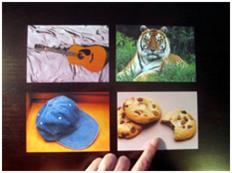
There are a number of ways to help build your child’s receptive vocabulary. Using photo cards is one basic and concrete vocabulary building tool that you can do at home. Place pictures of common objects on the table in front of your child. Ask your child to “touch the cookies” or “give me the hat.” When your child can follow the command and consistently select the requested picture, you have added a new word to their receptive vocabulary.

It is likely that your child will need help selecting the correct card… especially the first few times you try this task. Here is a trick to help make picking the right word easier. Start with just one card on the table and increase the number of pictures slowly. For example, if you are trying to teach the word cookies:


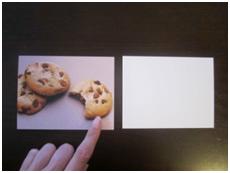
    1. Start with just the picture of the cookies on the table.
    2. After your child has learned to touch the cookies picture on request, add a blank card to the table. Ask your child to touch the cookies picture several more times, rotating the position of the two cards each time.
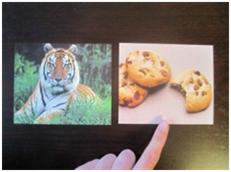
    3. Then, add a second picture to the table, and a third, and a fourth.
    4. Once your child can select the cookies picture each time, introduce new words using the same method!


This is a part of a series of guest posts by Angela Nelson on building language in children with autism. As the creator of the acclaimed Language Builder Picture Noun Card Set, Angela received her BA and JD from UCLA where she studied and practiced behavior psychology under Dr. Ivar Lovaas. She has been creating autism and special needs curriculum products since 1997.

Building Language for Your Child with Autism, Part 2: Matching Objects and Pictures as a Precursor to Language

Developmental Psychologist, Jean Piaget, observed that a child first becomes aware of a concept and then acquires the words to convey that concept. Think about this for a moment: a child has to know that an apple is a distinct and separate item, before they know they should give it a name. They have to realize that the apple is different than, say, the cup. This is where matching comes in.

To help teach this concept using pictures of objects, place two pictures on the table in front of your child, one picture of an apple, and the other of a cup (or some non-apple picture). Hand your child an identical picture of an apple. Ask your child to “match” the apples, or to “put with same.”

When your child can consistently match the two cards, regardless of the position of the cards, they likely understand that the apple is a distinct object. Now we are one step closer to giving that object a name!


This is a part of a series of guest posts by Angela Nelson on building language in children with autism. As the creator of the acclaimed Language Builder Picture Noun Card Set, Angela received her BA and JD from UCLA where she studied and practiced behavior psychology under Dr. Ivar Lovaas. She has been creating autism and special needs curriculum products since 1997.

Building Language for Your Child with Autism: A Guest Series by Angela Nelson

This week, we’re pleased to introduce a series of posts by Angela Nelson on building language in children with autism. As the creator of the acclaimed Language Builder Picture Noun Card Set, Angela received her BA and JD from UCLA where she studied and practiced behavior psychology under Dr. Ivar Lovaas. She has been creating autism and special needs curriculum products since 1997.

Emerging Language and Building Vocabulary

Language development varies from child to child, and there are wide ranges of expected “normal” language development in young children. If you have specific concerns about the pace of your child’s language development, you should definitely discuss this with your health care professional. However, for reference sake, by the age of two a child is expected to be able to:

  • Follow simple commands or instructions
  • Point to an object or picture when it is named for him or her
  • Recognize names of familiar objects, body parts and familiar faces
  • Repeat words spoken by others
  • Use simple phrases and 2 – 4 word sentences by 18 – 24 months

As we all know, there is no “typical” child with autism. Children on the Autism Spectrum may meet some of these objectives, all of these objectives, or none of these objectives. The goal is to identify your child’s specific language deficits (the areas you see them falling behind) and takes steps to help them catch up.

The first stages of language development, as described above, involve listening to words, imitating words, and building a basic vocabulary. In your child’s education program you may have heard professionals use terms like Receptive Language, Echolalia, Modeling, Matching, or Expressive Language. Don’t let these terms of art intimidate you. Really, they still just mean… listening to words, imitating words, and building a basic vocabulary. 

Encouraging Emerging Language Skills

A most basic step in typical language development is imitation. Many parents are surprised to learn that the parent imitating the child is almost as important as the child imitating the parent! When a 12 month old child looks at his or her mother and says “mamamama,” the mother almost instinctively replies back, “that’s right ‘mama.’” This feedback reinforces the child’s vocalization and encourages them to keep on chatting. Although children with autism may have delayed onset of this type of behavior, or may have some setbacks along the way; it is important to remember to continue to imitate vocalizations with your child to encourage verbal behavior.

Imitation will also provide the first steps in the formation of words for your child. This time I mean your child imitating you! While you are hoping to hear your child imitating full words, remember, this starts with imitating vowels, consonants and syllables. If you say “aaaaa” and your child responds back with “aaaaa,” this is a cause for celebration. You are one step closer to your child saying “apple” than you were before they could (or would) imitate your vocalization. Eventually, modeling words will become the way you build your child’s expressive vocabulary!

Check back this week for from Angela on Matching Objects andPictures as a Precursor to Language.

Study at Hunter College in NY on How Children with Autism Attend to Social Surroundings

Hunter College is conducting a research study where they are recording children’s eye gaze while watching short videos of social situtations to get a better idea of how children with autism attend to their social surroundings.
They are looking for children diagnosed with Autism Spectrum Disorder between 5 and 9 years of age. The study requires one visit to Hunter College in New York City which lasts for approximately 2-3 hours. Participants will be compensated $25 and feedback from standardized assessments will be available.

For more information on participating, email eyetracking@hunter.cuny.edu or call 212-396-6301.