We Want YOU to Name our Worm!

Name that Worm FB

We thought it was past time that our worm had a proper name, and we’re turning to YOU to decide what it should be! Suggest your names by clicking here to enter your name suggestion now.

Suggestions will be received through May 20th. Please be as creative as you like!

In the words of the great Dr. Seuss: “So… be your name Buxbaum or Bixby or Bray or Mordecai Ali Van Allen O’Shea, you’re off to Great Places! Today is your day!” Our worm needs a name! So get on your way!

Here’s What Was in YOUR ABA Toolbox

Thank you to all who participated in our ABA Toolbox giveaway last week! We’ve received some wonderful responses and feedback from parents, teachers, and therapists on their favorite products from our catalog and how they are using it with a special child, and we are thrilled to be sharing them with you!

Our biggest goal in this endeavor was to share with you the unbelievable wealth of experience and knowledge our community of parents, teachers, and therapists have in using our products in innovative and creative ways for their ABA programs.


Continue reading →

On the Need for Crisis Intervention Training: A Guest Article by Bobby Newman, PhD, BCBA

Last week, we discussed a comprehensive checklist for parents in placing their children in the right school environment. Service providers in special education programs play a vital role in students’ daily lives at school and are expected to understand certain protocols when behavioral difficulties arise. We couldn’t think of a more appropriate article than that of Bobby Newman, PhD, BCBA to shed light on this need for crisis intervention training in order to ensure the best learning environment for students.

On the Need for Crisis Intervention Training
by Bobby Newman, PhD, BCBA-D

It was one of those moments in life that seemed scripted. A colleague and I were being given a tour of a public school, a prospective placement for a student of my colleagues. The student in question had a history of aggressive behavior towards staff and bolting from the classroom towards the street. How such physical crises were going to be addressed was thus a major concern of mine. I asked the tour guide, the principal of the school, how such matters were handled and whether staff were formally trained in any crisis intervention philosophy and techniques. She informed me that they were not, but that there were “informal things that staff had taught one another.”

As if on cue, at that very moment a student came sprinting past us, with a staff member in pursuit. The staff member reached out and grabbed the sprinting student by the back of the collar, effectively stopping him by choking him with his shirt. My usual flimsy professionalism couldn’t survive this seemingly scripted moment, not to mention the loud choking noise, and I asked, “Is that one of the things staff have shown each other?”

Further questioning revealed that when students had serious outbursts, 911 was called. My mind went to Chicago where in 2012, police were called to the home of a child with autism during a behavioral crisis with tragic results. Very little else needed to be known to determine that the student’s parents would never agree to this school placement, and I couldn’t say that I blamed them.

Crisis intervention is one of those very sensitive issues in the field of developmental disabilities. There are people who want to ban the physical portion of crisis intervention training, either due to liability concerns or perhaps due to abuse concerns. I will agree that the potential for abuse exists if staff are allowed to put their hands on students/consumers. I will argue, however, that the possibility of abuse is much greater if we do not train and if we do not have formalized systems in place, or at least for mass exclusions of people from less restrictive settings due to the inability to maintain them there safely in such environments. Let me develop my argument:

  • Due to the nature of some developmental disabilities (e.g., difficulty in developing communication skills or sensory defensiveness), behavior that is not typical of same age peers can occur.
  • This behavior may sometimes take forms that can be dangerous to the person engaging in them (e.g., running into hazards or self-injurious behavior) or dangerous to those around them (e.g., aggression towards others or environmentally dangerous behavior such as object destruction).
  • At such times, we may be facing a “crisis,” when injury to self or others is imminent and probable and “crisis intervention” (verbal and possibly eventually physical) may be necessary to keep everyone physically safe. The guiding idea behind crisis intervention is to keep everyone safe. This includes the person engaging in the behavior, peers, and staff.

I wish to emphasize that a crisis is NOT an everyday occurrence. A crisis should not be routine, it should arise as a relatively infrequent occurrence that needs to be dealt with via crisis intervention protocols at that moment. I wish to distinguish crisis intervention from “behavior treatment plans,” which must be in place for behavior we often see from the individual in question. If you’re doing crisis intervention frequently, then this a matter for discussion of alterations to behavior management plans or resource allocation/availability. Crisis intervention is not a consequence meant to change the probability of behavior via a punishment contingency, and any physical interventions where one must put their hands on a student should be a last resort.

Even with this caveat in place, some would make the argument that crisis intervention training should not be provided, that it gives staff permission to be overly physical with students. While I will grant such a possibility exists, as I always tell my ethics classes, the argument about what you are not willing to do is not enough. One must be prepare to answer, “and then what?” Suppose staff were not trained. When a crisis occurred, they would be left with “doing the best they can” or otherwise improvising in the moment. Given this set of circumstances, staff would respond in their own ways to crises and injuries and abuse become probable, not just possible, as staff panic or lash out with whatever self-defense techniques they can think of or act in keeping with a faulty knowledge of body mechanics or physical hazards (witness the “choke stop” described above).

To summarize, the implications of the “do not train” argument are:

  • I know there will be crises due to the behavioral history and repertoires of the students in the program
  • I’m concerned about liability or staff becoming heavy-handed, so I’d rather not train people to safely deal with the crisis, I’d rather trust to their natural impulses or an “unofficial” policy/procedure that has grown up within the program.

What must be appreciated is that good crisis intervention training systems are based on sound behavioral principles, providing the supports the individual needs, rather than on controlling the behavior of the individual physically. The vast majority of crisis intervention training is based upon preventative measures that aim to teach the individual self-control and alternate behaviors, and to create settings that are not likely to create crises in the first place, rather than sheer physical intervention. Should a physical intervention be needed, safety is a foremost concern. Techniques are performed in such a way as to attempt to minimize injury. No technique, for example, is meant to cause pain, is meant to scare, uses impact for behavior control, or moves a limb beyond its normal range of motion.

To sum up the basic argument:

  • We know behavioral crises that can lead to serious injury may occur
  • If we do not train people, we are trusting the staff member’s individual reactions or “unofficial policy’ that cannot be traced or analyzed as it is unofficial.
  • If we do train people, however, we can create standards of conduct and accountability and we can aim at program design that avoids the need for physical intervention.

This seems to me to be our best bet for creating programs that are humane, not emotionally reactive, and encourage the development of effective problem solving strategies that rely on behavioral interventions, rather than relying on physical intervention by staff to keep everyone safe. This seems to me to be most consistent with ethical practice of Applied Behavior Analysis.

About the Author

Bobby Newman is a doctoral level Board Certified Behavior Analyst and Licensed Psychologist. Bobby is the first author on twelve books and has published over two dozen articles in professional journals, as well as numerous popular magazine articles and has hosted two series of radio call-in shows. Bobby is the Past-President of the Association for Science in Autism Treatment and the New York State Association for Behavior Analysis. A popular speaker, Bobby also provides direct treatment, staff training and consultation around the world, and has been honored for this work by several parents and professional groups. Bobby is a SCIP-R (Strategies for Crisis Intervention and Prevention, Revised) instructor and has published a manual to accompany crisis intervention training (Gentle Redirection of Aggressive and Destructive Behavior). In addition to his other clinical work, Bobby teaches non-violent crisis intervention philosophy and techniques for schools, agencies and families.
What’s in YOUR ABA Toolbox? Share and Win a $250 Gift Certificate

All of our products here at Different Roads to Learning are carefully selected to support both home and school ABA programs. Our community of parents, teachers and therapists have an unbelievable wealth of experience and knowledge in using our products in innovative and creative ways. We want to know What’s in Your ABA Toolbox?

Please fill out this form and share with us your go-to resource for working with students on the spectrum and tell us how you use it. All responses will be entered to win a $250 Gift Certificate* from Different Roads to Learning.

*Only one (1) response will be counted per person. Giveaway ends at 12:00pm ET on 05/05/2014. Submissions will be entered and selected by random for a chance to win a $250 Different Roads to Learning Gift Certificate good towards any future purchases from our catalog. Submissions will be shared on the Different Roads Blog at blog.difflearn.com on Monday, May 5th, 2014. Be sure to check back to our blog on that day to read all of the submissions! The winner will also be announced and contacted via email with their $250 Gift Certificate on May 5th, 2014. Entries for products and materials NOT included on www.difflearn.com or in the Different Roads Catalog will not be considered.

Pick of the Week: A Step-by-Step ABA Curriculum for Young Learners with ASD (Age 3-10)

Ensure the appropriate ABA program for your young learner with A Step-By-Step ABA Curriculum for Young Learners with Autism Spectrum Disorders (Age 3-10).  This curriculum uses the proven principles of Applied Behavior Analysis (ABA) to monitor the progress of children on the autism spectrum and make sure they reach their full potential. And this week only, you can take 15% off* your copy by entering in our promo code STEPABA when you checkout online!

This curriculum gives a clear outline on what to teach and how to teach it in order to ensure your young learner is reaching his or her developmental goals at crucial stages. The book’s three sections – Assessment, Curriculum, and Mastered – each include built-in data collection, which can be reproduced on the accompanying CD.  All three sections cover 10 pivotal areas of progress for children ages 3-10, including reading, writing, math, conversation, and social skills.  The Assessment section records the child’s initial level of learning and then tracks their progress over time. The Curriculum section provides the lesson plans for the skills which need to be developed, and the Mastered section is a tool for checking that learned skills are being retained over time.  It is also possible to record whether the child has adapted to using the skills in a variety of social settings, such as in the home or in the classroom.

This curriculum provides a solid foundation for working with a child with an autism spectrum disorder to ensure an appropriate ABA program for young learners.  Don’t forget – you can save 15%* this week on your copy of A Step-By-Step ABA Curriculum for Young Learners with Autism Spectrum Disorder (Age 3-10) by entering our promo code STEPABA at checkout!

*Offer expires at 11:59pm ET on May 6, 2014.  Not valid on past orders or with any other promotions and offers.  Be sure there are no spaces or dashes in your code at check out!


Tip of the Week: School Placement Checklist for Students with Autism

This time of year many parents are researching and visiting schools, trying to find a school placement that makes sense for their child. Here in New York City, parents have many options, while parents living in other places may be presented with very few options. In both situations, finding the right school placement to meet your child’s unique needs can feel impossible.

Over the years, I have visited many potential school placements with the families I’ve worked with. I’ve generated the list of questions below to help those families have more productive, focused, and useful school visits. I recommend that you read through the questions, then prioritize them before making school visits.

Teacher and children sitting on floors with hands raised

The Classroom Environment

  1. How many children are in the classroom?
  2. How many staff are in the classroom? Will your child have enough support as mandated by his/her IEP?
  3. Where is the classroom located? Does it require your child to walk up and down many stairs? Is it too close or too far from an exit? Is it isolated from the rest of the building?
  4. Is the classroom large enough for all students and staff to move safely and comfortably? Is the furniture appropriate for your child’s size?
  5. Does the classroom environment and structure fit the needs of your child?
  6. Are all students engaged in productive work?
  7. Are maladaptive behaviors appropriately addressed?
  8. If your child will be in a Collaborative Team Teaching class, what is the ratio of general education students to special education students?
  9. What academic supports are available in the classroom? Computers? Class library? Centers?
  10. What is the age range of students in the class? Does is span more than three years?
  11. Does the level of academic functioning within the classroom match your child’s needs?
  12. Does the level of language functioning within the classroom match your child’s needs?
  13. Do the behavior management needs of the classroom match your child’s needs?
  14. Do any students have 1:1 paraprofessionals to meet their needs as mandated by an IEP?

Academics

  1. What curriculum does the school use?
  2. Is there a specific teaching methodology used within the classroom? If so, what type of training do the teachers receive in that methodology?
  3. Will the teacher need to modify the curriculum in order to meet your child’s needs? If so, what supports will be in place to help him/her modify it appropriately?
  4. How often are student “mainstreamed” into the general education population? What is the school’s typical process for this?
  5. What typically happens to special education students after aging out of the school? What high schools or colleges do they go to? Do they secure jobs?

Related Services (Speech, OT, PT, Counseling)

  1. Are related services provided through pull out, push in, or a combination of both?
  2. Are related service providers assigned to the class on a regular basis?
  3. Do related service providers have enough time in their schedule to meet your child’s mandate?
  4. How are parents notified if sessions are missed or if special concerns arise during sessions?
  5. Are missed sessions made up?
  6. Does the school apply a set level of mandated services for each class?

Transportation

  1. How close is the school to my home?
  2. Is bus service available? If so, will it be provided by a mini-bus or a large yellow school bus? How long will my child have to spend on the bus? How many students will be on the bus? Is my child the first or last to be picked up or dropped of? Does the bus schedule interfere with my child’s medication schedule? Who will be responsible for taking my child off the bus in the morning and putting him/her on the bus in the afternoon?
  3. Where will my child line up at school in the morning and at dismissal? What is the staff/student ratio for supervision during those transitions?

Preschool children working together on puzzle. Image shot 2009. Exact date unknown.

Interaction with Peers in General Education/Shared Spaces

  1. What age range is represented within the entire school? Is it appropriate for your child?
  2. What opportunities are there for your child to interact with the general education population within the school (field trips, field day, extracurricular activities, etc.)? How often do these opportunities occur?
  3. Are there any social skills or extracurricular programs in which general education students come into your child’s classroom or special education students go into a general education classroom?
  4. How many children will be in the cafeteria while my child is eating there? What is the staff/student ratio of the cafeteria during that time? What age range will be sharing the cafeteria with my child?
  5. What extracurricular subjects will your child receive? Will these be offered in his/her classroom? Will your child need to travel to a separate classroom? Will extracurricular subjects be provided within the same class, or will my child be included with general education peers?
  6. Do students go on field trips? What class field trips have the students recently been on? Do students travel by bus? Are parents able to attend field trips? What is the child/teacher ratio on field trips? Will field trips be provided within the same class, or will my child be included with general education peers? How often do field trips occur?

Communication with the School

  1. What is the application process like? Any important deadlines? Online or paper application?
  2. How will the school stay in contact with me? Daily notebook? Emails?

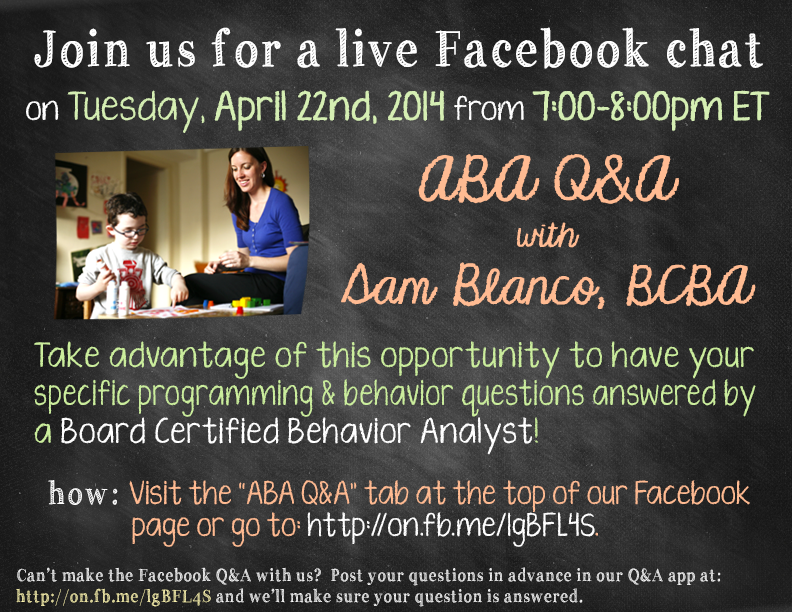
Join us TONIGHT for an ABA Q&A with Sam Blanco, BCBA

Join us for a live ABA Q&A with Sam Blanco, BCBA TONIGHT from 7:00 to 8:00pm ET! Our primary focus will be on Managing Difficult Behaviors. Here is a chance to get your specific questions answered in real time by a Board Certified Behavior Analyst. Just visit our Facebook page and post your question here. For details of the Q&A, visit the event page here.

If you can’t make the live Q&A with us on tonight, you can post your questions in advance, and we’ll make sure your questions are answered. Don’t forget to check back to the app for Sam’s answer!

Q&A with Sam_Revised 04.15.14

Different Roads to Learning reserves the right to remove or delete any questions and comments deemed to be of an inappropriate, offensive, and discriminatory nature. All answers are intended as suggestions only. Programming decisions and interventions should always be discussed with trained professionals prior to implementation. All programs should be individualized for a particular child or student and overseen by a qualified behavior analyst.

5 Essential Resources for Your ABA Program

Our focus here at Different Roads to Learning is always on supporting the language and social skills in children on the spectrum through evidence-based interventions. We’re staunch believers in Applied Behavior Analysis and we’ve built our extensive product line around the tools that will best support these programs. As we continue to focus on Autism Awareness this month, we asked our BCBA Sam Blanco to choose five of her go-to resources and tell us a bit about why they’re integral components in her work. This week, we’re are also offering a 15% discount* on these five essential resources from our catalog. Be sure to use our promo code ESSABA5 when you check out online or mention it when you call us at (800) 853-1057.

* * *

When you work with children with autism, you typically are focused on four goal areas: developing language and communication skills, improving social skills, increasing independence in both academic and daily living tasks, and addressing any maladaptive behaviors. While there are a wealth of resources available to help achieve goals in these areas, there are five resources I really can’t live without.

VB-MAPP: The Verbal Behavior Milestones Assessment and Placement Program by Mark L. Sundberg, Ph.D. is essential. It’s easy to use, provides a wealth of information in a relatively short period of time, and allows you to prioritize the unique needs of your particular learner. Beyond the milestones assessment, I love that the VB-MAPP provides a way to assess and measure barriers to learning such as aggressive behaviors, prompt dependence, and defective scanning skill. Finally, as a special educator, it can be difficult at times to know how your student is doing compared to his/her peers in a general education environment. The Transition Assessment portion of the VB-MAPP allows you to assess and measure progress towards specific skills necessary for transitioning to a less restrictive environment.

Language Builder Picture Cards: After the VB-MAPP, these cards are the first investment you should make if you’re working with learners with autism. They are designed to help you teach a wide range of skills including receptive language, expressive language, matching, sorting by category, and identifying feature, function, and class. I use these cards to play games with my learner to practice prepositions (such as hiding a card picturing a frog and having the learner find it by listening to directions like “the frog is under the pillow.”) I also use the cards as prompts for a “What am I thinking of” game. For this game I can look at the picture, then give the learner clues so he/she can guess what I’m describing (such as “I’m green. I have four legs. I hop.”) I then trade turns, and the learner has to look at a picture and provide clues for me to guess what is pictured. All in all, the Language Builder Picture Cards provide so many opportunities for language development you’ll never regret the investment.

Time Timer: I love the Time Timer so much that I actually own the 3-inch, 8-inch, and 12-inch models. For young learners, the clear visual indicator of the passage of time helps prepare them for transitions, complete transitions with greater levels of independence, and begin to understand the passage of time. Older learners use it to manage their time better during tasks, regulate their own behavior, and increase independence in both academic and daily living skill tasks. For all students, it helps facilitate a better understanding of the concept of time. When I taught in the classroom, I used the 12-inch model so that it was clearly visible for all students. I love the 3-inch model for older students who still need the visual tool.

A Work in Progress: When I first began teaching learners with autism, a colleague recommended A Work in Progress to me, and I have come back to it again and again over the years. It provides strategies and a curriculum for addressing the needs of learners with autism, including topics such as self-stimulatory behaviors, sleep problems, eating problems, toilet training, and social play. Most importantly, it describes how to meet the needs of learners with autism in language that is accessible. The curriculum portion of the book describes in detail what a teaching session should look like and how to run discrete trials. It also provides comprehensive instructions for dozens of programs.

Verbal Behavior Targets: Unlike A Work in Progress, this book is not a curriculum, but, as Luckevich states in the introduction, a guide to selecting targets “to meet the unique language goals of each individual child.” Verbal Behavior Targets provides hundreds of targets for each stage of language development (split into 6 chapters: words; multiple words; instructions and questions; sentences; category, feature, and function; and conversation topics. I know there have been many moments in the past, especially when I was first starting out, in which my learner would master a target skill and I would struggle to come up with additional targets. This book helps you continue to push your learner towards independence by providing a vast number of targets in developmentally appropriate sequence. And did I mention she also included data sheets?

As a therapist, finding quality teaching resources can be challenging. There are so many products to choose from and the choice and cost can be overwhelming. The items described above are not only high-quality, but are essential to providing the best possible learning environment. Investing in a few versatile, solid products saves you money over the long term, makes both teaching and prep time more efficient, and helps provide a vast range of possibilities for student learning.

* * *

This week only, you can save 15%* on any of these products on Sam’s list of 5 essential ABA resources by using promo code ESSABA5 when you check out online.

*Offer expires at 11:59pm ET on April 22, 2014. Not valid on past orders or with any other promotions and offers. Be sure there are no spaces or dashes in your code at check out!

Ready Set Play! Strategies for Modifying Games

In continuing our celebration of Autism Awareness Month, we’d like to share with you another article from our very own Sam Blanco, BCBA on how to modify games for learners with autism.  Sam focuses on helping educators and parents understand how to thoughtfully integrate games, toys, and technology for students with autism and other developmental delays, and here she presents a few simple, yet effective, ways of adapting every day games and toys to meet the needs to students on the spectrum.

Ready Set Play! Strategies for Modifying Games
by Sam Blanco, BCBA

Choosing games for learners with autism can be quite challenging, especially when your goal is to provide social opportunities through playing games with peers or siblings. Sometimes you find a game that you think your learner will find highly motivated, only to discover there are aspects of the game that make your learner lose interest quickly. Here are a few tips to help modify games to meet the needs of your individual learner.

One of the easiest and best modifications you can make is to shorten the duration of an activity. Most of the games and activities you will find on this website take 10-15 minutes. For longer activities, I will set a timer and let the learner know that the game will last for 10 minutes (or less, depending on the learner) or allow the learner to choose the duration of the game. Also, though it may feel unnatural, (especially if your learner is engaging with you when he/she rarely does) I try to end the activity when the learner’s interest is at its peak. This will make the learner more likely to request or be interested in the activity in the future.

If the game is too difficult for the learner, you can do some of the steps for your learner. For example, for some of my early learners, I will complete one or more steps in the game Roll & Play. Some of my learners struggle with grasping the cards between their index finger and thumb. I can pick up the card for them, and then continue with the game. This allows us to maintain a quick pace in the game, maintain the learner’s interest, and continue the focus on the skills presented in the game. It’s important to remember that just because you are completing some of the steps, it does not make the game less valuable. Usually, I am practicing grasping objects in other activities and will eventually introduce it into the game, but I want to maintain focus on only 1 to 2 skills when I am teaching through games. Otherwise, the game can become very slow and less motivating for the learner.

Another easy modification is to simply remove some parts of the game. S’Match is a fantastic memory game that helps learners match items based on three components: shape, color, and number. For some learners, I remove the spinner so that I can introduce the game with just two components. I’ll either verbally tell the learner “This time, we’re matching by color,” or I’ll have a textual cue. This way, I can focus on the skills of matching, while making the game easier for learners who might struggle with the skill of remembering three different components of each picture in the memory game. Once my learner has mastered the game with matching by two components, I introduce the spinner and matching along all three components. (There are also games I play with my learners that just involve the spinner, which you can find here.)

Increase your expectations as quickly as possible. For each of my learners, I typically have two categories of games: Emerging and Mastered. With emerging games, the learner still requires modifications, but I am trying to fade those modifications and increase expectations as quickly as possible while still maintaining the learner’s interest and motivation to play the game. With mastered games, the learner is able to play the game as designed with peers or siblings and I can focus on social goals instead of game-related goals.

Games provide a wide array of opportunities to teach academic, non-cognitive, and social skills. Modifications such as those listed above can open up these opportunities for your learner in age-appropriate and fun ways.

Sam Blanco is a Board Certified Behavior Analyst and an ABA provider for students ages 3-12 in NYC. Working in education for ten years with students with Autism Spectrum Disorders and other developmental delays, Sam has developed strategies for achieving a multitude of academic, behavior, and social goals, by organizing resources in an easy-to-use way that also directly connects to data collection and increasing progress in learners with autism. She is the lead contractor for Theatre Development Fund’s Autism Theatre Initiative, working to modify Broadway shows such as The Lion King and Spiderman. She also provides workshops for professionals and parents about assessment, managing difficult behaviors, verbal behavior, and using games and technology effectively in teaching practices. You can follow Sam on Twitter: @SamBlancoBCBA.

Pick of the Week: Early Intervention Resources

It’s a fact that Early Intervention leads to positive outcomes for our children. Understand the key principles of Early Intervention approaches with our two newest additions to our early intervention books, The Early Intervention Workbook and Early Intervention Every Day! These reference books cover evidence-based intervention approaches, as well as the best practices on implementation.  Buy one or both of them this week only and save 15%* by using our promo code DRLEI15 at check out.

The Early Intervention Workbook: Essential Practices for Quality Services was written for current and future early intervention providers of all disciplines who are looking to maximize their efficacy. The entire early intervention process is broken down into seven key principles with detailed tips, activities, and strategies on both what to do and how to do it. The workbook covers referral, initial visits with the family, evaluation and assessment, IFSP development and implementation, and supporting a smooth transition out of EI. The authors strive to empower professionals to make positive change happen on both a personal and systemic level by identifying and focusing on successful evidence-based intervention approaches and providing guidance on actual implementation. This is a comprehensive book for group training or independent work, and a great reference.

Effective early intervention doesn’t stop when the provider leaves a family’s home. For parents and caregivers, Early Intervention Every Day! is a practical sourcebook packed with research-based strategies that demonstrate how take a consistent, active role in supporting young children’s development. Targeting 80 skills in six key developmental domains for children birth to 3, this guide also gives professionals loads of ready-to-use ideas for helping families embed learning opportunities into their everyday routines. The guide empowers families to work on IFSP goals during recurring activities, such as grocery shopping or riding in the car, and to give children opportunities to practice and reinforce new skills throughout the day, along with many other strategies for helping children with developmental delays participate more fully in family life.

Remember – this week only, you can save 15%* on your order of either or both The Early Intervention Workbook or Early Intervention Every Day! by using promo code DRLEI15 when you check out online!

*Offer expires at 11:59pm ET on April 15, 2014.  Not valid on past orders or with any other promotions and offers.  Be sure there are no spaces or dashes in your code at check out!