Tip of the Week: Teaching Money Skills to Students with Autism in Natural Social Situations

Recently I took a thirteen-year-old boy with autism grocery shopping for the first time. We had practiced all of the steps for paying: looking at the total on the register, taking out the necessary bills or coins, waiting for change, making sure we had correct change, returning the money to the wallet, etc. While I thought he was ready to do this in a natural environment, I did not expect what actually happened.

Standing at the counter with a line of people impatiently waiting behind us, my student dumped all the change from his wallet on the counter and slowly began counting out the exact amount. I could hear other store patrons grumbling behind us when my student finally finished paying, then dropped coins all over the floor, and swept his remaining money back into his wallet.

The concern here is that some of the behaviors associated with autism can place an individual in danger if misunderstood by a cashier or store patron. My student appeared to be oblivious to the frustration of the people around him, offering no apology or explanation. There are many resources out there for teaching children with autism about identifying coins, counting out exact change, etc. But it’s essential that we think beyond the fundamentals of managing money to the more complex skills of managing the social situations that arise during money transactions on a daily basis.

Here are some social skills related to money to practice with your students:

  • Keep your wallet in your hand, do not lay it on the counter.
  • Look for the total on the register. If there is not a place to see the total, ask for it after all the items have been rung up.
  • Put the money in the cashier’s hand.
  • Put your hand out to receive change.
  • Once you have completed payment, make sure your wallet is securely back in your pocket or bag.
  • Understand how to respond if a cashier asks “Do you have exact change?” or “Do you have a smaller bill?” or any variation of those questions.
  • Pay with speed.
  • Understand how to ask to put an item back if you do not have enough money.
  • Know basic scripts for what to say in challenging situations, such as if you accidentally bump into someone with your shopping basket or you are taking a long time and another patron says something rude about it.

My takeaway from this experience was that I needed to provide practice in the natural environment much sooner than I had thought. I must consider the fact that we simply can’t contrive the broad range of possible interactions with strangers in a home or classroom setting. My students require dozens, if not hundreds, of opportunities to practice a skill before mastering it, and generalization is frequently challenging, so presenting them with a variety of natural environment experiences is important. I also must recognize that a student’s behavior will often vary from one environment to another, so the sooner I know what he or she is doing in the natural environment, the sooner I can implement meaningful instruction and intervention to address any problems. Finally, because ABA providers and teachers have more limited access to the natural environment than parents and caregivers, we should provide specific goals and teaching strategies to help them practice with the learner when we’re not present.

Data Sheets Now Available for Hooray for Play!

I get pretty excited about pretend play and it isn’t unusual for me to engage colleagues at length in a conversation about how it can be incorporated into a learner’s home program using naturalistic behavioral methods. I can go on and on about all of the various play schemas that can be taught, my observations regarding which play schemas are of the greatest interest to the learner’s peer group at the moment, and regular items from around the house that can be incorporated as props.

The Hooray for Play! cards break down all of this information into a framework that is easy to reference and remember. Additionally, the simple illustrations provide visual stimuli to facilitate conversation about various schemas, to prime a student before play begins, or to help facilitate choice during pretend play. However, it isn’t long into our conversation when my colleagues ask, “What about the data?” Of course, this is where the conversation ends up because in an ABA program, all decisions are data-driven and based on observable and clearly defined target behaviors. However, with something as fluid as pretend play, it can sometimes feel a bit daunting to break the play down into smaller parts without scripting it completely.

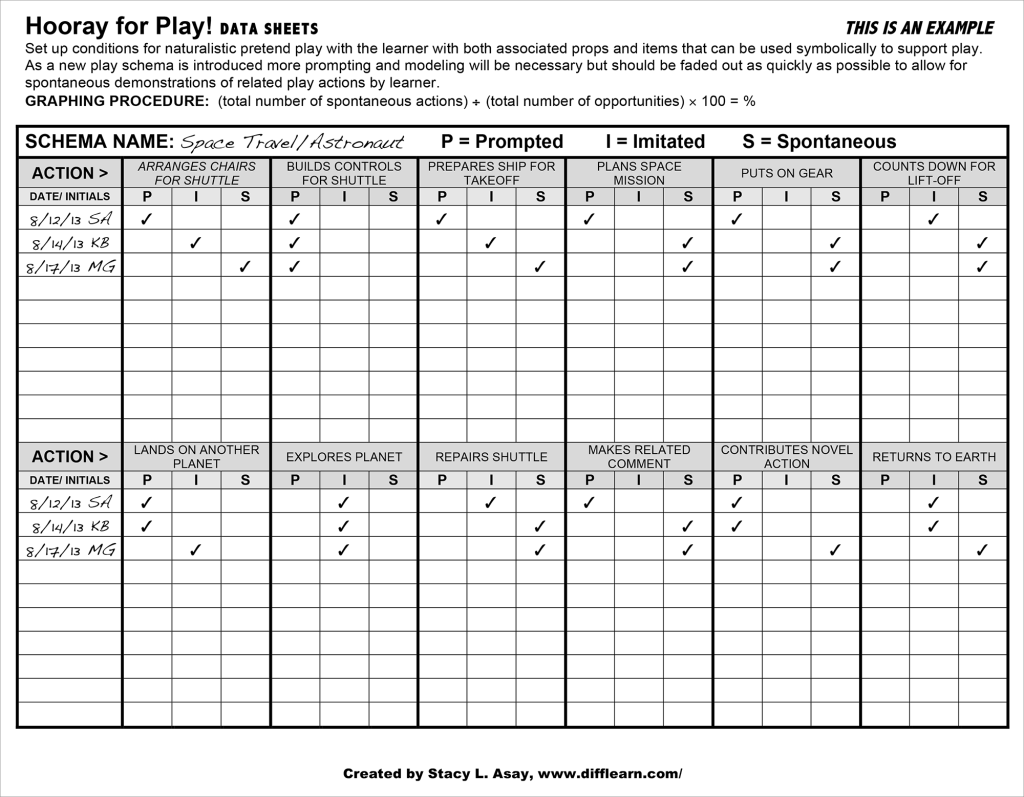
The Hooray for Play! Data Sheets allow for the most salient elements of a play schema to be taught while still leaving room for variation and flexibility, which can be critical when generalizing to peers. Additionally, the targets are not predetermined so that they can be individualized for the learner. Below, you will find an example of the data sheet with some rows filled in to illustrate what it might look like. A blank version is also available in the set, so that it can be individualized for a specific learner.

HoorayForPlay_DataSheets_Example

There are a variety of techniques founded in the science of Applied Behavior Analysis that are effective in increasing and improving play skills. Research-based procedures can range from very structured to more naturalistic and should be chosen based on an approach best suited for the learner.

Some examples include:

  • Video Modeling
  • Play Scripts
  • Pivotal Response Training (PRT)
  • Peer Training

References:
Charlop-Christy, M. H., Le, L., & Freeman, K. A. (2000). A comparison of video modeling with in vivo modeling for teaching children with autism. Journal of Autism and Developmental Disorders, 30 (6), 537-552.

Goldstein, H. & Cisar, C.L. (1992). Promoting interaction during sociodramatic play: teaching scripts to typical preschoolers and classmates with disabilities. Journal of Applied Behavior Analysis, 25, 265–80.

Koegel, L.K., Koegel, R.L., Harrower, J.K. & Carter, C.M. (1999). Pivotal response intervention. I: Overview of approach. Journal of the Association for Persons with Severe Handicaps, 25, 174-85.

Stahmer, A.C. (1999). Using pivotal response training to facilitate appropriate play in children with autistic spectrum disorders. Child Language Teaching and Therapy, 15, 29–40.

Pierce, K. & Schreibman, L. (1997). Using peer trainers to promote social behavior in autism: Are they effective at enhancing multiple social modalities? Focus on Autism and Other Developmental Disabilities, 12, 207–18.

NYS Licensing Process for Behavior Analysts Announced

The New York State Office of the Professions announced on Tuesday, June 3rd, 2014, the application process for licensed behavior analysts and certified behavior analyst assistants.  This process marks the first step in implementing the landmark ABA License Bill that was signed by New York State Governor Cuomo in January. This bill establishes a new state license for providers of applied behavior analysis (ABA) services to individuals with autism spectrum disorder. Now, individuals seeking to become licensed BCBA’s and BCaBA’s in New York will be able to register and become certified by the following requirements (subject to change in January 2016):


  1. Currently certified by the national Behavior Analyst Certification Board
  2. Submit a 4-page application
  3. Pay the required application fee
  4. At least 21 years of age
  5. Complete a 3-hour training in the identification and reporting of child abuse
  6. Be of good, moral character

Visit the NYS Office of the Professions’ website to view the detailed list of Licensure/Certification Requirements.

Special thanks to Eden II and ELIJA for sharing the news with us!

Meet Hannah Toale, Client Sales & Relationships Coordinator

Hannah ToaleWe’re so pleased to introduce you to the newest member of our team, Hannah Toale.
Hannah joined us in October and has been brightening our days since. That warm and welcoming voice you hear when you call? That’s Hannah. She joins us out of Smith College with a degree in Physics and fresh off a stint as Onsite Sales Supervisor at the illustrious High Line here in NYC.

Hannah has been hard at work coordinating all of our conferences and events, presenting Different Roads from Philadelphia to Ohio, New York to North Carolina (we’re trying to make our way West!). If you have an upcoming event, be it a conference, support group meeting, or professional development day, shoot her an email at hannah@difflearn.com and she’ll find a way for us to participate.

In addition to planning all of our conferences and outreach, Hannah is also our primary customer service person. It’s Hannah’s lovely, helpful and kind voice you hear when you call. She’s a delight to have in the office with her can-do attitude and willingness to always go the extra mile for all our customers. We’re sure anyone who has talked with her will agree!

Natasha asked Hannah a few questions about how she’s settling in so far…

Tell us a bit about yourself. You were a physics major and worked at the world famous High Line. How is the transition to client sales and conference coordinator going?

I studied physics at Smith College with the end goal of being a teacher. I think that many people are so intimidated by math and science they find it difficult to even approach the subjects. I truly believe that people are much more capable then they believe themselves to be and that with patience and approaching a topic from different angles there is so much room to learn and grow. These ideas were what drew me so strongly to Different Roads to Learning. The people and products here help teachers, parents, and care givers work with young children to accomplish a great deal with conventional and unconventional tools. For example the MotivAider, which can be used to help form or break habits for children and adults. Or the Time Timers to help visualize the passing of time. All of the products that Different Roads to Learning has cultivated over the past 19 years are to make learning and developing less intimidating and more fun and attainable and I am very excited to be a part of it.

What part of your day do you most enjoy?

I have really enjoyed answering the phone, even if that sounds silly.  I love being able to help people in whatever way I can and to make the ordering process as easy as possible. I have been able to speak with people all over the U.S. and occasionally receive calls other countries. It is so amazing to me that there are people all over the world with the same goal -helping young learners and Different Roads to Learning seems to be a place they can all go for materials and guidance. Being the first person a customer will talk to and either helping them, or asking someone who can makes it so much fun to work here. Also… working in an office with all of these games and toys is indisputably awesome.

Pick of the Week: “Expanding and Combining Sentences” Interactive Workbook

For students who are already able to talk or write in simple, choppy sentences, this interactive workbook will open gateways to success in language and literacy! Save 15%* on your purchase of Expanding and Combining Sentences by speech and language pathologist Marilyn M. Toomey this week only, by applying or mentioning our promo code EXPAND8 at check out!

Color picture pages, along with specific instructions, provide a means of evoking interesting and descriptive sentences from students.

Students will learn how to expand their sentences by using the color cues provided in the book, as pictures become progressively colorful and a new detail is added to the sequence. In no time at all, young learners will be able to tell an entire story by using complex and detailed sentences!

97 pages in total with 40 colored pages.  Preview the book.

This interactive workbook will be the perfect resource to teach the challenging task of making sentences more interesting with descriptive words.  Don’t forget – this week only, take 15% off* your order of Expanding and Combining Sentences by applying code EXPAND8 at checkout!

Marilyn M. Toomey is also the author of several other popular speech and language workbooks, such as Talking in Setences, Verbal Reasoning Activities, The Language of Perspective Taking, and much more.

*Offer is valid until 11:59pm EDT on 6/10/2014. Not compatible with other offers. Be sure there are no spaces or dashes in your code at checkout!

Modified Instructions for Shopping List Memory Game

We’re excited to bring you the fourth installment of our series of Modified Instructions, created by Sam Blanco, BCBA.  Sam’s Modified Instructions present 3-4 additional ways to play a mainstream game to make it most useful and accessible for our students with special needs.  These alternative instructions break down each adapted game by:

  • Age/Skill Level
  • Number of Players
  • Object
  • Skills Required
  • Materials Needed
  • Prep
  • Instructions
  • Considerations

In this installment, we’re introducing Sam’s Modified Instructions for Shopping List, one of our favorite memory games. Shopping List is an adorable memory game that also develops personal and social skills.

The goal of the game is to be the first to fill your cart with all of the items on your shopping list.  It is designed with the objective to have players fill a trolley with the items on their shopping list. However, there are multiple games and activities that can be played with these materials to meet the specific needs of your learners.

Included in the game are 4 cardboard carts, 4 shopping lists, and 32 beautifully illustrated items with dry-erase surfaces. Don’t forget to download our free Modified Instructions for Shopping List today!

Urge U.S. Congress to Cover ABA for Military Kids with Autism

A new bill was introduced requiring TRICARE to cover Applied Behavior Analysis (ABA) for all military children with developmental disabilities, including autism. The Caring for Military Children with Developmental Disabilities Act of 2014, sponsored by U.S. Representatives John Larson (D-CT) and Tom Rooney (R-FL), marks the latest effort in Congress to improve and standardize medical coverage of ABA therapy for military families affected by autism and other developmental disabilities.

It is estimated that 23,000 military dependents, including children of active duty, reserve and guard families, are affected by autism.

Excited returning soldier hugging her son

Given frequent duty station changes and social turmoil of military service, military children affected by autism often face additional challenges that their civilian counterparts do not necessarily face every day. “Our common sense bill helps ensure that the children of our troops and military retirees have access to the health care services they need,” Rooney said.

The bills, HR.4630 and S.2333, would provide access to ABA for all military children with developmental disabilities, improve coverage to address medically recommended treatment levels, and allow for coverage of the ABA tiered service delivery model which includes Board Certified Assistant Behavior Analysts and ABA Technicians.

TRICARE now has three different programs delivering ABA services in three different ways, and not one of them is permanent.

Please urge your U.S. Representatives and Senators to pass the new bill to make ABA coverage a permanent medical benefit under TRICARE for all military children affected by autism and other developmental delays. Visit Autism Speaks and take action by sending an email with your message of support for these military families in need.

VOTE to Name Our Worm!

Thank you to everyone who participated last week in suggesting a name for our worm! We had a blast reading through all the wonderfully quirky and creative suggestions. Out of hundreds of submissions, we’ve narrowed down the choices to our top 4, and now we’d like for YOU to vote on the best name!

Vote to Name Our Worm!

Cast your vote here! Results of the poll will be shared next week, so don’t forget to check back here or our Facebook page.

Introducing Little Mixers: A Weekly Social Skills Playgroup in Brooklyn

Little Mixers BklnStacy Asay, one of our wonderful and beloved consultants, is launching the Little Mixers series, a social skills group based in Brooklyn! Headed by Stacy and Sharon Alkalay, this weekly Little Mixers series will be a special mix of fun, food, and friendship for young children between the ages of 3 and 7. Sessions will be held at Beansprouts at 14th Street and 6th Avenue in Park Slope.

Each meeting will consist of a guided lesson, group discussion, interactive games and a cooking activity, all thematically focused around a particular social skill. Each week a new social skill will be introduced with the session, culminating in an expanded repertoire of social skills and perhaps a new friend!

Parents will be provided a hand-out with suggestions and strategies to practice throughout the week in order to facilitate carry-over of a target skill.

Little Mixers will be holding 2 sessions for Spring/Summer 2014:
Mondays: 4:30 p.m. – 5:30 p.m. (ages 5-7)
Thursdays: 4:30 p.m. – 5:30 p.m. (ages 3-5)

For more detailed information, please visit the Little Mixers website at www.littlemixersbrooklyn.com, or email Stacy Asay at littlemixersbrooklyn@gmail.com.

About the Group leaders

Sharon Alkalay, MS, CCC-SLP, is a speech-language pathologist with over 8 years of experience working with infants, toddlers and children. As a classically-trained musician, she enjoys incorporating multi-modal/multi-sensory techniques into her therapy sessions through use of music, art, movement, sensory integration and dramatic play. She believes that successful engagement with a child should be accomplished gracefully with creativity, humor and compassion. Her special interests include working with children with social-language difficulties, apraxia of speech, autism spectrum disorders and language/learning disorders.

Stacy L. Asay, LMSW, is a licensed social worker, providing home and school based services to children and their families in the New York City area. With nearly 16 years of experience, her work with special needs children integrates a strengths-based, holistic approach to child and family augmented with the tools of Applied Behavior Analysis, a methodology that allows for reliable measurement, objective evaluation of behaviors, and the systematic teaching of language and learning skills.  This results in an individualized curriculum that equips children with the tools they need for learning and living while honoring their unique spirit.