Different Roads iOS Apps Now Feature Family Sharing

Apple has recently introduced a new Family Sharing feature, which allows up to 6 family members to browse and access each other’s iTunes, iBooks, and App Store purchases, as well as share photos, calendars, and locations with each other. We’re excited to announce that all of our Different Roads apps in the iTunes App Store have also begun to support this feature. Family Sharing also includes parental controls, enabling parents to approve purchases and downloads initiated by children first.

Different Roads to Learning Apps
Clean Up Cateogory Sorting AppClean-Up: Category Sorting  This highly-rated interactive program develops language, reasoning, and sorting and classifying skills in young learners. Players must “clean up” by putting 75 photographic images of toys, food, and clothing away in the correct shopping cart, refrigerator, or toy box. Each target is introduced by its label (“Where does the Apple go?”) in each round where players see 15 unique images. Correct responses receive visual and auditory reinforcement while incorrect answers are corrected by a visual prompt of the correct answer flashing. This app builds foundational sorting skills for students just developing their sorting and classifying skills. Available on iPhone and iPad.

Whats that Sound App

What’s that Sound? Learning to Listen and Identify Sounds  This interactive and easy-to-grasp game develops auditory discrimination and processing skills in young learners. Players will improve their skills by matching objects and their associated sounds. Simple auditory processing skills lay the foundation for learning how to read, speak and spell.
Available on iPhone and iPad.
 

What Goes Together App

What Goes Together?  This interactive program develops language, discrimination, and reasoning skills in young learners. Clear, colorful images of everyday objects promote an understanding of functions and the relationships between items that children encounter on a daily basis. With built-in reinforcement and error correction, this game provides a solid foundation in building critical expressive and receptive language skills. Available on iPhone and iPad.

Tell Me About It App

Tell Me About It!  Featured as Editor’s Choice on Best Apps for Kids, this universal app is specifically designed for children with autism and other speech and language delays. Based on the Applied Behavioral Analysis approach, this program mimics an actual one-on-one instructional session with a therapist. The app provides 15 categories of language targets, such as body parts, household items, clothing and food, and six levels of difficulty, which progressively become more difficult, from labelling to shared feature, function, and category. This app also features an easy-to-read report card, which provides tracking data for each child and an option to e-mail the report card results. Available on iPhone and iPad.

To discover all of our current apps and what Family Sharing can do for your family, visit our iTunes App Store page.

Tip of the Week: Teaching Money Skills to Students with Autism in Natural Social Situations

Recently I took a thirteen-year-old boy with autism grocery shopping for the first time. We had practiced all of the steps for paying: looking at the total on the register, taking out the necessary bills or coins, waiting for change, making sure we had correct change, returning the money to the wallet, etc. While I thought he was ready to do this in a natural environment, I did not expect what actually happened.

Standing at the counter with a line of people impatiently waiting behind us, my student dumped all the change from his wallet on the counter and slowly began counting out the exact amount. I could hear other store patrons grumbling behind us when my student finally finished paying, then dropped coins all over the floor, and swept his remaining money back into his wallet.

The concern here is that some of the behaviors associated with autism can place an individual in danger if misunderstood by a cashier or store patron. My student appeared to be oblivious to the frustration of the people around him, offering no apology or explanation. There are many resources out there for teaching children with autism about identifying coins, counting out exact change, etc. But it’s essential that we think beyond the fundamentals of managing money to the more complex skills of managing the social situations that arise during money transactions on a daily basis.

Here are some social skills related to money to practice with your students:

  • Keep your wallet in your hand, do not lay it on the counter.
  • Look for the total on the register. If there is not a place to see the total, ask for it after all the items have been rung up.
  • Put the money in the cashier’s hand.
  • Put your hand out to receive change.
  • Once you have completed payment, make sure your wallet is securely back in your pocket or bag.
  • Understand how to respond if a cashier asks “Do you have exact change?” or “Do you have a smaller bill?” or any variation of those questions.
  • Pay with speed.
  • Understand how to ask to put an item back if you do not have enough money.
  • Know basic scripts for what to say in challenging situations, such as if you accidentally bump into someone with your shopping basket or you are taking a long time and another patron says something rude about it.

My takeaway from this experience was that I needed to provide practice in the natural environment much sooner than I had thought. I must consider the fact that we simply can’t contrive the broad range of possible interactions with strangers in a home or classroom setting. My students require dozens, if not hundreds, of opportunities to practice a skill before mastering it, and generalization is frequently challenging, so presenting them with a variety of natural environment experiences is important. I also must recognize that a student’s behavior will often vary from one environment to another, so the sooner I know what he or she is doing in the natural environment, the sooner I can implement meaningful instruction and intervention to address any problems. Finally, because ABA providers and teachers have more limited access to the natural environment than parents and caregivers, we should provide specific goals and teaching strategies to help them practice with the learner when we’re not present.

Data Sheets Now Available for Hooray for Play!

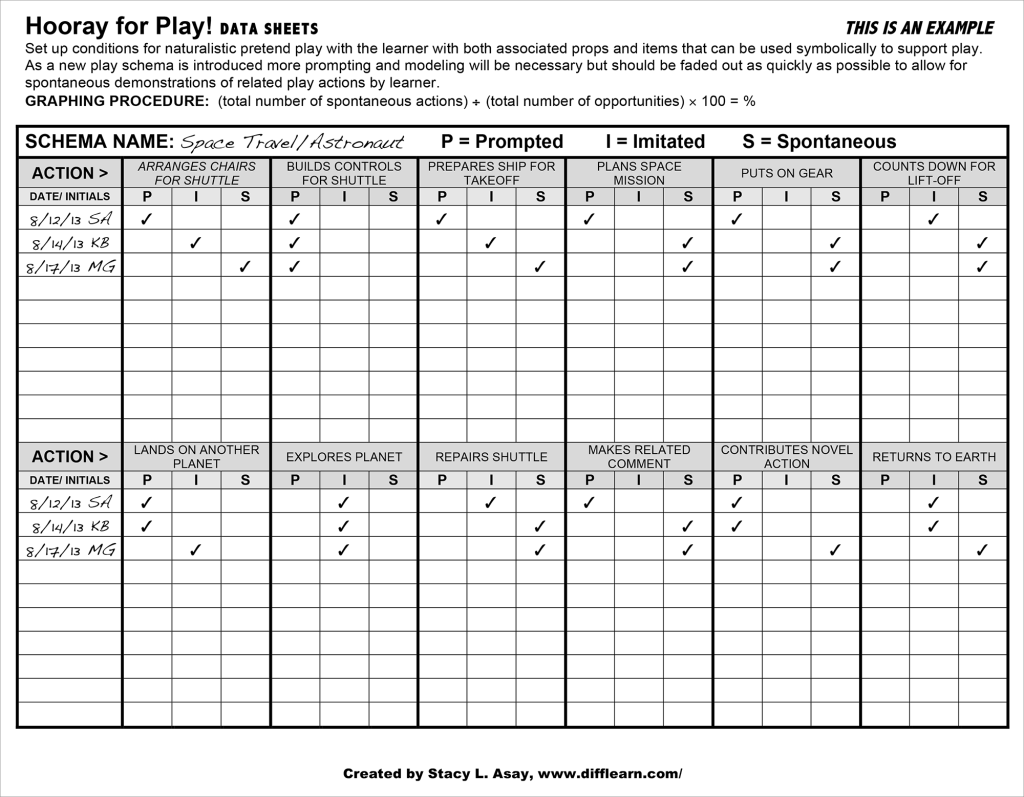
I get pretty excited about pretend play and it isn’t unusual for me to engage colleagues at length in a conversation about how it can be incorporated into a learner’s home program using naturalistic behavioral methods. I can go on and on about all of the various play schemas that can be taught, my observations regarding which play schemas are of the greatest interest to the learner’s peer group at the moment, and regular items from around the house that can be incorporated as props.

The Hooray for Play! cards break down all of this information into a framework that is easy to reference and remember. Additionally, the simple illustrations provide visual stimuli to facilitate conversation about various schemas, to prime a student before play begins, or to help facilitate choice during pretend play. However, it isn’t long into our conversation when my colleagues ask, “What about the data?” Of course, this is where the conversation ends up because in an ABA program, all decisions are data-driven and based on observable and clearly defined target behaviors. However, with something as fluid as pretend play, it can sometimes feel a bit daunting to break the play down into smaller parts without scripting it completely.

The Hooray for Play! Data Sheets allow for the most salient elements of a play schema to be taught while still leaving room for variation and flexibility, which can be critical when generalizing to peers. Additionally, the targets are not predetermined so that they can be individualized for the learner. Below, you will find an example of the data sheet with some rows filled in to illustrate what it might look like. A blank version is also available in the set, so that it can be individualized for a specific learner.

HoorayForPlay_DataSheets_Example

There are a variety of techniques founded in the science of Applied Behavior Analysis that are effective in increasing and improving play skills. Research-based procedures can range from very structured to more naturalistic and should be chosen based on an approach best suited for the learner.

Some examples include:

  • Video Modeling
  • Play Scripts
  • Pivotal Response Training (PRT)
  • Peer Training

References:
Charlop-Christy, M. H., Le, L., & Freeman, K. A. (2000). A comparison of video modeling with in vivo modeling for teaching children with autism. Journal of Autism and Developmental Disorders, 30 (6), 537-552.

Goldstein, H. & Cisar, C.L. (1992). Promoting interaction during sociodramatic play: teaching scripts to typical preschoolers and classmates with disabilities. Journal of Applied Behavior Analysis, 25, 265–80.

Koegel, L.K., Koegel, R.L., Harrower, J.K. & Carter, C.M. (1999). Pivotal response intervention. I: Overview of approach. Journal of the Association for Persons with Severe Handicaps, 25, 174-85.

Stahmer, A.C. (1999). Using pivotal response training to facilitate appropriate play in children with autistic spectrum disorders. Child Language Teaching and Therapy, 15, 29–40.

Pierce, K. & Schreibman, L. (1997). Using peer trainers to promote social behavior in autism: Are they effective at enhancing multiple social modalities? Focus on Autism and Other Developmental Disabilities, 12, 207–18.

NYS Licensing Process for Behavior Analysts Announced

The New York State Office of the Professions announced on Tuesday, June 3rd, 2014, the application process for licensed behavior analysts and certified behavior analyst assistants.  This process marks the first step in implementing the landmark ABA License Bill that was signed by New York State Governor Cuomo in January. This bill establishes a new state license for providers of applied behavior analysis (ABA) services to individuals with autism spectrum disorder. Now, individuals seeking to become licensed BCBA’s and BCaBA’s in New York will be able to register and become certified by the following requirements (subject to change in January 2016):


  1. Currently certified by the national Behavior Analyst Certification Board
  2. Submit a 4-page application
  3. Pay the required application fee
  4. At least 21 years of age
  5. Complete a 3-hour training in the identification and reporting of child abuse
  6. Be of good, moral character

Visit the NYS Office of the Professions’ website to view the detailed list of Licensure/Certification Requirements.

Special thanks to Eden II and ELIJA for sharing the news with us!

Pick of the Week: “Expanding and Combining Sentences” Interactive Workbook

For students who are already able to talk or write in simple, choppy sentences, this interactive workbook will open gateways to success in language and literacy! Save 15%* on your purchase of Expanding and Combining Sentences by speech and language pathologist Marilyn M. Toomey this week only, by applying or mentioning our promo code EXPAND8 at check out!

Color picture pages, along with specific instructions, provide a means of evoking interesting and descriptive sentences from students.

Students will learn how to expand their sentences by using the color cues provided in the book, as pictures become progressively colorful and a new detail is added to the sequence. In no time at all, young learners will be able to tell an entire story by using complex and detailed sentences!

97 pages in total with 40 colored pages.  Preview the book.

This interactive workbook will be the perfect resource to teach the challenging task of making sentences more interesting with descriptive words.  Don’t forget – this week only, take 15% off* your order of Expanding and Combining Sentences by applying code EXPAND8 at checkout!

Marilyn M. Toomey is also the author of several other popular speech and language workbooks, such as Talking in Setences, Verbal Reasoning Activities, The Language of Perspective Taking, and much more.

*Offer is valid until 11:59pm EDT on 6/10/2014. Not compatible with other offers. Be sure there are no spaces or dashes in your code at checkout!

Urge U.S. Congress to Cover ABA for Military Kids with Autism

A new bill was introduced requiring TRICARE to cover Applied Behavior Analysis (ABA) for all military children with developmental disabilities, including autism. The Caring for Military Children with Developmental Disabilities Act of 2014, sponsored by U.S. Representatives John Larson (D-CT) and Tom Rooney (R-FL), marks the latest effort in Congress to improve and standardize medical coverage of ABA therapy for military families affected by autism and other developmental disabilities.

It is estimated that 23,000 military dependents, including children of active duty, reserve and guard families, are affected by autism.

Excited returning soldier hugging her son

Given frequent duty station changes and social turmoil of military service, military children affected by autism often face additional challenges that their civilian counterparts do not necessarily face every day. “Our common sense bill helps ensure that the children of our troops and military retirees have access to the health care services they need,” Rooney said.

The bills, HR.4630 and S.2333, would provide access to ABA for all military children with developmental disabilities, improve coverage to address medically recommended treatment levels, and allow for coverage of the ABA tiered service delivery model which includes Board Certified Assistant Behavior Analysts and ABA Technicians.

TRICARE now has three different programs delivering ABA services in three different ways, and not one of them is permanent.

Please urge your U.S. Representatives and Senators to pass the new bill to make ABA coverage a permanent medical benefit under TRICARE for all military children affected by autism and other developmental delays. Visit Autism Speaks and take action by sending an email with your message of support for these military families in need.