Pick of the Week: Audible Time Timers – For Smooth Transitions Back to School

Transitions back to school can be difficult after a summer of changed routines. When it’s time to go back to school and reset day-to-day routines, a visual timer can make all the difference in timekeeping and easing the stress of structuring activities for your child or student. This week only, we’re taking 15%* off your order of the 3-inch, 8-inch, and 12-inch Audible Time Timers to help you help your learner with their transitions. Just enter promo code TIMETIMER at checkout to redeem your savings!

Recommended by Autism and ADHD experts, the Time Timer is entirely intuitive to use. This visual timer is great at solving time perception problems at all ages and ability levels, and is perfect for easy portability and in one-on-one and group settings.


A graphic clock-face gives the child visual understanding of time elapsing. This is ideal for timed activities and for getting ready. When the colored portion elapses, time is up. There is also an optional audible component that you can turn on so that the timer BEEPS when time is up. All Time Timers run on battery-operated quartz movement, and can be free standing or hung on a wall.

Don’t forget to save 15%* on your purchase of the 3-inch, 8-inch, and/or 12-inch Audible Time Timers this week only by using promo code TIMETIMER at checkout!

Read “Time Timer: Time to Build Independence,” an exclusive article by a parent about how she used the Time Timer to help her son challenge himself to get through a timed activity.

*Offer is valid until 11:59pm EDT on September 9th, 2014. Not compatible with any other offers. Be sure there are no spaces or dashes in your code at check out!

Tip of the Week: 6 Ways to Get the Most Out of Your Home ABA Program

CHILD IN SPEECH THERAPYWhile an ABA professional should be coming in to organize and run your ABA program, as a parent or guardian, there are some simple things you can do to make the time your child spends in a home session more effective. Several tips are here, but it may be unrealistic for you to follow ALL of these tips. Consider your home environment and family’s needs, then implement the tips that are the most feasible for your situation.

Following even one of these tips can make a big difference in your child’s sessions!

1)    Make sure all ABA materials are accessible. It’s important to have a system for storing the materials and the binder the ABA providers use. Some families I work with put everything into a box, a dresser drawer, or on a shelf the child cannot reach which is great. If the child utilizes an iPad for communication or reinforcement, be sure it’s available and charged. If any other items are necessary, such as edibles for reinforcement, make sure those are available at the beginning of the session. One parent I worked with used a craft organizer container with a clear plastic lid to store edibles, so when sessions began she’d set it on the table. All the different snacks were already broken into small pieces and organized in the box, freeing up more time for teaching during the session.

2)    Keep the area for ABA therapy free from distraction. Remove any items that are highly distracting for your student. Shut windows if you live on a noisy street. Make sure your cell phone is with you. This tip is especially challenging for families that live in studio apartments or have loud neighbors.

3)    Limit the number of disruptions from siblings or other family members. As an ABA therapist who is focused on increasing my students’ opportunities for social interaction, I don’t want to discourage the siblings and other family members from coming in. Interruptions should happen from time to time, and it’s important that my students learn to refocus after an interruption. But sometimes it becomes an obstacle to learning when there are consistent interruptions, or if I have to continue to redirect a sibling to other activities.  Instead, it’s better to structure activities with siblings and other family members, perhaps by teaching the learner with autism to request the sibling come play or adding it to the student’s activity schedule.

4)    When possible, reserve one or more highly motivating activities for ABA sessions. If a child has free access to all his/her motivating activities, then those activities are not as valuable when used in a session, and therefore less motivating. Sessions are most effective when the learner is working for something that they’re highly motivated by. It’s important to note here that I don’t want the child to only have access to fun things during sessions. I also don’t want the parents miss out on opportunities to enjoy motivating activities with the learner. The idea is to save a small number of motivating activities for sessions so the child maintains motivation and focuses on learning. This tip is especially challenging for families when the learner with autism is motivated by only one or two activities or items.

5)    Don’t allow the child to engage in their highest motivating activities right before an ABA session. I’ve had more than one case in the past in which I would get to the home and find my student watching his favorite TV show or playing his favorite game on the iPad. What would typically happen is that my student would associate my arrival with the end of his favorite activity, which would lead to crying, refusal to work, and/or attempts to escape. I want my students to be able to watch their favorite shows and play with their favorite games, but our sessions are more effective when those activities don’t take place immediately beforehand.

6)    Ask your provider if there are any changes you can make to improve sessions. Every home is different and every child’s needs are different. Your provider may be able to identify small changes for your specific situation that are not mentioned above. Opening that dialogue can be a powerful way to improve your child’s learning outcomes.  

WRITTEN BY SAM BLANCO, MSED, BCBA

Sam is an ABA provider for students ages 3-12 in NYC. Working in education for ten years with students with Autism Spectrum Disorders and other developmental delays, Sam has developed strategies for achieving a multitude of academic, behavior, and social goals.

Tip of the Week: Minimize Tantrums with High and Low-Quality Attention

Recently I began working with a family who has a six year old boy with autism named Austin (all names and identifying details have been changed to protect confidentiality). His mother was describing Austin’s behaviors when he couldn’t have something he wanted. She told me about him hitting his parents and younger brother, sweeping all materials off tables and shelves, and throwing himself on the floor. She was worried that he might hurt himself or hurt someone else. She told me that when he started this behavior, they would say, “Stop hitting.” They had been doing this for months, but his behavior had not improved.

Later that week, she sent me a video of Austin having one of his “mega-tantrums.” It was exactly as she described, though there was one important detail she had missed. Austin consistently sought out eye contact and physical contact with both of his parents. If they were moving around to pick up an item, he would move his body and face to maintain eye contact. If one of them sat down, he would quickly clamber into their lap while screaming and pounding their arms or the furniture. If one parent walked out of the room, he would immediately run to the other parent. This behavior was clearly maintained by attention. In order to decrease the behavior, his parents had the very difficult task of ignoring it ahead of them.

The next week I went out to their house to help them practice ignoring the behavior. We put in place a three-pronged plan:

  • When Austin wanted something he was not allowed to have, he would be given a choice of options. The options should be for preferred activities. For example, if he wants to watch TV but isn’t allowed to right now, the parent can say, “Austin, you can play with trains or you can do a puzzle.”
  • Once Austin starts hitting or screaming, he does not receive any attention. This includes eye contact, physical contact, and verbal prompts/reminders from his parents.
  • The parents can start one of the motivating activities in another location. For this family, the parents sat with the younger brother at the dining room table and the mother read a book out loud.

As I had forewarned the parents, Austin’s behavior initially intensified as he realized he was getting zero attention. He took a box of toys, turned it upside down, and dumped it all over the floor. His mother kept reading to his brother. He ran over to his father and hit his legs while screaming, the father got up and walked away. Then, Austin did something he had never done before. He climbed up onto the table and started walking around on the edge of it.

His mother looked at me and said, “How do I avoid giving him attention for that?” This is when it’s important to consider high-quality attention and low-quality attention. In order to keep him safe, his mother needed to be more proximal. She walked near where he was on the table, but did not pick him up, did not make eye contact, and did not speak to him. (I let her know that if she felt he was very unsafe, she could pick him up and remove him from the table but quickly letting him go, and withholding eye contact and verbal interaction.) She stayed nearby to catch him if he fell, but she did not provide attention for this dangerous behavior. Her proximity (or if she had chosen to pick him up off the table without eye contact or verbal interaction) constitutes low-quality attention. High-quality attention is only saved for appropriate behavior.

Think about what high-quality attention means for a young child: big facial expressions, expressive tones of voice, big movements, and physical contact. Prior to our intervention, Austin was getting all of those types of high-quality attention for inappropriate behaviors. But now he wasn’t getting any of that type of attention.

However, Austin had been engaging in inappropriate behaviors for attention for 2-3 years now, so changing this behavior takes a little time. For our first day of the intervention, Austin continued to yell and throw items for 40 minutes before he finally went over to where his mom was sitting and reading aloud the story (actually, the third story in a row). When he was near and quiet, his mom started reading in a wonderfully expressive tone, adding voices to the characters. Austin came closer. When a funny part of the story happened, Austin laughed. And then Austin’s mother encouraged him and his brother to imitate the characters in another part of the story. After he imitated the characters, he sat next to his mom and she put her arm around him. All of these high-quality forms of attention were now being given for appropriate interaction.

Sometimes you have to provide some attention in order to keep a child safe, but think to yourself what is high-quality attention for your learner: it may be tickles, silly faces, expressive speaking, or physical contact. Reserve those things for appropriate behaviors.

A few final notes about this intervention: (1) Austin’s inappropriate behaviors will probably still continue for a little bit longer. I’m certain that he will test it out a few more times, and his parents will have to stick to the intervention in order to completely get rid of what they had deemed as “mega-tantrums”; (2) This intervention only works for behaviors maintained by attention. If you’re uncertain about the function of a behavior, confer with a BCBA or an ABA provider for help; and (3) If you’re not certain you can follow through if the behavior persists for a long time (such as 40 minutes in Austin’s case) then give in the first time the learner asks. For more information on this, look back at my tip on Choosing When to Battle.

Simplifying the Science: Are You Giving Your Student Enough Freedom?

One of my favorite research papers was published in the Journal of Applied Behavior Analysis in 1990 by Diane J. Bannerman, Jan B. Sheldon, James A. Sherman, and Alan E. Harchik. The title is Balancing the Right to Habilitation with the Right to Personal Liberties: The Rights of People with Developmental Disabilities to Eat Too Many Doughnuts and Take a Nap. It’s an in-depth look at the level of control practitioners can exert over the individuals they serve, and the implications of that control.

It’s important to consider the ethical implications of requiring the individuals we work with to complete specified exercises at scheduled times, eat a healthy diet for all meals, and limit TV. I have seen situations in which the practitioner is holding the individual with developmental disabilities to a higher standard than they hold themselves! Most of you reading this can probably quickly rattle off the name of the last TV show you “binge-watched” or the delicious ice cream you enjoyed too much of.

So how do we teach making appropriate choices to individuals with developmental disabilities without denying the personal freedoms we all value?

One quote from the paper states, “Not only do people strive for freedom in a broad sense they also enjoy making simple choices, such as whether to engage in unproductive, though harmless, activities, like watching sitcoms on television, eating too many doughnuts, taking time off from work, or taking a nap before dinner.” In an effort to teach our learners independent skills, we often neglect to teach meaningful decision-making that reflects the types of decisions neurotypical adults make every day. Since the paper was originally published, there has been more work done on promoting decision-making skills for learners with developmental disabilities, but the issues described in the paper are still relevant today.

Here are a few key considerations described:

  • We need to consider client preference when creating daily schedules, goals, and access to preferred activities.
  • A client’s refusal to participate in an activity may not be a failure to teach appropriately but an expression of preference.
  • It is important for practitioners to teach choice-making. The paper states, “Many people require teaching to help them discover their own preferences and learn to make responsible choices.” We should consider this as an essential step towards promoting independence in our clients.
  • Inflexible schedules for clients can sometimes be obstacles to opportunities for choice-making.

The paper goes on to cite multiple research articles and laws for both sides of the argument about the right to choice for those with developmental disabilities. You can read the full text here.  Overall, I consider this article to be essential reading for anyone working with clients with disabilities. It provides a lot of information to support its final conclusion that “all people have the right to eat too many doughnuts and take a nap” and we have the responsibility to teach clients how to exercise such freedoms.

WRITTEN BY SAM BLANCO, msed, BCBA

Sam is an ABA provider for students ages 3-12 in NYC. Working in education for ten years with students with Autism Spectrum Disorders and other developmental delays, Sam has developed strategies for achieving a multitude of academic, behavior, and social goals.

Tip of the Week: Teaching Language—Focus on the Stage, Not the Age

Teaching language skills is one of the most frequent needs for children with autism, but also one of the most misunderstood skillsets amongst both parents and practitioners. The desire to hear your learner speak in full sentences can be overwhelming, making it especially difficult to take a step back and consider what it means to communicate and how communication skills develop in neurotypical children. Many times we get hung up on what a child should be capable of communicating at a certain age, rather than focusing on what they are capable of communicating at this stage of development.

Many practitioners and curricula utilize Brown’s Stages of Language Development.* Brown described the first five stages of language development in terms of the child’s “mean length of utterance” (or MLU) as well as the structure of their utterances.


From aacinstitute.org

Sometimes it is necessary to compare a child to his or her same-age peers in order to receive services or measure progress, but it can be detrimental to focus on what a child should be doing at a specific age instead of supporting them and reinforcing them for progress within their current stage.

Research has suggested that teaching beyond the child’s current stage results in errors, lack of comprehension, and difficulty with retention. Here are some common errors you may have witnessed:

  • The child learns the phrase “I want _____ please.” This phrase is fine for “I want juice, please” or “I want Brobee, please,” but it loses meaning when overgeneralized to “I want jump, please” or “I want play, please.” It’s better to allow your learner to acquire hundreds of 1-2 word mands (or requests) before expecting them to speak in simple noun+verb mands.
  • The child learns to imitate only when the word “say” is used. Then the child makes statements such as “say how are you today,” as a greeting or “say I’m sorry,” when they bump into someone accidentally. Here, the child clearly has some understanding of when the phrases should be used without understanding the meanings of the individual words within each phrase.
  • The child learns easily overgeneralized words such as “more.” This is useful at times, but the child can start using it for everything. Instead of saying “cookie” he’ll say “more.” Instead of saying “train,” he’ll say “more.” And he may say “more” when the desired item is not present, leaving the caregiver frustrated as he/she tries to guess what the child is requesting. Moreover, as language begins to develop, he may misuse it by saying things such as “more up, please.”
  • The child learns to say “Hello, how are you today?” upon seeing a person entering a room. A child comes into the classroom and the learner looks up, says “Hello, how are you today?” The child responds, “Great! Look at the cool sticker I got!” Your learner then doesn’t respond at all, or may say “fine,” as he has practiced conversations of greeting.

These are only a few of the common language errors you may see. While you may want your learner to speak in longer sentences, your goal should be to have them communicate effectively. With this goal in mind, it becomes essential to support them at their current stage, which means it’s essential to assess them and understand how to help them make progress.

This is why I always use the VB-MAPP to assess each child and make decisions about language instruction. I need to have a full understanding of how the learner is using language, and then move them through each stage in a clear progression. I may want the child to say “Hello, how are you today?” But when I teach them that, do they understand those individual words? Do they comprehend what today means as opposed to yesterday or tomorrow? Do they generalize the use of “how” to other questions?

As you make treatment decisions for your learner, think about their current stage and talk about how to support your child with both a Speech Language Pathologist and an ABA therapist.

*Brown, R. (1973). A first language: The early stages. London: George Allen & Unwin Ltd.

WRITTEN BY SAM BLANCO, MSEd, BCBA

Sam is an ABA provider for students ages 3-12 in NYC. Working in education for ten years with students with Autism Spectrum Disorders and other developmental delays, Sam has developed strategies for achieving a multitude of academic, behavior, and social goals.

Pick of the Week: Auditory Timer – ONLY $5 This Week!

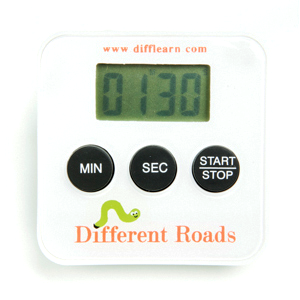
DRT207Keep your student on schedule with our popular Auditory Timer, and get yours for $7.95 only $5 this week (37% savings)! Enter promo code TIMER5 to redeem your savings at check out!

Our versatile white Auditory Timer can count both forwards and backwards, up to 99 minutes. The timer also counts seconds, and beeps when time has elapsed. You can also set it to go off in increments, such as every 5 minutes, with the simple push of one button. Press “START/STOP” to begin or stop timing. Then press both the “MIN” and “SEC” buttons simultaneously to reset the time. The personal timer also has a magnetized clip on the back so that it can be attached to pockets, belts, or the refrigerator. Only 1 AAA battery required.

Don’t forget—you can get your Auditory Timer for only $5 this week (37% savings) by using promo code TIMER5 at check out!

*Offer is valid until 11:59pm EDT on July 15, 2014. Not compatible with any other offers. Be sure there are no spaces or dashes in your code at check out!

Modified Instructions for Laundry Jumble Game

We’re excited to bring you the fifth installment of our series of Modified Instructions, created by Sam Blanco, BCBA. In this installment, we’re introducing Sam’s Modified Instructions for Laundry Jumble Game, one of our favorite matching and sorting games. Laundry Jumble is an adorable matching and sorting game that also develops tactile and fine motor skills.

Beautifully illustrated cards display various animals that tell users which article of clothing they need to find. Reach into the dryer to find the piece of clothing that matches the card using only your sense of touch. Make a match and you can keep your card. Watch out for the Skunk’s undies, though! Draw that and you lose a card. This is a fun and engaging game that encourages tactile exploration and fine motor skills with laughter.

Included in the game are 11 pieces of washable doll–size clothing, 30 game cards featuring full–color illustrations, and a fabric dryer measuring 8″L x 6.5″W x 10″H. Don’t forget to download our free Modified Instructions for Laundry Jumble Game today!

Sam’s Modified Instructions present 3-4 additional ways to play a mainstream game to make it most useful and accessible for our students with special needs.  These alternative instructions break down each adapted game by:

  • Age/Skill Level
  • Number of Players
  • Object
  • Skills Required
  • Materials Needed
  • Prep
  • Instructions
  • Considerations

Newly Released: The VB-MAPP Guide, 2nd Edition

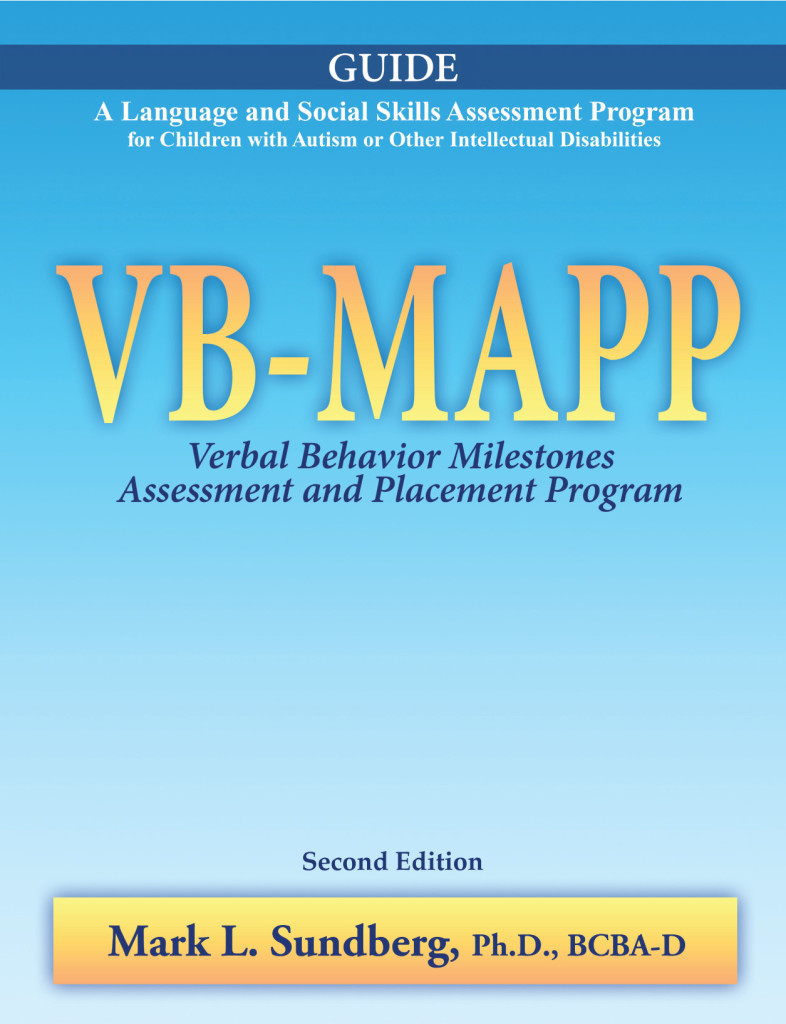
VB-MAPP Guide 2014 Cover.inddUpdate: The Second Edition of the VB-MAPP Guide has just been released. The 2nd Edition of the VB-MAPP Instructor’s Manual and Placement Guide contains an upgraded description of how to use Skinner’s analysis of verbal behavior for language assessment, the assessment instructions, and the specific scoring criteria for each of the 170 milestones. In addition, the manual contains a placement guide that offers specific suggestions for programming and direction for each of the 170 milestones achieved, as well as suggestions for IEP goals for each skill presented in the three levels of the VB-MAPP.

Don’t worry – the Guide is still compatible with the original Protocol! The Second Edition of the VB-MAPP Guide corresponds with the existing VB-MAPP Protocols and will not affect any Protocols you currently own.

Bulk discounts will continue to apply to the VB-MAPP Guide, 2nd Edition. Save 10% on the unit price if you buy 10 or more, and save 20% if you buy 25 or more of the Guide.

Simplifying the Science: Using Evidenced-Based Practices to Increase Food Variety for Children with Autism

An essential part of ABA is providing evidence-based treatment. Research is consistently being done all around the world to determine best practices for working with learners with autism, as well as addressing many issues outside of the realm of special education. This week, we’re pleased to introduce the first in a new month series: Simplifying the Science. In this feature, BCBA Sam Blanco will highlight one paper from the world of research to help provide you with a deeper resource base. She’ll delve into the study and offer some strategies on how the findings apply to your programming needs. Our hope is that these monthly tips will shed a different light for you on the importance of looking to research for guidance.

_________________________________

When faced with feeding issues, many parents or caregivers may not consider seeking out help from a BCBA or behavior analyst. There is a tendency to associate ABA with sitting at a table and completing discrete trials, but this is only one tool in a behavior analyst’s extensive toolkit. Whether you are providing intervention for feeding issues or seeking more information, it is essential to look to scientific research for help.

There are several studies available about feeding issues, and many of these studies are specific to feeding issues in individuals with autism. One such study was published in 2010 in the Journal of Applied Behavior Analysis (JABA) by Hildur Valdimarsdóttir, Lilja Ýr Halldórsdóttir, and Zuilma Gabriela SigurÐardóttir. “Increasing the Variety of Foods Consumed by a Picky Eater: Generalization of Effects Across Caregivers and Settings” provides one detailed case in which a five-year-old boy with autism refused to eat anything beyond meatballs, fishballs, fruits, and cereal. While his school had had some success with getting him to eat a few new items, the boy’s parents were unable to reproduce the same results at home.

The intervention the researchers used involved multiple steps that would require the assistance of a BCBA or skilled behavior analyst if you wanted to replicate it at home. In order to increase the number of foods this boy ate, the intervention included several behavioral techniques such as escape extinction (not allowing the child to escape mealtime upon refusing to eat or engaging in inappropriate behavior), stimulus fading (setting goals of increasing difficulty), and a schedule of reinforcement (frequency of reinforcement for appropriate behavior) that was systematically thinned as the child experienced success. By the end of the intervention, the boy was consuming 39 new, “non-preferred” foods, including 14 vegetables.

You can read the research study here, which I recommend you share with your child’s ABA provider. I also suggest taking a peek at the references listed at the end for insight into other resources. This particular study is of a five-year-old boy with autism, but you may find studies that are more relevant for your particular child.

In the end, when you’re feeling at a loss for strategies on improving your child’s eating, there is a lot of research out there. It takes time to go through it and set up a similar system for your own child, but the end result can have a huge impact on your child’s health as well as the stress-level in your home during mealtimes. It is definitely worth the effort to attain more information.

Written by Sam Blanco, BCBA

Sam is an ABA provider for students ages 3-12 in NYC. Working in education for ten years with students with Autism Spectrum Disorders and other developmental delays, Sam has developed strategies for achieving a multitude of academic, behavior, and social goals.

Pick of the Week: Decisions ColorCards – Teach reasoning skills in problem situations

Inspire rational decision-making with Decisions, a set of 30 beautifully clear images printed on large photo cards. This week only, you can take 15% off* your order of the Decisions ColorCards by entering in promo code DECIS6 at checkout!

Each card depicts an unexpected, unwelcome, or difficult situation to encourage logical thinking, using reasoning skills, and making prompt and rational decisions. Each scene presents a problem or requires specific decisions to be made, and varies from minor difficulties that upset daily life (e.g. missing a bus, waiting for a visitor) to elements of risk and danger (e.g. finding a pan on fire in the kitchen, stopping a water leak from the ceiling).

With the Decisions ColorCards, students will learn to:
  • make responsible choices
  • develop independent thought
  • keep safe
  • recognize consequences of intervening
  • understand the differences between minor difficulties and emergencies
  • find a balance between acting quickly and considering all aspects of a situation

Also included in this set is a CD-Rom that features printable versions of each card and graphic organizers that are useful for prompting meaning conversation.

Don’t forget—this week only, save 15%* on your purchase of the Decisions ColorCards by using or mentioning promo code DECIS6 when you check out online or over the phone with us!

*Offer is valid until 11:59pm EDT on June 24, 2014. Not compatible with any other offers. Be sure there are no spaces or dashes in your code at check out!