A Call for Conferences on Autism Spectrum Disorder, Applied Behavior Analysis, Verbal Behavior and Social Skills

Banner_LargeDo you know of any upcoming conference or workshops on Autism?! Please let us know of any ABA, Verbal Behavior or Speech-Language Therapy events and we will share it with our community. We strive to help our readers be informed about resources and events for parents and educators of children with autism or other developmental delays. No matter how big or how small – email info about your event to hannah@difflearn.com. Please include the date, location, scheduled sessions/speakers, registration details, contact information, and anything else you feel would be informative. If you have a flyer or website, send it over!

We’re always happy to send catalogs or a door prize for your attendees so don’t hesitate to contact us. Help us help our parents and teachers educate and inspire!

We’ll let our readers know about your event on our site where we keep a running list of upcoming conferences at https://www.difflearn.com/events.

Tip of the Week: Communicating with Paraprofessionals to Support Your Learner

Many students with autism and other developmental disabilities have an IEP that mandates a 1:1 paraprofessional (called an instructional assistant or teaching assistant in some states, but referred to as paraprofessional for the purposes of this article). Recently, I had the opportunity to provide a workshop to a large group of paraprofessionals in New York City. I was surprised to hear how some felt disconnected from the families of their students, especially considering how deep their relationships are with their students.

My conversations during that workshop caused me to reflect upon my own experience as a classroom teacher. Fortunately, I always had wonderful paraprofessionals who were essential to making the classroom run smoothly and helping our students achieve success, but I recognize now that they often were working with less information and less contact with the families than the teachers were. As a parent/guardian, you can help bridge that gap.

  • Communicate directly with the teacher and the paraprofessional. If you have critical information about your child, don’t assume that the teacher will share it with the paraprofessional. This can be important for big issues, such as allergies or new medicines, as well as smaller issues, such as an impending vacation or a sleepless night.
  • Share important goals with the paraprofessional. In many schools, the paraprofessional may never have seen your child’s IEP, though they frequently see your child for more time during each day. The paraprofessional also will usually see your child at times when the teacher will not, such as lunch and/or recess. If there are specific concerns about social skills, the paraprofessional likely has more opportunities for implementing social skills interventions than the teacher.
  • When you go to parent teacher conferences, ask both the teacher and the paraprofessional about your child’s performance in school. Because the paraprofessional sees the student in more environments, they may have more specific observations about transitions, special classes such as gym or art, and social interactions outside of the classroom.
  • Sometimes a student responds better to the paraprofessional than the teacher. If they do, find out why. The paraprofessional may be doing things that you and/or the teacher can replicate to help your child’s learning outcomes.
  • Show your appreciation for the paraprofessional. The job of a paraprofessional is very challenging: no preps, the need to adjust to each teacher’s style throughout the day, and the fact that they often end up managing any behavioral challenges during the day. A note of thanks can go a long way. And if you are the type of parent who gives small gifts or handmade items to teachers, don’t leave the paraprofessional out!

WRITTEN BY SAM BLANCO, MSED, BCBA

Sam is an ABA provider for students ages 3-12 in NYC. Working in education for ten years with students with Autism Spectrum Disorders and other developmental delays, Sam has developed strategies for achieving a multitude of academic, behavior, and social goals. Sam is currently pursuing her PhD in Applied Behavior Analysis at Endicott College.

Pick of the Week: Social Skills Games to Teach What’s “Just Right”

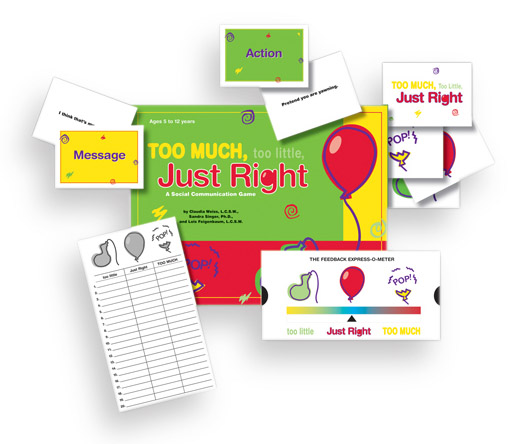
People communicate using not only words, but also tone of voice and body language. Many children, however, fail to notice these relatively subtle social cues in self-expression and personal space. This week, we’re featuring two of our newest social skills games, Too Much, Too Little, Just Right and Too Close, Too Far, Just Right to help you teach your learners what is “just right” in social situations. Use our promo code JUSTRIGHT to save 15%* on your sets!

Too Much, Too Little, Just Right teaches children to pay attention to tone of voice, observe body language, and note how these cues affect the message. Children assume two roles during game play: Messenger and Listener. They learn by observing others and by getting immediate feedback about their own expressive abilities. They learn to adjust volume, expression, gestures, and other physical cues in order to communicate effectively and achieve greater self-control, thus developing more appropriate and satisfying social relationships.

Ideal for 2 to 8 players, this game can be easily used with larger groups or classrooms as well. Because it focuses on social interaction rather than on a game board, the game can be played virtually anywhere. Clearly focused and easy-to-use, Too Much, Too Little, Just Right is an outstanding tool for those working with children who have autism spectrum disorders. The game includes: 45 Too Much/Too Little/Just Right Cards, 90 Message Cards, 64 Action Cards, 50 Response Cards, 100 Reward Chips, and 1 Feedback Express-O-Meter. Recommended for children ages 5-12 years.

Too Close, Too Far, Just Right teaches what’s “too close,” “too far,” or “just right” in social situations. Children take turns performing social scenarios described on the Role Play Cards, and then the instructor or group of students decides whether their proximity to each other is appropriate for the particular situation. The objective is to understand the concept the personal space. Focused and engaging, this game is a gentle way to help students with autism and ADHD grasp the idea of appropriate proximity and physical boundaries and thereby improve their relationships. The game includes 65 Role Play Cards, 24 color-coded Feedback Cards, 3 “Where do I stand?” Cards, 1 Footprint Mat, and 1 booklet with instructions, game preparations and play, and variations on game play with a large group or class. Recommended for children ages 5 and up.

Don’t forget to save 15%* on your order of Too Much, Too Little, Just Right or Too Close, Too Far, Just Right this week by using promo code JUSTRIGHT when you check out online or over the phone with us!

*Offer is valid until 11:59pm EDT on November 4th, 2014. Not compatible with any other offers. Be sure there are no spaces or dashes in your code at check out!

Pick of the Week: Token Towers – Reinforcing just got more fun!

We can never get enough reinforcement tools, especially for group settings. Help students meet behavioral or academic goals with these interactive Token Towers. And this week only, you can save 15%* on your set of the Token Towers, by using promo code TOKENTWR at check out.

Set goals using the colored ring and insert tokens as reinforcement for appropriate behaviors or correct responses. The hard plastic chips with smiley faces make a fun noise as they drop into the containers, which is almost as fun as watching the tokens pile up!

This kit includes four Token Towers (red, yellow, green, and blue) and 140 tokens (35 for each tower). Each Token Tower has target goal levels of 5, 10, 15, 20, 25, 30 and can hold a maximum of 35 tokens. The towers measure 6 ½” tall with tokens measuring 1 ½” in diameter. Recommended for children ages 3 and up.

Don’t forget! We’re featuring this newly added set of Token Towers as our Pick of the Week, so be sure to use promo code TOKENTWR to take 15% off* your order.

*Offer is valid until 11:59pm EST on October 28th, 2014. Not compatible with any other offers. Be sure there are no spaces or dashes in your code at check out!

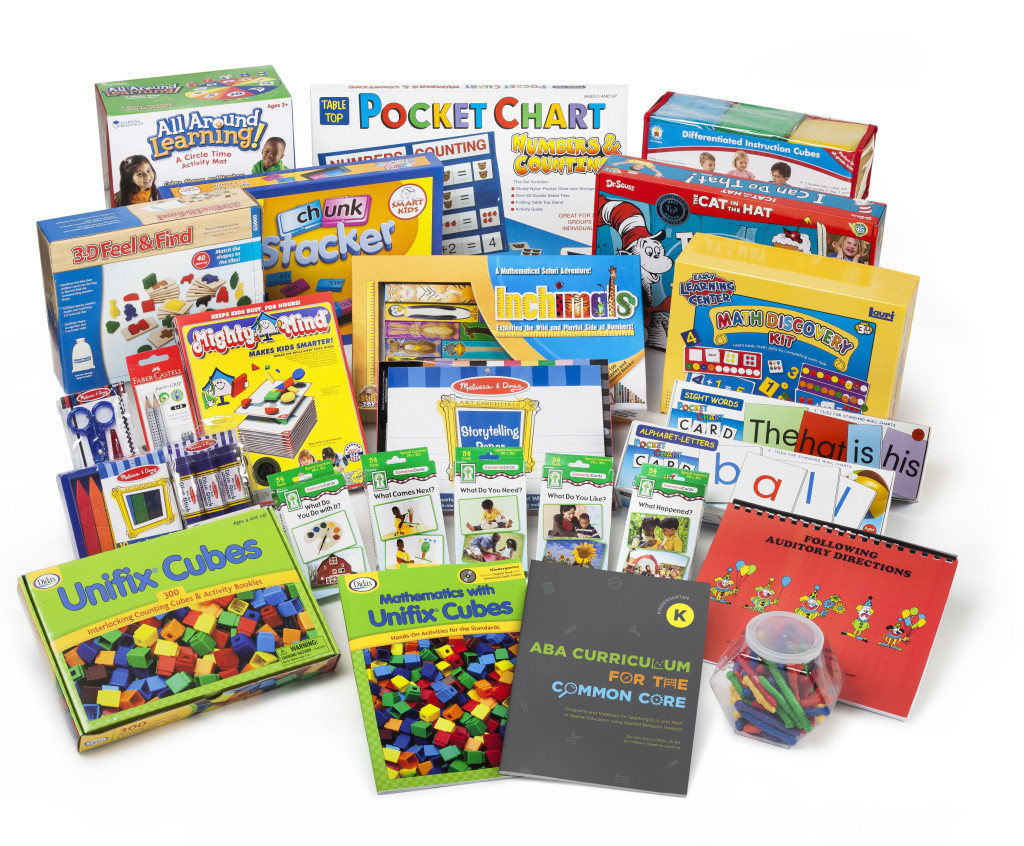
Come EAT, DRINK, and WIN as we launch the new ABA for the Common Core Kit!

CelebrateWormYou’re invited to our book release party
for the ABA Curriculum for the Common Core Kit for Kindergarten!

Join us on November 12 in NYC to meet author Sam Blanco, MSEd, BCBA and enjoy an evening with friends and colleagues. Cocktails and hors d’oeuvres will be served along with special giveaways. And one lucky attendee will win a FREE kit!

SamBlanco

Sam Blanco, BCBA, MSEd (www.samblanco.com)

We hope you’ll join us in launching this innovative and exciting new curriculum kit that presents ABA programs and targets for each of the Kindergarten Common Core State Standards.

Teachers, educators, consultants, behavioral therapists, and SLPs will love learning more about this groundbreaking curriculum kit. If you have a friend or colleague who is a teacher or behavioral consultant who might be interested in attending this event, please feel free to forward this invitation. All are welcome!

The event will be held in the Union Square neighborhood of New York City
Wednesday, November 12, 2014
6:30-8:30 pm

Space is limited so please RSVP as soon as possible to Abigail@difflearn.com.
A formal invitation with address details will be sent upon RSVP.

ABA Curriculum for the Common Core Kit - KindergartenIn order to present you with a great party, we need to know a few details so we can plan accordingly.

Please RSVP with the following information to Abigail@difflearn.com:

Name:

Organization or School:

Are you a teacher, therapist, consultant?

How old are your students?

Discipline (ABA, SLP, OT, etc.):

Increasing Play with Unit Blocks – Free Download

Blocks PileSymbolic play refers to a child’s ability to use one object or action to represent a different object or action within imaginary play. The symbolic play skill that involves object substitution typically begins to emerge around 18 months. For example, you might observe a child using an empty box for a “hat” or an overturned bucket for a “drum.” Blocks are a mainstay in early childhood classrooms because the benefits are innumerable. Block play can help to facilitate cooperation, visuo-spatial skills, problem solving ability, social skills, and language development, and is a good predictor of future mathematical abilities.
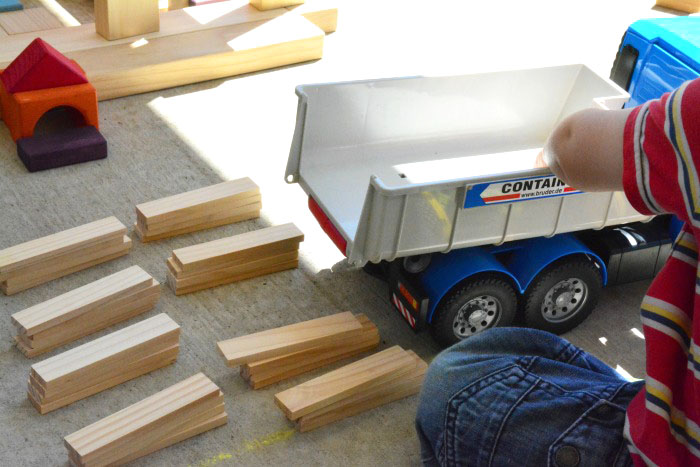
One hallmark of the diagnostic criteria for autism spectrum disorder is a presence of “persistent deficits in social communication and social interaction across multiple contexts, as manifested by difficulties in sharing imaginative play or in making friends.” Additionally, rigid thinking patterns may make symbolic play difficult for children with autism as they might view objects in a limited way that makes it difficult to pretend a block is something other than a block. Blocks on ShelfSince unit blocks are a huge component of early childhood classrooms everywhere one could imagine that exposure to them and some level of proficiency opens up huge social opportunities for learners with autism spectrum disorders with their mainstream peers in the classroom.

Some learners will require scaffolding in order to progress from the use of literal props within pretend play to object substitutions. Research suggests that systematic prompting is a common component of successful interventions used for teaching play.  Depending on the learner, various types of prompts will be used as you systematically move from most intrusive to least intrusive prompt levels. Sometimes, a learner begins to respond to natural cues before you have moved through each prompt level. However, for learners that require support froma visual prompt you can attach drawings of objects onto the blocks and then systematically fade them out. Once the learner begins to consistently use the blocks with the attached images you can use stimulus fading procedure to fade out the visual prompt. This can be done by photocopying the image and systematically changing the lightness until eventually the learner is presented with just the block.
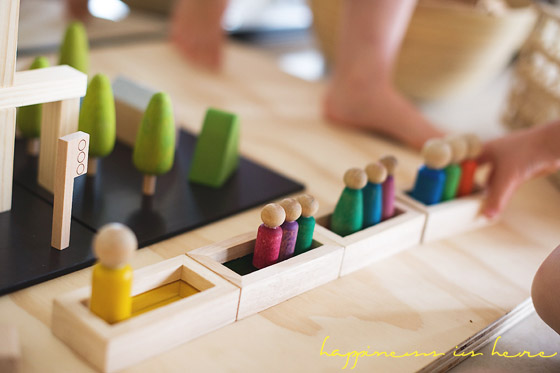

Below you will find downloadable images in the shape of unit blocks to help you facilitate symbolic play with a learner who requires visual prompts. The images are to scale and just the tip of the iceberg when it comes to all of the possibilities. It is important to teach various object substitutions for each block shape so that the skill is generalized. In a classroom where the curriculum is organized thematically, you could attach a few visuals to various blocks each time the theme changes to encourage symbolic play for the whole class.
Click here to download our Free Unit Blocks Template!

References

Cook, D. (1996). Mathematics sense making and role play in the nursery school. Early Childhood Development and Care, 121, 55-65.

Wolfgang, C., Stannard, L. & Jones, I. (2001). Block play performance among preschoolers as a predictor of later school achievement in mathematics. Journal of Research in Childhood Education, 15(20): 173-180.

Smilansky, S., & Shefatya, L. (1990). Facilitating play: A medium for promoting cognitive, socioemotional and academic development in young children. Gaithersburg, MD: Psychosocial & Educational Publications.

Christakis, D.A., Zimmerman F.J., & Garrison M.M. (2007). Effect of block play on language acquisition and attention in toddlers: a pilot randomized controlled trial. Arch Pediatr Adolesc Med. 161(10):967-71.

Pepler, D.J., & Ross, H.S. (1981(. The effects of play on convergent and divergent problem solving. Child Development, 52(4): 1202-1210.

Lang, R., O’Reilly, M., Rispoli, M., Shogren, K., et al. (2009). Review of interventions to increase functional and symbolic play in children with autism. Education and Training in Developmental Disabilities, 44(4), 481– 492.

Cooper, J. O., Heron, T. E., & Heward, W. L. (2007). Applied behavior analysis, 2nd ed. Upper Saddle River, N.J.: Pearson Prentice Hall.


Written by Stacy Asay, LMSW

Stacy is a licensed social worker, providing home and school based services to children and their families in the New York City area. With nearly 16 years of experience, her work with special needs children integrates a strengths-based, holistic approach to child and family augmented with the tools of Applied Behavior Analysis, a methodology that allows for reliable measurement, objective evaluation of behaviors, and the systematic teaching of language and learning skills.  This results in an individualized curriculum that equips children with the tools they need for learning and living while honoring their unique spirit.
Simplifying the Science: Using a MotivAider to Self-Monitor

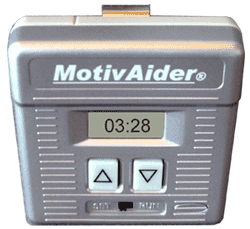
Teaching independent on-task behavior can be quite challenging when working with any student, but particularly so with some students with autism. In a study published in 2010, researchers Dina Boccuzzi Legge, Ruth M. DeBar & Sheila R. Alber-Morgan implemented and evaluated one way of teaching student to self-monitor their on-task behavior using a MotivAider. (The MotivAider is a simple electronic device that vibrates at timed intervals to provide an individual with a private prompt to engage in a specific behavior. It can be programmed to vibrate on a fixed or variable schedule at different duration and intensity levels.)

In this study, the researchers worked with a fifth grader with autism, a sixth grader with autism, and a fifth grader with cerebral palsy. They taught the boys to wear the MotivAider (calling it a pager) and note a + or a – to indicate their behavior each time the MotivAider vibrated. The behaviors they monitored were all related to being on-task: “eyes on my work,” “in my seat,” and “doing work.” Once each boy consistently rated his behavior upon feeling the vibration, the researchers implemented the intervention.
The MotivAider’s were initially set to vibrate every two minutes. Each time the MotivAider vibrated, the student would mark a + or a – for each of the behaviors on a sheet he had on his desk. Prior to the intervention, the average percentages of time each boy was on-task ranged from 26% to 77%. Upon implementation of the intervention, “all three students showed an immediate and substantial increase of on-task behavior ranging consistently from 80% to 100%.

The researchers also included a plan for fading out the use of the MotivAider‘s, changing from a fixed schedule of every two minutes, to an increasing variable schedule. The fading schedules varied for each student. For example, for one student, the fading schedule started with a variable schedule of a vibration about every four minutes, then moved to about every six minutes, then to about every eight minutes, and then to about every ten minutes. The MotivAider was then removed completely.

After the intervention was complete, researchers collected data once a week for three weeks to see if the intervention was maintained. During all three maintenance probes, “all students continued to demonstrate 80%-100% on-task behavior.”

We’ve talked about how to use MotivAider‘s in the past, but I particularly love this intervention because it is feasible for teachers to implement in the classroom, promotes independence in learners with autism, and allows teachers to focus on other issues. Take a look at the study here to get a fuller description of how to implement such an intervention with your students.

For more information about the MotivAider, click here.


WRITTEN BY SAM BLANCO, MSED, BCBA

Sam is an ABA provider for students ages 3-12 in NYC. Working in education for ten years with students with Autism Spectrum Disorders and other developmental delays, Sam has developed strategies for achieving a multitude of academic, behavior, and social goals. Sam is currently pursuing her PhD in Applied Behavior Analysis at Endicott College.

Online Briefs & Learning Modules for Evidence-Based Treatment Strategies

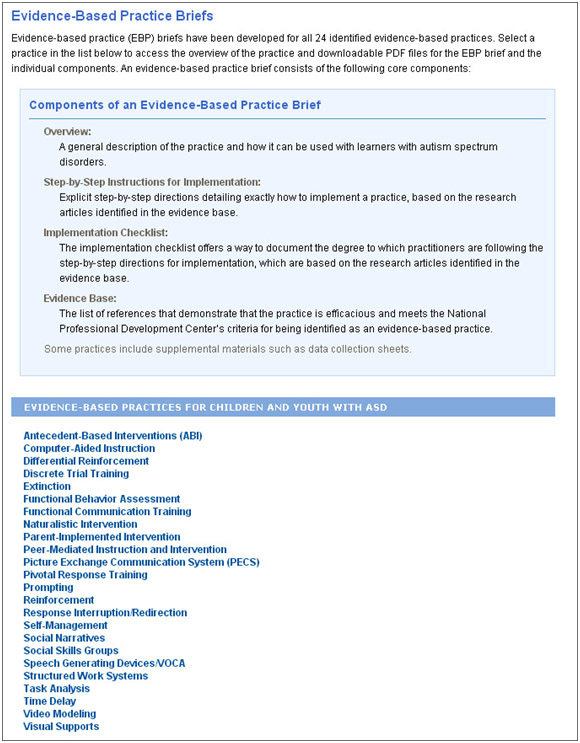
The National Professional Development Center on Autism Spectrum Disorders holds an impressive wealth of information and resources for evidence-based practices for children with autism. We wanted to share their website as a resource to both parents and providers, since evidence-based strategies are so important in devising a home or school-based program for students with ASD. Specifically, we found the online learning and training modules by the NPDC on ASD to be extremely useful and – even better – accessible to anyone online.

For the following evidence-based practices (EBP), the NPDC on ASD has developed briefs with the following components:

  • Overview of the practice
  • Step-by-step instructions for implementation
  • Checklist to document the degree of implementation
  • References that support the efficacy of the practice

Each brief package comes in downloadable PDF formats for easy saving and printing. Some practices also come with downloadable data collection sheets and supplemental materials for teachers to use.

EBP Briefs 1

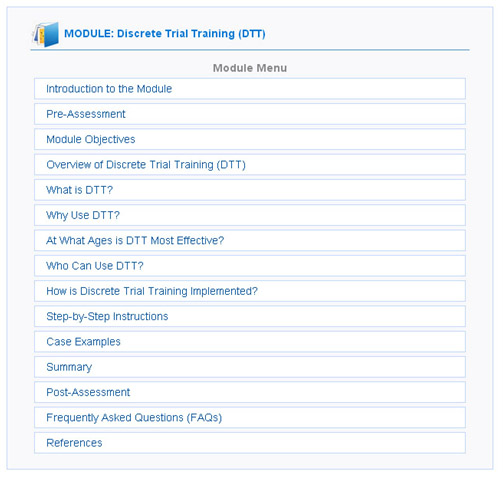
Additional resources provided by the NPDC on ASD include Learning Modules to accommodate children in early intervention (birth to 3 years).  The 10 Learning Modules touch upon:

  1. Discrete Trial Training (DTT)
  2. Functional Communication Training (FCT)
  3. Naturalistic Intervention
  4. Parent-Implemented Intervention
  5. Picture Exchange Communication System (PECS)
  6. Pivotal Response Training (PRT)
  7. Prompting
  8. Reinforcement
  9. Structured Work Systems
  10. Time Delay

Each module includes a pre-assessment, objectives, an overview of the evidence-based practice, detailed information about the use of the EBP, step-by-step instructions for implementing the practice, case studies, a summary, a post-assessment, frequently asked questions, and references at the end.

EBP Briefs 2

For more information on the NPDC, visit their website at www.autismpdc.fpg.unc.edu. 

Pick of the Week: NEW! Executive Function Curriculum Books

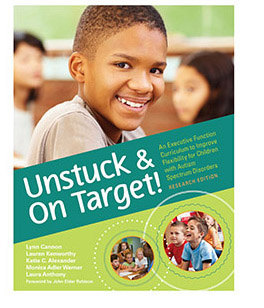
How can you help kids with autism be flexible, get organized, and work toward goals – not just in school but in everyday life? It’s all about executive function. This week, we’re offering 15% off* our newest books on teaching executive function: Unstuck & On Target: An Executive Function Curriculum and Solving Executive Function Challenges. Just use our promo code EXECFXN at check out to redeem these savings!

Unstuck_and_On_TargetThese practical resources for parents, teachers, and therapists help high-functioning students with autism improve on these critical skills.
Unstuck & On Target! is a robust classroom-based curriculum book that will help educators and service providers teach these executive function skills to high-functioning students with autism through ready-to-use lessons that promote cognitive and behavioral flexibility. This curriculum gives clear instructions, materials lists, modifications for each lesson, and intervention tips to reinforce lessons throughout the school day. Topics touched upon include flexibility vocabulary, coping strategies, setting goals, and flexibility in friendship, all introduced and reinforced with evidence-based lessons. Lessons will target specific skills, free up the instructor’s time, fit easily into any curriculum, ensure generalization to strengthen home-school connection, and best of all, make learning fun and engaging for students in the classroom.

Unstuck & On Target! also comes with an accompanying CD-ROM that contains printable game cards, student worksheets, and other materials for each lesson. The curriculum is targeted for students with cognitive ability and language skills ages 8-11.

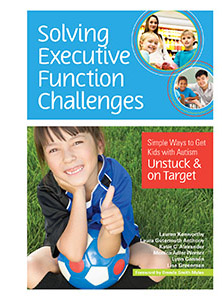
Solving_Executive_Function_ChallengesSolving Executive Function Challenges is a strategy guide that offers teachers and caretakers various ways to teach EF skills, including setting and achieving goals and being flexible, as well as ideas for accommodations and actions to address common problems (e.g. keeping positive, avoiding overload, coping, etc.).

To be used with or without the robust curriculum Unstuck and On Target!, this strategy guide aims to show how to embed executive function instruction in everyday scenarios with specific examples, samples IEP goals, and scripts and worksheets that break down tasks into manageable chunks. This guide is appropriate for learners in grades K–8.

Don’t forget – you can save 15%* this week only on these new executive function books by applying promo code EXECFXN at check out!

*Offer is valid until 11:59pm EDT on October 7th, 2014. Not compatible with any other offers. Be sure there are no spaces or dashes in your code at check out!

Tip of the Week: Altering the Teaching Environment to Address Problem Behaviors

A few years ago, I went in to observe an ABA therapist I was supervising. She was working with a ten-year-old girl with Aspergers. One of her goals was to increase eye contact during conversation, but her student wasn’t making much progress in this area. She had consulted the research and was considering a new behavior intervention plan, and wanted my input before doing so.

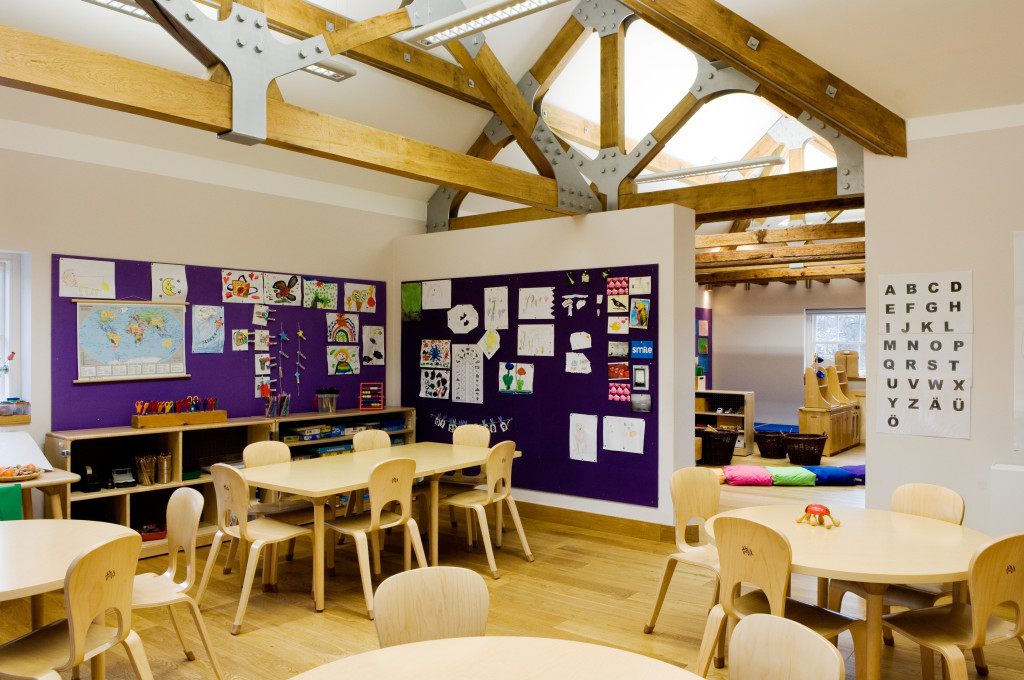
junior school classroom at the German School in Ham, by 3S Architects. Image shot 2006. Exact date unknown.The first thing I noticed when I walked in to observe was that she did her entire session at a long wooden table, sitting side-by-side with her student. After watching for about ten minutes, I asked if we could change the seating arrangement. We moved her student to the end of the table, then had the therapist sit next to her, but on the perpendicular side. This way, eye contact was much easier as they were able to face each other. The student’s eye contact improved instantly with a small environmental change. (Of course, once we made the environmental change, we worked together to address other changes that could be made to encourage eye contact.)

Environmental changes can be a quick and simple solution to some problem behaviors. Here are some questions to consider in order to alter the environment effectively:

  • Is it possible that a change in furnishings could change the behavior? For example, moving a child’s locker closer to the classroom door may decrease tardiness, putting a child’s desk in the furthest corner from the door may decrease opportunities for elopement, or giving your child a shorter chair that allows them to put their feet on the ground may decrease the amount of times they kick their sibling from across the table. You may also want to consider partitions that allow for personal space, clearly-marked spaces for organizing materials, proximity to students and distractions (such as windows or the hallway).
  • Can you add something to the environment to change the behavior? For example, your student may be able to focus better on independent work if you provide noise-cancelling headphones, line up correctly if a square for him/her to stand is taped to the floor, or your child may be more efficient with completing chores if they’re allowed to listen to their favorite music while doing so.  I’ve also seen some cases in which the teacher wears a microphone that wirelessly links to a student’s headphones, increasing that student’s ability to attend to the teacher’s instruction.
  • Will decreasing access to materials impact the behavior? For example, removing visuals such as posters and student work may increase your student’s ability to attend or locking materials in a closet when not in use may decrease your student’s ability to destroy or damage materials.
  • Will increasing access to materials impact the behavior? For example, making a box of pre-sharpened pencils may decrease the behavior of getting up frequently to sharpen pencils. (I recently visited a classroom in which the teacher put pre-sharpened pencils in a straw dispenser on her desk, and each week one student was assigned the job of sharpening pencils at the end of the day).

Whenever you do make changes to the environment, you may want to consider if the changes require fading. For example, if I make a square on the floor out of tape to teach my student where to stand in the line, I will want to fade that out of over time to increase their independence.

A final consideration is that whatever impact you expect the environmental change to have should be clearly defined and measured. Take data to ensure that the intervention is working so you can make adjustments as necessary.

For more detailed information on modifying environments, there is a great article from the Council for Exceptional Children by Caroline A. Guardino and Elizabeth Fullerton entitled “Changing Behaviors by Changing the Classroom Environment.” Click here for the article.

WRITTEN BY SAM BLANCO, MSED, BCBA

Sam is an ABA provider for students ages 3-12 in NYC. Working in education for ten years with students with Autism Spectrum Disorders and other developmental delays, she has developed strategies for achieving a multitude of academic, behavior, and social goals. Sam is currently pursuing her PhD in Applied Behavior Analysis at Endicott College.