Pick of the Week: Time Tracker Mini

We love this small, easy to program Time Tracker Mini! It’s a simple visual and auditory timer that has 360 degree viewing so it’s great for anywhere, in the classroom or at home. There are two simple dials: one for a total alarm time and one for the amount of warning time you’d like given before time is up. The timer turns green, yellow, then red as it counts down. The total alarm time can be set anywhere from 5 minutes to 2 hours in 5-minute increments.

Save 15% on the Time Tracker Mini this week only by entering the Promo Code BLOGTTM2 at checkout.

*Offer expires on December 6, 2011 at 11:59 pm EST. Not compatible with any other offer. Be sure there are no spaces after the Promo Code when you enter it at checkout.

Building Language for Your Child with Autism, Part 4: Building Expressive Vocabulary

This is the step where your child learns to actually say the words out loud. All of the tasks described in previous posts come into play when building your child’s expressive vocabulary. Picture cards are a useful tool again, because it just isn’t feasible to bring every object directly to your child. We certainly want them to learn the words bus and airplane, but it’s difficult to get those items into your living room!

The basic idea for building expressive vocabulary using picture cards is just to hold the card up and ask your child “what is it?” The intricacy comes in knowing how to prompt your child and how to fade that prompt. We talked previously about the importance of your child being able to imitate the words that you say. Imitation is the basis for the prompts you will use to build your child’s expressive vocabulary.

The first several times you ask your child the name of a new picture, you will likely have to model the word for him or her. For example, you ask your child “What is it?” If you do not get a response, you say “apple.” Ideally your child repeats the word “apple.” After a few tries, you can shorten your prompt to “app….” And then to “aaaa…….” And then perhaps to just opening your mouth as if to say “aaaa…” but not making a sound.

A Comprehensive Picture Card Library

It is a good idea to have a large selection of pictures ready to go when you start to teach the lessons we just described. Here are a few tips to help you choose or take appropriate pictures:

  1. Start with words that are familiar to your child. Words like apple, cup and cookies may be better than ­saxophone or stethoscope.
  2. Start with pictures on a plain white, or a distraction free background.
  3. Make sure to have duplicates available for the matching tasks when you first start out.
  4. Consider taking multiple pictures of the same item (6 different apples for example) to help your child generalize their newly learned words.
  5. As your child becomes more comfortable learning new words move to more natural settings for your pictures.
  6. Have a broad range of pictures, across multiple categories, ready for when your child is ready to move forward!
  7. If you take the pictures yourself, consider having them laminated for durability.If you don’t have the time to make your own pictures, a 350-Card Set of photo flash cards called the Language Builder Picture Card Set is avaibable and is specifically tailored to meet the needs of an early language vocabulary building program.


This is a part of a series of guest posts by Angela Nelson on building language in children with autism. As the creator of the acclaimed Language Builder Picture Noun Card Set, Angela received her BA and JD from UCLA where she studied and practiced behavior psychology under Dr. Ivar Lovaas. She has been creating autism and special needs curriculum products since 1997.


Building Language for Your Child with Autism, Part 3: Building Receptive Vocabulary

Receptive language refers to the thought process involved in hearing, processing and comprehending spoken language. When we mentioned above that a two year old child should be able to follow simple commands, point to objects when they are named, and recognize names of familiar objects; these objectives were examples of receptive language skills.

There are a number of ways to help build your child’s receptive vocabulary. Using photo cards is one basic and concrete vocabulary building tool that you can do at home. Place pictures of common objects on the table in front of your child. Ask your child to “touch the cookies” or “give me the hat.” When your child can follow the command and consistently select the requested picture, you have added a new word to their receptive vocabulary.

It is likely that your child will need help selecting the correct card… especially the first few times you try this task. Here is a trick to help make picking the right word easier. Start with just one card on the table and increase the number of pictures slowly. For example, if you are trying to teach the word cookies:


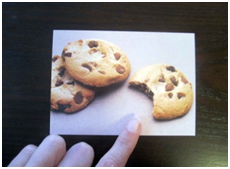
    1. Start with just the picture of the cookies on the table.
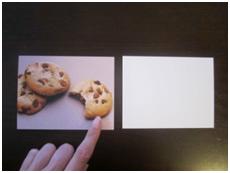
    2. After your child has learned to touch the cookies picture on request, add a blank card to the table. Ask your child to touch the cookies picture several more times, rotating the position of the two cards each time.
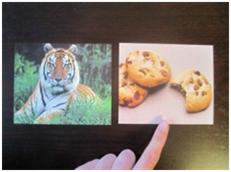
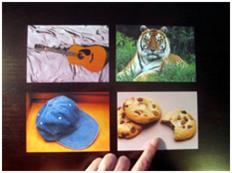
    3. Then, add a second picture to the table, and a third, and a fourth.
    4. Once your child can select the cookies picture each time, introduce new words using the same method!


This is a part of a series of guest posts by Angela Nelson on building language in children with autism. As the creator of the acclaimed Language Builder Picture Noun Card Set, Angela received her BA and JD from UCLA where she studied and practiced behavior psychology under Dr. Ivar Lovaas. She has been creating autism and special needs curriculum products since 1997.

Building Language for Your Child with Autism, Part 2: Matching Objects and Pictures as a Precursor to Language

Developmental Psychologist, Jean Piaget, observed that a child first becomes aware of a concept and then acquires the words to convey that concept. Think about this for a moment: a child has to know that an apple is a distinct and separate item, before they know they should give it a name. They have to realize that the apple is different than, say, the cup. This is where matching comes in.

To help teach this concept using pictures of objects, place two pictures on the table in front of your child, one picture of an apple, and the other of a cup (or some non-apple picture). Hand your child an identical picture of an apple. Ask your child to “match” the apples, or to “put with same.”

When your child can consistently match the two cards, regardless of the position of the cards, they likely understand that the apple is a distinct object. Now we are one step closer to giving that object a name!


This is a part of a series of guest posts by Angela Nelson on building language in children with autism. As the creator of the acclaimed Language Builder Picture Noun Card Set, Angela received her BA and JD from UCLA where she studied and practiced behavior psychology under Dr. Ivar Lovaas. She has been creating autism and special needs curriculum products since 1997.

Building Language for Your Child with Autism: A Guest Series by Angela Nelson

This week, we’re pleased to introduce a series of posts by Angela Nelson on building language in children with autism. As the creator of the acclaimed Language Builder Picture Noun Card Set, Angela received her BA and JD from UCLA where she studied and practiced behavior psychology under Dr. Ivar Lovaas. She has been creating autism and special needs curriculum products since 1997.

Emerging Language and Building Vocabulary

Language development varies from child to child, and there are wide ranges of expected “normal” language development in young children. If you have specific concerns about the pace of your child’s language development, you should definitely discuss this with your health care professional. However, for reference sake, by the age of two a child is expected to be able to:

  • Follow simple commands or instructions
  • Point to an object or picture when it is named for him or her
  • Recognize names of familiar objects, body parts and familiar faces
  • Repeat words spoken by others
  • Use simple phrases and 2 – 4 word sentences by 18 – 24 months

As we all know, there is no “typical” child with autism. Children on the Autism Spectrum may meet some of these objectives, all of these objectives, or none of these objectives. The goal is to identify your child’s specific language deficits (the areas you see them falling behind) and takes steps to help them catch up.

The first stages of language development, as described above, involve listening to words, imitating words, and building a basic vocabulary. In your child’s education program you may have heard professionals use terms like Receptive Language, Echolalia, Modeling, Matching, or Expressive Language. Don’t let these terms of art intimidate you. Really, they still just mean… listening to words, imitating words, and building a basic vocabulary. 

Encouraging Emerging Language Skills

A most basic step in typical language development is imitation. Many parents are surprised to learn that the parent imitating the child is almost as important as the child imitating the parent! When a 12 month old child looks at his or her mother and says “mamamama,” the mother almost instinctively replies back, “that’s right ‘mama.’” This feedback reinforces the child’s vocalization and encourages them to keep on chatting. Although children with autism may have delayed onset of this type of behavior, or may have some setbacks along the way; it is important to remember to continue to imitate vocalizations with your child to encourage verbal behavior.

Imitation will also provide the first steps in the formation of words for your child. This time I mean your child imitating you! While you are hoping to hear your child imitating full words, remember, this starts with imitating vowels, consonants and syllables. If you say “aaaaa” and your child responds back with “aaaaa,” this is a cause for celebration. You are one step closer to your child saying “apple” than you were before they could (or would) imitate your vocalization. Eventually, modeling words will become the way you build your child’s expressive vocabulary!

Check back this week for from Angela on Matching Objects andPictures as a Precursor to Language.
Pick of the Week: Hooray for Play! Flashcards

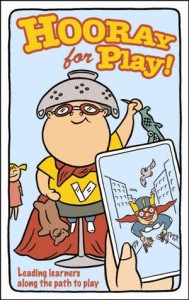
Hooray for Play! Leading Learners Along the Path to Play is literally fresh off the press and we couldn’t be more excited. Created by Stacy Asay, our brilliant behavioral consultant, we’re thrilled to offer this new tool for developing social and play skills.  Hooray for Play is a multi-use deck of 31 beautifully illustrated cards that offer children an opportunity for perspective taking, problem solving, cooperation, social emotional skill acquisition and language development.

The flashcards break down the components of the 31 individual play schema cards into three organized sections that provide a memorable framework for sociodramatic play. The Do! Section explains the various roles, Say!! outlines possible scripted statements by the involved actors and Play!!! offers suggestions for props and set-up. Have fun!

To save 15% this week only on Hooray for Play, simply enter the Promo Code BLOGHFP11 at checkout.

*Offer expires on November 15, 2011 at 11:59 pm EST. Not compatible with any other offer. Be sure there are no spaces after the Promo Code when you enter it at checkout.

Pick of the Week: Seasons Flashcards

As Summer has turned into Fall, it’s important for children to understand the changes that come along with the shifting of the seasons. This deck of Seasons Flashcards shows the activities of each season and what clothes we wear so that children understand how the things we do both inside and outdoors are affected by the time of year. The included cards depict how we snuggle under the covers in the winter cold or splash in the pool in the summer heat. With Autumn in full swing, this is the perfect time to introduce this concept.

To save 15% this week only on the Seasons cards, enter the Promo Code BLOGSF11 at checkout.

*Offer expires on October 25, 2011 at 11:59 pm EST. Not compatible with any other offer. Be sure there are no spaces after the Promo Code when you enter it at checkout.

Pick of the Week: Small Steps, Big Skills Video Modeling Game

This week’s pick at a 15% discount is Small Steps, Big Skills which is an evidence-based video modeling game that teaches 22 skills for independence. The software combines Applied Behavior Analysis methods of video modeling and least-to-most prompting by having players watch the skill being completed and then practicing it in a game format. The interactive program rewards players with 8 fun games and shows a wide variety of materials to promote generalization skills. The skill areas covered in the program are: Helping in the Kitchen, Getting Ready for the Day, Helping at Home, Cafeteria Time, My Clean Room, and Time to Relax.

To save 15% on Small Steps, Big Skills this week only, enter the Promo Code BLOGSSBS at checkout.

*Offer expires on October 18, 2011 at 11:59 pm EST. Not compatible with any other offer. Be sure there are no spaces after the Promo Code when you enter it at checkout.


Pick of the Week: Music in my Mouth – Songs for Speech & Language Skills

This CD with 26 original songs and the accompanying manual are designed to be used by SLPs, early educators and families to teach and practice a variety of skills related to the development of communication skills. Competence in communication is essential to a child’s personal, social, and academic success. Each song equips children with the concepts, behaviors, and self-talk skills that support the development of speech, language and social interaction. The manual provides detailed tips on how to integrate the songs with other activities.

Save 15% on Music In My Mouth this week only by entering the Promo Code BLOGMMM at checkout.

*Offer expires on October 4, 2011 at 11:59 pm EST. Not compatible with any other offer. Be sure there are no spaces after the Promo Code when you enter it at checkout.

25% OFF SALE! Today and Tomorrow Only

Today marks the official start of Autism Awareness month and Different Roads to Learning is kicking things off by offering a 25% storewide sale* today and tomorrow only!!!! To redeem your savings, enter the Promo Code WAAD11 at checkout at www.difflearn.com.  The sale runs April 1 and 2, 2011 until 11:59 pm EST. Don’t miss out on our biggest sale of the year, celebrating Autism Awareness and education.

*Offer NOT valid on the following products:
VB MAPP Assessment Kits (DRK 700, DRK 701),  10-Pack (DRB 682) & 25-Pack (DRB 683) of VB MAPP Protocols,  ABLLS-R Assessment Kits (DRK 702, DRK 703)*
 **The coupon code WAAD11 must be entered during checkout to receive offer. Offer only applies to selected products and not those currently on sale. Your order must be placed during the time of the World Autism Awareness Day Sale to qualify for this special offer. This promotion cannot be redeemed on previous orders placed. This promotional offer may not be combined with any other promotional or discount offers. Offer valid on www.difflearn.com only.