Happy Holidays!

Happy Holidays, from our Different Roads to Learning family to yours! We wish you all good health, peace, and happiness in the New Year.

We get a bit reflective here around the holidays and wanted to take the opportunity to tell you how thankful we are for all of you and your incredible efforts.

Our worm celebrates with you!

We’re so proud to be part of this community of wonderful parents, teachers, and therapists.

We’ll be operating on limited hours between December 24 and January 2 to give everyone here a chance to rest and regroup and come back in 2014 with a bang. You can still reach us at (800) 853-1057 and via email at info@difflearn.com. It just may take us a little longer than usual to get back to you. Orders will still be processed and shipped within 24-48 hours.

Enjoy your holiday, and we look forward to connecting with you in 2014!

Warmest regards,
Julie, Abigail, Natasha, Hannah, Stacy & Sam

Hints for the Holidays: Christmas

Christmas has its own set of unique stresses that may affect your child and make it difficult to uphold holiday traditions with the whole family. Here are eight tips to help ease the stress for everyone.

Create a visual or textual schedule
A lot of anxiety and confusion can be avoided by creating a schedule of the week or the day of Christmas. The schedule can be created to meet your particular child’s needs and can utilize pictures, texts, or an actual calendar. When possible, have your child participate in creating the schedule, and try to ensure that highly preferred activities come directly after less preferred activities.

Provide choices
This is a huge part of assisting your child in achieving success in any endeavor. As described above, you may use visual, textual, or verbal cues to provide choices. Choices can be between large activities, such as “Do you want to go see Santa or do you want to go shop for this year’s ornament” or can be between smaller activities, such as “Do you want to listen to Christmas music with the family or watch a Christmas movie with the family?”

Make an accessible safe space away from lights, music, or crowds
You may need to do this in the home where you are celebrating the holiday or in public spaces as you prepare for the holiday. It is important that your child have a way to appropriately communicate his/her need for a break and that need is respected.

See if there is a Quiet Santa or Sensitive Santa event available in your area
In many places there are now days in which visiting Santa has been organized to be more accessible for children with autism and other developmental delays or sensory needs. This is a good option if your child struggles with tolerating long lines, loud noises or music, or flashing lights.

Give a job/task
Leading up to the holidays, try to find tasks that your learner will enjoy such as decorating cookies, stringing the lights on the tree, or putting stamps on the envelopes for this year’s card. Having a meaningful and enjoyable job will improve the holidays for both your child and the rest of the family.

Find Christmas-themed activities your child can enjoy with the whole family

While your family may have many traditions that are important for you, it may not be necessary for your child to participate in all of them. It can be beneficial to create new traditions that are of high-interest for your child, such as a Christmas puzzle, Christmas bingo, or a round of 20 questions with Christmas-related answers. You can include these as part of a schedule, with the highly-preferred activity placed after a less preferred activity.

Pair Christmas activities with things your child enjoys
There are likely activities most people enjoy that your child is unable to tolerate. Try to pair these difficult activities with activities/items that your child does enjoy. For example, if your child is unable to tolerate the sounds and energy level of the whole family unwrapping gifts, you can pair that activity with something highly desirable that is frequently unavailable such as a specific toy or listening to his/her favorite song on headphones. You can ensure greater success if you have a few pairing sessions before the big day. For this example, you might have family members unwrap one box while your child has the preferred item/activity, then have family members unwrap 3 or more boxes while your child has the preferred item/activity.

Acknowledge your child’s successes
Let your child know when they’re participating in activities in appropriate ways. This can be verbal praise, physical reinforcement such as high fives, or access to preferred items.

Finally, remember that while you may need to make modifications, over time you can change those modifications to meet the changing needs of your family and your child. Changing or removing one or more holiday traditions this year does not mean they are gone forever, and reducing the stress of Christmas this year will increase the likelihood of happier Christmases in the future.

Introducing a New Support for the Child with Autism: The Acoustical Support

This week, we bring you a guest post from Martha Gabler. She’s going to share her experience with using an acoustical support to mark desired behaviors known as Teaching with Acoustical Guidance (TAGteach). The sound made by the acoustical marker (the click or ping) is sometimes referred to as a “tag.” TAGteach is based on the scientific principles of Applied Behavior Analysis and uses positive reinforcement and reinforcement schedules to build functional behaviors.

Hello. My name is Martha Gabler and I am the parent of a nonverbal teenage boy with autism. The purpose of this article is to introduce you to another type of support for children with autism that is coming into practice, and to ask you to consider it. There are many “supports” available nowadays for children with special needs. Most people are familiar with the adaptive equipment for children with physical disabilities: special chairs, grips, work platforms. In the autism community, most people are familiar with visual supports: picture systems, schedules, token boards, and so forth. These visual supports play a crucial role in educating children with autism and have proven to be extremely useful in both home and school settings.

Introducing Acoustical Support
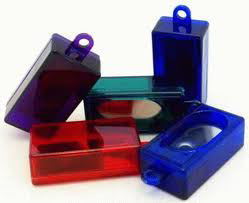
Box ClickersI would like to introduce you to another type of support: the “acoustical” support. An acoustical support is a neutral sound: a tap, click or ping. The acoustical support plays a crucial role in delivering positive reinforcement to a learner. The purpose of the sound is to inform a learner that he has done something right. The sound says, “YES, you did it.” The instructor, therapist or parent makes the sound at the exact moment that the child has performed a desired behavior. This behavior may be pointing to a picture of a cat, putting a puzzle piece into place, or, one of those rare beautiful flashes of meaningful eye contact or comprehension. As soon as the child has performed the task and the instructor has produced the sound, the child receives a treat (reinforcer). After a few trials, the neutral sound becomes a “conditioned reinforcer.”

Why is the Conditioned Reinforcer Important?

“A conditioned reinforcer is some initially meaningless signal—a sound, a light, a motion—that is deliberately presented before or during the delivery of a reinforcer,” explains behavior scientist, Karen Pryor. After a few experiences of hearing the sound and receiving a treat (reinforcer), the sound itself becomes meaningful for the child, and he starts to watch out for it. After the child is paying attention to the sound, he starts to pay attention to the behaviors that produced the sound. When he realizes that his own behaviors are producing the sound and the reinforcer, he learns to produce those desired behaviors more often. At that point, you have learning and communication. This use of a sound to signal success to the learner is called Teaching with Acoustical Guidance or TAGteach.

As a parent, when I started using a neutral sound (a click) to indicate to my son which behaviors of his would earn treats, he started doing more of those behaviors. My son was loud, chaotic and wild in the early years. He had self-stimulatory and aggressive behaviors. With my conditioned reinforcer (sometimes referred to as an “event marker” or a “tag”), I was able to tag my child every time he did something good. “Good” things were behaviors like Quiet Mouth, Both Feet On The Floor, Hands Still, or Eye Contact. The procedure is: Observe child, press clicker (tag) when child performs the desired behavior, then reinforce child (give a treat or token).

Tantrum Busting

The first time I ever used TAGteach (acoustical support), my son had just erupted into a tantrum, complete with shrieking, stomping and storming about. I tagged every split second that he had “Quiet Mouth” or “Both Feet On The Ground, and handed him a tiny piece of candy with each click. Twelve minutes later he was sitting quietly and calmly on the sofa, and we were able to go about our day. It was an incredibly empowering experience for me, compared to all the previous tantrums when I always felt panicky, demoralized and helpless. I never feared a tantrum or meltdown again because I had a powerful tool to help him calm down.

My Son Became More Skilled and Happier the More I Tagged

The more I communicated with my son via tags and positive reinforcement, the more skills he gained and the happier and better behaved he became. Despite the lack of speech, despite the sensory issues, the click rang loud and clear and told him he had done something good. He loved it and responded beautifully. He had many difficult behaviors, but I was able to tag a split second of a good behavior whenever it occurred, with the result that the split second became two seconds, then three seconds, then four seconds of the desired behavior, plus it occurred more often. Gradually I was able to “shape” disruptive behaviors into positive learning behaviors, and he gained many useful skills.

The Tag is Clear and Precise with No Emotional Baggage

The reason the tag (conditioned reinforcer) works so well is because of the precise information it provides to the child. It tells the child, in real time, exactly what he did that was right, at exactly the moment he did it. From the viewpoint of a child with autism, he receives precise, timely information from a neutral sound; there is no emotional burden, language processing or sensory issue to deal with. Thus the child is free to focus on the priceless information he is receiving: the wonderful knowledge that he has done something right.

The Time has Come for TAGteach

The time has come for the use of acoustical supports in the autism community. There are many reasons: this methodology is based on the scientific principles of Applied Behavior Analysis; it is effective, easy to learn, easy to do and low cost. It is flexible, portable and wonderful for teaching in the natural environment. It is an invaluable tool for weary, dispirited parents, and for over-burdened instructors in the classroom.

Thank you for reading to the end of this article! In the beginning of the article I asked you to consider this method. I hope you are now interested in learning more about using acoustical supports for a child with autism. There are links below with more information. If you have questions, please contact me via the website below. Best wishes to you all.

Martha Gabler and her husband are the parents of two sons. When the younger son turned three, autism entered their lives. The method described above, using an acoustical support to mark desired behaviors, is known as Teaching with Acoustical Guidance (TAGteach). The sound made by the acoustical marker (the click or ping) is sometimes referred to as a “tag.” TAGteach is based on the scientific principles of Applied Behavior Analysis and uses positive reinforcement and reinforcement schedules to build functional behaviors. Martha’s book describing how she used TAGteach with her son is entitled Chaos to Calm: Discovering Solutions to the Everyday Problems of Living with Autism.

For more information about using acoustical supports with autism, see www.autismchaostocalm.com.

For more information about Teaching with Acoustical Guidance, see www.tagteach.com.

Tip of the Week: Scanning – Best Teaching Practices

Scanning is one of the first skills we teach learners with autism. This skill, (looking at each item presented and using that information to make decisions,) is essential for almost every other skill we teach children in early childhood. Historically, we have taught scanning skills through matching and listener responding activities by lining up 3 pictures or objects, then having the learner choose the correct match out of the three items or point to the item we have named. However, this is not representative of the way scanning skills are used in the natural environment.

Toddler boy reaching for carrots in grocery storeConsider how you use scanning in your own life: searching a row of books on a shelf to find a particular title, trying to find your favorite tomato soup in a supermarket aisle filled with soups, or looking through a box of Legos for one blue square Lego to complete a structure. None of the ways we scan in the natural environment present materials in a field of 3 neatly lined-up items.

There are steps you should take in order to help prepare your learner for scanning in the natural environment. When working on matching items or identifying items, you should quickly reduce prompts (as discussed in this previous post) and increase the difficulty of scanning. There are two ways to do this: (1) increase the number of items in the field and (2) make the array of items messy.

If we take a look at matching, here is a sample of the steps for a matching program you might use to help teach the skill:

  1. Match an object to 1 of 3 objects placed on the table
  2. Match an object to 1 of 5 objects placed on the table
  3. Match an object to 1 of 5 objects placed in a messy array on the table
  4. Match an object to 1 of 8 objects placed in a messy array on the table
  5. Match an object to 1 of 10 objects placed in a messy array on the table
  6. Match an object to 1 of 5 objects with similar but non-matching items in the messy array (example: you’re trying to match a red car, in the array there will be a red car as well as a blue car and a red truck.)
  7. Match an object to 1 of 8 objects with similar but non-matching items in the messy array

As the learner masters each step, he/she is getting closer to what that skill looks like in the natural environment. Lastly, here are a few examples of how children use scanning in the natural environment. These can be used to practice the skill in ways that are motivating to your individual learner:

  • searching for all the pieces to a costume for dress up play
  • finding a specific piece to complete a puzzle or block structure
  • looking for his/her favorite candy or snack at the supermarket
  • finding a specified item in a picture (for example, if I have a learner that loves Elmo, I’ll find many pictues with Elmo shown and have the learner point him out)
  • retrieving shoes from a shelf or closet
  • picking out a nail polish color
  • choosing their favorite tv show from a DVR or computer menu
  • playing “I Spy”
  • finding the right tool from a messy utensil drawer for a cooking activity
  • retreiving his/her favorite train from a bucket of trains

Unique Program Gives Adults with Autism Greater Quality of Life

The Center for Autism and Related Disorders (CARD) launches the nation’s first-of-its-kind comprehensive treatment program for adults with autism spectrum disorder (ASD). The CARD Adult Services program uses intensive, scientifically-proven applied behavior analysis (ABA) therapy to place adults with ASD on the fast track to being functional in their daily lives, integrated into the community, and living their lives to their fullest potential.

Unlike any other program in the United States for adults with ASD, CARD Adult Services focuses on individualized treatment with the mission of minimizing challenging behaviors and maximizing skill acquisition to improve social skills, social language, basic language concepts, functional academics, adaptive skills, functional communication, executive function, and vocational skills. These skills are taught at home and at CARD centers and can also be provided in vocational settings.

“When people speak of individuals with autism, they tend to be referring to children because, statistically, 1 in every 88 children in America is diagnosed with autism spectrum disorder,” says Dr. Doreen Granpeesheh, CARD founder and CEO. “But the reality is that many adults with autism need therapy and daily support.”

Twenty-three-year-old Russell Rollens has received therapy since he was 22 months old. His biggest challenges include a lack of expressive skills and spontaneous language, behavioral issues, co-morbid medical issues, and a sleep disorder. He began using CARD Adult Services at the age of 18 to improve his behavioral and functional skills, and he is making measurable progress. In the past few months, he has been participating in a part-time day program where he works with horses. “My family and I are greatly indebted to CARD for making my beloved son’s life as good as it can be,” says Russell’s father Rick Rollens.

According to research, Russell is 1 of an estimated 1.5 million Americans living with ASD, making it one of the fastest-growing developmental disabilities in America. According to a 2012 survey by the Bureau of Labor Statistics 2012, the unemployment rate for individuals with a disability is 13.4 percent. CARD is working to decrease the number of unemployed adults with ASD by providing targeted therapy that increases their vocational skills, enabling them to join the workforce and maintain employment.

For more information about the CARD Adult Services program, visit their Programs page.

Source: PRWeb

Posted in ABA

Tip of the Week: Using a MotivAider to Help Parents Give Positive Reinforcement

Several years ago I worked with an eight-year-old girl named Stella in her home. Gina, her mother, was at her wit’s end. She had Stella, a four-year-old daughter, and an 18-month-old son to care for plus household duties, balancing work and home life, and maintaining her marriage. She constantly felt stressed, which was compounded by the fact that Stella was not yet speaking or communicating any needs beyond what she wanted to eat, was still not toilet trained, and made a mess everywhere she went. Gina felt that she spent her days following Stella around the house, picking up after her, and yelling at her to stop. She frequently would find Stella dumping out a bin of toys or sweeping all the books off of a shelf, then try to distract her with a Youtube video or a snack.

At this point, Gina was feeling hopeless.

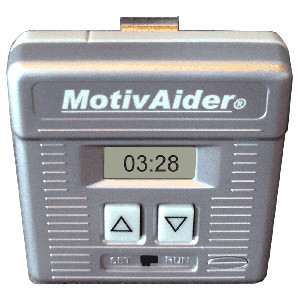
DRT_382_MotivAiderSo you can imagine that she was highly skeptical when I suggested that using the MotivAider, a simple device that vibrates at timed intervals, might make her life easier. And while she was prepared for me to try to change Stella’s behaviors, she was not expecting me to suggest she change some of her own behaviors. However, she decided to give it a try.

She set the MotivAider to vibrate every two minutes, then clipped it to her waistband. Her instructions? Every time she felt it vibrate, she should go find Stella. If Stella was engaging in appropriate behaviors (sitting calmly, looking at a book without damaging it, playing with a toy she enjoyed, or watching a video) Gina would give her some positive reinforcement. This included but was not limited to giving her hugs, presenting a snack, watching the video with her, or bringing up her favorite Youtube videos if she was doing something else. If Stella was engaging in an inappropriate behavior, Gina would ignore it (as long as Stella was not in any danger.)

To Gina’s surprise, Stella quickly stopped dumping out bins of toys and making a mess all over the house. All Gina needed was an easy reminder to catch Stella doing something good.

The MotivAider is one of my all-time favorite tools. You can program it to vibrate on a fixed or variable schedule at different duration and intensity levels. I use it for many things, but I’ve had great success in using it with parents. It’s easy for them to use independently, they can use it even when I am not present, and it fits into their busy lifestyles.

Many parents (and teachers) get stuck in the same cycle as Gina did, consistently reinforcing undesirable behaviors by providing attention whenever those behaviors are present. With the help of the MotivAider, Gina was able to change that contingency. (It should be noted that this intervention would not work as described above for a behavior that is not maintained by attention.)

While I was brought in to help change Stella’s behavior, we also changed Gina’s behavior. When we started, Gina provided reinforcement to Stella at every two minute interval in which she found her behaving appropriately. Over time we increased that interval, so that Stella wasn’t receiving such a high rate of reinforcement.

Gina reported that the house felt more calm now, and she had more energy during the day. It also gave her a confidence boost. Having success in this one area made her feel more hopeful and invested in creating success in other areas. Other families I’ve used it with have experienced similar results. One simple tool can lead to massive change for a family.

**Names and identifying characteristics have been changed to protect the identities of my clients.

Tip of the Week: Avoid Prompt Dependence When Teaching New Skills

“She won’t say hi unless I say ‘Say Hello.’” “He will only wash his hands if I put his hand on the knob to turn on the water.” “He won’t use his fork until I put it in his hand.”

I hear statements like this all the time from both parents and providers working with learners what autism. What they are describing is “prompt dependence,” which is when a learner requires a prompt from a teacher or parent in order to complete a task. So how do you avoid prompt dependence with your own learners?

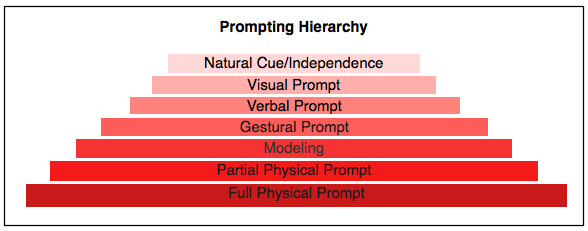
Let’s start with the prompt itself. There are many different ways to prompt which can be divided into levels by how intrusive the prompt is. Below is a sample of a prompt hierarchy, with the least intrusive prompt at the top and the most intrusive prompt at the bottom. Your goal is to quickly move through the prompt levels to move your learner to independence.

Prompting Hierarchy

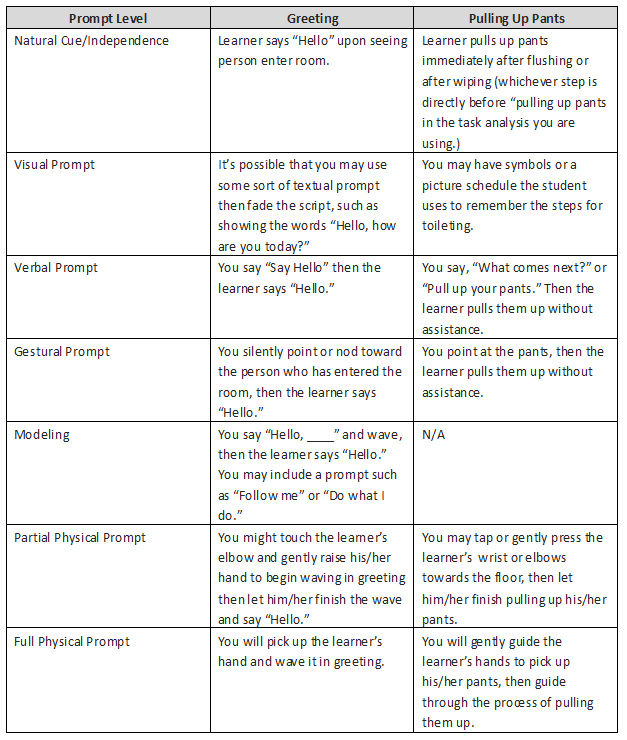
Now let’s look at two different examples to show these prompt levels. In the first example, the goal is for the learner to greet a person who walks into the room. In the second example, the goal is for the learner to pull up his/her pants after using the bathroom as a part of a toileting routine.

Prompt Chart

Research shows that least-to-most prompting increases potential for errors and slows down rate of acquisition for new skills. Therefore, most-to-least prompting is preferred for teaching new skills. This means that you would start at a full physical prompt, then move your way up the prompt heirarchy until your learner achieves independence with the task.

In the past, when working with discrete trials, it has been common practice to have a learner master a skill at a certain prompt level, then move to a less intrusive prompt and have the learner master the skill at that prompt level, steadily moving towards independence. This can actually encourage prompt dependence because the learner remains on the same prompt level for too long.

Instead, you should try to quickly move up the prompt hierarchy in a way that makes sense for the skill you are trying to teach. Below are some tips to help you help your learners achieve independence.

  • Follow the rule of three: Whether you are teaching with discrete trials or in the natural environment, once your learner has successfully responded to a demand three times consecutively, move to a less intrusive prompt.
  • If you are taking data, make a notation of what prompt level you are using at each step. (And remember, that only independent responses should be counted towards the learner’s percentage of correct responses.)
  • At the end of a session or group of trials, note what prompt level you were at by the end of the session. Then start at that level during the next session.
  • If your learner does not respond correctly when you move to a less intrusive prompt, then move back to the most recent prompt level. Once they respond again correctly at that prompt level three times consecutively, move again to a less restrictive prompt.
  • Remember that verbal prompts are very difficult to fade. Though they are less instrusive, you should avoid using them when possible.
  • You can pair prompts and then fade out the more intrusive prompts. For example, with the sample of pulling up pants described above, you can pair a visual prompt with a gestural prompt by showing the symbol for pulling up pants while pointing at the pants. Over time, you stop using the symbol and just use the gestural prompt. The gestural prompt can be faded by moving your point further and further away from the pants.
  • Write down what the prompt levels will look like for the specific task you are teaching. This way you will be fully prepared to quickly move your learner towards independence.
  • Differentiate your reinforcement! If you move to a less intrusive prompt and the learner responds correctly, then you should immediately provide a stronger reinforcer than you did for previous responses. If a learner spontaneously responds without a prompt, you should do what I call “throwing them a party” by combining reinforcers (such as tickles and high fives) or providing a highly desirable reinforcer.

Prompting can be very difficult to do well, but following these tips should help set your learner on the path to independence.

Tip of the Week: Do It Again

Teacher and Student In A Classroom At SchoolTeaching learners with autism or other developmental delays can frequently be a complicated, stress-inducing labor of love. This is why I especially appreciate that one of the most useful strategies in working with learners of all ages is just three simple words: “Do it again.”

The basic idea behind “Do it again,” (Or “Try it again,” or “Do it better”) is that you are calmly stating that the learner must try an action again and do it better than previously done. You are not yelling, you’re voice isn’t even raised. And you are communicating to the learner that you know he/she is capable of doing more.

In some cases, working with learners who may require more invasive prompts such as physical prompts, it may be necessary to have two adults for this to work best. Below are a few example scenarios of how this might work.

Scenario One

  • Teacher asks student to hand a paper to her.
  • Learner drops paper on desk next to her hand.
  • Teacher: (Hands paper back to student.) Try it again. (Holds hand out for paper.)
  • Learner places paper in hand.
  • Teacher: Thank you.

Scenario Two

  • Non-verbal learner wants to get attention from teacher. Grabs teacher’s shirt and pulls.
  • Second adult (possibly another teacher or paraprofessional): Try it again. (Provides hand-over-hand assistance for giving a light tap to get teacher attention.)
  • Teacher: What do you need, _____?

Scenario Three

  • Learner: S@*!
  • Teacher: Try again.
  • Learner: S@*!
  • Teacher: Try it again. (calm, even tone)
  • Learner: I’m mad.

Scenario Four

  • Learner is running across the room to get a toy.
  • Teacher: Go back. Try again. (The learner must return to the point in which he/she began to run.)
  • Learner walks across the room.

Behaviors to use this with:

  • recurring behaviors in which you know the student knows the rule, or you have repeated the rule many times
  • behaviors that are maintained by attention or desiring “shock value” such as cursing, insulting, or using rude language
  • increasing behaviors related to polite speech
  • decreasing behaviors that could cause injury (such as running in the classroom or being rough with peers or adults)

Why it works:

  • you are demonstrating a calm sense of control
  • you are demonstrating that you have and enforce high expectations
  • you are willing to spend the time to have your learner complete requests correctly
  • the learner is still receiving attention, but it is low-quality attention. You should differentiate the quality of the attention you provide based on the quality of the learner’s behavior.
  • the learner still gets what he/she desires, but only after behaving in the desired manner. It is important that the learner still receives the tangible, attention, or escape instead of being punished for finally engaging in the desired behavior, EVEN IF the learner has to “do it again” multiple times. Over time, the learner will engage in the appropriate behavior more quickly because it increases the speed with which they receive the desired item or activity.


Pick of the Week: AFLS School Skills Assessment Protocol

We’re excited to let you know that the AFLS School Skills Assessment Protocol, the latest protocol in the Assessment of Functional Living Skills Series (AFLS), is now available. This assessment, skills tracking system, and curriculum guide assesses and develops a variety of skills, routines and social situations that are critical for success in educational settings. This week only, we are offering a 15% discount off your order of the AFLS School Skills Assessment Protocol. Apply our promo code BLOGAFLS5 to your order at checkout to redeem your savings. Note that this Protocol is only available to registered users of the AFLS Guide. Your registration number will be required upon ordering. This five-digit number begins with “FS” and can be found printed on the lower left hand corner of your AFLS Guide.

The skills included in the School Skills Protocol are essential for successful functioning in different types of classrooms, in all parts of the school campus, and with peers and various staff.

The AFLS School Skills Assessment Protocol also incorporates skills that are necessary in a wide range of classroom environments (i.e., special day classes, “pull out” classrooms, inclusion, regular education), and considers the individual’s level of development (e.g., language, behavior, and cognitive abilities). All age levels of education (i.e., elementary school, middle school, high school, college) are addressed. The School Skills Protocol includes:

  • Classroom Mechanics
  • Routines and Expectations
  • Meals at School
  • Social Skills
  • Technology
  • Common Knowledge
  • Core Academics
  • Applied Academics

This week only, save 15% on your purchase of the AFLS School Skills Assessment Protocol by entering in the promo code BLOGAFLS5 at checkout!*

*Offer is valid until October 29, 2013 at 11:59pm EST. Order must include AFLS Registration number located on the front lower left-hand corner of your AFLS Guide. Be sure to exclude spaces and/or dashes in your registration number and promo code!

Pick of the Week: Three Bear Family Counters & Sequencing Cards

Teaching sequencing to our early learners is important for developing logical order of thinking. Practicing hands-on sequencing skills makes discovering abstract concepts even more enjoyable with these manipulatives. This week only, save 15% on the set of Three Bear Family Counters and Sequencing Cards. Just enter in the promo code BLOG3BFC at checkout to redeem your savings.

These adorable counting bears come in three sizes, three weights and 6 colors for counting, size and weight comparison, categorizing by color and for developing pattern and sequencing skills. These bears are also proportionally weighted and can be used on a balance for measurement discoveries. This 96-piece set contains 24 Papa, 24 Mama, and 48 Baby Bear counters.

Perfect for use with the Three Bear Family Counters, these sequencing cards can help develop your child’s ability to recognize size, color, patterns, and logic, as well as early math skills. Children can actively explore and discover abstract concepts through hands-on learning. This set also comes with 30 full-color activities and a teacher’s guide.

Remember, this week only, take 15% off your order of the Three Bear Family Rainbow Counters and Sequencing Cards by entering in the promo code BLOG3BFC at checkout!*

*Offer is valid until Oct. 22nd, 2013 at 11:59pm EST. Not compatible with any other offer. Be sure there are no spaces in the promo code at checkout!