Different Roads to Learning Celebrates the Release of the “ABA Curriculum for the Common Core: Kindergarten”

We’ve just wrapped up a successful event in celebration of BCBA Sam Blanco’s newly released ABA Curriculum for the Common Core for Kindergarten. We couldn’t be more grateful and proud of the work that Sam has accomplished in creating this robust and one-of-a-kind curriculum kit with us. We’d like to thank all of the educators, professionals, parents, and friends again who joined us this past Wednesday.

The ABA Curriculum for the Common Core Kit: Kindergarten and other raffle prizes. (Masao Katagami)


Guests had the opportunity to connect with each other over an autumnal arrangement of hors d’oeuvres, delicious sushi, baked sweets, and wine, while looking through all the materials and components of the ABA Curriculum for the Common Core Kit. A special raffle was also held, during which guests had the chance to try their luck at winning any of the 4 raffle prizes: one Language Builder set and the Curriculum Book for the ABA Curriculum for the Common Core, one Time Timer PLUS and the curriculum book, the What the Heck Does That Mean?! Idioms Game, and last but not least, the entire kit for the ABA Curriculum for the Common Core: Kindergarten. Congratulations to the raffle winners – Alicia, Meaghan, Linda – and of course, the big winner of the kit, Debbie!

Party attendees mingle over food and the ABA Curriculum for the Common Core Kit: Kindergarten. (Masao Katagami)


Sam Blanco, MSED, BCBA tells guests about the curriculum and kit. (Masao Katagami)

View all of the event photos on our Facebook page here.

For more information about the ABA Curriculum for the Common Core Kit: Kindergarten, please email info@difflearn.com. Requests to arrange a demonstration or training with the curriculum kit can be directed to Abigail at (212) 604-9637 or abigail@difflearn.com.

Pick of the Week: ABA Curriculum for the Common Core for Kindergarten

We’re thrilled to introduce this pioneering curriculum kit containing both the materials and programs to teach each Kindergarten Common Core standard for both English Language Arts and Math. Authored by Sam Blanco, MSEd, BCBA, the curriculum has been created exclusively for students in special education settings using the evidence-based principles of Applied Behavior Analysis (ABA).

We’re offering this robust curriculum kit for a limited-time introductory price of $499.95.

Completely unique, this kit contains a curriculum book that drills down into each standard and breaks it into teachable steps. Programs are presented in a format that supports data collection and ease of use. Each Common Core standard is presented on its own page with clear instructions detailing the Teaching Procedure, Discriminative Stimulus (Sd), and Materials required for teaching. Each standard lists several targets that demonstrate the component steps and skills required for mastery.

A thorough “how-to” guide presents the main tenets of ABA, giving staff an accessible understanding of Motivation and Reinforcement, Pairing, Prompting, Generalization, Natural Environment Teaching, Preference Assessment, and Data Collection. In addition, comprehensive Data Sheets are included, along with samples of how to complete them.

Our ABA Curriculum for the Common Core Kit comes with more than 24 quality, versatile manipulatives, flashcards, games and tools. The curriculum book explicitly explains how to use these materials to teach and generalize each standard. The materials included in the kit have been carefully selected to not only assess and teach each standard and prerequisite skill, but also be wonderful additions to any classroom setting. The materials can be used during more intensive group and one-to-one instruction, as well as during center time and independent play.

The goal of this curriculum kit is to make the Common Core standards accessible and relevant to students with autism and special needs. Additionally, by breaking each standard down and drilling into the prerequisite skills, the opportunity exists to use these Kindergarten programs for older students who are not developmentally able to meet grade-level standards. By equipping teachers with teachable steps for each and every standard and pairing the teaching with motivating, versatile materials, the ABA Curriculum for the Common Core Kit puts Kindergarten students in Special Education on the path to achieving success.

 You can also purchase today the Curriculum Book separately for only $64.95 $59.95. This curriculum book is best utilized in conjunction with our ABA Curriculum for the Common Core Kit: Kindergarten and explicitly explains how to use the materials presented in the kit to teach and generalize each standard. Soft Cover, 176 pages, by Sam Blanco, MSEd, BCBA.

 Special educators and consultants are already finding this to be an invaluable resource in the classroom.

 Advance Praise for the ABA Curriculum for the Common Core

 “ABA Curriculum for the Common Core is bound to be the type of reference book every special educator will be reaching for. With its comprehensive, accessible, and task-analyzed programs, ABA strategies, and data collection sheets, Sam Blanco has created a compilation dream for all educators working with children who have special needs.”
– Val Demiri, PhD, BCBA-D

“This highly organized and comprehensive curriculum is a must for all special education teachers working to implement the common core standards in the classroom. Every teacher and student need is anticipated and planned for. With this curriculum as a resource, the common core standards are no longer an obstacle, but instead an accessible program of study for all students.”
– Linda McSorley, Special Education Teacher

Continue reading →

Tip of the Week: Easy Modification for Promoting Functional iPad Use

The iPad is a highly motivating item for many kids. But many parents and teachers find it frustrating to teach kids with autism to use the iPad functionally. Here are three tips that can help you promote functional use.

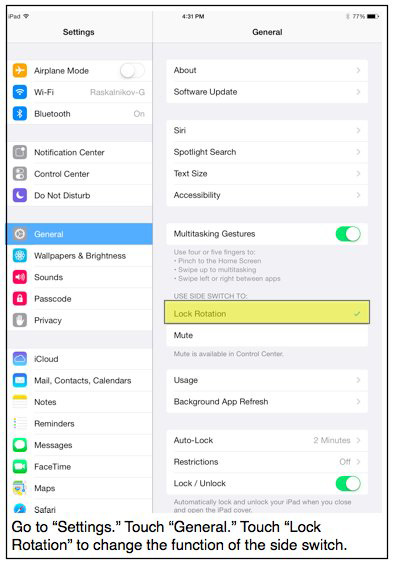
  1. Lock Rotation – Some learners with autism like to watch the screen rotate as they move the iPad. This prevents them from using the iPad to complete tasks, create visual or audio products, or play games. There is a small switch on the side of the iPad that is factory preset to mute the volume. You can change the function of this switch to lock rotation, preventing your learner from fixating on rotating the screen.LockRotation_Image
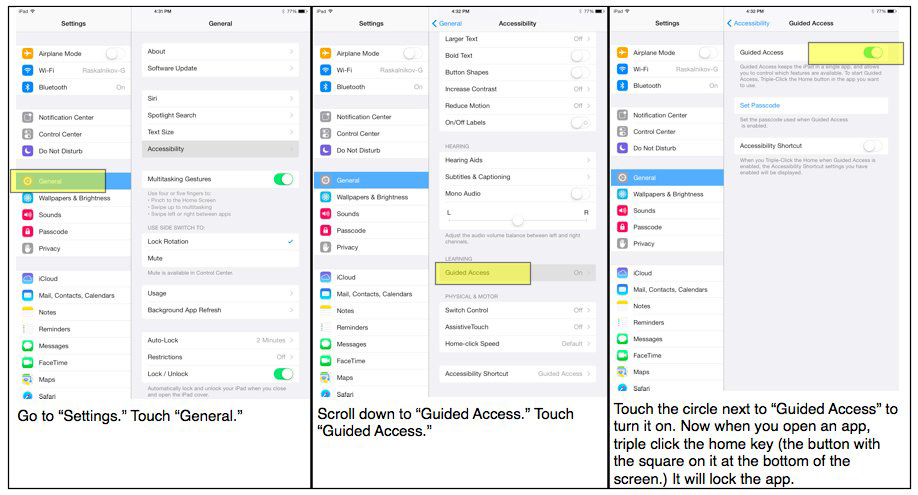
  2. Guided Access – When providing access to the iPad, it’s a good idea to give your learner options of particular apps to engage with instead of providing free access to everything available on the device. For example, during a teaching session, I might say, “When it’s time for a break, do you want to play Match or Simon?” When it’s time for the break, I open the app the learner chose, then activate Guided Access, which makes it impossible for the learner to switch to other apps.GuidedAccess_Image
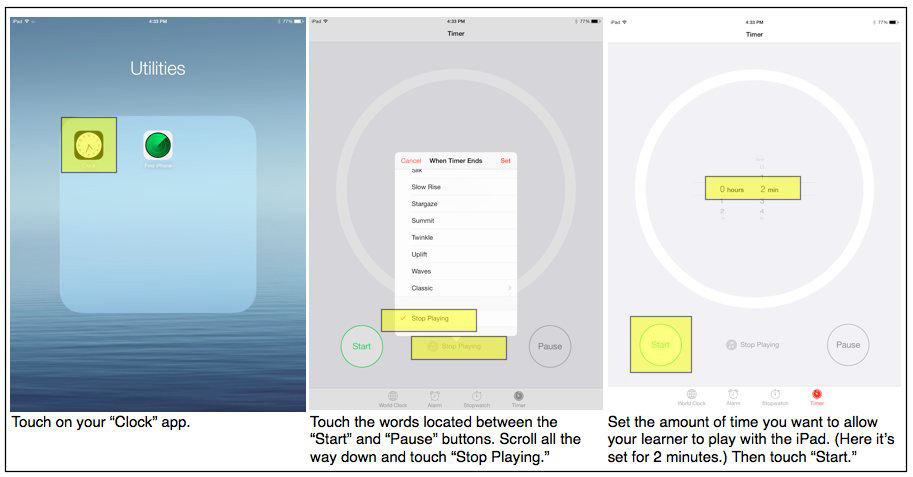
  3. Timed Play – Sometimes I want to limit the amount of time a learner spends on the iPad. When I am providing a student a break during a teaching session, frequently I limit the time to 2–3 minutes. Parents may allow their child to play on the iPad for 30 minutes. You can set the iPad to immediately shut off at the specified time. I like to use this function because it prevents the end of an preferred activity from being associated with me.TimedPlay_Image

**Unfortunately, the iPad is the only tablet with which I am familiar. If you use another tablet and have tips such as those above, please share them with us!


WRITTEN BY SAM BLANCO, MSED, BCBA

Sam is an ABA provider for students ages 3-12 in NYC. Working in education for ten years with students with Autism Spectrum Disorders and other developmental delays, Sam has developed strategies for achieving a multitude of academic, behavior, and social goals. Sam is currently pursuing her PhD in Applied Behavior Analysis at Endicott College.

Tip of the Week: Communicating with Paraprofessionals to Support Your Learner

Many students with autism and other developmental disabilities have an IEP that mandates a 1:1 paraprofessional (called an instructional assistant or teaching assistant in some states, but referred to as paraprofessional for the purposes of this article). Recently, I had the opportunity to provide a workshop to a large group of paraprofessionals in New York City. I was surprised to hear how some felt disconnected from the families of their students, especially considering how deep their relationships are with their students.

My conversations during that workshop caused me to reflect upon my own experience as a classroom teacher. Fortunately, I always had wonderful paraprofessionals who were essential to making the classroom run smoothly and helping our students achieve success, but I recognize now that they often were working with less information and less contact with the families than the teachers were. As a parent/guardian, you can help bridge that gap.

  • Communicate directly with the teacher and the paraprofessional. If you have critical information about your child, don’t assume that the teacher will share it with the paraprofessional. This can be important for big issues, such as allergies or new medicines, as well as smaller issues, such as an impending vacation or a sleepless night.
  • Share important goals with the paraprofessional. In many schools, the paraprofessional may never have seen your child’s IEP, though they frequently see your child for more time during each day. The paraprofessional also will usually see your child at times when the teacher will not, such as lunch and/or recess. If there are specific concerns about social skills, the paraprofessional likely has more opportunities for implementing social skills interventions than the teacher.
  • When you go to parent teacher conferences, ask both the teacher and the paraprofessional about your child’s performance in school. Because the paraprofessional sees the student in more environments, they may have more specific observations about transitions, special classes such as gym or art, and social interactions outside of the classroom.
  • Sometimes a student responds better to the paraprofessional than the teacher. If they do, find out why. The paraprofessional may be doing things that you and/or the teacher can replicate to help your child’s learning outcomes.
  • Show your appreciation for the paraprofessional. The job of a paraprofessional is very challenging: no preps, the need to adjust to each teacher’s style throughout the day, and the fact that they often end up managing any behavioral challenges during the day. A note of thanks can go a long way. And if you are the type of parent who gives small gifts or handmade items to teachers, don’t leave the paraprofessional out!

WRITTEN BY SAM BLANCO, MSED, BCBA

Sam is an ABA provider for students ages 3-12 in NYC. Working in education for ten years with students with Autism Spectrum Disorders and other developmental delays, Sam has developed strategies for achieving a multitude of academic, behavior, and social goals. Sam is currently pursuing her PhD in Applied Behavior Analysis at Endicott College.

Come EAT, DRINK, and WIN as we launch the new ABA for the Common Core Kit!

CelebrateWormYou’re invited to our book release party
for the ABA Curriculum for the Common Core Kit for Kindergarten!

Join us on November 12 in NYC to meet author Sam Blanco, MSEd, BCBA and enjoy an evening with friends and colleagues. Cocktails and hors d’oeuvres will be served along with special giveaways. And one lucky attendee will win a FREE kit!

SamBlanco

Sam Blanco, BCBA, MSEd (www.samblanco.com)

We hope you’ll join us in launching this innovative and exciting new curriculum kit that presents ABA programs and targets for each of the Kindergarten Common Core State Standards.

Teachers, educators, consultants, behavioral therapists, and SLPs will love learning more about this groundbreaking curriculum kit. If you have a friend or colleague who is a teacher or behavioral consultant who might be interested in attending this event, please feel free to forward this invitation. All are welcome!

The event will be held in the Union Square neighborhood of New York City
Wednesday, November 12, 2014
6:30-8:30 pm

Space is limited so please RSVP as soon as possible to Abigail@difflearn.com.
A formal invitation with address details will be sent upon RSVP.

ABA Curriculum for the Common Core Kit - KindergartenIn order to present you with a great party, we need to know a few details so we can plan accordingly.

Please RSVP with the following information to Abigail@difflearn.com:

Name:

Organization or School:

Are you a teacher, therapist, consultant?

How old are your students?

Discipline (ABA, SLP, OT, etc.):

Simplifying the Science: Using a MotivAider to Self-Monitor

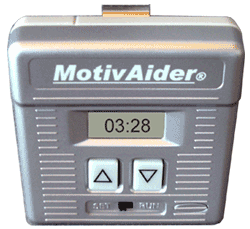
Teaching independent on-task behavior can be quite challenging when working with any student, but particularly so with some students with autism. In a study published in 2010, researchers Dina Boccuzzi Legge, Ruth M. DeBar & Sheila R. Alber-Morgan implemented and evaluated one way of teaching student to self-monitor their on-task behavior using a MotivAider. (The MotivAider is a simple electronic device that vibrates at timed intervals to provide an individual with a private prompt to engage in a specific behavior. It can be programmed to vibrate on a fixed or variable schedule at different duration and intensity levels.)

In this study, the researchers worked with a fifth grader with autism, a sixth grader with autism, and a fifth grader with cerebral palsy. They taught the boys to wear the MotivAider (calling it a pager) and note a + or a – to indicate their behavior each time the MotivAider vibrated. The behaviors they monitored were all related to being on-task: “eyes on my work,” “in my seat,” and “doing work.” Once each boy consistently rated his behavior upon feeling the vibration, the researchers implemented the intervention.

The MotivAider’s were initially set to vibrate every two minutes. Each time the MotivAider vibrated, the student would mark a + or a – for each of the behaviors on a sheet he had on his desk. Prior to the intervention, the average percentages of time each boy was on-task ranged from 26% to 77%. Upon implementation of the intervention, “all three students showed an immediate and substantial increase of on-task behavior ranging consistently from 80% to 100%.

The researchers also included a plan for fading out the use of the MotivAider‘s, changing from a fixed schedule of every two minutes, to an increasing variable schedule. The fading schedules varied for each student. For example, for one student, the fading schedule started with a variable schedule of a vibration about every four minutes, then moved to about every six minutes, then to about every eight minutes, and then to about every ten minutes. The MotivAider was then removed completely.

After the intervention was complete, researchers collected data once a week for three weeks to see if the intervention was maintained. During all three maintenance probes, “all students continued to demonstrate 80%-100% on-task behavior.”

We’ve talked about how to use MotivAider‘s in the past, but I particularly love this intervention because it is feasible for teachers to implement in the classroom, promotes independence in learners with autism, and allows teachers to focus on other issues. Take a look at the study here to get a fuller description of how to implement such an intervention with your students.

For more information about the MotivAider, click here.


WRITTEN BY SAM BLANCO, MSED, BCBA

Sam is an ABA provider for students ages 3-12 in NYC. Working in education for ten years with students with Autism Spectrum Disorders and other developmental delays, Sam has developed strategies for achieving a multitude of academic, behavior, and social goals. Sam is currently pursuing her PhD in Applied Behavior Analysis at Endicott College.

How to Assess and Address Pants-Wetting Behavior—A Response to a Teacher’s Question

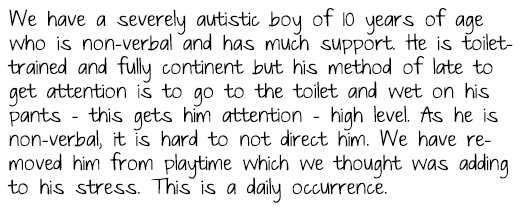
Sometimes we get specific questions from teachers and parents about managing problem behaviors that are quite common. In these cases, we think it can be helpful to share the question and response, so that others in similar situations might benefit from the suggestions offered. Bed and pants-wetting can be an enormously challenging issue both at home and at school, so when we received the following question from a teacher in Australia about her student, we thought it was a great opportunity to offer some suggestions and strategies on how to address the behavior.

PantsWettingQA

This is definitely a difficult behavior to address. It’s also challenging to provide accurate advice without directly observing the behavior, instead here are a few questions to consider and potential resources.

  • First and foremost, this is a behavior in which you should consult with a Board Certified Behavior Analyst for assistance. You can find BCBAs in your area by going to this webpage: https://www.bacb.com/?page=100155. If possible, reach out to more than one to find the BCBA who is the best fit for you and your learner.
  • Second, you should conduct a functional assessment to clearly determine the reason for the behavior. It may be for attention, but you may discover there is a different cause. It is best to perform a formal functional analysis, but if that is not possible, you may consider using the Functional Assessment Screening Tool (FAST). To get the best results from this, you should have more than one person fill it out, and, if possible, one person who observes the behavior but is unfamiliar with the child. Compare results to see if you are in agreement, then make a behavior intervention plan based on the function of the behavior. For more information about the FAST and its reliability compared to a formal functional assessment, you should refer to the study by Iwata, Deleon, & Roscoe (2013).
  • If indeed the behavior is for attention, consider how to provide minimal attention for pants-wetting. You mention that he receives high-level attention right now. What qualifies as high-level for him? Is it eye contact? Physical touch? Proximity? There are ways to remove each of these types of attention while also making sure you address the behavior hygienically.
  • While your son is continent, some of the strategies that are used in toilet training may prove helpful in intervening with this behavior. Take a look at this article by Kroeger & Sorenson-Burnworth (2009), which “reviews the current literature addressing toilet training individuals with autism and other developmental disabilities.” It may provide potential solutions that you have not attempted.

I hope this information is helpful! And good luck as you plan and implement your intervention.


WRITTEN BY SAM BLANCO, MSED, BCBA

Sam is an ABA provider for students ages 3-12 in NYC. Working in education for ten years with students with Autism Spectrum Disorders and other developmental delays, Sam has developed strategies for achieving a multitude of academic, behavior, and social goals. Sam is currently pursuing her PhD in Applied Behavior Analysis at Endicott College.

When Kids Are Just Kids: Avoiding Over-Pathologizing Behaviors of Children with Autism

A diagnosis of autism can be very challenging for a child and for his/her family. But one of the most difficult aspects of autism is that it is not clear cut what behaviors are related to autism, and what behaviors are related to just being a kid. Every child tantrums sometimes. Every child talks back sometimes. Every child engages in dangerous behavior sometimes.

When I look back on my own childhood, I think of several behaviors I exhibited: in third grade I cut my own hair while my teacher’s back was turned, in fourth grade I got mad at my brother and threw an alarm clock at him, and in seventh grade I loved Agatha Christie books so much that I frequently refused to go outside and sat in my room reading by myself for hours on end. If I had autism, any one of these behaviors may have been pathologized instead of being considered as just a part of growing up.

So how do you parse through all the behaviors your learner is exhibiting and figure out which ones you should actually be worried about? Here are a few questions to ask yourself in determining behaviors to address:

  • First and foremost, is the behavior dangerous?
  • Secondly, how often and for how long does your learner engage in the behavior
  • How different is this behavior from the learner’s same-age peers? For example, does your three year old cry for a couple minutes when told that she can’t have her favorite toy, or does she cry for two hours and refuse to engage with any other toys for the rest of the day?
  • How is this behavior interfering with the learner’s ability to learn?
  • How is this behavior interfering with the learner’s ability to engage with peers and family members?
  • Is the behavior related to a skill? For example, pacing the room and flapping your arms is typically not related to a skill, but building Lego models can be related to a skill. If it is related to a skill, think about ways to provide opportunities for expanding that skill.

The answers to these questions should be able to inform the decisions that you make in intervening with behaviors. And we should remember that above all else, kids with autism are still just kids.

WRITTEN BY SAM BLANCO, MSED, BCBA

Sam is an ABA provider for students ages 3-12 in NYC. Working in education for ten years with students with Autism Spectrum Disorders and other developmental delays, she has developed strategies for achieving a multitude of academic, behavior, and social goals. Sam is currently pursuing her PhD in Applied Behavior Analysis at Endicott College.

Tip of the Week: Altering the Teaching Environment to Address Problem Behaviors

A few years ago, I went in to observe an ABA therapist I was supervising. She was working with a ten-year-old girl with Aspergers. One of her goals was to increase eye contact during conversation, but her student wasn’t making much progress in this area. She had consulted the research and was considering a new behavior intervention plan, and wanted my input before doing so.

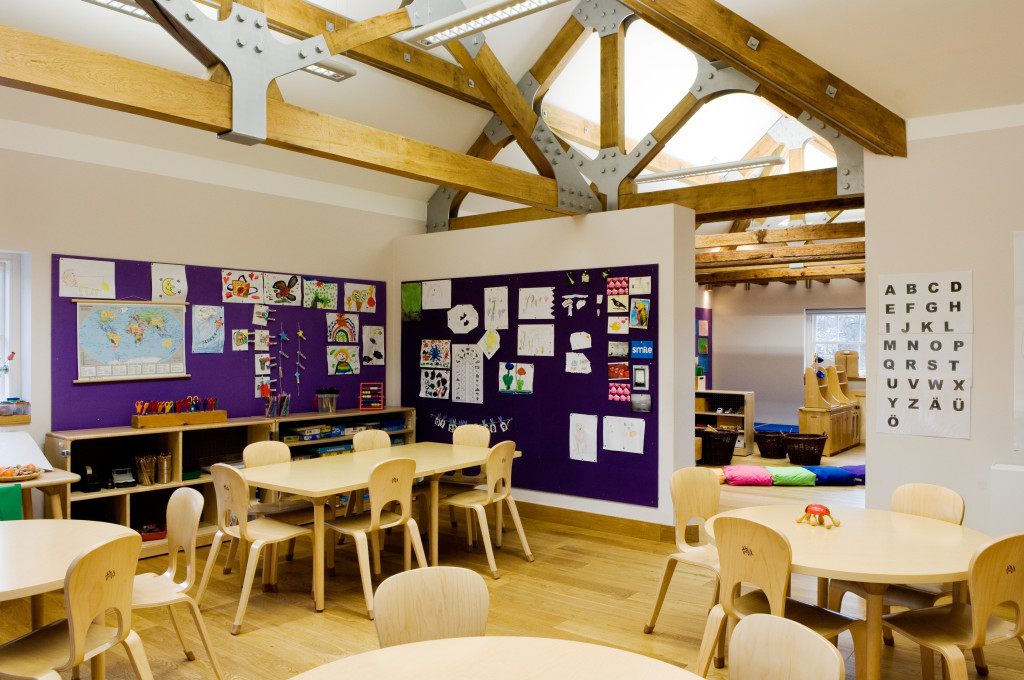
junior school classroom at the German School in Ham, by 3S Architects. Image shot 2006. Exact date unknown.The first thing I noticed when I walked in to observe was that she did her entire session at a long wooden table, sitting side-by-side with her student. After watching for about ten minutes, I asked if we could change the seating arrangement. We moved her student to the end of the table, then had the therapist sit next to her, but on the perpendicular side. This way, eye contact was much easier as they were able to face each other. The student’s eye contact improved instantly with a small environmental change. (Of course, once we made the environmental change, we worked together to address other changes that could be made to encourage eye contact.)

Environmental changes can be a quick and simple solution to some problem behaviors. Here are some questions to consider in order to alter the environment effectively:

  • Is it possible that a change in furnishings could change the behavior? For example, moving a child’s locker closer to the classroom door may decrease tardiness, putting a child’s desk in the furthest corner from the door may decrease opportunities for elopement, or giving your child a shorter chair that allows them to put their feet on the ground may decrease the amount of times they kick their sibling from across the table. You may also want to consider partitions that allow for personal space, clearly-marked spaces for organizing materials, proximity to students and distractions (such as windows or the hallway).
  • Can you add something to the environment to change the behavior? For example, your student may be able to focus better on independent work if you provide noise-cancelling headphones, line up correctly if a square for him/her to stand is taped to the floor, or your child may be more efficient with completing chores if they’re allowed to listen to their favorite music while doing so.  I’ve also seen some cases in which the teacher wears a microphone that wirelessly links to a student’s headphones, increasing that student’s ability to attend to the teacher’s instruction.
  • Will decreasing access to materials impact the behavior? For example, removing visuals such as posters and student work may increase your student’s ability to attend or locking materials in a closet when not in use may decrease your student’s ability to destroy or damage materials.
  • Will increasing access to materials impact the behavior? For example, making a box of pre-sharpened pencils may decrease the behavior of getting up frequently to sharpen pencils. (I recently visited a classroom in which the teacher put pre-sharpened pencils in a straw dispenser on her desk, and each week one student was assigned the job of sharpening pencils at the end of the day).

Whenever you do make changes to the environment, you may want to consider if the changes require fading. For example, if I make a square on the floor out of tape to teach my student where to stand in the line, I will want to fade that out of over time to increase their independence.

A final consideration is that whatever impact you expect the environmental change to have should be clearly defined and measured. Take data to ensure that the intervention is working so you can make adjustments as necessary.

For more detailed information on modifying environments, there is a great article from the Council for Exceptional Children by Caroline A. Guardino and Elizabeth Fullerton entitled “Changing Behaviors by Changing the Classroom Environment.” Click here for the article.

WRITTEN BY SAM BLANCO, MSED, BCBA

Sam is an ABA provider for students ages 3-12 in NYC. Working in education for ten years with students with Autism Spectrum Disorders and other developmental delays, she has developed strategies for achieving a multitude of academic, behavior, and social goals. Sam is currently pursuing her PhD in Applied Behavior Analysis at Endicott College.

Simplifying the Science: Parent-Conducted Toilet Training for Kids with Autism

For many of the families I work with, toilet training their child with autism becomes a long, painful process. I typically recommend the Rapid Toilet Training (RTT) protocol developed by Azrin & Foxx (1971) but many parents struggle to maintain implementation without the presence of a behavior therapist or toilet training specialist. And while Azrin & Foxx’s results have been replicated in other studies, RTT has primarily been used in educational and outpatient settings, and the amount of time it has taken to complete toilet training has been longer than in the initial study.

This is why I was especially excited to come across the study by Kroeger & Sorensen (2010) about “A parent training model for toilet training children with autism,” which is based on Azrin & Foxx’s initial study with some key modifications. This study focuses on parent-conducted toilet training in the home and was completed with two children with autism.

As mentioned in previous blog posts, the best interventions usually are multi-pronged approaches. This is no different. While there are multiple steps involved, it’s important to recognize that one of these children was fully toilet trained in 4 days, and the other in 11 days. Both children maintained toilet training skills when researchers checked in at 2 weeks, 6 months, and 3 years. Setting aside a few days or a couple of weeks to complete this intensive protocol may be intimidating at first, but achieving similar results as the two children in the study has a huge impact on the life of your child and the entire family.

Prior to starting the intervention, they received medical consent and clearance from the children’s attending developmental pediatricians. They then performed a preference assessment (the RAISD) to determine reinforcers. The study then states that “The families were asked to restrict the children’s access to these reinforcers for a minimum of 3 days prior to implementing the intensive training treatment protocol.”

The intensive toilet training program had 5 components:

Increased fluids: In consultation with a pediatrician, the study states that “parents were instructed to increase the children’s access to fluids for 3 days prior to implementing the training.” This increase in fluid intake continued until 6:00 PM on the first day of training.

Toilet scheduled sitting: Since the protocol was completed in the privacy of the children’s homes, the children were able to remain undressed from the waist down while being toilet trained. The children were continuously seated on the toilet, then able to leave the toilet for voiding in the toilet, or for brief “stretching” breaks. As they achieved higher frequency of appropriate voiding in the toilet, the amount of time spent on the toilet decreased and the amount of time escaping the toilet increased. (The schedule for fading out time seated on the toilet is detailed in Table 1 of the study.) Also, while seated on the toilet, the child was able to play with preferred items, but not the most preferred items.

Reinforcement for continent voids: According to the study, “If the child successfully voided while on a scheduled sit, they were provided immediate reinforcement (primary edible reinforcement and planned escape to a preferred activity). If the child self-initiated a void while on a break, he was provided immediate reinforcement and a new break time was begun after the self-initiated break.”

Redirection for accidents: When accidents occur, a neutral verbal redirection was provided, such as “We go pee on the toilet” and then the child was physically redirected back to the toilet. Once they were on the toilet, a scheduled sit was begun.

Chair scheduled sitting: Once the child began to experience success with voiding on the toilet, a chair was placed next to the toilet. During scheduled sits, the child would sit on the chair. If he began to void on the chair, the study states that he “was provided with the least intrusive, minimal, physical prompt. When he independently moved from the chair to the toilet to void three consecutive times, the chair was systematically moved away from the toilet in 2-feet increments.”

The study goes into further detail on each of these five components, as well as how to generalize the skill and how parents were trained in the protocol. The study made modifications to the Azrin & Foxx study to make it easier to apply in the home setting for parents, and it removed any form of punishment.

While this is a comprehensive toilet training program that requires a high level of time and attention from the parents, it is set up to help parents achieve results in a relatively short period of time.

The study states, “Parents of incontinent children with developmental disabilities report higher personal stress and distress likely related to the toileting problems presented by their children than parents of toilet trained children with developmental disabilities. It could be deduced then that continence training not only increases associated hygiene factors and access to activities and placements, but also increases the quality of life for the parents by reducing stress and subsequently for other family members such as siblings as corollary recipients of the distress” (Macias et al., 2006).

The potential to improve the quality of life for both your child with autism and your entire family is worth the challenge of implementing this protocol.

WRITTEN BY SAM BLANCO, MSED, BCBA

Sam is an ABA provider for students ages 3-12 in NYC. Working in education for ten years with students with Autism Spectrum Disorders and other developmental delays, Sam has developed strategies for achieving a multitude of academic, behavior, and social goals.