
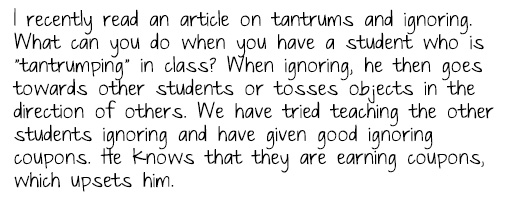
Sometimes we get questions from school teachers and parents about managing problem behaviors. Our BCBA Sam Blanco recently received a question from a school teacher in Alabama about her tantruming student in the classroom. We thought this was a perfect opportunity to share Sam’s response to her question as it may often apply to other parents and teachers. Read on below for the question and Sam’s response!
Addressing difficult behaviors in the classroom environment presents some unique challenges. It’s also challenging to provide accurate advice without directly observing the behavior. Instead, here are a few questions to consider and potential resources.
- What does the tantrum look like when it begins? Is he screaming? Crying? Throwing items? Banging his desk? Try to define the behavior so it is observable and measurable. If it’s observable, then everyone who interacts with the child will agree with exactly what behavior requires intervention. If it’s measurable, you will be able to easily note progress. An observable and measurable definition of a tantrum could be “Screams and cries for 10-12 minutes” or it could be “Stomps his feet on the ground 20-30 times.”
- What is typically happening directly before a tantrum takes place? What typically happens directly before it escalates? Can you change something about what happens directly beforehand that might impact his behavior?
- What is different about the environment on days/class periods in which he does not tantrum? Is it something you can replicate on other days/class periods?
- You should conduct a functional assessment to clearly determine the reason for the behavior. It may be for attention, but you may discover there is a different cause. It is best to perform a formal functional analysis, but if that is not possible, you may consider using the Functional Analysis Screening Tool (FAST). To get the best results from this, you should have more than one person fill it out, and, if possible, one person who observes the behavior but is unfamiliar with the child. Compare results to see if you are in agreement, then make a behavior intervention plan based on the function of the behavior. For more information about the FAST and its reliability compared to a formal functional assessment, you should refer to the study by Iwata, Deleon, & Roscoe (2013).
- Frequently, tantrums in classrooms start when a demand has been placed. This may be because they are attempting to escape the demand, but it may also be because the demand is a signal that attention may become available (Repp & Karsh, 1994). If you determine that it is, in fact, for attention, are there things you can do to provide high quality attention prior to the tantrum? Perhaps you find that he usually works for about three minutes before he starts to tantrum. You can then provide high quality attention for successfully working for three minutes and label his appropriate behaviors. Over time, you systematically increase the number of minutes he works before accessing that high quality attention. The goal is to provide him with plenty of opportunities for success before he begins to tantrum.
- A strong classroom token economy may be more successful than “good ignoring coupons.” For example, when I was a classroom teacher, I used paperclips for the tokens. Each student had a bag on the chalkboard with his/her name on it and they earned paperclips throughout the day for a variety of positive behaviors. At the end of the day, we counted paperclips and students could choose to save them or spend them on one of the items on a student-created menu of choices. The paperclips worked because they weren’t designed for a specific behavior. In the instance you described, the boy is put in a position where he has no chance to earn a coupon. However, if the language is changed so that when other students earn for ignoring, you say, “You’re earning a coupon/paperclip/token for sitting quietly at your desk,” the boy now has a decision to continue his inappropriate choices, or work to earn the same coupon the other kids are earning. He may still choose to tantrum, but at least now he has options!
- The Lovaas Institute blog has a great post about addressing challenging behaviors in the classroom. You can view that here.
Hopefully this information has helped! And good luck as you plan your intervention!
WRITTEN BY SAM BLANCO, MSED, BCBA
Sam is an ABA provider for students ages 3-12 in NYC. Working in education for ten years with students with Autism Spectrum Disorders and other developmental delays, Sam has developed strategies for achieving a multitude of academic, behavior, and social goals.
 While an ABA professional should be coming in to organize and run your ABA program, as a parent or guardian, there are some simple things you can do to make the time your child spends in a home session more effective. Several tips are here, but it may be unrealistic for you to follow ALL of these tips. Consider your home environment and family’s needs, then implement the tips that are the most feasible for your situation.



 Later that week, she sent me a video of Austin having one of his “mega-tantrums.” It was exactly as she described, though there was one important detail she had missed. Austin consistently sought out eye contact and physical contact with both of his parents. If they were moving around to pick up an item, he would move his body and face to maintain eye contact. If one of them sat down, he would quickly clamber into their lap while screaming and pounding their arms or the furniture. If one parent walked out of the room, he would immediately run to the other parent. This behavior was clearly maintained by attention. In order to decrease the behavior, his parents had the very difficult task of ignoring it ahead of them.

 Teaching language skills is one of the most frequent needs for children with autism, but also one of the most misunderstood skillsets amongst both parents and practitioners. The desire to hear your learner speak in full sentences can be overwhelming, making it especially difficult to take a step back and consider what it means to communicate and how communication skills develop in neurotypical children. Many times we get hung up on what a child should be capable of communicating at a certain age, rather than focusing on what they are capable of communicating at this stage of development.



 When faced with feeding issues, many parents or caregivers may not consider seeking out help from a BCBA or behavior analyst. There is a tendency to associate ABA with sitting at a table and completing discrete trials, but this is only one tool in a behavior analyst’s extensive toolkit. Whether you are providing intervention for feeding issues or seeking more information, it is essential to look to scientific research for help.
 Recently I took a thirteen-year-old boy with autism grocery shopping for the first time. We had practiced all of the steps for paying: looking at the total on the register, taking out the necessary bills or coins, waiting for change, making sure we had correct change, returning the money to the wallet, etc. While I thought he was ready to do this in a natural environment, I did not expect what actually happened.
 Keep your wallet in your hand, do not lay it on the counter.