Introducing Little Mixers: A Weekly Social Skills Playgroup in Brooklyn

Little Mixers BklnStacy Asay, one of our wonderful and beloved consultants, is launching the Little Mixers series, a social skills group based in Brooklyn! Headed by Stacy and Sharon Alkalay, this weekly Little Mixers series will be a special mix of fun, food, and friendship for young children between the ages of 3 and 7. Sessions will be held at Beansprouts at 14th Street and 6th Avenue in Park Slope.

Each meeting will consist of a guided lesson, group discussion, interactive games and a cooking activity, all thematically focused around a particular social skill. Each week a new social skill will be introduced with the session, culminating in an expanded repertoire of social skills and perhaps a new friend!

Parents will be provided a hand-out with suggestions and strategies to practice throughout the week in order to facilitate carry-over of a target skill.

Little Mixers will be holding 2 sessions for Spring/Summer 2014:
Mondays: 4:30 p.m. – 5:30 p.m. (ages 5-7)
Thursdays: 4:30 p.m. – 5:30 p.m. (ages 3-5)

For more detailed information, please visit the Little Mixers website at www.littlemixersbrooklyn.com, or email Stacy Asay at littlemixersbrooklyn@gmail.com.

About the Group leaders

Sharon Alkalay, MS, CCC-SLP, is a speech-language pathologist with over 8 years of experience working with infants, toddlers and children. As a classically-trained musician, she enjoys incorporating multi-modal/multi-sensory techniques into her therapy sessions through use of music, art, movement, sensory integration and dramatic play. She believes that successful engagement with a child should be accomplished gracefully with creativity, humor and compassion. Her special interests include working with children with social-language difficulties, apraxia of speech, autism spectrum disorders and language/learning disorders.

Stacy L. Asay, LMSW, is a licensed social worker, providing home and school based services to children and their families in the New York City area. With nearly 16 years of experience, her work with special needs children integrates a strengths-based, holistic approach to child and family augmented with the tools of Applied Behavior Analysis, a methodology that allows for reliable measurement, objective evaluation of behaviors, and the systematic teaching of language and learning skills.  This results in an individualized curriculum that equips children with the tools they need for learning and living while honoring their unique spirit.

Guest Article: “Wandering and Autism” by Sarah Kupferschmidt, MA, BCBA

There are compelling statistics today that highlight the need to address the issue of our children wandering and going missing.  The safety of chidren with autism is an enormous concern for parents and caregivers alike.  Last month, we shared BCBA Sam Blanco’s interview with Gary Weitzen on safety, wandering, and emergency planning for individuals on the spectrum.  This week, we’re thrilled to bring you a guest article by Sarah Kupferschmidt, MA, BCBA. Sarah has written a wonderfully informative article on how to use the Behavior Skills Training framework to teach your child help-seeking behavior in cases of wandering.
Wandering and Autism
by Sarah Kupferschmidt, MA, BCBA

We seem to be hearing about more and more cases of children with autism wandering and going missing in the media.  In some of these cases the children were reunited safely with their families, but in many unfortunate instances, tragedy ensued.  There is evidence to suggest that this may be more common than most people realize.   The Interactive Autism Network (IAN) and the Kennedy Krieger Institute published a study in 2012, in the Journal of Pediatricson this very topic.  According to the study,  49% of the parents that were interviewed reported that their child with autism had wandered or bolted.  Moreover, more than half of those children that did wander actually went missing.  Compelling numbers aside, what I found even more important about the results of this study was that for obvious reasons parents reported that they were experiencing high levels of stress related to the prospect of their child wandering, but, they were also feeling helpless to a certain extent because they felt that they did not know what they could do about the wandering.

The good news in all of this is that there is hope for those families.  There are ways that we may be able to help prevent children with autism from going missing in the event that they do wander. Behavioral Skills Training (BST), which is a framework based on Applied Behavior Analysis, has been shown to be effective in teaching a variety of different skills to individuals with and/or without a disability.  Specifically, it has been shown to be effective in teaching help-seeking behavior in children with autism (Bergstrom, R., Najdowski, A.C., Tarbox, J., 2012).   This framework involves breaking a complex skill like “seeking help when lost” into its component parts and teaching the child to engage in those behaviors when relevant. For example,   in the article mentioned above, children with autism were taught what to do if they were lost in a store. The help-seeking behavior was broken down into the following steps:
  1. Shout out for the person you are with (e.g., “Mom” or “Dad”)
  2. Look for and walk over to store employee
  3. Tell the employee, “I’m lost”
These steps were taught using the BST framework which includes the following critical elements:
  1. Instructions: Explaining to the child what they should do
  2. Modeling:  Showing the child what they should do
  3. Rehearsal: Practicing with the child
  4. Feedback: Providing feedback to the child on how they did

Each of these steps are fairly self-explanatory.  The instructions step is simply telling the child in words what they should do.  Perhaps you could include some visuals when you are reviewing the steps of what they should do when they get lost.  The next step is showing them how it should be done.  I typically use video models but it is possible to demonstrate it live if you don’t have a recording device.  The next steps are critical in the development of this new skill.  Set up a safe situation with the child where you can go out in the community and practice the three steps.  You could bring the visuals along with you if your child needed that little bit of extra help.  If your child did all three steps correctly it is important to praise them immediately and to let them know what they did well.  If they missed one or more of the steps let them know what they did well and remind them of what they need to do differently next time.  For example, you might say “nice job shouting out for mom or dad, next time, don’t forget to tell the cashier you are lost”.  These steps would be practiced until your child was able to do it fluently.

While the BST framework has evidence to support its use, it is important to remember that every child is unique and has different strengths and weaknesses.  In my experience, the children that would do well in this type of program have certain pre-requisite skills.  Ideally, they would already be able to follow simple instructions, have the ability to imitate, and the ability to identify strangers and familiar people.  While children with autism may be at higher risk for wandering, there are things that we can teach parents/teachers to do to help reduce the risk for compromised safety and/or harm that are grounded in ABA.  If you are worried about your child’s risk for wandering, then I would recommend you contact a local Board Certified Behavior Analyst (BCBA) that can assist you in determining if a program such as the one described above would be suitable for you and your child.

About the Author

Sarah Kupferschmidt is a Board Certified Behavior Analyst (BCBA) who has worked with hundreds of children with autism and their families across Ontario. She has had the privilege of supervising ABA programs and training clinical staff in those programs.  Currently Sarah offers parent coaching and workshops to teach parents but also educators on the most effective ways to teach children using the principles of ABA.  She is also a part-time faculty member at Mohawk College in the Autism Behavioral Science program, in the social sciences program at McMaster University, and an Adjunct Professor at Sage Graduate School.  Sarah is CEO and co-Founder of Special Appucations Inc., which is a company that creates educational products that help maximize the learning potential for children with autism because they are designed using the principles of ABA.  Sarah has appeared as a guest on CP24, CHCH news, Hamilton Life and the Scott Thompson radio show as an authority on autism.

Teaching Functional Living Skills to Children with Autism at the Grocery Store

We hear over and over again how children with autism may need hundreds or even thousands of opportunities to practice a skill before acquiring it. It’s important to keep this fact in mind when it comes to functional living skills (e.g. making the bed, cooking a meal, etc.). Many of the parents I work with prefer to focus on academic skills rather than functional living skills. Some feel that by focusing on functional living skills, they’re giving up on larger goals for their child, such as being placed in a general education environment, having the opportunity to go to college, and/or having the opportunity to have a career.

I always encourage parents to focus on both academic and functional living skills. While it may seem unnecessary to start thinking about teaching a nine year old how to grocery shop, it’s really just providing them with many, many opportunities to practice the skill. Typically developing children “practice” grocery shopping from a young age by watching their parents and playing “store” with friends, but children with autism are unlikely to observe their parents while they’re shopping or to play such games as “store” without explicit instruction. By practicing the skill with your child early on, you’re promoting future independence.

You can practice these skills when you are in the grocery store with your child, and you may just find that your child enjoys shopping. (Grocery shopping is a favorite activity for two of my current students.) It may be beneficial for you to just start out with one skill, choosing the one you think your child is the most likely to experience success with or that your child will be the most motivated by.

 BEGINNER SKILLS
  • Choosing if you need a cart or a basket (Is our list long or short? Do we have big or small items?)
  • Using a grocery list (reading the list, crossing off items already placed in cart/basket)
  • Using supermarket signs to find items (understanding categories, knowing where to look for signs)
  • Greeting cashier
 INTERMEDIATE SKILLS
  • Choosing good fruit or vegetables (looking for bruises, identifying ripeness)
  • Giving money to cashier
  • Accepting change from cashier
  • Taking bags when it’s time to leave
 ADVANCED SKILLS
  • Comparison shopping (looking at unit price, comparing prices of two brands)
  • Making sure you received correct change
  • Returning an item that is damaged

You shouldn’t limit these skills to just the grocery store either. All of these skills are useful in department stores, pharmacies, book stores, and more. Your child may be more motivated to use these skills at the book store or a toy store. You can help your child learn the skills there, then generalize them to other types of stores.

If you need help getting started, you should ask your child’s teacher or therapist to accompany you on your first trip. They can help you identify the appropriate steps to put your child on the path to independence.

Here’s What Was in YOUR ABA Toolbox

Thank you to all who participated in our ABA Toolbox giveaway last week! We’ve received some wonderful responses and feedback from parents, teachers, and therapists on their favorite products from our catalog and how they are using it with a special child, and we are thrilled to be sharing them with you!

Our biggest goal in this endeavor was to share with you the unbelievable wealth of experience and knowledge our community of parents, teachers, and therapists have in using our products in innovative and creative ways for their ABA programs.


Continue reading →

Pick of the Week: Spot It! Matching Game

Our absolute favorite matching and visual discrimination game, Spot It! provides endless fun and challenge to learners of all ages.  Out of the 55 cards, there is always one, and only one, matching symbol between any two cards.  Players can develop a sharp eye and quick reflexes, as they play any of the five included games. This week only, you can save 15%* on your order of the Spot It! matching card game by applying our promo code SPOTIT3 at checkout!

Easy to learn but never boring, this is a great resource for developing visual perception, focus, and reaction time.  This game is easy enough to include students of all skill levels but challenging enough to keep everyone interested in playing.

Take 15% off* your order of Spot It! this week by mentioning or using code SPOTIT3 over the phone with us at (800) 853-1057 or at checkout online.

*Offer is valid until 11:59pm ET on May 13, 2014. Not compatible with any other offer. Be sure there are no spaces or dashes in your code at checkout!

Tip of the Week: School Placement Checklist for Students with Autism

This time of year many parents are researching and visiting schools, trying to find a school placement that makes sense for their child. Here in New York City, parents have many options, while parents living in other places may be presented with very few options. In both situations, finding the right school placement to meet your child’s unique needs can feel impossible.

Over the years, I have visited many potential school placements with the families I’ve worked with. I’ve generated the list of questions below to help those families have more productive, focused, and useful school visits. I recommend that you read through the questions, then prioritize them before making school visits.

Teacher and children sitting on floors with hands raised

The Classroom Environment

  1. How many children are in the classroom?
  2. How many staff are in the classroom? Will your child have enough support as mandated by his/her IEP?
  3. Where is the classroom located? Does it require your child to walk up and down many stairs? Is it too close or too far from an exit? Is it isolated from the rest of the building?
  4. Is the classroom large enough for all students and staff to move safely and comfortably? Is the furniture appropriate for your child’s size?
  5. Does the classroom environment and structure fit the needs of your child?
  6. Are all students engaged in productive work?
  7. Are maladaptive behaviors appropriately addressed?
  8. If your child will be in a Collaborative Team Teaching class, what is the ratio of general education students to special education students?
  9. What academic supports are available in the classroom? Computers? Class library? Centers?
  10. What is the age range of students in the class? Does is span more than three years?
  11. Does the level of academic functioning within the classroom match your child’s needs?
  12. Does the level of language functioning within the classroom match your child’s needs?
  13. Do the behavior management needs of the classroom match your child’s needs?
  14. Do any students have 1:1 paraprofessionals to meet their needs as mandated by an IEP?

Academics

  1. What curriculum does the school use?
  2. Is there a specific teaching methodology used within the classroom? If so, what type of training do the teachers receive in that methodology?
  3. Will the teacher need to modify the curriculum in order to meet your child’s needs? If so, what supports will be in place to help him/her modify it appropriately?
  4. How often are student “mainstreamed” into the general education population? What is the school’s typical process for this?
  5. What typically happens to special education students after aging out of the school? What high schools or colleges do they go to? Do they secure jobs?

Related Services (Speech, OT, PT, Counseling)

  1. Are related services provided through pull out, push in, or a combination of both?
  2. Are related service providers assigned to the class on a regular basis?
  3. Do related service providers have enough time in their schedule to meet your child’s mandate?
  4. How are parents notified if sessions are missed or if special concerns arise during sessions?
  5. Are missed sessions made up?
  6. Does the school apply a set level of mandated services for each class?

Transportation

  1. How close is the school to my home?
  2. Is bus service available? If so, will it be provided by a mini-bus or a large yellow school bus? How long will my child have to spend on the bus? How many students will be on the bus? Is my child the first or last to be picked up or dropped of? Does the bus schedule interfere with my child’s medication schedule? Who will be responsible for taking my child off the bus in the morning and putting him/her on the bus in the afternoon?
  3. Where will my child line up at school in the morning and at dismissal? What is the staff/student ratio for supervision during those transitions?

Preschool children working together on puzzle. Image shot 2009. Exact date unknown.

Interaction with Peers in General Education/Shared Spaces

  1. What age range is represented within the entire school? Is it appropriate for your child?
  2. What opportunities are there for your child to interact with the general education population within the school (field trips, field day, extracurricular activities, etc.)? How often do these opportunities occur?
  3. Are there any social skills or extracurricular programs in which general education students come into your child’s classroom or special education students go into a general education classroom?
  4. How many children will be in the cafeteria while my child is eating there? What is the staff/student ratio of the cafeteria during that time? What age range will be sharing the cafeteria with my child?
  5. What extracurricular subjects will your child receive? Will these be offered in his/her classroom? Will your child need to travel to a separate classroom? Will extracurricular subjects be provided within the same class, or will my child be included with general education peers?
  6. Do students go on field trips? What class field trips have the students recently been on? Do students travel by bus? Are parents able to attend field trips? What is the child/teacher ratio on field trips? Will field trips be provided within the same class, or will my child be included with general education peers? How often do field trips occur?

Communication with the School

  1. What is the application process like? Any important deadlines? Online or paper application?
  2. How will the school stay in contact with me? Daily notebook? Emails?

Safety, Wandering and Emergency Planning for Individuals with Autism: An Interview with Gary Weitzen of POAC and the Autism Shield Program

The safety of individuals with autism is an enormous concern for parents and caregivers across the country. POAC Autism Services consulted with Dennis Debbaudt to pioneer The Autism Shield Program providing safety training for police, fire fighters, and EMTs. More recently, POAC has developed a companion workshop designed for caregivers, teachers, and child study team members.

Sam had a chance to talk with Gary Weitzen, Executive Director of POAC Autism Services. Gary is an excellent source of information and has been incredibly generous and proactive in sharing his experiences and knowledge with the community. POAC has now trained more than 15,000 police officers and first responders on autism recognition and safety. We’re sure you will find Gary’s insight and suggestions exceedingly helpful and applicable to children and adults of all ages.

***

Fifteen years ago, Gary Weitzen’s five-year-old son with autism went missing. The first place his parents looked was the lake, because like many children with autism, they knew he was drawn to water. Fortunate to find him in time to save him, this experience and many similar stories Gary would hear over the years, were the impetus for creating the Autism Shield Program. Gary is now the Executive Director at POAC, an organization in New Jersey that provides free resources for the autism community.

“The Autism Shield Program is a comprehensive program really designed to keep our children safe in their schools, homes, and communities,” Gary said. “It originally started training police officers. Multiple FBI studies have shown that if you have autism or any other developmental disability you’re seven times more likely to encounter police than if you don’t have autism.  We’ve expanded it to the current program which also includes firefighters, EMTs, emergency first responders, school nurses, prison guards, and parents.”

One thing that Gary stresses repeatedly is the need for children with autism to learn how to swim.

“I lived with the fact that my son almost drowned. [Fifteen years ago] it was just huge numbers of children with autism drowning. Like every week another child with autism died, another child with autism died. It was overwhelming,” Gary said. “We thought, we have to do something here. We have to let parents and police know exactly what’s going on here.”

Eight years ago, POAC started training police departments on how to respond to emergency situations that involved individuals with autism.

Wandering Child

“I always tell the first responders the same thing: individuals with autism are never lost. Ever. They’re always going somewhere. They didn’t wander out of the house like someone with Alzheimer’s would or even a small child would. Our guys are going somewhere so you want to try to get the information right away about where you think they might be going from the caregiver. If you get that information beforehand, you can try to search there. Always start a search with bodies of water. Always. If the child is missing from a specific location, start with concentric circles out and hit every body of water,” Gary said.

Two more suggestions have been extremely beneficial for law enforcement and first responders in dealing effectively with individuals with autism. The first is to speak in short, direct sentences telling the individual what TO DO instead of what NOT to do. The second is to provide a prompt if the individual is without identification and not giving contact information upon request.

“Let’s say, you ask Charlie his phone number, he doesn’t give you a phone number. Ask his phone number again, but this time prompt it with the area code for that area. ‘Charlie, what’s your phone number, 9-7-3…’ Ninety-nine times out of 100 our guys with autism will finish their phone number.”

Gary also suggests families complete an Emergency Planner and to register with 911 in order to assist with improving safety and emergency response efforts. He urges families to utilize services such as Project Lifesaver.

“[Project Lifesaver] has been in existence for over 15 years. It’s LoJack for our kids who wander off. It was designed for Alzheimer’s patients and expanded to individuals with autism. There are now more individuals with autism that are on it than people with Alzheimer’s,” Gary said. “The success rate in 15 years nationwide: 100%. There’s never been a case of an individual on the program not being found alive ever, ever, ever. Hundred percent success rate. And the average time it takes from the time mom calls up ‘My child is missing’ until the sheriff’s officer has their child in their hands: 14 minutes.”

For individuals who may not tolerate the Project Lifesaver bracelet, Gary recommends creating a rule about cell phones and using the cell phone to ensure the individual is safe.

“If the rule is I always have to have my smartphone with me, in my pants pocket, guess what, they will always have that smartphone with them in their pants pocket. And it doesn’t have to be turned on,” Gary said. “It just has to have power and with iPhones and Androids you can get free apps like the Find My iPhone. There’s also programs out there with Verizon, AT&T, and other providers for $10 a month to put a family locator on the phone, set up a location, so if the phone moves 50 feet away from wherever the location, work, school, home, mom or dad gets a text instantly. The phone is on the move. And you can track it in real time. So there are so many things that are out there that people need to take advantage of and could take advantage of. They just have to be told about them.”

Beyond wandering and encounters with police, POAC also works with fire departments and with parents to increase safety during house fires.

“Very often, individuals with Asperger’s will hide in a house fire. And look, regardless of their age—face it—our guys and girls will re-enter a burning building. This happens all the time. All the time, firefighters come, they save the child, the child’s with mom, with other kids, and in the confusion of the fire, especially if there’s somebody still in the house they’re trying to save, we’ve had so many individuals with autism walk right back into the burning house in front of the police, firefighters, and their family and burn alive and die in the house.”

Gary recommends running fire drills at home with clear rules, such as, “Stand by Mrs. Smith’s mailbox.” It’s also important to identify who will be responsible for the individual with autism during an emergency. But Gary cautions that even with supervision, an individual with autism may be dangerously insistent about re-entering a burning building.

“So, where’s the best place to put a child at the scene of a house fire? Locked in the back of a police car. They’ll potentially scream, bang their head, maybe hurt themselves, but they’re alive. They’re alive,” Gary said. “We have videos of a child wandering off and the firefighter actually trying to hold them and the kid just runs across the street back toward the building.”

POAC has also provided many trainings for both parents and professionals about sexual education for individuals with autism. Gary describes sexual abuse as a major problem for individuals with developmental disabilities that people are afraid to address.

“Unfortunately, the sexual abuse rate with our guys to sexual predators is through the roof. The numbers for females are, close to 70% of females with autism were sexually assaulted by predators. Seventy percent. Seven out of ten of our girls are sexually assaulted before age 18. And the number’s around 40% for males. And I go into why that is, they’re the perfect victim. They don’t understand intent, they don’t understand the social rules.”

“You have to start sexual education with our guys in preschool,” Gary said. “That shocks people when I say that, but Sex Ed in preschool is, ‘What a bathing suit covers no one’s allowed to touch.’ That’s Sex Ed in preschool. So it’s not as scary as people think. But you know when most Sex Ed is taught to individuals with developmental disabilities? After something happens. After someone gets assaulted or after someone masturbated in class or someone touched someone inappropriately. You know, we better do something! No, they’re fifteen! Start early.”

“A big problem for parents of children with autism, and I say this as a parent of a child with autism, is that you’re thinking it’s not your kid. Parents on the lower end of the scale always think, ‘Nothing’s ever going to happen to my child because somebody’s always with them—it’s them kids with Asperger’s who are running willy-nilly off by themselves all the time—those are the ones getting into trouble.’ And then right across the room, the parents with the higher functioning kids think, ‘Well nothing’s ever going to happen to my son because my son tells me everything, it’s those low-functioning kids who can’t speak that everything’s happening to.’ But, it’s happening to all of our kids equally, wherever they fall on the spectrum, and the problem is the parents always think ‘Well, not my kid, it’s somebody else’s.’  No, you’ve got to think, this definitely could be my child so what do I have to do to increase his safety?”

POAC continues to provide free workshops and resources to residents in New Jersey. And Gary will continue with that effort for a long time yet. “I always joke that the Irish in me wants stuff to be meat and potatoes. I want it to be real. I want it to be real for the families. I want it to be real for the officers. Any one of our trainings, I want the person to walk away with something that they can use that day to make a child safer.”

TipsForParents_4.16.14

If this story has touched you or you feel you can use it, Gary asks that you please consider making a tax-deductible donation to POAC.


POAC Logo

Pick of the Week: Early Intervention Resources

It’s a fact that Early Intervention leads to positive outcomes for our children. Understand the key principles of Early Intervention approaches with our two newest additions to our early intervention books, The Early Intervention Workbook and Early Intervention Every Day! These reference books cover evidence-based intervention approaches, as well as the best practices on implementation.  Buy one or both of them this week only and save 15%* by using our promo code DRLEI15 at check out.

The Early Intervention Workbook: Essential Practices for Quality Services was written for current and future early intervention providers of all disciplines who are looking to maximize their efficacy. The entire early intervention process is broken down into seven key principles with detailed tips, activities, and strategies on both what to do and how to do it. The workbook covers referral, initial visits with the family, evaluation and assessment, IFSP development and implementation, and supporting a smooth transition out of EI. The authors strive to empower professionals to make positive change happen on both a personal and systemic level by identifying and focusing on successful evidence-based intervention approaches and providing guidance on actual implementation. This is a comprehensive book for group training or independent work, and a great reference.

Effective early intervention doesn’t stop when the provider leaves a family’s home. For parents and caregivers, Early Intervention Every Day! is a practical sourcebook packed with research-based strategies that demonstrate how take a consistent, active role in supporting young children’s development. Targeting 80 skills in six key developmental domains for children birth to 3, this guide also gives professionals loads of ready-to-use ideas for helping families embed learning opportunities into their everyday routines. The guide empowers families to work on IFSP goals during recurring activities, such as grocery shopping or riding in the car, and to give children opportunities to practice and reinforce new skills throughout the day, along with many other strategies for helping children with developmental delays participate more fully in family life.

Remember – this week only, you can save 15%* on your order of either or both The Early Intervention Workbook or Early Intervention Every Day! by using promo code DRLEI15 when you check out online!

*Offer expires at 11:59pm ET on April 15, 2014.  Not valid on past orders or with any other promotions and offers.  Be sure there are no spaces or dashes in your code at check out!

NEW! Modified Instructions for Games & Toys, Created by Sam Blanco, BCBA

LetsPlay_WormThere are many great mainstream games available out there but it can sometimes be challenging to know if a particular game’s intended uses are feasible for a learner on the spectrum. With a few simple tips and modifications, many of these games can be altered to provide an excellent learning opportunity through play and most of all, fun.

We’ve worked with Sam to select some of our favorite games and toys. She’s field tested all of these with her students and figured out creative and innovative ways to adapt each game to meet the needs of her learners. Our Modified Instructions present 3-4 alternative ways to play the game, in addition to the regular intended uses suggested by the manufacturer. Sam’s Modified Instructions break down each adapted game by:

  • Age/Skill Level
  • Number of Players
  • Object
  • Skills Required
  • Materials Needed
  • Prep
  • Instructions
  • Considerations

This week, we’re introducing the first set of Modified Instructions for S’Match! Memory Game available as a free download at Different Roads to Learning. Just follow the link and click on “Modified Instructions” to download your free copy.

S’Match! is a favorite around here as it presents an exciting new SPIN on the classic game of Memory. This engaging multi-player game challenges players to find matches by the attributes of color, number or category. The game allows readers and pre-readers to learn and play together as the colorful cards feature both pictures and words. Download our Modified Instructions for Use for S’Match! for free today!

Tip of the Week: Avoid Prompt Dependence When Teaching New Skills

“She won’t say hi unless I say ‘Say Hello.’” “He will only wash his hands if I put his hand on the knob to turn on the water.” “He won’t use his fork until I put it in his hand.”

I hear statements like this all the time from both parents and providers working with learners what autism. What they are describing is “prompt dependence,” which is when a learner requires a prompt from a teacher or parent in order to complete a task. So how do you avoid prompt dependence with your own learners?

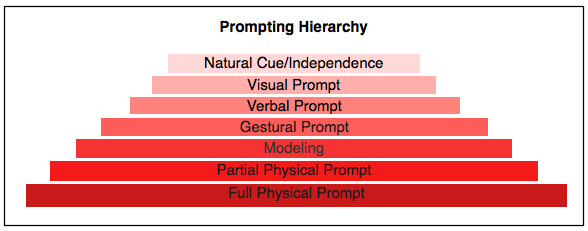
Let’s start with the prompt itself. There are many different ways to prompt which can be divided into levels by how intrusive the prompt is. Below is a sample of a prompt hierarchy, with the least intrusive prompt at the top and the most intrusive prompt at the bottom. Your goal is to quickly move through the prompt levels to move your learner to independence.

Prompting Hierarchy

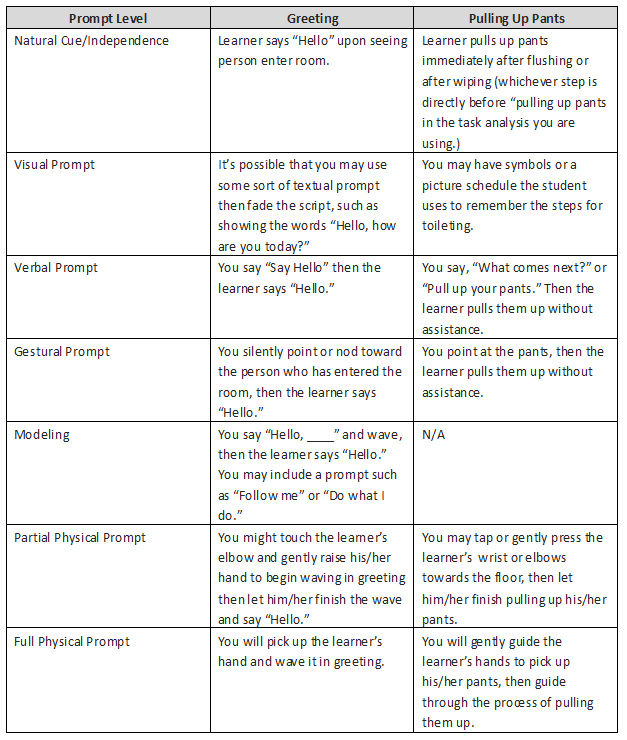
Now let’s look at two different examples to show these prompt levels. In the first example, the goal is for the learner to greet a person who walks into the room. In the second example, the goal is for the learner to pull up his/her pants after using the bathroom as a part of a toileting routine.

Prompt Chart

Research shows that least-to-most prompting increases potential for errors and slows down rate of acquisition for new skills. Therefore, most-to-least prompting is preferred for teaching new skills. This means that you would start at a full physical prompt, then move your way up the prompt heirarchy until your learner achieves independence with the task.

In the past, when working with discrete trials, it has been common practice to have a learner master a skill at a certain prompt level, then move to a less intrusive prompt and have the learner master the skill at that prompt level, steadily moving towards independence. This can actually encourage prompt dependence because the learner remains on the same prompt level for too long.

Instead, you should try to quickly move up the prompt hierarchy in a way that makes sense for the skill you are trying to teach. Below are some tips to help you help your learners achieve independence.

  • Follow the rule of three: Whether you are teaching with discrete trials or in the natural environment, once your learner has successfully responded to a demand three times consecutively, move to a less intrusive prompt.
  • If you are taking data, make a notation of what prompt level you are using at each step. (And remember, that only independent responses should be counted towards the learner’s percentage of correct responses.)
  • At the end of a session or group of trials, note what prompt level you were at by the end of the session. Then start at that level during the next session.
  • If your learner does not respond correctly when you move to a less intrusive prompt, then move back to the most recent prompt level. Once they respond again correctly at that prompt level three times consecutively, move again to a less restrictive prompt.
  • Remember that verbal prompts are very difficult to fade. Though they are less instrusive, you should avoid using them when possible.
  • You can pair prompts and then fade out the more intrusive prompts. For example, with the sample of pulling up pants described above, you can pair a visual prompt with a gestural prompt by showing the symbol for pulling up pants while pointing at the pants. Over time, you stop using the symbol and just use the gestural prompt. The gestural prompt can be faded by moving your point further and further away from the pants.
  • Write down what the prompt levels will look like for the specific task you are teaching. This way you will be fully prepared to quickly move your learner towards independence.
  • Differentiate your reinforcement! If you move to a less intrusive prompt and the learner responds correctly, then you should immediately provide a stronger reinforcer than you did for previous responses. If a learner spontaneously responds without a prompt, you should do what I call “throwing them a party” by combining reinforcers (such as tickles and high fives) or providing a highly desirable reinforcer.

Prompting can be very difficult to do well, but following these tips should help set your learner on the path to independence.