Pick of the Week: Talk Blocks & Boards

We’ve loved these Talk Boards and Talk Blocks since we first laid eyes on them for the myriad possibilities they offer to fully customize a lesson or activity for each student. They’re designed to fit perfectly with the Basic Vocabulary, Alphabet, Kindergarten, and First Grade Vocabulary Photo Card Sets.

The Talk Boards  are double-sided with write-on/wipe-off surfaces and come in a set of 3. You can record a 10-second message for each one enabling you to get creative in endless, fun ways!


The Talk Blocks come in a set of 5, each a unique color, and you can record 30-seconds for each one to adapt activity instructions, assess or reinforce skills.

This week only, save 15% on all Talk Boards and Blocks as well as the 4 sets of Vocabulary Cards – Alphabet, Basic, Kindergarten and First Grade – by entering the Promo Code BLOGTBT2 at checkout.


*Offer expires on February 28, 2012 at 11:59 pm EST. Not compatible with any other offer. Be sure there are no spaces after the Promo Code when you enter it at checkout.


AUTISM PARTNERSHIP’S LATEST STUDY PROVES SUCCESS OF INTENSIVE THERAPY

AUTISM PARTNERSHIP’S LATEST STUDY REVEALS PROMISING TREATMENT RESULTS IN CHILDREN WITH AUTISM SPECTRUM DISORDER

Historically considered a lifelong disorder, a new study published in “Education and Treatment of Children,” reveals that intensive behavioral treatment can have life-changing results for children with Autism Spectrum Disorder. (www.autismpartnership.com)


Autism Spectrum Disorder (ASD) has been regarded as an extremely serious disorder that severely impacts the lives of children and their families.  The prognosis has been bleak at best and the future was one of restricted opportunities. Although treatment based upon Applied Behavior Analysis (ABA) has provided strong evidence as to its effectiveness, many of these studies fell under harsh scrutiny and were considered controversial across the field. However, a new study conducted by Autism Partnership to be published in Education and Treatment of Children answers many of these critiques and criticisms.

The study, which tracked 64 students ranging from age 1.5 to 8 years, spanned four countries – the United States, the United Kingdom, Hong Kong and Australia. Each child underwent an average of 22.5 hours of ABA treatment weekly (provided in schools, homes and clinics) for roughly 3.5 years. The results demonstrated that 45 out of the 64 children’s IQ’s increased an average of 22.5 points.  Such a significant increase demonstrates not only the effectiveness of intervention but is predictive of future success in school.  Moreover, these children were able to successfully participate in general education classrooms.

                “It is so gratifying to be part of life changing treatment which will enhance the quality of children and families lives,” says Dr. Ronald Leaf, lead author of this study.  “But parents should understand that this treatment is not a miracle nor is it easy.  It is a long journey, with ups and downs and numerous challenges to overcome. It requires everyone who touches the child’s life to work together in partnership.”

                Autism Partnership is one of the nation’s premier agencies dedicated to providing intensive behavior intervention for children with autism and their families. Established in 1994 by world-renowned psychologists Ron Leaf and John McEachin, Autism Partnership offers a comprehensive program and a variety of proven services, including in-home, in-classroom and one-on-one, as well as lectures and workshops. All programs are handled by expert staff and tailored to each individual child, family and caregiver, with the goal of helping that child achieve their best life. For more information, visit www.autismpartnership.com.


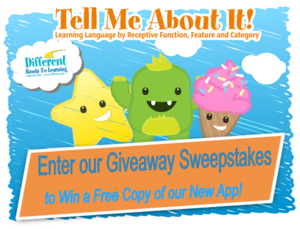
Tell Me About It! Sweepstakes – Win A Free Copy of Our New App!

 Different Roads to Learning is thrilled to offer you the chance to win a free copy of our latest iPhone/iPad App for teaching language to students with Autism or speech and language delays: Tell Me About It! Learning Language by Receptive Function, Feature & Category. This special offer ends on February 17, 2012 at 11:59 PM EST.

 Tell Me About It! teaches the label, category, function, and features of more than 235 language targets over 6 levels of incremental difficulty with over 1000 unique testable attributes. The presentation of each language target conforms to an Applied Behavior Analysis (ABA) discrete trial program, with reinforcement provided by a token economy system. Once the user collects the given number of tokens, they are rewarded with an adorable 5-10 second animation clip of the token character.

 Tell Me About It! provides a self-contained discrete trial program that error corrects and provides direct reinforcement to the student while collecting and synthesizing data for up to 10 students. There is a Student Report Card in the format of a data sheet that displays data for each student, with an option to email the results.

For complete details on our sweepstakes and to enter, click here! 

Currently, our new app Tell Me About It!is being sold in the iTunes store for $9.99. You have the chance to win it for free by entering our Sweepstakes!

 To learn more about Tell Me About It!, visit the store in iTunes by clicking here! 


Pick of the Week: Music In My Mouth Manual & CD

Music In My Mouth presents 26 original songs along with a user’s manual that have been designed by speech-language pathologists, early childhood educators, and families to teach and practice the skills for developing communication skills. Competence in communication is essential for a child’s personal, social, and academic success. The songs target sound production, language skills, fluency, social communication and play skills. The 64-page manual provides tips on how to integrate the songs in individual therapy sessions, group speech therapy, in the classroom, at home, or even in the car.

This week, save 15% on Music In My Mouth by entering the Promo Code BLOGMIM2 at checkout.

*Offer expires on February 14, 2012 at 11:59 pm EST. Not compatible with any other offer. Be sure there are no spaces after the Promo Code when you enter it at checkout.

Share Your Experience: Call for Photos


Would you like to be featured in the next Different Roads catalog? We’d love to shine a spotlight on you and your child’s journey. Send us a photo of your students using your favorite product from Different Roads. Or send us one that captures your child’s triumphs, both large and small. We’ll be honoring your experience in our next issue.
 
If you’re interested in participating, send a photo with your name and contact information to abigail@difflearn.com with the subject line CATALOG PHOTO.


Different Roads Introduces ‘Tell Me About It! Learning Language By Receptive Function, Feature & Category’ – An iPhone/iPad App

We’re thrilled to introduce you to our latest iPhone/iPad App for teaching language to students with Autism: Tell Me About It! Learning Language by Receptive Function, Feature & Category.

Tell Me About It! teaches the label, category, function, and features of more than 235 language targets over 6 levels of incremental difficulty with over 1000 unique testable attributes. The presentation of each language target conforms to an Applied Behavior Analysis (ABA) discrete trial program, with reinforcement provided by a token economy system. Once the user collects the given number of tokens, they are rewarded with an adorable 5-10 second animation clip of the token character. Tell Me About It! provides a self-contained discrete trial program that error corrects and provides direct reinforcement to the student while collecting and synthesizing data for up to 10 students. There is a Student Report Card in the format of a data sheet that displays data for each student, with an option to email the results.


 Categories

The App covers 15 categories of language targets that include: Animals, Body Parts, Clothing, Food, Household Items, Dishes, Utensils, Tools, Toys, School Supplies, Sports, Vehicles, Accessories, Furniture, and Musical Instruments.


Levels
The App advances from the basic building blocks of language – simple labeling – all the way through shared features across categories. The Levels presented in incremental difficulty are: Labels; Categories; Function; Feature; Randomized Feature, Function, Category; and Shared Featured, Function, Category.


Teacher’s Console
Teachers and parents can delve into the Teacher’s Console to control the settings for each student by turning the written labels for each language target ON/OFF, selecting a specific token character, selecting the default Level, and choosing a Reinforcement Schedule.

There is even a motion that administrators can use while a game is in progress to access the Teacher’s Menu to adjust the settings or view reports. To access the Teacher’s Bar, simply swipe 2 fingers in an upward motion from the bottom of the screen up.  


Reinforcement Schedule

The Reinforcement Schedule determines how many targets the student must answer correctly in order to complete a trial session and receive a 5-10 second animation reward.  There is an option for 3, 5, or 10 tokens and you can even select the token character you want or keep the default setting of Random.


Reward

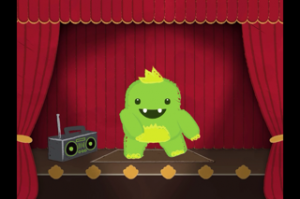
Once the student obtains the set number of tokens, they are rewarded with an adorable and engaging animation clip, complete with stimulating images and sounds.


Reporting & Data

Tell Me About It! tracks each student’s progress and provides a report after every trial as well as a comprehensive Report Card accessible in the teacher’s console. You’ll see a + for every correct response and a – for incorrect ones. If a student hasn’t yet mastered a target, you’ll see the number of presentations in parentheses after the score. You can also email the Report Card to share data and progress.


Determining Mastery of Targets

This App strives to mimic an actual one-on-one instructional session with a therapist as much as is possible in an application. For this App, we determine which targets will be defined as mastered by the program in a variety of ways depending on how many times they have been presented.  When answered correctly on the very first presentation, the student receives both a token and verbal praise and that target is considered “known” or mastered and not presented again on that level.  If the answer is not correct on that first presentation, the target will be reintroduced in subsequent trials and must then be answered correctly on two different, consecutive presentations to be considered mastered. When an incorrect response is given, error correction is provided by having the correct image flash while auditory correction is also provided. The App then shuffles the placement of the images, and re-presents the same question. If the student answers correctly on this second attempt, they receive verbal praise only (no token) and then move to another question.  Note that your Data sheets will display, in parentheses, how many times each target has been presented so that you are always aware of your student’s progression and where there might be deficits.

 To Purchase


To purchase Tell Me About It! for $9.99, visit the App store in iTunes by clicking here!


Other Apps

We’re proud to offer two other quality Apps for developing language and cognitive skills.

What Goes Together?

This app teaches young learners early association skills, relationships, reasoning by asking them to match what items go with others.


What’s That Sound? Learning to Listen and Identify Sounds

This app develops auditory processing and listening skills. Hear a sound and touch the image of what makes that sound.
Pick of the Week: Sign to Talk Nouns Flashcards

Sign to Talk: Nouns presents 150 photographic flashcards designed to shape verbal language specifically for individuals with autism and other developmental challenges. These cards are ideal for their crisp, clear images and their Kaufman Speech Praxis word shell breakdowns which help to shape articulation skills on the back of each card. The set offers myriad teaching opportunities as each card also depicts a photo of a person demonstrating the sign in ASL and a description of the hand shapes for each target item. Use this deck for home or school, to teach sign manding, or for the child-appropriate images that aid in any language acquisition program.

This week only, save 15% on the Sign to Talk: Nouns by entering the Promo Code BLOGSTN at checkout.

*Offer expires on February 7, 2012 at 11:59 pm EST. Not compatible with any other offer. Be sure there are no spaces after the Promo Code when you enter it at checkout.

Individualized Token Economy Systems – Strategies for Teaching Students with ASD by Autism Partnership

Individualized Token Economy Systems

 At Autism Partnership we have found the development and implementation of individualized token economy systems to be a powerful tool in accelerating progress for our students. Token economies have been shown to be an extremely effective contingency management system for a variety of populations. Initially, Ted Allyon used token economies to provide consequences to hospitalized mentally ill residents. The procedure proved to be extremely effective and quickly token systems were utilized with other populations exhibiting challenging behavior problems, including “delinquent” adolescents (Montrose Wolf) and mentally retarded adults (Nathrin Azrin).

Today, token economies are used to address a variety of behavioral concerns including those of children with Attention Deficit Disorder and Autism Spectrum Disorder as well as typically developing children. Token economies have been so widely recognized as effective and efficient behavior management strategies to such a degree that they are routinely being employed in general education classrooms throughout the world. (Star Charts, Table Points, Marble Jar).

Tokens are symbols (e.g., points, coins, stickers, ticks or check marks, toy parts, etc), which are delivered immediately after a target response and are exchanged later for an item or activity of preference. Tokens therefore symbolize access to other preferred items or experiences, technically referred to as “generalized reinforcement”. Initially the tokens in and of themselves are not rewarding but once the student understands that tokens can be “exchanged” for preferred activities, their value is established. A daily life example of this process would be our use of money which allows us to purchase desired items or experiences. Creative systems often use motivating tokens such as pictures of favorite cartoon characters, athletes or musicians. Pictures of the target behavior can be used as the symbol as well. The tokens are clearly displayed, allowing the student to always see how many they have earned, and how many more they need to earn until reinforcement will be delivered.

This is part of a guest series by Autism Partnership founders Ron Leaf, John McEachin and Mitchell Taubmann. Established in 1994, Autism Partnership is one of the nation’s premier agencies dedicated to providing intensive behavior intervention for children with autism and their families. They offer a comprehensive program and a variety of proven services, including in-home, in-classroom and one-on-one, as well as lectures and workshops. All programs are handled by expert staff and tailored to each individual child, family and caregiver, with the goal of helping that child achieve their best life. For more information, visit www.autismpartnership.com.

Reinforcement Development – Strategies for Teaching Students with ASD by Autism Partnership

Reinforcement Development

 When discussing the importance of reinforcement often parents and teachers alike will comment that reinforcement doesn’t work because there is nothing that the child finds to be reinforcing.   Often this is not accurate: there are lots of potential reinforcers but they are receiving them for “free.”  That is they are not earned or technically they are not contingent.  They watch TV, play on the computer or go on an outing without them being earned.  If they were made to be contingent upon behavior they would indeed change behaviors.  Moreover, there are often many things that could be reinforcers but if the student doesn’t know how to play with, say, the toy, therefore it too is not a reinforcer. 

Identifying reinforcers often requires creativity.  By “definition” children with ASD enjoy self-stimulation.  Perhaps their self-stimulation can be used as a reinforcer.  For example, you may provide them the opportunity to line up objects, sift sand or perseverate on a topic as a reinforcer.  As another potential reinforcer you can bother them by making demands and intruding upon their space and then leaving them alone can serve as the reinforcer.

Naturally, if you were to use self-stimulation or escape as a reinforcer, you would want to use this as a means to develop other reinforcers.  For example, when engaging in self-stimulation you may associate it with music so that music eventually becomes a reinforcer.  Association can also be used with escape.  For example,  when they escape a demand,  direct them to play on the computer thereby making the computer a reinforcer.

Whether a student has established reinforcers or if truly there is nothing that is reinforcing, it is necessary to develop reinforcers.  But it takes creativity and being highly systematic!  The following are a few ideas on how to develop reinforcers:


  •  Sometimes reinforcement development can be as simple as exposing the child to potential reinforcers. 
  •  Giving free access to potential reinforcers can also create new reinforcers. 
  • An effective way to develop reinforcers is to associate potential reinforcers with established reinforcers.
  •  The “packaging” of the reinforcer can is another strategy to develop reinforcers.  Often you can “sell” the reinforcer by being enthusiastic and playful. 
  • Assessing what the student likes and then creating reinforcers based upon interests can create reinforcers. 

Giving students choices can be effective in the development of the reinforcement.  Simply giving a student a choice of which of two toys he would like to play with can have the effect of making the selected toy as a reinforcer. 

This is part of a guest series by Autism Partnership founders Ron Leaf, John McEachin and Mitchell Taubmann. Established in 1994, Autism Partnership is one of the nation’s premier agencies dedicated to providing intensive behavior intervention for children with autism and their families. They offer a comprehensive program and a variety of proven services, including in-home, in-classroom and one-on-one, as well as lectures and workshops. All programs are handled by expert staff and tailored to each individual child, family and caregiver, with the goal of helping that child achieve their best life. For more information, visit www.autismpartnership.com.

Teaching Interactions – Strategies for Teaching Students with ASD by Autism Partnership

Teaching Interactions

 Teaching Interactions (TI’s) are another instructional format that can be invaluable in teaching children skills.  This instructional technique was developed at the University of Kansas as part of the Teaching Family Model for delinquent youth.  TI’s have several benefits as it allows for structured training of more complex, often sophisticated skills in a highly natural, interpersonal, expanded conversational format.  TI’s are designed to teach complex skills (e.g., social skills, problem solving, etc.).  They utilize shaping and reinforcement to teach a skill and rely on a task analysis format.  The teaching style is typically conversational and flexible in nature, providing the student multiple opportunities to participate in the teaching process.  Although flexible, the technique approaches teaching skills systematically, and requires planning for generalization.  Following are the 6 steps of a TI and both guidelines and considerations when utilizing this teaching technique.


  • Initiation & Labeling
  • Rationale
  • Demonstration
  • Practice
  • Feedback
  • Consequences

This is part of a guest series by Autism Partnership founders Ron Leaf, John McEachin and Mitchell Taubmann. Established in 1994, Autism Partnership is one of the nation’s premier agencies dedicated to providing intensive behavior intervention for children with autism and their families. They offer a comprehensive program and a variety of proven services, including in-home, in-classroom and one-on-one, as well as lectures and workshops. All programs are handled by expert staff and tailored to each individual child, family and caregiver, with the goal of helping that child achieve their best life. For more information, visit www.autismpartnership.com.