Online Briefs & Learning Modules for Evidence-Based Treatment Strategies

The National Professional Development Center on Autism Spectrum Disorders holds an impressive wealth of information and resources for evidence-based practices for children with autism. We wanted to share their website as a resource to both parents and providers, since evidence-based strategies are so important in devising a home or school-based program for students with ASD. Specifically, we found the online learning and training modules by the NPDC on ASD to be extremely useful and – even better – accessible to anyone online.

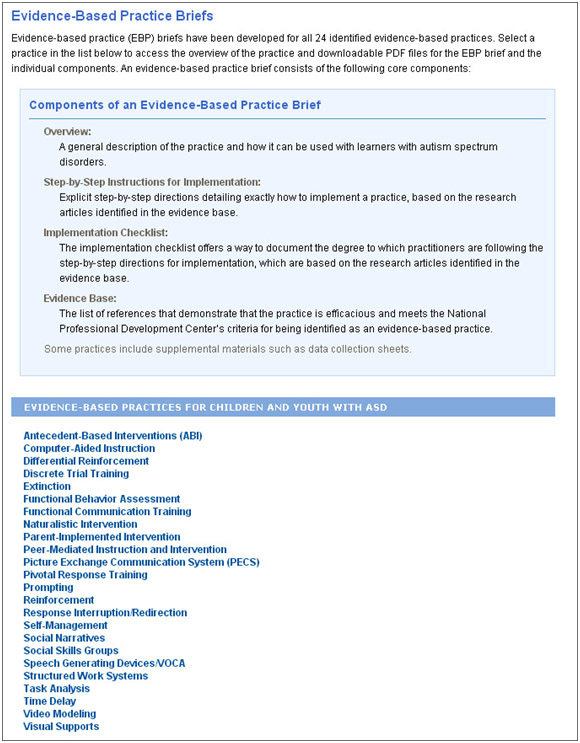
For the following evidence-based practices (EBP), the NPDC on ASD has developed briefs with the following components:

  • Overview of the practice
  • Step-by-step instructions for implementation
  • Checklist to document the degree of implementation
  • References that support the efficacy of the practice

Each brief package comes in downloadable PDF formats for easy saving and printing. Some practices also come with downloadable data collection sheets and supplemental materials for teachers to use.
EBP Briefs 1

Additional resources provided by the NPDC on ASD include Learning Modules to accommodate children in early intervention (birth to 3 years).  The 10 Learning Modules touch upon:

  1. Discrete Trial Training (DTT)
  2. Functional Communication Training (FCT)
  3. Naturalistic Intervention
  4. Parent-Implemented Intervention
  5. Picture Exchange Communication System (PECS)
  6. Pivotal Response Training (PRT)
  7. Prompting
  8. Reinforcement
  9. Structured Work Systems
  10. Time Delay

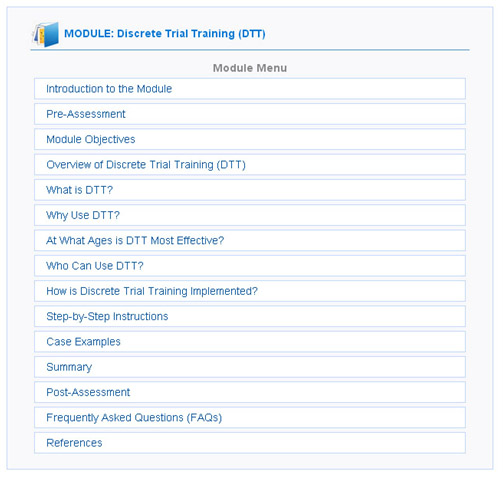
Each module includes a pre-assessment, objectives, an overview of the evidence-based practice, detailed information about the use of the EBP, step-by-step instructions for implementing the practice, case studies, a summary, a post-assessment, frequently asked questions, and references at the end.
EBP Briefs 2

For more information on the NPDC, visit their website at www.autismpdc.fpg.unc.edu. 
Pick of the Week: NEW! Executive Function Curriculum Books

How can you help kids with autism be flexible, get organized, and work toward goals – not just in school but in everyday life? It’s all about executive function. This week, we’re offering 15% off* our newest books on teaching executive function: Unstuck & On Target: An Executive Function Curriculum and Solving Executive Function Challenges. Just use our promo code EXECFXN at check out to redeem these savings!

Unstuck_and_On_TargetThese practical resources for parents, teachers, and therapists help high-functioning students with autism improve on these critical skills.
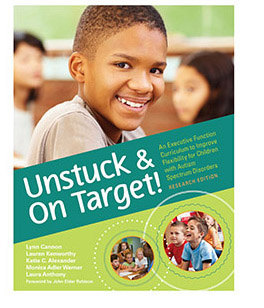
Unstuck & On Target! is a robust classroom-based curriculum book that will help educators and service providers teach these executive function skills to high-functioning students with autism through ready-to-use lessons that promote cognitive and behavioral flexibility. This curriculum gives clear instructions, materials lists, modifications for each lesson, and intervention tips to reinforce lessons throughout the school day. Topics touched upon include flexibility vocabulary, coping strategies, setting goals, and flexibility in friendship, all introduced and reinforced with evidence-based lessons. Lessons will target specific skills, free up the instructor’s time, fit easily into any curriculum, ensure generalization to strengthen home-school connection, and best of all, make learning fun and engaging for students in the classroom.

Unstuck & On Target! also comes with an accompanying CD-ROM that contains printable game cards, student worksheets, and other materials for each lesson. The curriculum is targeted for students with cognitive ability and language skills ages 8-11.

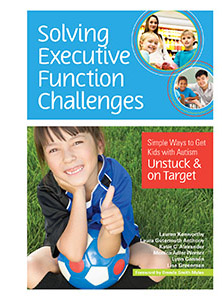
Solving_Executive_Function_ChallengesSolving Executive Function Challenges is a strategy guide that offers teachers and caretakers various ways to teach EF skills, including setting and achieving goals and being flexible, as well as ideas for accommodations and actions to address common problems (e.g. keeping positive, avoiding overload, coping, etc.).

To be used with or without the robust curriculum Unstuck and On Target!, this strategy guide aims to show how to embed executive function instruction in everyday scenarios with specific examples, samples IEP goals, and scripts and worksheets that break down tasks into manageable chunks. This guide is appropriate for learners in grades K–8.

Don’t forget – you can save 15%* this week only on these new executive function books by applying promo code EXECFXN at check out!

*Offer is valid until 11:59pm EDT on October 7th, 2014. Not compatible with any other offers. Be sure there are no spaces or dashes in your code at check out!

Pick of the Week: “Classifying with Seasons” Fun Deck – Teach time concepts with match-up games and more

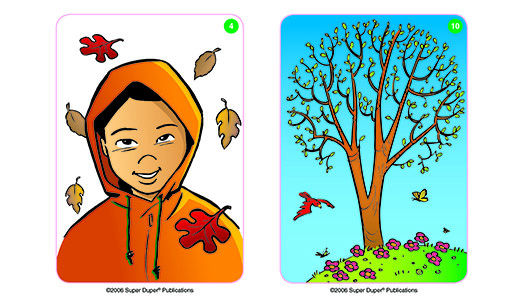
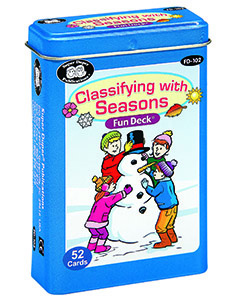
Classifying with SeasonsWinter, Spring, Summer, or Fall… What happens in each season and what do you need for it? With the changing season and cooler days, we thought it was the perfect time to share our newly added Classifying with Seasons Fun Deck as our Pick this week. The Classifying with Seasons Fun Deck contains 13 illustrated cards for each season, depicting holidays, activities, clothing, and weather that might occur. This week, take 15% off* your set of Classifying with Seasons by entering our code CLASSIFY at check out!

Use the Classifying with Seasons Fun Deck to teach time concepts, categorizing, and more. These cards come in a sturdy tin, and make great match-up games, as well as conversation and story starters.

Fall Examples

This week only, don’t forget to save 15%* on your deck of the Classifying with Seasons cards by entering promo code CLASSIFY at check out!

*Offer is valid until 11:59pm EDT on September 30th, 2014. Not compatible with any other offers. Be sure there are no spaces or dashes in your code at check out!

Pick of the Week: Unifix Cubes & Workbook with CD – Hands-on early math activities

Perfect for early counting and mathematical operations, our newly added Unifix Cubes and accompanying Mathematics for Unifix Cubes Workbook and CD: Kindergarten will provide numerous activities and games for teaching young learners early math concepts. This week only, save 15%* on your set of Unifix Cubes and/or the accompanying Mathematics for Unifix Cubes Workbook and CD-Rom by entering our code UNIFIX at check-out.

Each set of Unifix Cubes contains 300 cubes in 10 assorted colors: red, dark blue, light blue, yellow, green, orange, maroon, brown, black, and white, great for teaching math concepts such as patterning, addition, subtraction, multiplication, division, and much more.

Your 90-page Mathematics for Unifix Cubes Workbook and CD: Kindergarten provides ready-to-use activities for early math, including worksheets, games, cards, and full teaching instructions, assessment, and extension suggestions. The accompanying CD-Rom contains a digital version of the workbook, as well as virtual Unifix Cubes that can be projected on the computer to make rods, patterns, and more.

Don’t forget to use promo code UNIFIX at check-out to save 15%* this week on your set of Unifix Cubes and Mathematics for Unifix Cubes Workbook and CD!

*Offer is valid until 11:59pm EDT on September 23rd, 2014. Not compatible with any other offers. Be sure there are no spaces or dashes in your code at check out!

Pick of the Week: Prepositions StoryCards—Learn basic prepositions & sequencing through storytelling!

Learn and practice using basic prepositions with creative storytelling with story cards and finger-puppets! You can also save 15%* this week on Prepositions StoryCards by using our promo code PREPOS2 at checkout. This set of 48 beautifully illustrated cards is designed to develop children’s understanding of basic prepositions such as in, on, under, above, below, and around.

With only illustrations and no words, Prepositions StoryCards promotes expressive language in storytelling form, and each story is flexible to your student’s standards. An accompanying booklet includes suggested stories for each of the 4 sets of story cards, as well as approaches for building and reinforcing preliminary concepts, developing verbal comprehension, improving attention and listening skills, expanding expressive language and vocabulary, and sequencing.

Four felt finger-puppets depicting the main character in each story are also included as an interactive and playful tool for reinforcing preliminary concepts.

Don’t forget to take 15%* off your set of Prepositions StoryCards when you order it online or by phone with promo code PREPOS2 at checkout!


*Offer is valid until 11:59pm EDT on August 26th, 2014. Not compatible with any other offers. Be sure there are no spaces or dashes in your code at check out!

Modified Instructions for Parachute Play

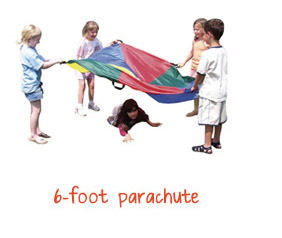
We’re excited to bring you the sixth installment of our series of Modified Instructions, created by Sam Blanco, BCBA. In this installment, we’re introducing Sam’s Modified Instructions for Parachute Play. Our bright and colorful parachutes are perfect for motivating young learners during the summer holidays.

   6ft-Parachute 12ft-Parachute

Continue reading →

Pick of the Week: “The Cow Says Moo” – 10 Tips to Teach Your Toddler to Talk

Teach your child to communicate with words and expand his or her language skills with the new early intervention guide The Cow Says Moo. And this week only, you can take 15% off* your purchase of The Cow Says Moo by entering in our promo code MOO15 at check out!

The Cow Says Moo is an early intervention guide that teaches parents easy-to-use, common-sense strategies for helping their children learn to communicate. The 10 tips and appendices filled with songs, checklists, and resources rely on the same methods that practitioners use when providing direct home-based speech therapy to toddlers and their families.

Tips focus on things like giving your child a reason to talk, using sign language, oral motor exercises, finding the right word, pairing movement with sound and more.

This simple guide delivers speech therapy activities that any parent can implement right away.

Save 15%* on your order of The Cow Says Moo this week by mentioning or entering in promo code MOO15 at checkout.

*Offer is valid until 11:59pm EDT on July 1, 2014. Not compatible with any other offer. Be sure there are no dashes or spaces in your code at check out!

Different Roads iOS Apps Now Feature Family Sharing

Apple has recently introduced a new Family Sharing feature, which allows up to 6 family members to browse and access each other’s iTunes, iBooks, and App Store purchases, as well as share photos, calendars, and locations with each other. We’re excited to announce that all of our Different Roads apps in the iTunes App Store have also begun to support this feature. Family Sharing also includes parental controls, enabling parents to approve purchases and downloads initiated by children first.

Different Roads to Learning Apps

Clean Up Cateogory Sorting AppClean-Up: Category Sorting  This highly-rated interactive program develops language, reasoning, and sorting and classifying skills in young learners. Players must “clean up” by putting 75 photographic images of toys, food, and clothing away in the correct shopping cart, refrigerator, or toy box. Each target is introduced by its label (“Where does the Apple go?”) in each round where players see 15 unique images. Correct responses receive visual and auditory reinforcement while incorrect answers are corrected by a visual prompt of the correct answer flashing. This app builds foundational sorting skills for students just developing their sorting and classifying skills. Available on iPhone and iPad.

Whats that Sound App

What’s that Sound? Learning to Listen and Identify Sounds  This interactive and easy-to-grasp game develops auditory discrimination and processing skills in young learners. Players will improve their skills by matching objects and their associated sounds. Simple auditory processing skills lay the foundation for learning how to read, speak and spell.
Available on iPhone and iPad.


What Goes Together App

What Goes Together?  This interactive program develops language, discrimination, and reasoning skills in young learners. Clear, colorful images of everyday objects promote an understanding of functions and the relationships between items that children encounter on a daily basis. With built-in reinforcement and error correction, this game provides a solid foundation in building critical expressive and receptive language skills. Available on iPhone and iPad.

Tell Me About It App

Tell Me About It!  Featured as Editor’s Choice on Best Apps for Kids, this universal app is specifically designed for children with autism and other speech and language delays. Based on the Applied Behavioral Analysis approach, this program mimics an actual one-on-one instructional session with a therapist. The app provides 15 categories of language targets, such as body parts, household items, clothing and food, and six levels of difficulty, which progressively become more difficult, from labelling to shared feature, function, and category. This app also features an easy-to-read report card, which provides tracking data for each child and an option to e-mail the report card results. Available on iPhone and iPad.

To discover all of our current apps and what Family Sharing can do for your family, visit our iTunes App Store page.

Pick of the Week: “Expanding and Combining Sentences” Interactive Workbook

For students who are already able to talk or write in simple, choppy sentences, this interactive workbook will open gateways to success in language and literacy! Save 15%* on your purchase of Expanding and Combining Sentences by speech and language pathologist Marilyn M. Toomey this week only, by applying or mentioning our promo code EXPAND8 at check out!

Color picture pages, along with specific instructions, provide a means of evoking interesting and descriptive sentences from students.

Students will learn how to expand their sentences by using the color cues provided in the book, as pictures become progressively colorful and a new detail is added to the sequence. In no time at all, young learners will be able to tell an entire story by using complex and detailed sentences!

97 pages in total with 40 colored pages.  Preview the book.

This interactive workbook will be the perfect resource to teach the challenging task of making sentences more interesting with descriptive words.  Don’t forget – this week only, take 15% off* your order of Expanding and Combining Sentences by applying code EXPAND8 at checkout!

Marilyn M. Toomey is also the author of several other popular speech and language workbooks, such as Talking in Setences, Verbal Reasoning Activities, The Language of Perspective Taking, and much more.

*Offer is valid until 11:59pm EDT on 6/10/2014. Not compatible with other offers. Be sure there are no spaces or dashes in your code at checkout!

Teaching Functional Living Skills to Children with Autism at the Grocery Store

We hear over and over again how children with autism may need hundreds or even thousands of opportunities to practice a skill before acquiring it. It’s important to keep this fact in mind when it comes to functional living skills (e.g. making the bed, cooking a meal, etc.). Many of the parents I work with prefer to focus on academic skills rather than functional living skills. Some feel that by focusing on functional living skills, they’re giving up on larger goals for their child, such as being placed in a general education environment, having the opportunity to go to college, and/or having the opportunity to have a career.

I always encourage parents to focus on both academic and functional living skills. While it may seem unnecessary to start thinking about teaching a nine year old how to grocery shop, it’s really just providing them with many, many opportunities to practice the skill. Typically developing children “practice” grocery shopping from a young age by watching their parents and playing “store” with friends, but children with autism are unlikely to observe their parents while they’re shopping or to play such games as “store” without explicit instruction. By practicing the skill with your child early on, you’re promoting future independence.

You can practice these skills when you are in the grocery store with your child, and you may just find that your child enjoys shopping. (Grocery shopping is a favorite activity for two of my current students.) It may be beneficial for you to just start out with one skill, choosing the one you think your child is the most likely to experience success with or that your child will be the most motivated by.

 BEGINNER SKILLS
  • Choosing if you need a cart or a basket (Is our list long or short? Do we have big or small items?)
  • Using a grocery list (reading the list, crossing off items already placed in cart/basket)
  • Using supermarket signs to find items (understanding categories, knowing where to look for signs)
  • Greeting cashier
 INTERMEDIATE SKILLS
  • Choosing good fruit or vegetables (looking for bruises, identifying ripeness)
  • Giving money to cashier
  • Accepting change from cashier
  • Taking bags when it’s time to leave
 ADVANCED SKILLS
  • Comparison shopping (looking at unit price, comparing prices of two brands)
  • Making sure you received correct change
  • Returning an item that is damaged

You shouldn’t limit these skills to just the grocery store either. All of these skills are useful in department stores, pharmacies, book stores, and more. Your child may be more motivated to use these skills at the book store or a toy store. You can help your child learn the skills there, then generalize them to other types of stores.

If you need help getting started, you should ask your child’s teacher or therapist to accompany you on your first trip. They can help you identify the appropriate steps to put your child on the path to independence.