Many parents and teachers struggle with addressing vocal stereotypy or “scripting” in children with autism. Since stereotypy is frequently automatically reinforcing, (meaning that the behavior is maintained by the sensation produced by the behavior) it is especially difficult to address. While this type of behavior does occur in typically developing children (think of a young child singing the same song repeatedly for several weeks or a toddler repeating a newly learned sound) there is concern that this behavior persists in children with autism and other developmental disabilities in such a manner that it interferes with learning.
In 2007, William H. Ahearn, Kathy M. Clark, Rebecca P.F. McDonald and Bo In Chung published a study in the Journal of Applied Behavior Analysis entitled “Assessing and Treating Vocal Stereotypy in Children with Autism.” The study defined vocal stereotypy as “any instance of noncontextual or nonfunctional speech and included singing, babbling, repetitive grunts, squeals, and phrases unrelated to the present situation.” It focused on four learners (two boys and two girls) who had autism and were referred for the study because their vocal stereotypy interfered with their ability to learn. The children ranged in age from 3-11. Three of them used speech to communicate while one used PECS.
The study describes potential interventions from previous research before introducing its goal of interrupting the vocal response then redirecting. This is called RIRD – Response Interruption/Redirection. In RIRD, when the child made an inappropriate vocalization, the teacher blocked them by interrupting immediately, then redirecting them to another behavior. The redirection involved prompts for vocal behavior such as saying “Where do you live?” or “Say ‘red.’” When a child made an appropriate vocalization, it was always followed by a teacher comment.
RIRD produced substantially lower rates of stereotypy for all four of the children and an increase in appropriate vocalizations for three of the children. One thing that is striking about these results is that “sessions were 5 min in duration, and two to three sessions were conducted 3 days per week.” This is a degree of time commitment that is replicable in the home or school environments.
If your child or student is presenting with stereotypy that interferes with learning, it is valuable to look at this study, as well as similar studies by Cassella, Sidener, Sidener, & Progar (2011) and Athens, Vollmer, Sloman, & Pipkin (2008). Consult with a BCBA or ABA provider for assistance in implementing the intervention.
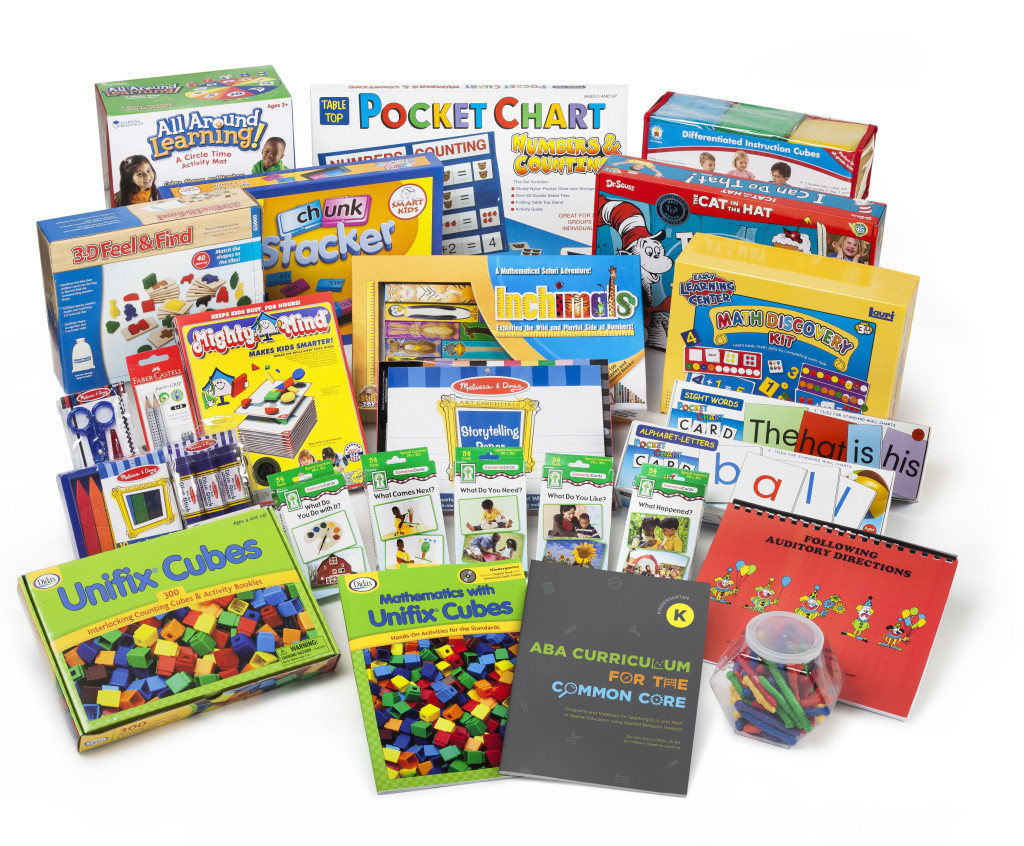
 We’re thrilled to introduce this pioneering curriculum kit containing both the materials and programs to teach each Kindergarten Common Core standard for both English Language Arts and Math. Authored by Sam Blanco, MSEd, BCBA, the curriculum has been created exclusively for students in special education settings using the evidence-based principles of Applied Behavior Analysis (ABA).

 Do you know of any upcoming conference or workshops on Autism?! Please let us know of any ABA, Verbal Behavior or Speech-Language Therapy events and we will share it with our community. We strive to help our readers be informed about resources and events for parents and educators of children with autism or other developmental delays. No matter how big or how small – email info about your event to
 Many students with autism and other developmental disabilities have an IEP that mandates a 1:1 paraprofessional (called an instructional assistant or teaching assistant in some states, but referred to as paraprofessional for the purposes of this article). Recently, I had the opportunity to provide a workshop to a large group of paraprofessionals in New York City. I was surprised to hear how some felt disconnected from the families of their students, especially considering how deep their relationships are with their students.




 Symbolic play refers to a child’s ability to use one object or action to represent a different object or action within imaginary play. The symbolic play skill that involves object substitution typically begins to emerge around 18 months. For example, you might observe a child using an empty box for a “hat” or an overturned bucket for a “drum.” Blocks are a mainstay in early childhood classrooms because the benefits are innumerable. Block play can help to facilitate cooperation, visuo-spatial skills, problem solving ability, social skills, and language development, and is a good predictor of future mathematical abilities.
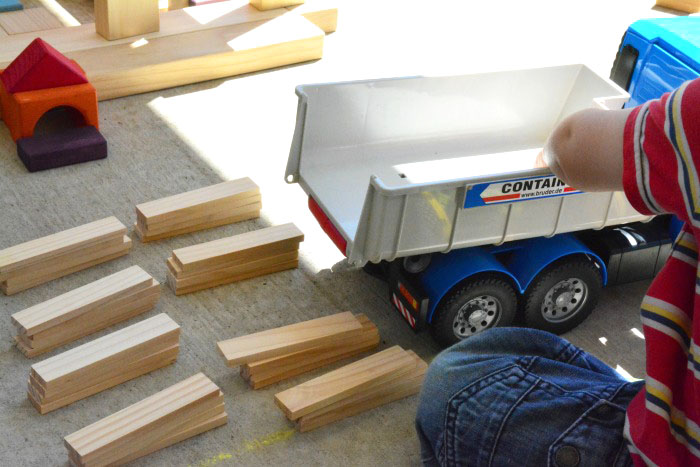 One hallmark of the diagnostic criteria for autism spectrum disorder is a presence of “persistent deficits in social communication and social interaction across multiple contexts, as manifested by difficulties in sharing imaginative play or in making friends.” Additionally, rigid thinking patterns may make symbolic play difficult for children with autism as they might view objects in a limited way that makes it difficult to pretend a block is something other than a block.
 Since unit blocks are a huge component of early childhood classrooms everywhere one could imagine that exposure to them and some level of proficiency opens up huge social opportunities for learners with autism spectrum disorders with their mainstream peers in the classroom.
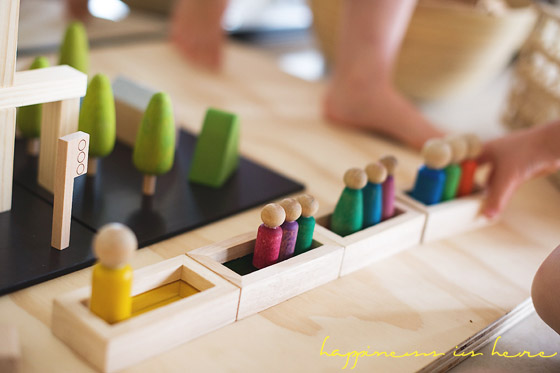 drawings of objects onto the blocks and then systematically fade them out. Once the learner begins to consistently use the blocks with the attached images you can use stimulus fading procedure to fade out the visual prompt. This can be done by photocopying the image and systematically changing the lightness until eventually the learner is presented with just the block.


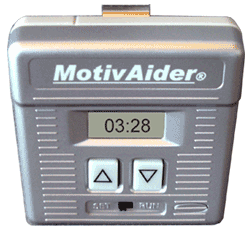 In this study, the researchers worked with a fifth grader with autism, a sixth grader with autism, and a fifth grader with cerebral palsy. They taught the boys to wear the MotivAider (calling it a pager) and note a + or a – to indicate their behavior each time the MotivAider vibrated. The behaviors they monitored were all related to being on-task: “eyes on my work,” “in my seat,” and “doing work.” Once each boy consistently rated his behavior upon feeling the vibration, the researchers implemented the intervention.