How to Assess and Address Pants-Wetting Behavior—A Response to a Teacher’s Question

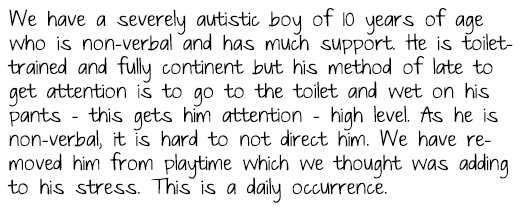
Sometimes we get specific questions from teachers and parents about managing problem behaviors that are quite common. In these cases, we think it can be helpful to share the question and response, so that others in similar situations might benefit from the suggestions offered. Bed and pants-wetting can be an enormously challenging issue both at home and at school, so when we received the following question from a teacher in Australia about her student, we thought it was a great opportunity to offer some suggestions and strategies on how to address the behavior.
PantsWettingQA

This is definitely a difficult behavior to address. It’s also challenging to provide accurate advice without directly observing the behavior, instead here are a few questions to consider and potential resources.

  • First and foremost, this is a behavior in which you should consult with a Board Certified Behavior Analyst for assistance. You can find BCBAs in your area by going to this webpage: https://www.bacb.com/?page=100155. If possible, reach out to more than one to find the BCBA who is the best fit for you and your learner.
  • Second, you should conduct a functional assessment to clearly determine the reason for the behavior. It may be for attention, but you may discover there is a different cause. It is best to perform a formal functional analysis, but if that is not possible, you may consider using the Functional Assessment Screening Tool (FAST). To get the best results from this, you should have more than one person fill it out, and, if possible, one person who observes the behavior but is unfamiliar with the child. Compare results to see if you are in agreement, then make a behavior intervention plan based on the function of the behavior. For more information about the FAST and its reliability compared to a formal functional assessment, you should refer to the study by Iwata, Deleon, & Roscoe (2013).
  • If indeed the behavior is for attention, consider how to provide minimal attention for pants-wetting. You mention that he receives high-level attention right now. What qualifies as high-level for him? Is it eye contact? Physical touch? Proximity? There are ways to remove each of these types of attention while also making sure you address the behavior hygienically.
  • While your son is continent, some of the strategies that are used in toilet training may prove helpful in intervening with this behavior. Take a look at this article by Kroeger & Sorenson-Burnworth (2009), which “reviews the current literature addressing toilet training individuals with autism and other developmental disabilities.” It may provide potential solutions that you have not attempted.

I hope this information is helpful! And good luck as you plan and implement your intervention.


WRITTEN BY SAM BLANCO, MSED, BCBA

Sam is an ABA provider for students ages 3-12 in NYC. Working in education for ten years with students with Autism Spectrum Disorders and other developmental delays, Sam has developed strategies for achieving a multitude of academic, behavior, and social goals. Sam is currently pursuing her PhD in Applied Behavior Analysis at Endicott College.
Online Briefs & Learning Modules for Evidence-Based Treatment Strategies

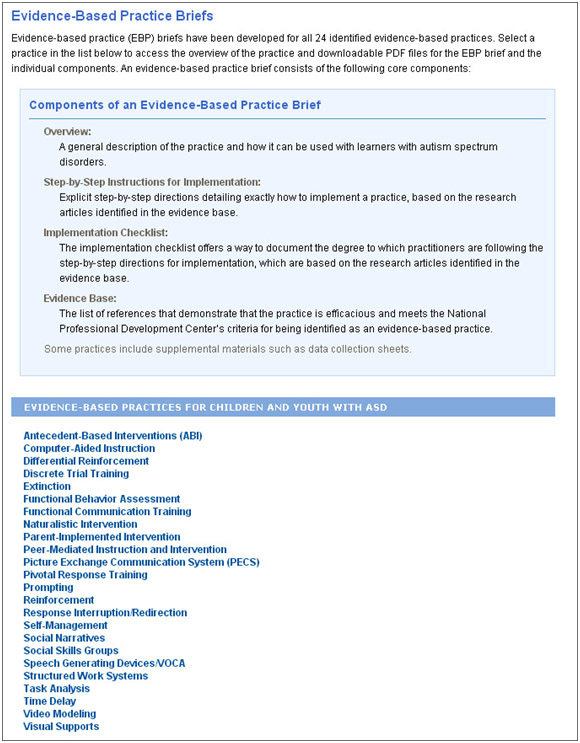
The National Professional Development Center on Autism Spectrum Disorders holds an impressive wealth of information and resources for evidence-based practices for children with autism. We wanted to share their website as a resource to both parents and providers, since evidence-based strategies are so important in devising a home or school-based program for students with ASD. Specifically, we found the online learning and training modules by the NPDC on ASD to be extremely useful and – even better – accessible to anyone online.

For the following evidence-based practices (EBP), the NPDC on ASD has developed briefs with the following components:

  • Overview of the practice
  • Step-by-step instructions for implementation
  • Checklist to document the degree of implementation
  • References that support the efficacy of the practice

Each brief package comes in downloadable PDF formats for easy saving and printing. Some practices also come with downloadable data collection sheets and supplemental materials for teachers to use.

EBP Briefs 1

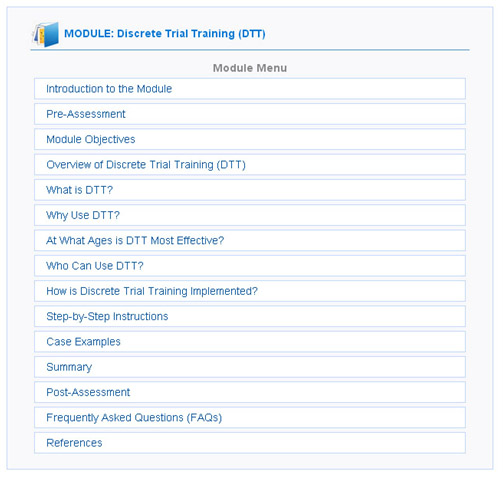
Additional resources provided by the NPDC on ASD include Learning Modules to accommodate children in early intervention (birth to 3 years).  The 10 Learning Modules touch upon:

  1. Discrete Trial Training (DTT)
  2. Functional Communication Training (FCT)
  3. Naturalistic Intervention
  4. Parent-Implemented Intervention
  5. Picture Exchange Communication System (PECS)
  6. Pivotal Response Training (PRT)
  7. Prompting
  8. Reinforcement
  9. Structured Work Systems
  10. Time Delay

Each module includes a pre-assessment, objectives, an overview of the evidence-based practice, detailed information about the use of the EBP, step-by-step instructions for implementing the practice, case studies, a summary, a post-assessment, frequently asked questions, and references at the end.

EBP Briefs 2

For more information on the NPDC, visit their website at www.autismpdc.fpg.unc.edu. 

Pick of the Week: NEW! Executive Function Curriculum Books

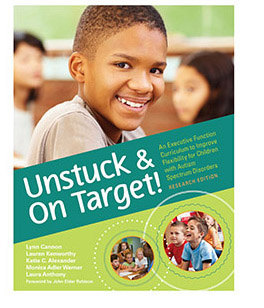
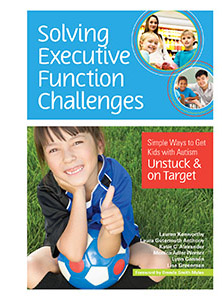
How can you help kids with autism be flexible, get organized, and work toward goals – not just in school but in everyday life? It’s all about executive function. This week, we’re offering 15% off* our newest books on teaching executive function: Unstuck & On Target: An Executive Function Curriculum and Solving Executive Function Challenges. Just use our promo code EXECFXN at check out to redeem these savings!

Unstuck_and_On_TargetThese practical resources for parents, teachers, and therapists help high-functioning students with autism improve on these critical skills.

Unstuck & On Target! is a robust classroom-based curriculum book that will help educators and service providers teach these executive function skills to high-functioning students with autism through ready-to-use lessons that promote cognitive and behavioral flexibility. This curriculum gives clear instructions, materials lists, modifications for each lesson, and intervention tips to reinforce lessons throughout the school day. Topics touched upon include flexibility vocabulary, coping strategies, setting goals, and flexibility in friendship, all introduced and reinforced with evidence-based lessons. Lessons will target specific skills, free up the instructor’s time, fit easily into any curriculum, ensure generalization to strengthen home-school connection, and best of all, make learning fun and engaging for students in the classroom.

Unstuck & On Target! also comes with an accompanying CD-ROM that contains printable game cards, student worksheets, and other materials for each lesson. The curriculum is targeted for students with cognitive ability and language skills ages 8-11.

Solving_Executive_Function_ChallengesSolving Executive Function Challenges is a strategy guide that offers teachers and caretakers various ways to teach EF skills, including setting and achieving goals and being flexible, as well as ideas for accommodations and actions to address common problems (e.g. keeping positive, avoiding overload, coping, etc.).

To be used with or without the robust curriculum Unstuck and On Target!, this strategy guide aims to show how to embed executive function instruction in everyday scenarios with specific examples, samples IEP goals, and scripts and worksheets that break down tasks into manageable chunks. This guide is appropriate for learners in grades K–8.

Don’t forget – you can save 15%* this week only on these new executive function books by applying promo code EXECFXN at check out!

*Offer is valid until 11:59pm EDT on October 7th, 2014. Not compatible with any other offers. Be sure there are no spaces or dashes in your code at check out!

Guest Article: “Promoting Socialization in Children with Autism Through Play” by Julie Russell

We’re so pleased to bring you this guest post by Julie Russell, Educational Director at the Brooklyn Autism Center (BAC). BAC is a not-for-profit ABA school serving children aged 5–21. Here, Julie describes specific, simple strategies for promoting socialization in children on the spectrum.

_______________________________

Promoting Socialization in Children with Autism Through Play
by Julie Russell, Brooklyn Autism Center

Socialization – defined as a continuing process where an individual acquires a personal identity and learns the norms, values, behavior, and appropriate skills – is a vital part of life. It is also a particularly difficult skill for individuals with autism. Children with autism often struggle with initiating conversation, requesting information, making contextual comments, and listening and responding to others. These difficulties can interfere with the development of friendships for children on the spectrum.

The best way to improve socialization in children with autism is to emphasize play. There are several strategies to teach play skills to children on the spectrum that can help them improve socialization and develop friendships.

One method of teaching socialization is to condition the typically-developing peer as a reinforcer by pairing the peer with items and activities that are reinforcing for the child with Autism. The peer can give the child with Autism a preferred edible or join in on a preferred activity for the child with autism. If Ben’s (the child with autism) favorite edible is Twizzlers and his preferred activity is completing a puzzle, Adam (his typically developing peer) can offer Ben a Twizzler and join in on completing the puzzle. The typically developing peer is then associated with both the preferred edible and the preferred activity, making Adam a reinforcer for Ben.

This method is a great way to make the peer more desirable for the child with autism. The items or activities used for conditioning should only consist of items/activities that the child with autism already enjoys. When trying to introduce a new item or activity to the child with autism, peers should not be included right away. Trying to teach how to play with the item and the peer simultaneously can be confusing and over-stimulating for the child with autism. The child with autism should first be taught how to play appropriately with the age-appropriate activity during individual instruction, and then the peer can be included in the activity once mastery of the activity has been demonstrated.

Another way to promote socialization is to engage the child with autism in cooperative games, or any activity that requires interaction where each child has a role that is needed in order to complete the activity. This way, the motivation to engage with the typically developing peer will be higher. When teaching the child with autism how to play cooperative games, such as board games, you can include teaching skills that target turn taking and sharing. Children with autism (or any child) may have difficulties with giving up preferred items/activities, so these may be challenging skills to teach. In order to teach these skills with success, begin by having the child with autism share and take turns with non-preferred items/activities, then gradually fade in more highly preferred items to take turns and share.

Evidence-based practices such as social stories, peer modeling, and video modeling are also excellent methods to promote socialization in children with autism. Reading social stories and watching “expert” peers interact will allow children with autism to view and understand appropriate behavior before interacting with a new peer or practicing skills such as turn-taking, requesting information, and listening and responding to others.

All of the above methods of promoting socialization are used in Brooklyn Autism Center’s after school program BAC Friends, which pairs our students with typically developing peers from neighboring elementary and middle schools. We also provide additional opportunities for our students to practice peer socialization (along with academic work) during our reverse inclusion program with Hannah Senesh Community Day School. These methods combined with enthusiastic peers have helped our students improve their socialization skills and develop meaningful friendships.

_______________________________

WRITTEN BY JULIE RUSSELL, MS, BCBA

Julie holds an M.S. in Applied Behavior Analysis from Simmons College in Boston, Massachusetts and received her BCBA in 2009. She has over 10 years of experience working with children with autism and related developmental differences in centers, schools, school districts and home-based programs. Julie received her supervision hours for board certification in behavior analysis by Dr. Nathan Blenkush, Ph.D., BCBA from JRC in Boston, Massachusetts. She was a Clinical Supervisor at ACES (Center for Applied Behavior Analysis) in San Diego California and Clinical Supervisor at the ELIJA School in Levittown, NY before joining the Brooklyn Autism Center as Educational Director.

Tip of the Week: Altering the Teaching Environment to Address Problem Behaviors

A few years ago, I went in to observe an ABA therapist I was supervising. She was working with a ten-year-old girl with Aspergers. One of her goals was to increase eye contact during conversation, but her student wasn’t making much progress in this area. She had consulted the research and was considering a new behavior intervention plan, and wanted my input before doing so.

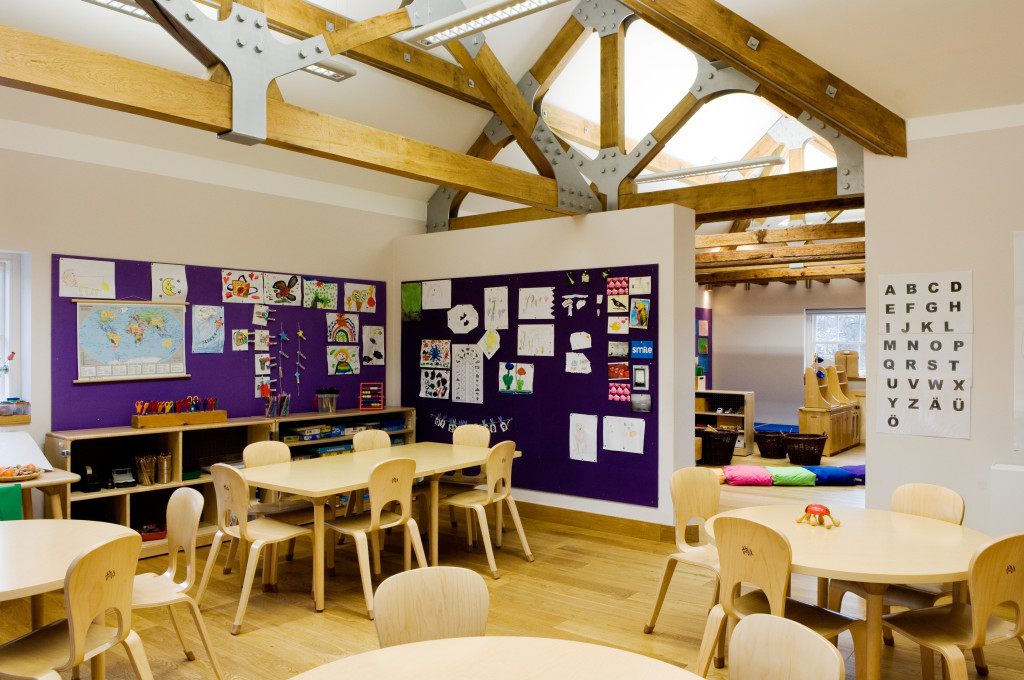
junior school classroom at the German School in Ham, by 3S Architects. Image shot 2006. Exact date unknown.The first thing I noticed when I walked in to observe was that she did her entire session at a long wooden table, sitting side-by-side with her student. After watching for about ten minutes, I asked if we could change the seating arrangement. We moved her student to the end of the table, then had the therapist sit next to her, but on the perpendicular side. This way, eye contact was much easier as they were able to face each other. The student’s eye contact improved instantly with a small environmental change. (Of course, once we made the environmental change, we worked together to address other changes that could be made to encourage eye contact.)

Environmental changes can be a quick and simple solution to some problem behaviors. Here are some questions to consider in order to alter the environment effectively:

  • Is it possible that a change in furnishings could change the behavior? For example, moving a child’s locker closer to the classroom door may decrease tardiness, putting a child’s desk in the furthest corner from the door may decrease opportunities for elopement, or giving your child a shorter chair that allows them to put their feet on the ground may decrease the amount of times they kick their sibling from across the table. You may also want to consider partitions that allow for personal space, clearly-marked spaces for organizing materials, proximity to students and distractions (such as windows or the hallway).
  • Can you add something to the environment to change the behavior? For example, your student may be able to focus better on independent work if you provide noise-cancelling headphones, line up correctly if a square for him/her to stand is taped to the floor, or your child may be more efficient with completing chores if they’re allowed to listen to their favorite music while doing so.  I’ve also seen some cases in which the teacher wears a microphone that wirelessly links to a student’s headphones, increasing that student’s ability to attend to the teacher’s instruction.
  • Will decreasing access to materials impact the behavior? For example, removing visuals such as posters and student work may increase your student’s ability to attend or locking materials in a closet when not in use may decrease your student’s ability to destroy or damage materials.
  • Will increasing access to materials impact the behavior? For example, making a box of pre-sharpened pencils may decrease the behavior of getting up frequently to sharpen pencils. (I recently visited a classroom in which the teacher put pre-sharpened pencils in a straw dispenser on her desk, and each week one student was assigned the job of sharpening pencils at the end of the day).

Whenever you do make changes to the environment, you may want to consider if the changes require fading. For example, if I make a square on the floor out of tape to teach my student where to stand in the line, I will want to fade that out of over time to increase their independence.

A final consideration is that whatever impact you expect the environmental change to have should be clearly defined and measured. Take data to ensure that the intervention is working so you can make adjustments as necessary.

For more detailed information on modifying environments, there is a great article from the Council for Exceptional Children by Caroline A. Guardino and Elizabeth Fullerton entitled “Changing Behaviors by Changing the Classroom Environment.” Click here for the article.

WRITTEN BY SAM BLANCO, MSED, BCBA

Sam is an ABA provider for students ages 3-12 in NYC. Working in education for ten years with students with Autism Spectrum Disorders and other developmental delays, she has developed strategies for achieving a multitude of academic, behavior, and social goals. Sam is currently pursuing her PhD in Applied Behavior Analysis at Endicott College.
States Begin to Include ABA Coverage

It looks like progress is being made on getting treatments such as ABA covered by insurance. Disability Scoop is reporting that states are finally starting to include coverage of treatments like Applied Behavior Analysis for children with autism under Medicaid. This means that states must cover services consistent with the categories defined by Early and Periodic Screening, Diagnostic and Treatment services (EPSDT). This includes Applied Behavior Analysis, speech and occupational therapies, and other personal care services.

Read the full article here.

Has anyone in CA, NV, and CT had success with getting services like ABA covered?


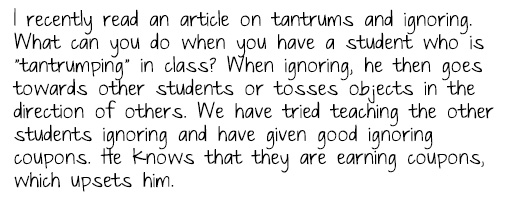
How to Manage and Reduce Classroom Tantrums—A Response to a Teacher’s Question

Sometimes we get questions from school teachers and parents about managing problem behaviors. Our BCBA Sam Blanco recently received a question from a school teacher in Alabama about her tantruming student in the classroom. We thought this was a perfect opportunity to share Sam’s response to her question as it may often apply to other parents and teachers. Read on below for the question and Sam’s response!

Tantrum Question

Addressing difficult behaviors in the classroom environment presents some unique challenges. It’s also challenging to provide accurate advice without directly observing the behavior. Instead, here are a few questions to consider and potential resources.

  • What does the tantrum look like when it begins? Is he screaming? Crying? Throwing items? Banging his desk? Try to define the behavior so it is observable and measurable. If it’s observable, then everyone who interacts with the child will agree with exactly what behavior requires intervention. If it’s measurable, you will be able to easily note progress. An observable and measurable definition of a tantrum could be “Screams and cries for 10-12 minutes” or it could be “Stomps his feet on the ground 20-30 times.”
  • What is typically happening directly before a tantrum takes place? What typically happens directly before it escalates? Can you change something about what happens directly beforehand that might impact his behavior?
  • What is different about the environment on days/class periods in which he does not tantrum? Is it something you can replicate on other days/class periods?
  • You should conduct a functional assessment to clearly determine the reason for the behavior. It may be for attention, but you may discover there is a different cause. It is best to perform a formal functional analysis, but if that is not possible, you may consider using the Functional Analysis Screening Tool (FAST). To get the best results from this, you should have more than one person fill it out, and, if possible, one person who observes the behavior but is unfamiliar with the child. Compare results to see if you are in agreement, then make a behavior intervention plan based on the function of the behavior. For more information about the FAST and its reliability compared to a formal functional assessment, you should refer to the study by Iwata, Deleon, & Roscoe (2013).
  • Frequently, tantrums in classrooms start when a demand has been placed. This may be because they are attempting to escape the demand, but it may also be because the demand is a signal that attention may become available (Repp & Karsh, 1994). If you determine that it is, in fact, for attention, are there things you can do to provide high quality attention prior to the tantrum? Perhaps you find that he usually works for about three minutes before he starts to tantrum. You can then provide high quality attention for successfully working for three minutes and label his appropriate behaviors. Over time, you systematically increase the number of minutes he works before accessing that high quality attention. The goal is to provide him with plenty of opportunities for success before he begins to tantrum.
  • A strong classroom token economy may be more successful than “good ignoring coupons.” For example, when I was a classroom teacher, I used paperclips for the tokens. Each student had a bag on the chalkboard with his/her name on it and they earned paperclips throughout the day for a variety of positive behaviors. At the end of the day, we counted paperclips and students could choose to save them or spend them on one of the items on a student-created menu of choices. The paperclips worked because they weren’t designed for a specific behavior. In the instance you described, the boy is put in a position where he has no chance to earn a coupon. However, if the language is changed so that when other students earn for ignoring, you say, “You’re earning a coupon/paperclip/token for sitting quietly at your desk,” the boy now has a decision to continue his inappropriate choices, or work to earn the same coupon the other kids are earning. He may still choose to tantrum, but at least now he has options!
  • The Lovaas Institute blog has a great post about addressing challenging behaviors in the classroom. You can view that here.

Hopefully this information has helped! And good luck as you plan your intervention!


WRITTEN BY SAM BLANCO, MSED, BCBA

Sam is an ABA provider for students ages 3-12 in NYC. Working in education for ten years with students with Autism Spectrum Disorders and other developmental delays, Sam has developed strategies for achieving a multitude of academic, behavior, and social goals.

Pick of the Week: Audible Time Timers – For Smooth Transitions Back to School

Transitions back to school can be difficult after a summer of changed routines. When it’s time to go back to school and reset day-to-day routines, a visual timer can make all the difference in timekeeping and easing the stress of structuring activities for your child or student. This week only, we’re taking 15%* off your order of the 3-inch, 8-inch, and 12-inch Audible Time Timers to help you help your learner with their transitions. Just enter promo code TIMETIMER at checkout to redeem your savings!

Recommended by Autism and ADHD experts, the Time Timer is entirely intuitive to use. This visual timer is great at solving time perception problems at all ages and ability levels, and is perfect for easy portability and in one-on-one and group settings.


A graphic clock-face gives the child visual understanding of time elapsing. This is ideal for timed activities and for getting ready. When the colored portion elapses, time is up. There is also an optional audible component that you can turn on so that the timer BEEPS when time is up. All Time Timers run on battery-operated quartz movement, and can be free standing or hung on a wall.

Don’t forget to save 15%* on your purchase of the 3-inch, 8-inch, and/or 12-inch Audible Time Timers this week only by using promo code TIMETIMER at checkout!

Read “Time Timer: Time to Build Independence,” an exclusive article by a parent about how she used the Time Timer to help her son challenge himself to get through a timed activity.

*Offer is valid until 11:59pm EDT on September 9th, 2014. Not compatible with any other offers. Be sure there are no spaces or dashes in your code at check out!

Tip of the Week: 6 Ways to Get the Most Out of Your Home ABA Program

CHILD IN SPEECH THERAPYWhile an ABA professional should be coming in to organize and run your ABA program, as a parent or guardian, there are some simple things you can do to make the time your child spends in a home session more effective. Several tips are here, but it may be unrealistic for you to follow ALL of these tips. Consider your home environment and family’s needs, then implement the tips that are the most feasible for your situation.

Following even one of these tips can make a big difference in your child’s sessions!

1)    Make sure all ABA materials are accessible. It’s important to have a system for storing the materials and the binder the ABA providers use. Some families I work with put everything into a box, a dresser drawer, or on a shelf the child cannot reach which is great. If the child utilizes an iPad for communication or reinforcement, be sure it’s available and charged. If any other items are necessary, such as edibles for reinforcement, make sure those are available at the beginning of the session. One parent I worked with used a craft organizer container with a clear plastic lid to store edibles, so when sessions began she’d set it on the table. All the different snacks were already broken into small pieces and organized in the box, freeing up more time for teaching during the session.

2)    Keep the area for ABA therapy free from distraction. Remove any items that are highly distracting for your student. Shut windows if you live on a noisy street. Make sure your cell phone is with you. This tip is especially challenging for families that live in studio apartments or have loud neighbors.

3)    Limit the number of disruptions from siblings or other family members. As an ABA therapist who is focused on increasing my students’ opportunities for social interaction, I don’t want to discourage the siblings and other family members from coming in. Interruptions should happen from time to time, and it’s important that my students learn to refocus after an interruption. But sometimes it becomes an obstacle to learning when there are consistent interruptions, or if I have to continue to redirect a sibling to other activities.  Instead, it’s better to structure activities with siblings and other family members, perhaps by teaching the learner with autism to request the sibling come play or adding it to the student’s activity schedule.

4)    When possible, reserve one or more highly motivating activities for ABA sessions. If a child has free access to all his/her motivating activities, then those activities are not as valuable when used in a session, and therefore less motivating. Sessions are most effective when the learner is working for something that they’re highly motivated by. It’s important to note here that I don’t want the child to only have access to fun things during sessions. I also don’t want the parents miss out on opportunities to enjoy motivating activities with the learner. The idea is to save a small number of motivating activities for sessions so the child maintains motivation and focuses on learning. This tip is especially challenging for families when the learner with autism is motivated by only one or two activities or items.

5)    Don’t allow the child to engage in their highest motivating activities right before an ABA session. I’ve had more than one case in the past in which I would get to the home and find my student watching his favorite TV show or playing his favorite game on the iPad. What would typically happen is that my student would associate my arrival with the end of his favorite activity, which would lead to crying, refusal to work, and/or attempts to escape. I want my students to be able to watch their favorite shows and play with their favorite games, but our sessions are more effective when those activities don’t take place immediately beforehand.

6)    Ask your provider if there are any changes you can make to improve sessions. Every home is different and every child’s needs are different. Your provider may be able to identify small changes for your specific situation that are not mentioned above. Opening that dialogue can be a powerful way to improve your child’s learning outcomes.  

WRITTEN BY SAM BLANCO, MSED, BCBA

Sam is an ABA provider for students ages 3-12 in NYC. Working in education for ten years with students with Autism Spectrum Disorders and other developmental delays, Sam has developed strategies for achieving a multitude of academic, behavior, and social goals.

Federal Ruling Ensures that Insurers Must Cover ABA Therapy

GavelFederal Judge Michael H. Simon in Oregon ruled last week that insurance providers cannot deny coverage of Applied Behavior Analysis (ABA) therapy for children diagnosed on the autism spectrum. The ruling was in response to a lawsuit against Providence Health Plan, an insurance provider that denied coverage of ABA therapy for children diagnosed with autism, while simultaneously granting coverage for children without a diagnosis. ABA therapy, which can cost over $50,000 a year, involves a behavioral interventionist working with a child in the family’s home or in his school to address behavioral deficits for up to forty hours a week.

Oregon State Governor John Kitzhaber also agreed with this ruling and will adjust state health plans to reflect Judge Simon’s decision. The discrepancy between insurance policies and what providers actually cover arises because the medical community views ABA as “a medically necessary treatment of autism,”1 whereas some insurance providers accept it as an educational service that is provided in schools. Since autism is also classified as a “developmental disability,” instead of a mental health disorder, insurers exclude ABA coverage for those with autism, which is also a violation of mental health parity laws.

In some states like California, several warnings have been issued to insurance companies after several denials of ABA coverage had been overturned on appeal. Regional centers now fund ABA therapy by service providers, as well as insurance companies. With President Obama’s signing of Autism CARES last week, the federal ruling will hopefully set a precedent for insurance companies across the country to allow coverage of ABA therapy for families of children diagnosed with autism. ABA therapy is the most influential and widely cited form of therapy for autism, showing the most promise and efficacy in the treatment of autism.

1 https://exm.nr/1oJvnxa