Tip of the Week: Using Differential Reinforcement of High Rates of Behavior to Increase Preferred Behaviors

Differential Reinforcement of High Rates of Behavior (DRH) is “reinforcing only after several responses occur at or above a pre-established rate” (Mayer, Sulzer-Azaroff, & Wallace, 2013). There are times when a behavior is already in a student’s repertoire, but you may want to increase the rate of the behavior.

Mother Waking SonFor example, let’s say Harold frequently won’t get up independently on weekdays before school. It’s driving his parents crazy, because they have to drag him out of bed several days a week. You may set up a DRH to increase the rate of him getting up independently. Since Harold currently gets up independently at least one time per week, you would set the goal for two times per week. (You don’t want to set the goal too high, because then Harold might not ever come into contact with reinforcement, and his behavior will likely remain unchanged.) Let Harold know that if he gets up independently two days in a row, you will make his favorite breakfast on the second day. Once Harold has met this goal a few time, increase the requirement for reinforcement. You would move from two days in a row to three days in a row in order to receive his favorite breakfast.

You would continue this until you had reached a pre-arranged goal. It’s important to be realistic in our expectations. You don’t want to change the goal to quickly or make it unreachable. You also don’t want to place higher demands on an individual with disabilities than you do the general population (as discussed in our previous Simplifying the Science article). Many people, for instance, hit the snooze button several times before they actually get up, so it may not be necessary to require an individual with disabilities to wake up the very first time the alarm clock rings 100% of the time.

You may discover that your intervention with Harold is working quite well for a couple weeks, then suddenly stops working. You may need to backtrack a bit, and require fewer consecutive days of independently waking up. Or, you may need to vary the reinforcement. It’s possible that having his favorite breakfast has lost some of its power as a reinforcer.

Finally, after the behavior has reached your goal rate, you should begin to fade the reinforcement entirely. Of course, Harold should still have access to his favorite breakfast, but you should not continue to give it to him on the fifth consecutive day of waking up independently for years to come!

DRH is yet another variation of differential reinforcement that can be very useful for you. It’s also provides an opportunity for a much more positive interaction than introducing punishment to Harold for not waking up independently, and can decrease everyone’s stress levels at the beginning of the day.

References

Mayer, G. Roy, Sulzer-Azaroff-B. & Wallace, M. (2013). Behavior Analysis for Lasting Change-3rd ed. Cornwall-on-Hudson, NY: Sloan Publishing.

WRITTEN BY SAM BLANCO, MSED, BCBA

Sam is an ABA provider for students ages 3-12 in NYC. Working in education for ten years with students with Autism Spectrum Disorders and other developmental delays, Sam has developed strategies for achieving a multitude of academic, behavior, and social goals. Sam is currently pursuing her PhD in Applied Behavior Analysis at Endicott College.

Tip of the Week: Differential Reinforcement of Low Rates of Behavior

Differential Reinforcement of Low Rates of behavior (DRL) is “a schedule of reinforcement in which reinforcement: (a) follows each occurrence of the target behavior that is separated from the previous response by a minimum interresponse time, or (b) is contingent on the number of responses within a period of time not exceeding a predetermined criterion” (Cooper, Heron & Heward, 2007).

There may be times when you want to greatly reduce a behavior, but don’t want to eliminate it altogether. Researchers have used DRL to decrease many behaviors, including: stereotypic responding (Singh, Dawson, & Manning, 1981), talking out in class (Dietz & Repp, 1973), and rate of taking bites while eating (Lennox, Miltenberger, and Donelly, 1987).

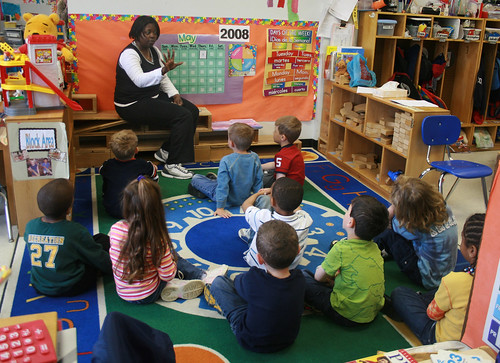
There are a few different ways to implement DRL. You might select a target number of times the behavior can be exhibited within a full session, then deliver reinforcement to the individual if they exhibit the behavior that number of times or less within the session. For example, Gina teaches in a preschool where they have a 5-minute circle time each morning. During circle time, a boy named Luke raises his hand constantly. Gina wants to reduce the number of times he raises his hand during circle time, but she does not want to eliminate the behavior altogether. She took some baseline data and discovered that he raised his hand approximately 12 times during each circle time. Gina decided that Luke would be allowed to go to the water table, (his favorite activity,) if he raised his hand 10 times or less during circle time. This is called a criterion limit. As his behavior decreased, she would decrease the number of times he was able to raise his hand in order to access reinforcement. Her goal was to get him down to 3 instances of raising his hand during the circle time activity. This procedure for DRL is useful in a classroom setting, because it does not require the teacher to take a lot of data or keep track of intervals, though that might be appropriate in other situations.

Another possibility for implementing DRL is to use an interval schedule of reinforcement. As in the previous procedure, you would set a criterion limit (like Gina did with the limit of 10 instances of hand-raising). However, for this procedure, you would divide the session into intervals and set a criterion limit for each interval. If the number of times the behavior is emitted meets the criterion limit or is less than the criterion limit, then the individual receives reinforcement at the end of the interval. So, Gina could use an interval DRL for addressing Luke’s behavior. In this instance, she might divide the 5-minute circle time into 10 30-second intervals. (I would suggest wearing a VibraLite watch or an interval app such as the ABA Interval Recording App to track the intervals.) Gina decides that the criterion limit will start at 2 instances of hand-raising each interval. If Luke raises his hand 2 times or less in an interval, then at the end of the interval she gives him a little bit of individualized attention, such as a pat on the shoulder or verbal praise.

A third way to implement a DRL is called spaced-responding DRL. In this procedure, you will measure interresponse time (or IRT… behavior analysts love their abbreviations, don’t they?!). So, in Gina’s intervention with Luke, this means that she would measure the amount of time from one instance of hand-raising to the next instance of hand-raising, or “the duration of time between two responses” (Cooper, Heron, & Heward, 2007). The goal here would be to increase the amount of time between instance of hand-raising, which would mean that Luke was raising his hand less frequently. Gina discovers that Luke is raising his hand about once every 25 seconds. She will begin by providing social reinforcement when he has gone 30 seconds without raising his hand. Over time, she will systematically increase the IRT until Luke is raising his hand approximately once every 2 minutes during circle time.

When designing an intervention using DRL there are a few things you should consider:

  • You do not want to use DRL with self-injurious or dangerous behaviors.
  • DRl usually produces a slow change in the behavior, so if it necessary to quickly decrease the rate of a behavior, you should select a different form of differential reinforcement.
  • There are several ways to implement DRL, and you should select the procedure that makes the most sense for the behavior you are addressing and the environment you are in.
  • Plan ahead so you are systematically decreasing the number of responses the individual is engaging in.
  • Be sure to take baseline data to determine your criterion limits! DRL will not be successful if you set them too low for your child or client to come into contact with reinforcement.
  • Get help when implementing DRL. Talk to a BCBA about the best way to implement it for your learner.

REFERENCES

Cooper J.O, Heron T.E, Heward W.L. Applied behavior analysis (2nd ed.) Upper Saddle River, NJ: Pearson; 2007

Dietz, S. M., & Repp, A. C. (1973). Decreasing classroom misbehavior through the use of DRL schedules of reinforcement. Journal of Applied Behavior Analysis, 6(3), 457.

Lennox, D. B., Miltenberger, R. G., & Donnelly, D. R. (1987). Response interruption and DRL for the reduction of rapid eating. Journal of Applied Behavior Analysis, 20(3), 279-284.

Singh, N. N., Dawson, M. J., & Manning, P. (1981). Effects of spaced responding DRL on the stereotyped behavior of profoundly retarded persons. Journal of Applied Behavior Analysis, 14(4), 521-526.

WRITTEN BY SAM BLANCO, MSED, BCBA

Sam is an ABA provider for students ages 3-12 in NYC. Working in education for ten years with students with Autism Spectrum Disorders and other developmental delays, Sam has developed strategies for achieving a multitude of academic, behavior, and social goals. Sam is currently pursuing her PhD in Applied Behavior Analysis at Endicott College.

Tip of the Week: DRA and DRO – Differential Reinforcement Tools for Behavioral Change

Recently we’ve been delving into different types of differential reinforcement. We’ve taken a look at why differential reinforcement is valuable as well as how to use DRI. Today, we’ll look at two more that are closely related: Differential Reinforcement of Alternative behavior (DRA) and Differential Reinforcement of Other behavior (DRO).

DRA is “a procedure for decreasing problem behavior in which reinforcement is delivered for a behavior that serves as a desirable alternative to the behavior targeted for reduction and withheld following instances of the problem behavior (e.g., reinforcing completion of academic worksheet items when the behavior targeted for reduction is talk-outs)” (Cooper, Heron, & Heward, 2007). The key thing to remember here is if you are implementing a DRA, a specified alternative behavior has been selected for reinforcement.

For example, Miss Watson wants her students to stop calling out answers. She decides she will not reinforce students calling out. In her situation, this means that if a student calls out she will not provide them with any attention, including reminders not to call out. She is going to reinforce the alternative behavior of raising your hand. This is a very common use of DRA, and it works well.

In another example, Lisa’s daughter often cries when she doesn’t get what she has asked for. Sometimes this results in attention, and sometimes it results in Lisa finally giving in and providing the item. Lisa decides to use DRA to address this behavior. With this intervention, any time that her daughter says “Okay” instead of crying when refused an item, Lisa provides reinforcement in the form of attention or playing with a different item than was requested.

DRO is quite similar. It is “a procedure for decreasing problem behavior in which reinforcement is contingent on the absence of the problem behavior during or at specific times” (Cooper, Heron, & Heward, 2007). With DRO, you would reinforce any behavior that wasn’t the behavior targeted for change.

For example, Mrs. Cuthbert notices that Anne is staring out the window frequently during lass. She decides to implement DRO. She sets a MotivAider for 5 minute intervals. Each time the MotivAider buzzes, she looks up and if Anne is doing any behavior other than staring out the window, Mrs. Cuthbert provides reinforcement. (There are two ways to implement DRO, which we’ll get to in a future post.)

DRO is especially beneficial because it is widely applicable, relatively rapid, and often durable and general (Mayer, Sulzer-Azaroff, & Wallace, 2014). However, you should be aware that you may run the risk of reinforcing other unwanted behavior. It can also make you focus on the “negative,” since you’re always looking for the problem behavior or the absence of the problem behavior (as opposed to a specific desired behavior, as in DRA.)
DRA and DRO are useful tools to add to your arsenal of behavior change tools. You may be wondering why it’s important to consider the differences between DRI, DRA, and DRO. The key to remember is that using these terms and understanding the possible strategies for reinforcement improves your implementation of interventions and your communication with other adults implementing those interventions.

References

Cooper J.O, Heron T.E, Heward W.L. Applied behavior analysis (2nd ed.) Upper Saddle River, NJ: Pearson; 2007

Optional Text: Mayer, G. Roy, Sulzer-Azaroff-B. & Wallace, M. (2013). Behavior analysis for lasting change (3rd ed.). Cornwall-on-Hudson, NY: Sloan Publishing.

WRITTEN BY SAM BLANCO, MSED, BCBA

Sam is an ABA provider for students ages 3-12 in NYC. Working in education for ten years with students with Autism Spectrum Disorders and other developmental delays, Sam has developed strategies for achieving a multitude of academic, behavior, and social goals. Sam is currently pursuing her PhD in Applied Behavior Analysis at Endicott College.

Pick of the Week: NEW! ABA Curriculum for the Common Core Kit: 1st Grade

Following up on our ground-breaking Kindergarten kit for the ABA Curriculum for the Common Core, we’re thrilled to introduce the long-awaited ABA Curriculum for the Common Core: 1st Grade. This week, we’re also offering 15% off the normal retail price – just enter our promo code 1STGRADE at checkout to redeem your savings!

Utilizing the same accessible format, this new curriculum rooted in Applied Behavior Analysis addresses each and every Common Core State Standard for 1st grade students. Created by Sam Blanco, MSEd, BCBA, this curriculum has been devised exclusively for students in special education settings using the evidence-based principles of Applied Behavior Analysis (ABA).

Just like the Kindergarten version, the ABA Curriculum for the Common Core Kit: 1st Grade contains a curriculum book that drills down into each standard and breaks it into teachable steps. Programs are presented in a format that supports data collection and ease of use. Each Common Core standard is presented on its own page with clear instructions detailing the Teaching Procedure, Discriminative Stimulus (Sd), and Materials required for teaching. Each standard lists several targets that demonstrate the component steps and skills required for mastery. Additionally, every standard page references the correlating Kindergarten standard to drill down to for students who have not met the prerequisite skills for the first grade standard. A thorough “how-to” guide presents the main tenets of ABA, giving staff an accessible understanding of:

  • Motivation and Reinforcement
  • Pairing
  • Prompting
  • Generalization
  • Natural Environment Teaching
  • Preference Assessment
  • and Data Collection

In addition, comprehensive Data Sheets are included in the curriculum guide, along with samples of how to complete them. The goal of this curriculum kit is to make the Common Core standards accessible and relevant to students with autism and special needs.

Don’t forget to redeem your savings this week on the brand-new ABA Curriculum for the Common Core Kit: 1st Grade. Just mention or enter our promo code 1STGRADE when you check out with us online or over the phone!

Tip of the Week: Differential Reinforcement of Incompatible Behavior

In a recent post, I talked about Skinner’s emphasis on differential reinforcement. Today, we are going to take a closer look at Differential Reinforcement of Incompatible behavior (DRI). DRI is defined as “a procedure for decreasing problem behavior in which reinforcement is delivered for a behavior that is topographically incompatible with the behavior targeted for reduction and withheld following instances of the problem behavior (e.g., sitting in seat is incompatible with walking around the room) (Cooper, Heron, & Heward, 2007).

Let’s look at a few examples of DRI in action:

  • Mrs. Clark is teaching a classroom with six students with autism. One of her students has recently begun to pinch his arms. She takes data on the behavior and discovers that it functions for attention. (When he pinches his arms, she or a teacher’s aid comes over and tells him “no pinching.”) She decided to implement an intervention that utilizes DRI. She teaches him how to sit with his hands intertwined on his desk. This is an incompatible behavior with pinching because he is not able to pinch while his hands are intertwined. She and the teacher’s aid reinforce him for intertwining his hands (come over and tell him, “great job” or “I like how you’re sitting”) and do not provide attention when he engages in arm pinching.
  • Carly has a 9-year-old daughter. When her daughter wants a break from doing homework, she reaches over and hits Carly’s arm. Carly typically says, “Do you need a break now?” Then, she allows her to take a five-minute break. Carly recognized that her daughter’s intensity with hitting seemed to be increasing, and she was worried she might get hurt. She decided to implement an intervention that utilized DRI. She put a timer on the table within her daughter’s reach, and taught her daughter to touch the timer when she wanted a break. This is an incompatible behavior because her daughter cannot simultaneously touch the timer and hit Carly. When Carly’s daughter touched the timer, she immediately received a break. When she hit Carly, she did not receive a break. This was an especially useful intervention because, over time, Carly taught her daughter to set the timer on her own and become more independent with managing break times.
  • Mr. Holley teaches a preschool class. During circle time, many of his students become very excited and can be quite loud. Sometimes it seems as though all of his students are yelling at the same time. Once they become too loud, it is very challenging to regain their attention. He decides to implement an intervention utilizing DRI. He uses a decibel meter on his tablet (such as the app Too Noisy). He teaches the students that when the noise level is below a certain number or threshold they all earn stickers. This is differential reinforcement of an incompatible behavior because the children cannot possibly speak loudly and softly simultaneously.

DRI is not always the best option. For example, it may be very challenging to come up with an incompatible behavior. Or, in the case of self-injurious or aggressive behavior, it may be dangerous to use such an intervention.

If you do use DRI, you may consider explicitly telling your learner(s) that you are implementing this new plan, such as Mr. Holley did in the third example above. And remember, this is only one form of differential reinforcement. If DRI is not appropriate for your situation, there are definitely still options for reinforcing appropriate behavior in an effective and efficient manner.

References

Cooper, J.O., Heron, T.E., & Heward, W.L. (2007). Applied Behavior Analysis – 2nd ed. Englewood Cliffs, NJ: Prentice-Hall.

WRITTEN BY SAM BLANCO, MSED, BCBA

Sam is an ABA provider for students ages 3-12 in NYC. Working in education for ten years with students with Autism Spectrum Disorders and other developmental delays, Sam has developed strategies for achieving a multitude of academic, behavior, and social goals. Sam is currently pursuing her PhD in Applied Behavior Analysis at Endicott College.

Tip of the Week: Why Differential Reinforcement is Preferred to Punishment

In B.F. Skinner’s phenomenal book The Technology of Teaching, he briefly discusses problems with punishment. He explains that the use of punishment (defined as adding or subtracting something from the environment in order to reduce the occurrence of a behavior), is not as clear-cut as we might imagine.  When we attempt to punish a behavior, it’s quite likely that we will unintentionally suppress a broader range of behaviors than we intended.

Skinner gives the example of a child who has touched a candle flame and been burned. The child has probably been taught not to touch the flame, but Skinner argues that it’s quite possible that “in the presence of a candle flame he will not be likely to explore any part of the environment, to reach for or grasp objects of any kind” (Skinner, 1968, p. 186). This is an important consideration, especially when we consider the classroom.  We have to ask ourselves, when we punish certain behaviors, are we unintentionally suppressing other, desirable behaviors?  And in punishing the undesirable behavior, are we clearly communicating to the child what the desirable behavior is?

Skinner then moves on to discuss alternatives to punishment. What he describes is known today as differential reinforcement.  Since Skinner wrote The Technology of Teaching, a great deal of research has been completed on differential reinforcement, which “consists of reinforcing particular behavior(s) of a given class (or form, pattern or topography) while placing those same behaviors on extinction and/or punishing them when they fail to match performance standards or when they occur under inappropriate stimulus conditions” (Mayer, Sulzer-Azaroff, & Wallace, 2014).  Put simply, we reinforce the desired behavior and do not reinforce the undesired behavior.

Today we have categories for many different types of differential reinforcement to better describe strategies for implementation.

Types of differential reinforcement include:

  • Differential Reinforcement of Alternative Behavior (DRA)
  • Differential Reinforcement of Other Behavior (DRO)
  • Differential Reinforcement of Incompatible Behavior (DRI)
  • Differential Reinforcement of High Rates of Behavior (DRH)
  • Differential Reinforcement of Low Rates of Behavior (DRL)

Differential reinforcement is an incredibly useful tool for teachers and parents.  So we will devote several Tips of the Week over the upcoming months to how to use it effectively, taking a closer look at each of the types listed above.

References

Mayer, G. Roy, Sulzer-Azaroff-B. & Wallace, M. (2013). Behavior analysis for lasting change (3rd ed.). Cornwall-on-Hudson, NY: Sloan Publishing.

Skinner, B. F. (1968). The technology of teaching. New York: Appleton-Century-Crofts.

WRITTEN BY SAM BLANCO, MSED, BCBA

Sam is an ABA provider for students ages 3-12 in NYC. Working in education for ten years with students with Autism Spectrum Disorders and other developmental delays, Sam has developed strategies for achieving a multitude of academic, behavior, and social goals. Sam is currently pursuing her PhD in Applied Behavior Analysis at Endicott College.

Tip of the Week: Clearing Up the Misconceptions About Reinforcement

ABA often gets a bad rap due to misunderstandings about reinforcement. In my career alone, I’ve had people tell me that people are not like rats and pigeons, that reinforcement harms intrinsic motivation, and that when I do produce behavior change, it has nothing to do with ABA but with my abilities as a teacher. Today, I’d like to clear up some misconceptions about reinforcement.

Reinforcement is not equivalent to rewards. Reinforcement is anything that occurs immediately following a behavior that increases the future likelihood of that behavior. For instance, I am more likely to say hello to my neighbor down the street because in the past he has responded by saying “hello” back to me. However, I do not say hello to my next door neighbor because she has never responded to my greeting. My history of reinforcement with the neighbor down the street increases the likelihood that I will greet him upon seeing him.

Flowers GrassReinforcement occurs in the natural environment all the time, whether we are conscious of it or not. We are reinforced by paychecks for going to work, by our favorite dessert for visiting a restaurant 30 minutes out of our way, by compliments when we get a new haircut, and more. ABA utilizes reinforcement when an individual is not acquiring skills in order to help them learn. And when ABA is implemented correctly, reinforcement should be as close to naturally occurring reinforcers as possible and should be reduced systematically over time to levels that would naturally occur in their environment.

Reinforcement works for dogs and for humans. The previous two points illustrate that humans do respond to reinforcement, and decades of scientific research back that up. Comparing the work behavior analysts do with humans to the work behavior analysts do with other animals is not far off base. What is off base is using such a comparison to imply that behavior analysts treat people with disabilities like dogs. As with other professionals who work with individuals with disabilities, (such as speech therapists, physical therapists, nurses, etc.) most behavior analysts are professionals who put a lot of time, care, and love into their work.

Child Blowing BubblesReinforcement is individualized. Everything we do in ABA is individualized, because human beings are wonderfully complex creatures that cannot be characterized by statistics, averages, or norms. One of my students may find stickers reinforcing; another may show no interest. One student may find listening to music reinforcing; another may cover his ears and ask me to turn it off. In ABA, we seek to find the items and activities that are motivating for individuals; then use those as tools not only for reinforcement, but for increasing skills and broadening interests and opportunities. In an ideal ABA session, my students spend a lot of time engaging with items and activities that they enjoy while also learning and growing.

It’s easy to fall prey to misconceptions about reinforcement, but such misconceptions can make it impossible for us to understand how to alter the environment in order to provide the best possible outcomes for our students. As Skinner put it, “The ideal of behaviorism is to eliminate coercion: to apply controls by changing the environment in such a way as to reinforce the kind of behavior that benefits everyone.”

Over the next few weeks, we will be publishing a series on Differential Reinforcement procedures that will help you become more skilled in using reinforcement to affect behavior change.

WRITTEN BY SAM BLANCO, MSED, BCBA

Sam is an ABA provider for students ages 3-12 in NYC. Working in education for ten years with students with Autism Spectrum Disorders and other developmental delays, Sam has developed strategies for achieving a multitude of academic, behavior, and social goals. Sam is currently pursuing her PhD in Applied Behavior Analysis at Endicott College.

Interview with Lisa Carling, Director of the Theatre Development Fund’s Accessibility Programs

Lisa Carling is the Director of the Theatre Development Fund’s Accessibility Programs in New York City. Recently, she sat down to speak with BCBA Sam Blanco about their Autism Theatre Initiative. TDF’s next autism-friendly performance will be The Lion King on Sunday, September 27, 2015 at 1PM. The Lion King was the first autism-friendly performance TDF organized back in October 2011, and has been so popular that it is now an annual event each fall at the end of September. Read on for Lisa Carling’s inside scoop on the Autism Theatre Initiative!

SAM BLANCO: Tell me a little bit about how the Autism Theatre Initiative came about.

LISA CARLING: It came about because we had a very successful program for students in the District 75 schools who had hearing loss and vision loss. We would schedule Wednesday matinee performances of Broadway shows, and bring these kids with their teachers to see Broadway performances. We were hearing more and more from special ed teachers, “This is great, but what can you do for all the kids in the District 75 schools that are on the autism spectrum.” We didn’t know, because the more we talked to parents, educators, therapists, the more we realized that this population would probably benefit more from a designated performance, being able to come to a show and be themselves. It wouldn’t be fair to mix them with typical audiences that may not understand atypical behavior. We also realized from talking with parents that they’re very few opportunities for families to do something together if you have a child or adult on the spectrum, what can you do together with siblings, grandparents, aunts and uncles. So we wanted to create an opportunity for families to come to the theatre together and have a terrific time in a judgment-free, welcoming environment where the children or adults on the spectrum could just be themselves, and the parents and siblings would not have to explain a thing. Anything goes. No judgments.

SB: Do you feel that judgment-free aspect is what has really drawn people in?

LC: I do. We’re very careful with the material, what productions we choose. We go after what most families want to see, family-friendly productions, big musicals, easy storylines, colorful costumes, dancing and singing, what everyone loves. And then we will ask the production if they are able to make slight modifications in sound and lighting. We rely on specialists in the autism community who can come and take a look at a production and then say, here are maybe a dozen places where it would really be beneficial if the sound could be turned down a level, we usually say not above 90 decibels, or the lighting is just too intense. We always stress when we talk to a show that these are suggestions and if they can make them that would be great. If not, we will warn the parents ahead of time at point-of-purchase. And we always emphasize we want it to be the same great show, the same terrific Broadway musical that families all over the country want to see when they come to New York.

We tried something different in December by doing a play for the first time, The Curious Incident of the Dog in the NightTime. We were very leery of that. We didn’t know what it would be like for families to come and see a serious drama, albeit with very funny moments in it, about situations that they may live with 24/7. But it was an opportunity to stretch our expectations and to offer something newer to the autism community, to identify older people in the community, college-aged students on the spectrum, older adults.

SB: What was the response to that?

LC: It was unbelievable. It was very moving to all of us. The cast, every cast member, had tears in his eyes at the curtain call. And there was a very moving moment at the end of the play, where Christopher, after he’s told his teacher all the things he’s accomplished: he found his mother, he wrote a book, he solved the mystery of who murdered Wellington, and he says something to the effect, he asks her, “This means I can do anything, can’t I?” And he asks her three times, and that question just hangs there unanswered by the teacher. But for our autism-friendly performance, there was a teenager who shouted right back at him, “yes, you can!” And it was such an affirmation of the impact of that show on this audience.

There was a time when we would have shied away from offering a performance where there was strong language in it, or violence. There’s a scene where the father strikes his son. The show worked with us on that and it was choreographed in a different way. It was more suggestive and not as startling. But we did it. And we’re not afraid anymore to just put opportunities out there. Parents know their kids the best, and if they think their child or adult can’t handle something then they’ll let us know or they won’t buy tickets.

SB: Are you involved with other theatres who are putting on autism-friendly performances?

LC: This year’s National Autism Theatre Initiative advisory partnerships varied in scope from Stages St. Louis’s 235 seat Playhouse at Westport Plaza in Chesterfield, MO that offered a sensory-friendly performance of The Aristocats in June for groups of school children on the spectrum in the St. Louis area; to The Big Apple Circus in Brooklyn, NY which presented a total eight autism-friendly performances of Metamorphosis throughout the year in up to 1,700 seat tents in Manhattan and Queens, NY; Boston, MA; and Bridgewater, NJ. The impact on attendees with autism or with other developmental or cognitive disabilities was immeasurable. From a mother at Stages St. Louis, “My daughter is in this show. Until today, her younger brother had never seen her perform because he is autistic and needs to get up and walk around every now and then and can be loud when he’s excited. Today, he not only saw his sister perform but he felt he was in a safe space, and he gave her a standing ovation every time she walked on stage.”

SB: With the partnerships, what resources do you provide?

LC: Conference calls. We help them in the planning. We recommend give yourself first time six months to a year to plan for this. We show them examples of the social narrative, character guides, video of what it’s like to walk inside the theatre, various supports day-of, what works out the best for us in terms of the koosh balls and stress stars. Just essentially, share our play book, what worked well for us and we always emphasize adapting for your community. And that goes for what you call the performance as well. In New York, we use the term autism-friendly because our community wants that and because in the initial planning they wanted to own that word and raise the awareness. Other parts of the country might use the term sensory-friendly, in the U.K. they like relaxed performances. But it doesn’t matter. The thought process is the same, you’re welcoming people on the autism spectrum as well as individuals with other developmental or cognitive disabilities and making slight adjustments that make the experience more comfortable.

SB: What advice do you have for theaters or other organizations who want to create autism-friendly events?

LC: Jump in and do it. Don’t be afraid because you will learn every time you do it; you’re going to do it better. Opening up accessibility for people on the spectrum as well as for other individuals with cognitive and developmental disabilities is where the need is right now. All theaters get it about providing captioning and audio description, but they are neglecting a huge audience in their communities. So, make the effort. Reach out there, you will not regret it.

I would advise choosing the first production (or productions) that are going to be successful. Particularly the first one. Make sure it’s a positive experience because this is a new audience. So look for a show that would be engaging to all families. Please do a weekend matinee. Scheduling this on a weekday. About 90% of the people on our surveys say they want a Saturday or Sunday matinee. They cannot come during the week. Again, this is geared for families. If you’re working with school groups, that might be different. Oh, an advisory group. Three is a good number. Make sure you get some outside input, someone who’s looking at the production you’re considering with an autism eye. Because what an artistic director might think is a good choice is not necessarily what someone who works with people on the spectrum, or someone on the spectrum. Don’t discount the value of having someone on the spectrum as one of your advisors.

SB: Can you describe some of the feedback you have received from participants?

LC: The overwhelming feedback we’ve received again and again is how wonderful it is to be in a judgment-free environment, where parents and siblings can just relax. They don’t have to worry about explaining behavior, they don’t have to feel that they’re being stared at. One very telling comment came from a mother last April after our Disney Junior show, who said, “Here I am, sitting in a theater with 2,000 strangers, and yet I feel we’re all part of the same family.” She’s right. They all understand each other. So a child who’s stimming or needs to get up, is singing along, it’s wonderful. There’s no difference. It’s not bothering anyone.

SB: Are you always able to offer the tickets at 40-50% off or is that the goal?

LC: That’s the goal. We hit that most of the time. If you have a family of four that you want to bring to a Broadway show, and you’ve got parking involved and public transportation, it’s important to keep the cost low. And then you get into all the additional expenses parents have: medical expenses, schooling, one-on-one therapists.

SB: Can you tell me anything about future direction of ATI?

LC: We are interested in working with off-off Broadway companies and consultancies where we will help them provide autism-friendly performances during the summer which is a hard time for us to book an autism-friendly Broadway show so we have our summers to help smaller theaters that might be willing to open their shows to the community.

SB: Is there anything I left out?

LC: I want to cite National Theater America Office with Curious Incident. They recognized that they wanted to make the show as affordable to the autism community as possible, so they went out and sought funding to underwrite the cost. So all of our Curious Incident tickets we were able to sell for $25. Orchestra to balcony, $25 thanks to the National Theater’s funding to help underwrite the cost. I wish more producers thought in terms of providing these affordable opportunities. It’s in the nature of the commercial theater that it’s very expensive to do shows, but if occasional opportunities could come along like this, we could reach so many more people. I remember getting e-mails from parents who were saying, “This is the first time I’ve ever been able to sit in the orchestra.”

ABOUT LISA CARLING

Lisa CarlingLisa Carling is Director of TDF Accessibility Programs (TAP) at Theatre Development Fund where she runs a department of services for people with physical disabilities as well as individuals on the autism spectrum or with other developmental or cognitive disabilities. She has spoken on accessibility panels for the Broadway League Education Forums, Association of Performing Arts Presenters, Americans for the Arts and the Kennedy Center’s Leadership Exchange in Arts and Disabilities (LEAD) conferences. Lisa received a “Distinguished Leadership in Hearing Accommodation Award” from the Hearing Loss Association of America New York City Chapter in 2015 and a “Community Hero Award” from Best Buddies New York in 2014. TDF has won seven accessibility awards honoring her department achievements, including the “Excellence in Accessibility Leadership Award” at the 2006 LEAD conference. Her credits include: launching the “Autism Theatre Initiative” (2011) which makes theatre accessible to children and adults on the spectrum and their families; designing TDF’s “National Open Captioning Initiative” (2004) that partners with regional theatres across the country to expand audiences of people with hearing loss; and establishing TDF’s open captioning on Broadway program (1997). Lisa created “Access for Young Audiences” (1995), a service that provides sign language interpreting, open captioning (added, 1998) and audio description (added, 2008) for students with hearing and vision loss who attend specially scheduled Wednesday matinee performances on Broadway. Lisa holds an MFA from Yale School of Drama.


The Countdown to “ABA Tools of the Trade” Begins

We’re incredibly excited to let you know about a new collaboration between Sam Blanco, MSEd, BCBA and Val Demiri, PhD that will focus on data collection and effective behavior change in the classroom while utilizing the most effective tools in ABA. Different Roads to Learning is proud to have this excellent resource scheduled for publication in early 2016. The partnership between these two powerhouses is sure to make ABA Tools of the Trade: A Resource for Data Collection and Effective Behavior Change a must-have for your library.

The book bridges the gap between applied research and real-world settings, including the classroom, home, and community environments. It provides information about efficient tools available for effective data collection and meaningful behavior change. Beyond exploring a wide range of tools available for your use, it offers a comprehensive analysis of the decision-making process for increasing desirable behaviors, decreasing maladaptive behaviors, and examining your own behavior.

We’ll be sharing a tip from Sam and Val’s excellent Facebook page – ABA Tools of the Trade – with you every week so be sure to stay tuned.

Tip of the Week: Use a Time-Out Ribbon

Time-out can be an effective procedure for addressing behaviors that do not function for escape. However, often it can be difficult to implement, and in some schools is not even allowed. There are valid concerns related to time-out. For example, you may not have the opportunity to supervise a child in a separate location for time-out, or you might want to keep them in the same place so they don’t miss a lesson during class.

The time-out ribbon may be an excellent solution for just those types of instances. When Foxx and Shapiro (1978) first wrote about the time-out ribbon, they referred to it as “nonexclusionary time-out,” meaning the individual does not have to be excluded from an environment or activity to be “in time-out.” In their initial study, all students wore a ribbon on their wrist. When the individual has the time-out ribbon on, they have access to socially-mediated reinforcement. If the time-out ribbon is removed, they do not have access to that reinforcement. (Foxx & Shapiro also note that it does not have to be a ribbon, but could be anything that is easy to wear and easy to remove.) However, by again demonstrating appropriate behavior, the ribbon can be placed again on the individual’s wrist.

In a time where we often focus on new, high tech solutions, such as the use of iPads or SmartBoards to introduce behavior change procedures, it’s important to draw attention to low-tech solutions that are easy to implement. Another aspect of the time-out ribbon that is attractive for our particular population is that it provides a clear visual indication that reinforcement is available.

A possible drawback is that, in a classroom setting, if the ribbon is removed, the student could continue to engage in disruptive behavior. Foxx and Shapiro emphasize the need to pair the ribbon with social reinforcement when first introducing it to the individual. This increases the likelihood that the individual will correct their behavior to earn the ribbon back.

Foxx & Shapiro demonstrated the effectiveness of the time-out ribbon with five boys with developmental disabilities. Since then, two more studies have demonstrated the efficacy of the procedure. We know that time-out can be highly effective from a wealth of research over recent decades, but if it’s not available, you should definitely consider the possible use of the time-out ribbon.

Further Reading

Alberto, P.A., Heflin, L.J., & Andrews, D. (2002). Use of the timeout ribbon procedure during community-based instruction. Behavior Modification, 26(2), 297-311.

Foxx, R.M. & Shapiro, S.T. (1978). The timeout ribbon: A nonexclusionary timeout procedure. Journal of Applied Behavior Analysis. 11(1), 125-136.

Laraway, S., Snycerski, S., Michael, J. & Poling, A. (2001). The abative effect: A new term to describe the action of antecedents that reduce operant responding. The Analysis of Verbal Behavior, 18, 101-104.

WRITTEN BY SAM BLANCO, MSED, BCBA

Sam is an ABA provider for students ages 3-12 in NYC. Working in education for ten years with students with Autism Spectrum Disorders and other developmental delays, Sam has developed strategies for achieving a multitude of academic, behavior, and social goals. Sam is currently pursuing her PhD in Applied Behavior Analysis at Endicott College.