World Autism Awareness Day

In recognition of World Autism Awareness Day, UN Secretary-General Ban Ki-moon noted that early interventions can make a tremendous impact on the lives of children with autism.

With the number of children affected with autism being reported as high as 1 in 50, there is an urgent need to ensure that children are given a proper diagnosis along with early intervention and behavioral therapy that will make a difference in their lives. Our products are geared towards educating and empowering children at every step, from early intervention to school-age programs.

In honor of World Autism Awarness Day and Autism Awareness Month, Different Roads is thrilled to offer 25% off storewide today through April 4.*  To redeem your savings, please enter the Promo Code WAA13D at www.difflearn.com or call us at 800-853-1057 to place your orders.


*Sale does NOT apply to the following products: VB-MAPP Assessment Kits (DRK 700, DRK 701), ABLLS-R Assessment Kits (DRK 702, DRK 703), 10- and 25-packs of VB-MAPP Protocols (DRB 682, DRB 683).*

WAA13D Sale runs from April 2, 2013 through April 4, 2013 at midnight EST.

**This promotion cannot be applied to previous orders.**

 The coupon code must be entered during checkout to receive offer. Offer only applies to selected products and not those currently on sale. Your order must be placed during the time of the World Autism Awareness Day Sale to qualify for this special offer. This promotional offer may not be combined with any other promotional or discount offers.

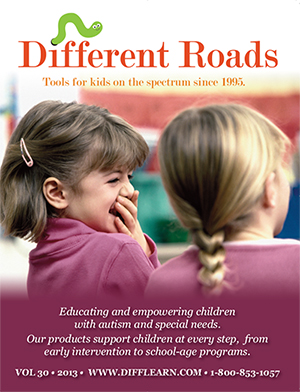
Our new catalog is here!

And it’s a big one for us – Volume 30! Over 18 years and 30 catalogs, our mission has always stayed the same: to educate and empower children with autism and special needs. We’re so proud of our 30th Catalog and we think you will be quite excited by the 70 new products that we’ve added. We’ll be highlighting and featuring some of our best new products in our Pick of the Week segment so be sure to keep an eye out for special offers by joining our mailing list.

The new catalog contains all of your favorite go-to’s, like the Language Builder and the Time Timer, along with spectacular new products for Early Intervention, teaching social skills, developing conversation and so much more.

You can always request a paper catalog on our site, or you can click here for our fully interactive e-catalog that enables you to dowload, print and link back to the products on our site.

We’re thrilled to share this milestone with you and can’t wait to hear your thoughts on our new products.

Important Statement on the Tragedy in Newtown from Michael John Carley of GRASP

In the wake of the sheer horror of what transpired at Sandy Hook Elementary School last week, our hearts and thoughts are with all of the victims, their families and the entire community. In watching endless news reports, information is coming out that the perpetrator may have been diagnosed with Asperger’s Syndrome. With so much misinformation about the real manifestations of Autism Spectrum Disorder, we wanted to share this important statement from Michael John Carley, Exectutive Director of GRASP (The Global and Regional Asperger Syndrome Partnership), which eloquently reminds us of what we need to focus on.

December 14, 2012

We here at GRASP (and I as the father of two school-age boys), cannot be more saddened and devastated by the news of the shootings in Newtown, CT. Our thoughts, wishes, prayers, and heaviest hearts go out to the victims and their families.

While it has not been confirmed, two major news outlets are now speculating that the shooter, Adam Lanza, had been diagnosed with Asperger’s Syndrome. Much remains to be seen to provide the full picture of who this man was, but AS may indeed have been a part of his makeup.

We urge everyone to remember what GRASP has stated since our beginning: That having Asperger’s or the autism spectrum in your life—as an individual, a parent…etc.—does not carry any bearing with whether or not you will become (for lack of a better term) “a good person” in this life. While the majority of statistics prove that we are infinitely more prone to be the victims of violence than the perpetrators of violence, we are not immune from becoming people capable of making terrible, horrible choices. No one is. 

So we ask that everyone please steer away from getting too caught up in the spectrum angle. Let us focus instead on mourning; lamenting through grief that such a terrible and tragic event befell us all on this awful, awful day. Let us focus on the families impacted, and care for them, so that someday far off maybe we can explain—though never justify—what happened today. Perhaps then we will finally force those responsible for our care to pass legislations that could have helped prevent this tragedy, or revoke the legislations that may have assisted it.

With our greatest condolences to those impacted,

Peace,

Michael John Carley
Executive Director
GRASP

Cyber Monday Sale – Save 20%!

Different Roads to Learning is thrilled to be offering 20% off storewide TODAY ONLY! To redeem your savings, enter the Promo Code CYBER12 at checkout at www.difflearn.com.

We have all of the materials that parents and teachers need for Early Intervention, ABA programs, play therapy, teaching social skills to school-age children and more! In addition, we have tons of wonderful educational games and toys that make great gifts for any child or student.

Remember, enter the Promo Code CYBER12 at checkout to redeem your discount – valid today only!


 *Offer NOT valid on the following products: VB MAPP Assessment Kits (DRK 700, DRK 701), 10-Pack of VB MAPP Protocols (DRB 682), 25-Pack (DRB 683) of VB MAPP Protocols, ABLLS-R Assessment Kits (DRK 702, DRK 703). Offer expires Monday, November 26, 2012 at 11:59 EST. Be sure there are no spaces when you enter your Promo Code.

Wait, What Are We Talking About?

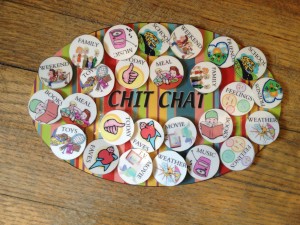
I typically work with very young learners in Early Intervention but there was a time I was working with older children, which necessitated work on conversation skills and topic maintenance. With the start of a new academic year and changes to my caseload I am currently finding myself with students who again need some assistance in this area.  Children with autism spectrum disorders often struggle in conversations because of limited or restricted interests, attending issues, difficulty determining what is relevant or salient to the topic and might also struggle with the rapid transitions necessary to shift between speaker and listener.  This change in my caseload has meant that I’ve found myself digging into old files and unearthing some ancient DIY efforts of mine that I had used in the past.  What I came across that I wanted to share was a visual support that I had used in small groups to facilitate a variety of skills.  It’s something I called Chit Chat and it helped to cue the students in shifting from speaker to listener while maintaining a balance in the conversation with turn taking and reciprocity as well as staying on topic.

The idea was that we would all sit down for a “chat” and initially I would go first in order to model how the board was used rather than providing explicit instruction until the group could use the board on their own and I could fade myself out of the conversation.  The first speaker would choose a token corresponding to a topic of interest, make a statement relevant to the topic chosen and then pass the token to a friend.  The token would provide a prompt for the speaker to maintain the chosen topic as well as cue the rest of the group to visually reference the child whose turn it is to be speaker.  Depending on the level of the group I would individualize the number of conversational exchanges on one topic required before bridging to a new topic. The group I was working with at the time was able to talk about more general topics but this could be individualized to more specific topics depending on the group of students you are working with.

I’m excited embarking upon a new academic year with all it’s unique challenges and successes and am happy to dust off Chit Chat and give it another whirl this year with all new students.  I would be curious to hear from other educators and therapists what tools they’ve created that they find themselves going back to year after year.  You might be surprised what you find at the bottom of your file cabinet!

Also, check out this great link I stumbled across from POPARD Provincial Outreach Program for Autism and Related Disorders in British Columbia, Canada.

https://www.autismoutreach.ca/elearning/social-skills/conversation-and-topic-maintenance

Pick of the Week: Multipurpose Picture Schedule

This week’s pick is the versatile Multipurpose Picture Schedule. All classrooms – especially those with young learners – incorporate various visual schedules to structure an activity or the day’s events. This communication board can be self-standing, used on a table top or hung on a wall. There are 2″ of loop-side fabric on both sides to make all sides usable. You can prearrange your symbols and store extras on the back to ease quick transitions. The board measures 4″ x 33″ when opened.  (*Note: the picture symbols are not included).

This week only, save 15% on the Multipurpose Picture Schedule by entering the Promo Code BLOGMPP7 at checkout.

*Offer expires on October 30, 2012 at 11:59 pm EST. Not compatible with any other offer. Be sure there are no spaces after the Promo Code when you enter it at checkout.

Introducing our new All About Social Skills! Catalog: Teaching Tools for School-Age Students with ASD

We’re thrilled to introduce our new All About Social Skills! Teaching Tools for School-Age Students catalog! As our students and children have made such incredible progress, one of the greatest challenges they face lies in the realm of social skills. We scoured the sources and have come up with a group of books, flashcards, and CD/DVDs that we think will help your students navigate their homes, schools and communities with confidence.

We’re excited to introduce you to Michelle Garcia-Winner whose books and curriculum offer a treatment framework and curriculum that target improving social thinking abilities in individuals with ASD from kindergarten through grade 12.

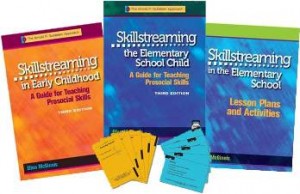
The Skillstreaming series is a social skills training program that employs a four-part approach – modeling, role-playing, performance feedback, and generalization – to teach essential prosocial skills to children and adolescents. Skillstreaming is an evidence-based strategy to systematically teach social skills and a variety of behaviors, from academic competency and playing sports to daily living and making friends. There are books and skill cards for Skillstreaming in Early Childhood as well as Skillstreaming the Elementary School Child.

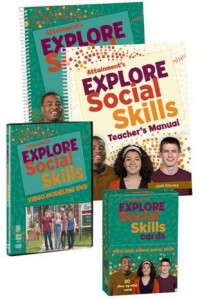
The new Explore Social Skills Introductory Kit provides a full-year curriculum focusing on the development of 50 social skill sets for students in grades 6-12. The kit includes a Teacher’s Manual, Student Book, Flashcard Set and Video Modeling DVD. The skills addressed are those essential to attaining social competency and success in school, the community, and the workplace.

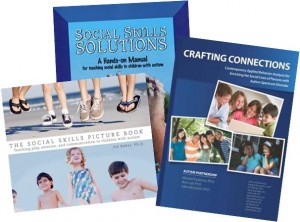
And these are just some of the products featured in our new All About Social Skills! catalog. You’ll also find our best-selling books such as Crafting Connections, Social Skills Solutions, and the Social Skills Picture Book.

In celebration of the publication of our new catalog, we’re offering 15% off on ALL of the materials featured in All About Social Skills! Teaching Tools for School-Age Students. Redeem your savings by entering the Promo Code BLOGABS3 at checkout.

*Offer expires on October 23, 2012 at 11:59 pm EST. Not compatible with any other offer. Be sure there are no spaces after the Promo Code when you enter it at checkout.


The Success of Early Intervention!

The other day our wonderful consultant Stacy Asay came to chat. Stacy has been working with young children in early intervention for 15 years.  Whenever we look at new products or books, we always ask her to give us an opinion on its value to teaching children on the autism spectrum.

We were discussing the benefits of Early Intervention – what kids on the spectrum are like when they are two years old and the amazing skills and capabilities that they acquire through applied behavior analysis and verbal behavior teaching.  Children who can’t make words or eye contact at 2 are able to hold long discussions about their favorite topics at 4.

As Abigail and I started thinking about the astounding success that these children have been making over the years, it dawned on us that our mission here at Different Roads is being fulfilled by these kids!

Our mission is to make a difference in the lives of children diagnosed with autism, giving them tools needed to find success in gaining independence.  We just figured out that by the time our pre-school students get to a school age program, they know how to label, ask questions and do math.  What they need is guidance in social skills.

We are amazed by the progress of so many of our young students…..we know that our products have made a difference and we’re so happy to share in each child’s success. Many of you have stories of these successes. We hope that you will find the time to share stories of the new capabilities and skills that your child has acquired through early intervention.

Pick of the Week: Know the Code at School & Social Standards at School

With the school year in full swing now, social skills can be a challenge in any classroom. This week’s pick helps students know the social code and standards expected at school by providing visual cues and checklists to help them both understand and regulate their own behavior.

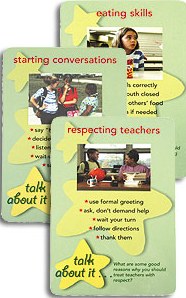
Know the Code at School Social Skills Cards illustrate 50 social skills in typical school scenarios. Each card shows a skill with a relevant photo, lists five sequential steps to accomplish the skill and suggests a talking point. The cards are great for games and role plays at an elementary or middle school level.

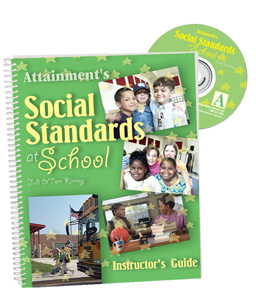
Social Standards at School  is comprised of fifty-three social skills that are involved in a typical school day. From waking up in the morning to going to sleep at night, this guide is a great resource for working with higher functioning children. The book covers skills such as getting ready for school, classroom behavior, transitions, peer relationships and common etiquette. Each skill provides teacher guidelines and a student self-monitoring page. Each of the skills is then broken down into five steps and contains guidelines which include an objective with five benchmarks, problem-solving checklist and a script for teachers to follow when reviewing the skills with students. Self-monitoring pages help students keep track of their social progress. By using this concise record keeping system, users can integrate the teaching of social skills into IEP’s.

This week, help your students develop their social skills independently and save 15% on Know the Code at School and Social Standards at School by entering the Promo Code BLOGSS12 at checkout.

 *Offer expires on October 2, 2012 at 11:59 pm EST. Not compatible with any other offer. Be sure there are no spaces after the Promo Code when you enter it at checkout.

Building Early Reading and Language Skills in Children with Autism: A Guest Post by Joan Green

This week, we’re thrilled to share a guest post by our friend and colleague, Joan Green. Joan has taught special education in California for 20 years and was even selected as the Special Education Teacher of the Year in 1997. As a member of an Autism Task Force, she co-authored a certification of competency for teaching children with autism. Based on her years of experience in the classroom, she developed a series of Interactive Reading Books designed to build language and literacy in your learners. These books have been incredibly popular over the years and we thought you all might enjoy learning a bit more about how and why they were created and how she implemented them with her students. Joan’s Interactive Reading Books are all available as this week’s Pick of the Week at a 15% discount. Just enter the promo code BLOGIRB7 at checkout.


I taught special education in Los Angeles schools for 20 years. In the beginning I had children with a variety of disabilities including Down syndrome, Williams Syndrome, Kabuki Syndrome and other developmental delays. During this time the students with autism were in specific autism programs and not in my class. After a few years I began teaching Early Childhood Special Education and began getting children with autism in my program.  These children are often diagnosed between 2 and 3 years of age and begin early intervention services. Once the child turns three and they begin public school it is important that teachers know the strategies that are helpful to children with autism. I began going to seminars on Teacch, Floortime, PECS, PRT, and ABA and read many books written by respected individuals who had worked with children with autism. I learned that visual strategies were very important and helpful for these children and incorporated the strategies I had learned and provided visual information throughout my classroom.

All of my students were either non-verbal or language delayed and I began using PECS (Picture Exchange Communication System) with all of my students. Picture Exchange Communication does not require that children speak; giving a picture card to someone is their communication. If, however, a child did have some speech, I wanted to hear it. If they could use one word utterances, I wanted two, if they used two words, I wanted three. I began putting sentence strips around my room that the children would bring to me to request objects or activities. All the interesting new materials were put within sight, but out of reach. On top of the cabinet could be a new truck and the sentence strip attached to the cabinet reading, “I want truck please.” Children would bring me the strip and if they had expressive language we would “read” the strip together and they would get the truck to play with. When they were done the truck would go back to the top of the cabinet. I used a Visual Schedule to help the children understand their day, what was going to be happening and if there were any changes in expected activities.

I found that when given the visual cue of a picture, the children were beginning to speak and label more than they had before. When the children began increasing their vocabulary by using pictures and sentence strips I thought to myself, “If they can read a sentence, then they can read a book. What is a book but a bunch of sentences?” and this is how the idea of Interactive Reading Books came into being.

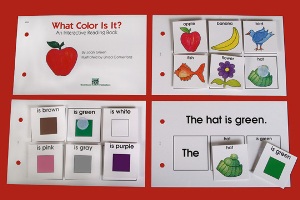
 Children with autism are often taught using a method called Applied Behavior Analysis. There is a sequence of activities that are used to help the children acquire language where they match, identify and then label pictures. I utilized this strategy and developed a book called What Color Is It? where the children matched pictures of objects and colors, then identified and labeled them and finally they were to be sequenced into sentence order and read in sentence form. The children would practice reading the sentences with the pictures and finally read the sentences without any picture cues. Since some children with autism are good at memorization, I made put the books on rings so the sentence order could be changed to help determine if the child was reading or had memorized  the sentence order.
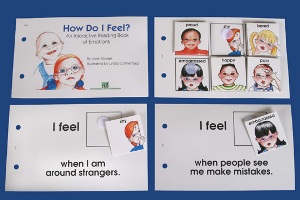
Using the students’ IEP goals, I began creating books that taught the skills they needed. Reading color words and number words are kindergarten goals so What Color Is It? and How Many? were two of our first books. We followed up with Things I Do At Home and I Go to School which included the vocabulary and visual schedule of activities that are performed in their home and school environments. All of the children in my class and many children in special education have speech goals on their IEP and therefore all our Interactive Reading Books were created to be helpful in reaching speech and language goals. We now have 18 titles and many cover more advanced language skills, such as idioms, functions, social behavior and more.


The full list of titles appears below. Remember, this week only, save 15% on all of Joan Green’s Interactive Reading Books by entering the Promo Code BLOGIRB7 at checkout.

 Action!
How Do I Feel?
How Many?
Things I Do at Home
I Go To School
What Color Is It?
Sounds Good to Me! An Interactive Reading Book with Phonucs and the Alphabet
The Ups and Downs of Opposites
What Do I Do? Appropriate School Behaviors
What Do I Say? Appropriate Social Responses
What’s It For? Function and Categorizing
Meet the Word Family
Show Me A Sign: An Interactive Reading Book About Safety Signs
What Do They Really Mean? An Interactive Reading Book About Idioms

*Offer expires on September 26, 2012 at 11:59 pm EST. Not compatible with any other offer. Be sure there are no spaces after the Promo Code when you enter it at checkout.